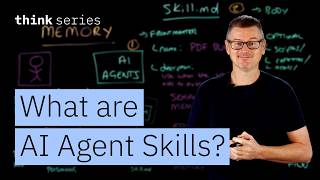

What Are AI Agent Skills?
45sQuickly defines a trending AI concept in a clear, engaging way.
▶ Play Clip"The title accurately describes the content; the video thoroughly explains what agent skills are and how they work."
AI agent skills are an open standard that adds procedural knowledge—step-by-step workflows—to AI agents, which otherwise excel at reasoning and facts but lack knowledge of how to perform specific tasks. The skill format is a simple skill.md file with YAML front matter (name and description) and markdown instructions, plus optional folders for scripts, references, and assets.
AI agents are good at reasoning and facts but lack procedural knowledge—the specific steps to get work done, like a 47-step workflow for a financial report.
A skill is a skill.md file in a folder, with YAML front matter (mandatory name and description) and markdown instructions below.
The description tells the agent when to use the skill, acting as a trigger condition (e.g., 'use this when the user asks to extract a PDF').
Optional folders include scripts (executable code), references (additional docs), and assets (templates/data files).
Skills use three-tier progressive disclosure: tier 1 loads only name/description (metadata), tier 2 loads full instructions when relevant, tier 3 loads resources only when needed.
MCP provides tool access, RAG handles factual knowledge, fine-tuning bakes knowledge into model weights. Skills provide procedural knowledge—how to do things.
The skill.md format is an open standard (Apache 2.0) at agent-skills.io, adopted by Claude Code, OpenAI Codex, and others.
Semantic memory (facts) maps to RAG, episodic memory (experiences) maps to conversation logs, procedural memory (skills) maps to skill files.
Skills can include executable scripts with access to file systems and API keys, so review skills for prompt injection, tool poisoning, or malware before use.
Skills are procedural memory for AI agents, defined in a simple markdown file, conditionally triggered via progressive disclosure, and standardized across platforms. They enable agents to perform repeatable tasks beyond their built-in knowledge.
What is the main problem with AI agents that skills solve?
AI agents lack procedural knowledge—the specific steps to perform tasks like generating a compliant financial report.
0:36
What is the file format of an AI agent skill?
A skill.md file (markdown file in a folder).
1:41
What are the two mandatory fields in the YAML front matter of a skill?
Name and description.
2:09
How does the description field function in a skill?
It acts as a trigger condition that tells the agent when to use the skill.
2:35
What are the three optional directories in a skill folder?
Scripts, references, and assets.
3:32
Explain the three tiers of progressive disclosure in skills.
Tier 1: loads only name and description (metadata). Tier 2: loads full instructions when the skill is relevant. Tier 3: loads resources (scripts, references, assets) only when needed.
4:41
How does MCP differ from skills?
MCP provides tool access to external APIs, but doesn't tell the agent when to use them or what to do. Skills provide the procedural knowledge for when and how.
6:34
What type of knowledge does RAG handle?
Factual knowledge—pulling relevant chunks from a knowledge database at runtime.
7:04
What is the open standard URL for the skill.md format?
agent-skills.io
8:45
What security risks are associated with skills?
Prompt injection, tool poisoning, and hidden malware in publicly available skills.
10:45
Procedural knowledge gap
Identifies the core problem skills solve: agents lack step-by-step workflows.
0:36Simple skill format
The skill is just a markdown file, making it easy to create and share.
1:41Progressive disclosure
Efficient loading mechanism prevents context window overflow.
4:41Skills vs MCP, RAG, fine-tuning
Clarifies how skills complement other knowledge integration methods.
6:34Cognitive science analogy
Maps agent memory types to human memory, making the concept intuitive.
9:16[00:00] What are AI agent skills and
[00:04] standard adopted by practically
[00:09] Well, because skills address a
[00:14] Now AI agents, they're pretty good reasoners and
[00:19] LLMs or large language models
[00:24] They can tell you about Kubernetes
[00:30] or the airspeed velocity of an unladen swallow,
[00:36] They lack procedural knowledge.
[00:41] The stuff that's specific to
[00:47] like let's say a 47-step workflow for
[00:57] Yeah, that would be fun.
[00:59] An AI agent that is running a
[01:06] encounters a task like generating this
[01:12] Either somebody needs to prompt it with every
[01:20] to do that every time, or worse still, the
[01:26] Now a skill is how you actually
[01:34] into the agent and the format of a
[01:41] It's simply a skill.md file.
[01:46] That's a markdown file in a folder.
[01:50] So let me draw out what a
[01:55] So at the top.
[01:58] Skill.md file is some YAML front letter.
[02:04] So let's have a look at what
[02:09] Well, at a minimum, there are two things.
[02:13] So there is a name and there is description.
[02:21] These are the two mandatory fields.
[02:24] Now the name identifies the skill,
[02:28] the description that tells the agent what
[02:35] Now this description is pretty important
[02:42] tells agent exactly when this skill applies,
[02:50] And the description here that says something like,
[02:57] Now there are some other fields you can put
[03:02] but it's name and description that are mandatory.
[03:05] Now below the front mater, we also have a field.
[03:12] Now these are the actual instructions.
[03:16] These are the step-by-step workflows, the
[03:20] whatever the agent needs to know to do the job.
[03:23] And it's just written in plain markdown.
[03:27] And then the skill folder can contain
[03:32] So you don't have to have
[03:36] One of those optional folders is the scripts.
[03:42] And this has executable JavaScript or Python
[03:51] There's also a references directory that
[03:58] gets loaded if the agent determines it needs it.
[04:02] And finally, the other optional
[04:07] that contains static resources
[04:12] That's what an agent skill looks like, but
[04:20] So what happens when there are
[04:25] Loading all of them into the LLM
[04:29] blow through the token budget before
[04:34] So skills use something
[04:41] And progressive disclosure works in three tiers.
[04:46] So tier one is metadata only, and that applies.
[04:53] So at startup, the agent loads just the
[04:58] So that's just a handful of tokens per skill.
[05:01] So even if there are a hundred skills installed,
[05:07] And this is kind of essentially
[05:12] Now tier two, this relates
[05:17] When the agent sees a request that
[05:21] it reads the complete skill.md body into context.
[05:26] And this tells the agent what to
[05:31] And that identification, the matching
[05:36] the skill available is something that
[05:41] The model decides when it
[05:45] which is why a good skill
[05:50] Then tier three, that's
[05:54] So these are the resources that maps to the
[06:00] And they only get loaded when a
[06:04] So the agent starts with a lightweight
[06:09] That's the name and description.
[06:11] It pulls in the detailed instructions
[06:15] based on matching the trigger condition.
[06:18] And it grabs resources only at the point of need.
[06:21] Now skills bring a type of knowledge to agents.
[06:26] There are several ways to
[06:28] So let's just briefly compare them
[06:34] And the first one I just want to mention is MCP.
[06:39] That's Model Context Protocol.
[06:42] What sort of knowledge does MCP give you?
[06:45] Gives you tool access.
[06:47] It gives agents the ability to call out to
[06:53] MCP is about what the agent can reach,
[06:57] but it doesn't tell the agent when to
[07:03] So that's MCP.
[07:04] Another one is RAG, Retrieval
[07:10] and RAG that handles factual
[07:15] Relevant chunks from our
[07:18] which is pretty handy when the
[07:22] But RAG doesn't teach an
[07:24] It's reference material.
[07:27] What about another one?
[07:28] How about fine tuning?
[07:32] What can that do for us?
[07:33] Well, fine tuning bakes knowledge
[07:40] Now that's something that's
[07:43] And if the model changes the
[07:46] Now skills don't really do any of this so
[07:58] Well skills handle as I mentioned
[08:05] It's how to do things in what
[08:10] and because they just files Well,
[08:14] they could be easily updated and you
[08:19] Now, in practice, skills will
[08:24] forms of knowledge like, well, MCP for example.
[08:27] So MCP provides the capability to invoke something
[08:31] externally and the skill provides the
[08:37] Now, one more thing to say about skills.
[08:41] Is that the skill.md format is an open standard,
[08:45] and it's published at agent skills.io
[08:56] and it was adopted across a bunch of AI platforms
[09:00] like Claude Code and OpenAI
[09:05] So a skill built for one platform works
[09:11] Now there's a useful way to think about
[09:16] Now humans have distinct types of memory.
[09:19] There's semantic memory, which are facts.
[09:22] So Rome is the capital of Italy.
[09:25] There's episodic memory, which are experiences.
[09:29] So, uh, I went to Rome last summer.
[09:33] Actually I did, and it was lovely.
[09:35] Uh, and then there's procedural memory, which
[09:41] streets of Rome and live to tell
[09:47] Now agent architectures are
[09:52] So semantic memory, that maps
[09:59] augmented generation and knowledge bases.
[10:02] Episodic memory.
[10:03] Well, that really maps to conversational.
[10:08] Logs and interaction history
[10:12] Well, yep, that maps quite nicely to skill files.
[10:20] Now, one thing that does need mentioning
[10:29] scripts with access to file systems
[10:37] That's what makes them powerful, but
[10:45] Because when an agent runs one of these scripts,
[10:50] it's typically executing
[10:53] and audits have found publicly
[10:58] contain bad stuff like prompt injection, bad stuff
[11:04] like tool poisoning, bad
[11:10] Basically the usual suspects
[11:13] So, so treat skill installation
[11:18] team treats installing any software dependency,
[11:21] which is to say, review it and understand what
[11:28] So, So where does this leave us?
[11:30] Well, skills are procedural memory for AI agents.
[11:34] They're defined in a markdown
[11:38] that teaches an agent how to do a specific job.
[11:42] Skills are conditionally triggered
[11:48] progressive disclosure and the
[11:52] So an agent that already
[11:56] of an unlaid and swallow, African and European,
[11:59] can now also learn how to perform any
[12:05] So that's AI agent skills.
[12:07] If you're using them, let me know in the comments.
⚡ Saved you 0h 12m reading this? Transcribe any YouTube video for free — no signup needed.