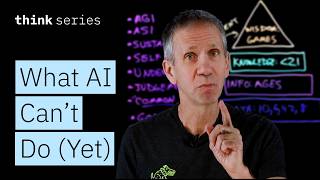

Don't Bet Against AI
42sThe speaker challenges common predictions that AI can't do certain things, claiming most were wrong, which sparks curiosity and debate.
▶ Play Clip"Title accurately reflects content: the video discusses limits of AI, generative AI, NLP, and AGI as promised."
This video explores the limits of AI by first defining the data-information-knowledge-wisdom pyramid, then examining past AI limitations that have been overcome (reasoning, NLP, creativity, real-time perception), current challenges (hallucinations, AGI, sustainability, self-awareness, judgment, common sense, goal setting, sensation, deep emotions), and finally the complementary roles of humans (defining what and why) and AI (executing how).
Data is raw facts; information adds context; knowledge adds interpretation; wisdom is applied knowledge. AI currently handles knowledge, but wisdom remains a human domain.
Complex problem solving and reasoning were once considered impossible for AI, but IBM's Deep Blue beat chess grandmaster Garry Kasparov in 1997.
Human language nuance, idioms, and humor were deemed too difficult. Yet Eliza (1965) and IBM Watson (2011 Jeopardy win) showed progress; modern chatbots understand context and intent.
AI can now generate art and music, drawing on influences similarly to human creators. This challenges the notion that AI cannot be creative.
Self-driving cars and robots perceive and react to their environment in real time, a capability once confined to science fiction.
Generative AI confidently asserts false information. Techniques like retrieval-augmented generation (RAG) and mixture of experts reduce hallucinations but the problem is not fully solved.
Today's AI excels in narrow domains but lacks general intelligence across all areas. AGI, matching human-level performance across domains, remains unachieved.
Large AI models consume enormous energy and require extensive cooling. Scaling with more processors is unsustainable; using appropriately sized models is a key challenge.
Whether AI systems are truly self-aware or understand meaning is a philosophical question. They can simulate thought but may lack genuine comprehension.
AI struggles with ethical judgments, subjective quality assessments (e.g., music taste), and common sense. These require wisdom, which is the top of the DIKW pyramid.
AI can handle micro-goals within a larger task but not define the overarching purpose. Sensation (taste, feel) is partially implemented but not fully integrated.
AI can simulate emotions but likely does not experience joy, sadness, or loss. Genuine emotional experience remains a human trait.
Humans excel at defining 'what' to do and 'why' (purpose, meaning). AI excels at figuring out 'how' to execute tasks efficiently. Collaboration leverages both strengths.
AI has surpassed many historical limitations, but challenges like AGI, sustainability, and true understanding remain. Humans should focus on purpose and direction while AI handles execution; betting against AI's continued progress is unwise.
What are the four levels of the DIKW pyramid?
Data, Information, Knowledge, Wisdom.
01:15
What is the difference between data and information?
Data is raw facts; information adds context to data.
01:30
Which IBM computer beat Garry Kasparov at chess in 1997?
Deep Blue.
04:26
What was the name of the early chatbot from 1965?
Eliza.
05:47
What game did IBM Watson win in 2011?
Jeopardy.
06:11
What is a hallucination in generative AI?
When the system confidently asserts something that is not true.
09:57
Name two techniques to reduce hallucinations.
Retrieval-augmented generation (RAG) and mixture of experts.
10:20
What is artificial general intelligence (AGI)?
An AI that is as smart as a person across all domains.
11:16
What is a major sustainability issue with current AI systems?
They consume enormous amounts of electricity and require extensive cooling.
12:08
According to the video, what two questions should humans focus on?
What to do and why to do it.
17:47
DIKW Pyramid Explained
Provides a foundational framework for understanding AI's capabilities and limitations.
01:15Deep Blue Beats Kasparov
Demonstrates that reasoning, once considered an AI limit, was overcome.
04:26Hallucinations as a Key Challenge
Highlights a persistent problem that undermines trust in generative AI.
09:57Humans Define What and Why
Clarifies the complementary roles of humans and AI, emphasizing human purpose.
17:47Don't Bet Against AI
Summarizes the video's core message: past predictions of AI limits have been wrong.
19:22[00:00] Artificial intelligence is everywhere right
[00:05] emails for you. You may be wondering if there
[00:11] heard many people over the last few decades
[00:16] but it's never going to be able to do, and
[00:20] of those predictions have in common? They were
[00:25] growth in AI capabilities, bringing it from the
[00:30] most of those things that so many thought
[00:35] many limitations still exist, but my advice would
[00:42] you want to be wrong. In this video, we're going
[00:47] how it differs from data and information, and
[00:52] a look at what have been considered to be the
[00:58] have actually been accomplished and what's still
[01:02] about the role of AI and humans and where each one
[01:09] amazing technology to our best advantage. Let's
[01:15] exists among data, information, knowledge, and
[01:23] out. So, we'll start with data. Okay, this is just
[01:30] like this, I say 10 six uh 42 and 8. Okay, that's
[01:39] do with that, but that's data for you. Okay, now
[01:47] information. So this is where we sort of processed
[01:53] that this data actually represents the ages of
[02:01] This has more meaning to us. Now if I take that
[02:08] to the information that we just had. Now we end up
[02:16] So for instance in this case we might say okay
[02:22] room are under the age of 21. So now we've done
[02:30] last piece of this is applied knowledge. Applied
[02:38] look at this all of this information, all of this
[02:44] what, we've got these people in a room. Let's
[02:50] to keep them occupied. So, uh the 42-year-old
[02:57] a 10-year-old and a and an 8-year-old would play,
[03:01] for a little while. So this is an example very
[03:06] here data information knowledge and wisdom each
[03:14] and all of these then lead to the ultimate of
[03:20] is data. Well, that's a database. For instance,
[03:25] but that's all it is, just a collection of raw
[03:30] running on a computer. That's now information
[03:35] added context to all of that data. Knowledge, this
[03:41] adding more interpretation to the information
[03:46] still trying to get. And that's wisdom. Back when
[03:52] studying AI in its earliest days, there were a lot
[03:57] of AI. Maybe one day we'll have a system that's
[04:02] maybe even in our lifetimes." For instance, one of
[04:07] to reason. We needed a system. If we really
[04:12] is a part of that. So the ability to figure out
[04:19] uh this was beyond our capability uh certainly in
[04:26] computer that can play chess. IBM in 1997 came
[04:33] Gary Kasparov, the best chess player in the world,
[04:38] a lot of problem solving. People thought you'd
[04:42] a grandmaster. Again, that's already happened. So,
[04:49] that was really difficult for a long time was
[04:56] has a lot of nuance, a lot of idioms, things
[05:01] And sometimes you're supposed to interpret it
[05:06] Uh for instance, as I've given examples before, if
[05:10] doesn't mean that there are small animals falling
[05:16] system is going to really be intelligent in
[05:20] understand those things. It needs to be able
[05:24] when you're cracking a joke and when you're not.
[05:28] and sometimes it's because it's a bad dad joke.
[05:34] tell the difference between what is humor and what
[05:39] here. In 1965, there came about a first the first
[05:47] was not using modern technology called Eliza. And
[05:53] it wasn't very great conversations, but it would
[05:59] how are you feeling today? How does that make you
[06:04] like you're talking to one of these very passive
[06:11] 2011 when we came out with Watson which played
[06:18] and beat champions at that because Jeopardy is
[06:24] and things like that. You can't program all of
[06:29] really has to understand the meanings behind
[06:34] as I say, we've already accomplished that. And
[06:39] to understand a lot of this nuance and they're
[06:44] natural language and understand what you mean in
[06:50] one of the most remarkable aspects of generative
[06:55] the first time. We feel like a computer really
[07:01] asking for. In some cases, even anticipate the
[07:05] would. We consider that to be intelligent.
[07:10] I remember hearing a lot of people say, you know,
[07:16] they actually do. Uh, we've got where with
[07:22] new works of music. And you can say, well, but
[07:27] guess what? When people compose a new song or draw
[07:34] we've heard as well. Listen to all the top musical
[07:39] yeah. Here are my musical influences." So, those
[07:43] influenced the way that they create. So, we are
[07:48] the old. But that doesn't mean just because a
[07:53] fact it is. They're coming up with new ideas and
[07:58] our creativity on certain things that have
[08:04] here's another one. Real time perception.
[08:12] of science fiction at one point, but we have them
[08:16] but a self-driving car is one of those where it's
[08:22] see what's going on, anticipate where the next
[08:28] be at a specific point in time and do all of
[08:34] uh decisions about that. Robots are having to do
[08:39] So all of these things that basically we used to
[08:46] you know what, we've done all of those. Now, let's
[08:51] progress, but I don't know if we would say, you
[08:55] one of those would be uh the area of you've
[09:02] intelligence uh and an index for that? Well, these
[09:10] I feel like some people are just able to
[09:13] but that's a whole other subject. But an EQ in
[09:19] the ability for them to understand your moods
[09:24] So there is some level of awareness in terms of
[09:28] we have the stories about people who felt an
[09:34] some people feel emotional relationship to their
[09:39] that these systems can talk to us and understand
[09:45] moods and things like that is certainly in the
[09:51] at least in some cases. Now, another area that's a
[09:57] of hallucinations. Hallucinations are a difficult
[10:03] AI where the system basically confidently asserts
[10:10] predict what the right answer would be and many
[10:15] But when it's wrong, it is shockingly wrong in
[10:20] are making hallucinations less and less likely.
[10:26] uh helps with this where we feed additional
[10:31] model doesn't just use its own imagination to come
[10:37] helps as well where we have different models
[10:42] Uh so there are things that we can do in order
[10:49] doing that. So this is one of those I wouldn't say
[10:55] that we're moving into it. So this one's somewhat
[11:01] kind of already done or are still working on
[11:06] move those out of the way. And now, let's take a
[11:11] current limits? What are the problems that we're
[11:16] of the limits of AI is a thing called artificial
[11:22] are super smart in a specific area, in a specific
[11:28] bots that we have today, they seem to know a lot
[11:33] limitations. For instance, they don't do real-time
[11:38] for instance. So artificial general intelligence
[11:43] doing all the things that we consider to be
[11:48] person would do across all the different domains.
[11:52] achieved in a single system yet. The next level
[11:58] where we have something that is better than
[12:03] now again the stuff of science fiction. Not saying
[12:08] yet. Another problem that's still to be solved is
[12:16] that can do amazing stuff but boy do they suck
[12:22] They need lots of cooling. They're very expensive
[12:27] able to scale if we just keep throwing more and
[12:32] going to work. We're going to end up using all the
[12:37] uh to to run some of these queries. So, we're
[12:42] decisions with sustainability. Use models that are
[12:47] the right size model. In some cases, a small model
[12:52] might even hallucinate less if we've got the right
[12:58] we're doing that is not yet, I would say, a solved
[13:02] about it. Another one that is really the area that
[13:10] is a system self-aware? Does it know it exists?
[13:17] know the answer to that. This is really not a
[13:22] question. So, I'm not going to try to deal with
[13:27] answer would be. But another thing that gets us
[13:33] a system can spit out a lot of things, but
[13:39] does it really know what the meaning of the
[13:44] but there's always the question of is this really
[13:50] I don't know. I'll tell you there's a lot
[13:53] may be only simulating thought and simulating
[13:59] draw the line clearly, but uh this seems to be an
[14:06] the biggest broadest context that we'd like it
[14:12] was talking about data, information, knowledge
[14:18] the business of wisdom and judgment. And in this
[14:26] Maybe ethical judgments. Can it determine what
[14:32] that? Some people have a real hard problem with
[14:37] to program a system that will if we can't figure
[14:42] know that right now these are limitations that
[14:47] something that's just very subjective like the
[14:52] what I think is really great music, you may
[14:56] you have no judgment at all." Uh, but I have a
[15:02] able they're able to generate music and they're
[15:06] gibberish but can they tell what is going to be a
[15:11] music area. So there's a lot of of work here in
[15:16] qualitative judgments as well. How about this one
[15:24] in uh in quotes because air quotes because um I
[15:31] again we have limitations with people. So we can't
[15:37] what we consider to be common sense because we all
[15:42] there are some things that we know and the systems
[15:48] there are some certainly some limitations to
[15:53] some people would say that with today's agentic
[16:00] go off and accomplish those things. And what I'm
[16:05] micro goals. These are sort of the small things
[16:11] and the macro goals. So the larger task, this
[16:18] doing it. And right now today's agents are able
[16:23] the larger objective, but the big goal, why would
[16:29] uh without uh beyond its reach at the moment. And
[16:36] AI system really sense things? Does it understand
[16:42] taste? Um that sort of stuff. The things that
[16:46] that are able to certainly see and hear. Can
[16:52] but there's a lot of other things that go into uh
[16:58] together in one system. And then here's the really
[17:05] system really able to feel the same way that we
[17:12] experience sadness, loss, uh, accomplishment? Does
[17:19] I know some people who don't really do all
[17:24] of the things that is difficult to put into a
[17:31] really feeling these kinds of things? So, I would
[17:35] to one degree or another are limitations with
[17:41] and for AI? How do we work together? How do we
[17:47] people really should be over here doing this kind
[17:53] we want to do? That's the overall macrolevel goal,
[18:00] What's the purpose of this? Is there meaning in
[18:05] we're trying to accomplish? And without purpose,
[18:11] are still far better at that kind of thing. And we
[18:17] Over here on this side, once we've told the system
[18:23] agent figure out the how and go off and perform
[18:30] lot of things much faster than a person could. and
[18:36] to know what to do in the first place. We need
[18:41] it felt like for the longest time we were making
[18:47] just took off. And we're at this this inflection
[18:53] is going to go, no one really knows. But what I
[19:00] of milestones that we've accomplished already.
[19:06] that still need to be done, which is actually
[19:10] it and the possibilities of problem solving, then
[19:16] ultimately we're going to get end up with systems
[19:22] So my advice to you if you start looking at
[19:28] become preoccupied with those because the people
[19:33] this that or the other thing have generally been
⚡ Saved you 0h 19m reading this? Transcribe any YouTube video for free — no signup needed.