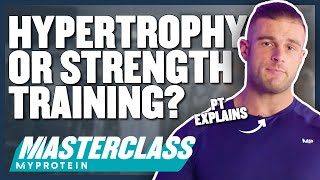

Hypertrophy vs Strength: Injury Risk
40sDirectly addresses a common worry about injury, sparking debate on training safety.
▶ Play Clip"The title accurately reflects the content, which clearly explains hypertrophy vs. strength training with practical examples."
This video by Chris Broomed explains the key differences between hypertrophy training (building muscle size) and strength training (increasing power output). It covers rep ranges, exercise selection, rest periods, and injury risk, emphasizing that your goal should determine your training approach.
Hypertrophy training aims to increase muscular size; strength training aims to increase power output and move weight from A to B.
Hypertrophy uses slow, controlled movements further from one-rep max, lowering injury risk. Strength uses explosive movements closer to one-rep max, increasing injury risk.
Common rep range for hypertrophy is 8–12, but can include 3–5 and 12+. Strength training typically uses 3–5 reps.
Hypertrophy works through a variety of movement patterns (e.g., decline, flat, incline, fly for chest) to fully fatigue the muscle. Strength focuses on one primary movement (e.g., bench press) to increase load.
Strength training uses longer rest periods and less muscle fatigue; hypertrophy uses shorter rest periods to force blood into the muscle and achieve full fatigue.
Strength training avoids isolation exercises; hypertrophy combines compound exercises first (for significant load) then isolation exercises (for localized stress).
What is the primary goal of hypertrophy training versus strength training?
Hypertrophy training focuses on increasing muscular size; strength training focuses on increasing power output and moving weight from A to B.
00:12
Why does hypertrophy training carry a lower risk of injury compared to strength training?
Hypertrophy training is further from the one-rep max, uses slow controlled movements, and has a lower risk of injury.
00:28
What is the most common rep range for hypertrophy training?
The most common rep range for hypertrophy is 8–12 reps, but it can include 3–5 and 12+ reps.
01:05
What rep range is typical for strength training?
Strength training typically uses 3–5 reps.
01:05
Why is the negative portion of a rep less important in strength training compared to hypertrophy training?
In strength training, the negative portion is less important because the goal is simply to move the weight from point A to B.
01:48
How does exercise selection differ for hypertrophy training when targeting the chest?
In hypertrophy training, you would use a variety of movement patterns (e.g., decline, flat, incline, fly) to fully fatigue the muscle.
02:17
How do rest periods differ between strength and hypertrophy training?
Strength training uses longer rest periods to allow full recovery between sets; hypertrophy uses shorter rest periods to force blood into the muscle.
02:57
Why are isolation exercises not recommended for strength training?
Isolation exercises are avoided in strength training because they don't help increase the load on the bar and increase injury risk.
03:12
What is the typical order of exercises in a hypertrophy training session?
In hypertrophy training, you start with compound exercises to create significant load, then use isolation exercises for localized stress.
03:26
Core Definitions
Clearly distinguishes hypertrophy (muscle size) from strength training (power output), setting the foundation for the entire video.
00:12Rep Range Flexibility
Challenges the common myth that hypertrophy is only 8–12 reps, explaining that a variety of rep ranges can still be hypertrophy-focused.
01:05Negative Portion Importance
Highlights the critical role of the negative phase in hypertrophy vs. its irrelevance in strength training, a key technical distinction.
01:48Movement Pattern Variety
Explains how hypertrophy training uses multiple movement patterns (e.g., decline, flat, incline) to fully fatigue a muscle, unlike strength training which focuses on a single primary lift.
02:17Exercise Selection Strategy
Provides a practical rule: avoid isolation exercises in strength training due to injury risk and lack of benefit, while hypertrophy training combines compound and isolation moves.
03:12[00:00] Hi guys, my name is Chris Broomed and in this video I'm going to talk you through the differences between hypertrophy training and strength training.
[00:12] With hypertrophy training you'd best define this by training to increase muscular size. Whereas strength training you would define more so by trying to increase power output and simply moving the weight from A to B. So the pros and cons to do with the different styles of
[00:28] training would be if you were to use hypertrophy training it is further away from the one rep max and is a lower risk of injury because of that and it's more so slow controlled movements.
[00:40] Whereas strength training you would better use power movements and use an explosive fashion. More so moving the weight from A to B and you'd be closer to your one rep max sometimes even testing
[00:52] the one rep max which obviously carries a much higher risk of injury. So you have to be much more careful when choosing the right kind of training and you would base it on your goal if your goal is to increase muscular size and hypertrophy is a better way to go. It's often being confused in the past.
[01:05] If hypertrophy is your goal your training between 8 to 12 reps is the most common rep range to fall in whereas strength training would be 3 to 5 but that's not often the case these days. If you're training for hypertrophy you're also working towards muscular failure and with that it's through a variety of
[01:20] rep ranges so that could be 3 to 5, 8 to 12 or 12 and above it still would be hypertrophy training and I would always advise people to work through a variety of rep ranges when trying to build muscular
[01:33] size. The whole idea is that we're trying to load the muscles in a way that creates a stimulus whereas when we come into strength training you're trying to keep the reps low and create mechanical tension a neurological drive. So if you see someone doing for example a deadlift in a strength training
[01:48] power lifting style fashion it would be explosive up slamming down with little control because that is not their aim is to get the weight up. If you're a muscle trying to build muscle doing the same exact kind of deadlift you would come up controlled and down controlled because the
[02:04] negative portion of the rep is also incredibly important when trying to create that stimulus. We're trying to get as much as we can out of the set to create as much stimulus as possible in the recovery process whereas strength training you're simply trying to get more weight on the bar
[02:17] and move from point A to point B. When it comes to training for hypertrophy we're often trying work in each session through a variety of movement patterns. So for example if you're trying to work your chest you'd be looking at maybe a decline movement, flat movement and an incline movement
[02:31] and maybe a fly so you've worked through each movement pattern to try and fully fatigue the muscle through every range of motion you can. Whereas if you're looking for strength training you'd often be looking to maybe bench press as a primary movement and spend the majority of the session
[02:45] working on increasing your bench press. So not necessarily trying to fully fatigue the muscles but trying to repeat max power output on the bench press. So you'd often see longer rest between sets
[02:57] and less fatigue through the muscle whereas hypertrophy you're often looking at shorter rest periods and trying to really force blood into that muscle and get it to be fully fatigue by the end of the session creating that maximum stimulus for growth. And then lastly when it comes to exercise
[03:12] selection when coming to strength training you wouldn't really choose isolation exercises because you don't want to serve much purpose when it comes to increasing the load on the bar. That would increase your risk of injury significantly as well and this wouldn't really gain much benefit in that
[03:26] area. And then when it comes to hypertrophy training you'd often choose a mixture. Usually starting with the compound exercises and moving to isolation exercises later in the session when you start to reach a higher point of fatigue. The reason we use the compound exercises in this style of training
[03:41] is to create a more significant load to the muscle which helps break down those fibers and then we could cause the localized stress with an isolation movement. For example if you were to go a chest press
[03:54] movement working through a heavy load and then choose a lighter load and really contract the muscle in a peck fly that would be something we'd combine in a session whereas strength training you're looking at just pressing exercises as your primary movements. So to summarize guys when it comes to
[04:11] strength training we're looking at mainly compound exercises focusing on a small number of exercise per session and trying to create that big power output. When it comes to hypertrophy it's looking at working through a variety of rep ranges, a variety of movement patterns and really trying to fatigue the muscle
[04:26] to let it grow bigger whilst gaining strength in the process. If you found this video useful don't forget to subscribe to my Protein YouTube channel for more videos like this and to give this video a
⚡ Saved you 0h 04m reading this? Transcribe any YouTube video for free — no signup needed.