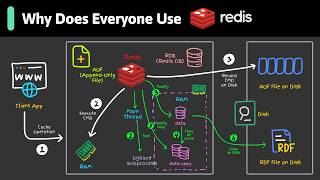

Why Redis is a single-threaded speed demon
44sExplains a common misconception about Redis's speed with a clear, surprising insight about batching.
▶ Play Clip"Delivers a solid, informative overview of Redis, matching the title's promise with clear explanations and practical insights."
This video provides a comprehensive overview of Redis, explaining its core design principles, persistence options, scaling strategies, and common use cases. It emphasizes how Redis's single-threaded, in-memory architecture and rich data structures make it a versatile tool for system design.
Redis is a single-threaded, in-memory data structure server. This means it processes commands sequentially, stores data in RAM for low latency, and exposes various data structures like strings, lists, hashes, sets, and sorted sets.
Redis processes commands one at a time in a single thread. This ensures predictable ordering and eliminates the need for locks. While Redis 6+ added IO threads for networking, command logic remains sequential. If one command blocks, all others wait.
Redis hides latency by batching commands. Clients can use pipelining to send multiple commands in one round trip, keeping the socket busy and improving throughput.
Storing data in RAM gives sub-millisecond response times but risks data loss on crash unless persistence is configured. This trade-off is central to how teams use Redis.
Redis values can be strings, lists, hashes, sets, sorted sets, or streams. Commands like INCR are atomic because of single-threaded execution, preventing race conditions when multiple clients update the same key.
Teams often run Redis as a pure cache with persistence off, relying on the database as source of truth. Alternatively, they may use replicas for availability, RDB snapshots for warm restarts, or AOF (append-only file) for durability with configurable fsync policies.
Start with a single instance, add replicas for read scaling, and use client-side sharding (e.g., consistent hashing) for write scaling. Redis Cluster offers automatic sharding and failover but adds operational complexity.
Redis is used for caching (with TTL or eviction policies), rate limiting (using atomic counters and Lua scripts), and leaderboards (using sorted sets). These patterns generalize to trending lists, top sellers, and more.
Redis's combination of speed, simplicity, and versatile data structures makes it a valuable tool in system design. Understanding its trade-offs around execution, persistence, and data structures allows teams to integrate it effectively.
What is Redis?
Redis is a single-threaded, in-memory data structure server.
00:02
How does Redis achieve high performance despite being single-threaded?
It uses batching (pipelining) to send multiple commands in one network round trip, keeping the socket busy.
01:01
What are the three main design choices highlighted in the video?
Single-threaded execution, in-memory storage, and exposing data structures directly.
00:02
What is the downside of in-memory storage?
Data is lost if the machine crashes unless persistence is configured.
01:29
Name three persistence options for Redis.
No persistence (pure cache), RDB snapshots, and AOF (append-only file).
02:45
What is the default fsync policy for AOF and how much data can be lost?
Append fsync every second; at most 1 second of data can be lost.
04:11
How does client-side sharding work in Redis?
The application hashes each key and picks a Redis node based on the hash, using consistent hashing for dynamic scaling.
05:19
What data structure is used for leaderboards?
Sorted sets.
07:29
Single-threaded execution simplifies concurrency
Explains why Redis avoids locks and race conditions, a key architectural advantage.
00:31In-memory storage trade-off
Highlights the fundamental trade-off between speed and durability, central to Redis usage.
01:29AOF durability configuration
Provides concrete numbers (1 second of data loss) and trade-offs for durability settings.
04:11Client-side sharding with consistent hashing
Explains a practical scaling technique that avoids the complexity of Redis Cluster.
05:19Sorted sets for leaderboards
Shows how a simple data structure solves a common problem elegantly.
07:29[00:02] so many system design problems? And why do so many teams rely on it in production? Reddus is versatile. It's worth the time to learn it well. In this video, we focus on three ideas. How Reddus executes commands, how it stores
[00:17] and persists data, and how people use it in real systems. Let's start with what Reddus is. Reddus is a single threaded in-memory data structure server. This short description highs three important design choices.
[00:31] First, single thread execution. Reddus processes commands one at a time in a single thread. Strictly speaking, Reddus 6 and newer added IO threads for networking, but the actual command logic still runs sequentially. The order is
[00:46] predictable. The first request in is the first request processed. There are no locks to reason about and no concurrent writes to the same key. If one command blocks, every other command waits behind it. You might ask, if radus uses only
[01:01] one thread to run commands, how does it stay fast? Reddus hides latency with batching. Clients can bundle commands with pipelining while rep set of commands in the transaction. One network round trip now carries many commands.
[01:15] The single thread still executes each command in order, but the socket stays busy instead of waiting for each request response pair. Second, Reddus keeps data response pair. Second, Reddus keeps data in RAM. The upside is very low latency.
[01:29] Reddus can respondse in sub millisecond time even when we send hundreds of commands per second. The downside is durability. If the machine dies, the data in memory is gone unless we configure persistence carefully. This
[01:43] trade-off is central to how teams use Reddus. We'll come back to this. Third, Reddus is a key value store that exposes data structures directly. A value in radius can be many things. For example, it can be a string, a list, a hash, a
[01:59] set, a sort of set, or a stream. The protocol is small and simple, but Reddus provides many specialized commands for each data structure. Here's a simple example of a counter. We call set counter five. Get counter returns five.
[02:15] Increment counter bumps it atomically to six. Each command acts on a key. Atomicity matters when multiple clients touch the same key. Because Reddus runs commands one at a time, increment completes as a single atomic step.
[02:31] Multiple clients incrementing the same counter won't interfere with each other. Now let's move on to persistent and durability. Because Reddus lives in memory, we need to plan for crashes. Different teams make different choices.
[02:45] Many teams run Reddus as a pure cache with persistence turned off. The database is the source of truth. Rights go to the database. Reddus only stores cached results. If radus crashes in this setup, we lose the cache. The
[03:00] application rebuilds it on demand by quering the database. No important data is lost because we never treated radus as the source of truth. Some teams skip this persistence but add replicas. The primary note handles all rights.
[03:14] Replicas handle read traffic. If the primary dies, a replica is promoted to replace it. In this case, we may lose availability for a few second during failover, but we preserve most of the cache data in memory on the replicas.
[03:28] This trace this IO overhead for memory overhead. Each replica roughly doubles the memory footprint. Another option is to enable RDB snapshots. We configure Reddus to take a snapshot every few minutes. On restart, Reddus loads the
[03:43] snapshot into memory. This allows radius to come back with warm data instead of an empty cache. We accept losing the rights that happened after the last snapshot. For a cache workload, this is usually a reasonable tradeoff because
[03:56] the cache warms up quite quickly. When reddus holds data we cannot afford to lose, we turn on that penon file. A common configuration is a pen only. Yes. With append fsync every sack. Reddus appends each write to a log on disk. The
[04:11] operating system flushes buffer right to disk roughly once per second. In a crash, we lose at most 1 second of data. We can configure f-sync after every command for a stronger durability, but that is much slower and has a big impact
[04:26] on throughput. Most teams avoid that unless the data sets is small and latency is not critical. In practice, the real question is whether rather should hold critical state at all or whether it should just be used as a
[04:38] cache. Many teams keep critical data in a durable database and rely on Reddus a durable database and rely on Reddus mainly for caching and ephemeral state. That covers persistence. Next, let's talk about scaling Reddus. Most teams
[04:52] start with a single Reddus instance. On decent hardware, a single nook can handle a large number of operations per second for many workloads. When read become the bottleneck, the first scaling step is to add replicas. The primary
[05:05] nook accepts all rights. Replicas serve read traffic. This increases read throughput. But write throughput is still kept by the primary. When right volume grows too large for a single instance, many teams adopt client side
[05:19] sharding. We run multiple independent reddus instances. The application hashes each key and picks a reddus note based on the hash. For a static cluster, a simple modular hash works. For dynamic scaling, libraries such as katama use
[05:35] consistent hashing so that adding or removing a note does not reshuffle all keys. Each note here is independent. There is no cross, no coordination and no distributed protocol between Reddus servers. It would treat Reddus as a
[05:49] cache and no failure simply causes cache misses for the subset of keys that live on that node until the cache repopulates. Reddus cluster also exists as an option. It provides automatic sharding and failover. But this comes
[06:03] with added complexity. Operating and debugging a reddus cluster setup is also more complex than running independent nodes. Because of this, many teams prefer simple client side sharding for cache workloads and only adopt Reddus
[06:16] cluster when they needed specific guarantees. Now let's review some common reddus workloads. Classic use case is caching. A service checks reddus before hitting the database. If there's a cache hit, we
[06:29] returns the value immediately. If there is a cache miss, we query the database, store the result in Reddus, and return the response to the client. Over time, the cash fills up, we need a cleanup strategy. One approach is to set a time
[06:43] to live on each key. After the TTL expires, the key stops being returned and is cleaned up lazily. Another approach is to configure a memory limit and an eviction policy so that Reddus evicts keys, for example, the least
[06:59] recently used one when memory is full. Multiple service instances can share counters through Reddus. We use atomic increment commands on keys that represent a user, an IP, or an API token. Combined with TTLs or lure
[07:14] scripts, we can implement various ray limiting algorithms without adding a separate coordination service. There are many nuances here, so we dedicate an entire video to this topic. Check the link in the description. So far, Reddus
[07:29] looks like a fast key value store. The data structure server part becomes powerful when we look at features like sort leaderboards are a common example. A sort of set maintains items order by score. We can insert a player with a
[07:44] score, update a score when it changes, query the top end players, or look up a player's rank. This operation typically run in algorithmic time relative to the size of the set. This pattern generalizes well. We can build trending
[07:59] post lists, most active users, top sellers, and many other top end ranking problems on top of sort of set. Let's wrap up. Reddus is fast, predictable, and versatile. Single thread execution keeps behavior simple to reason about
[08:15] inmemory storage delivers very low latency. Native data structure such as hashes and sort of sets solve problems that would be clunky to implement in a relational database. Most teams start with a single instance at replicas for
[08:29] read traffic and availability. Then use client side sharding when they need more right throughput. When we understand these trade-off around execution, persistence and data structures, Reddus fits cleanly into our system designs.
[08:44] interview? Join our community where we offer comprehensive courses on system design, coding, behavioral questions, machine learning, and object-oriented machine learning, and object-oriented design. Learn more at byitebico.com.

⚡ Saved you 0h 09m reading this? Transcribe any YouTube video for free — no signup needed.