
Open-Source AI: Break Free from Proprietary Walls
45sThe promise of freedom and cost control in AI development taps into the growing desire for independence from big tech.
▶ Play Clip"The title promises a comprehensive stack overview and delivers a solid, if brief, tour of key tools — though it could dive deeper into each component."
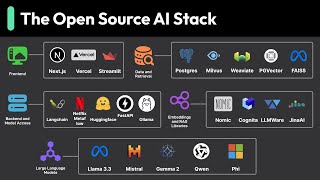
The video provides an overview of the modern open-source AI stack, covering front-end frameworks, data handling with RAG, backend APIs, model deployment, and storage solutions. It emphasizes the benefits of open-source AI, such as control and cost-effectiveness, while acknowledging the challenges of maintenance and expertise.
Open-source AI gives freedom and control, breaking down proprietary barriers and enabling experimentation without high upfront costs.
For scalable apps, Next.js and SvelteKit are recommended for streaming capabilities. For rapid prototyping, Streamlit and Gradio allow building interfaces in pure Python.
RAG (Retrieval Augmented Generation) dynamically pulls relevant contexts during inference. Documents are converted into vectors using embedding models, stored in a vector database, and retrieved at query time to inject into the model's context window.
Nomic Atlas visualizes embeddings, LlamaIndex builds processing pipelines, Apache Tika handles content extraction from various file formats, and Gina AI supports multimodal search.
FastAPI provides a solid API foundation with WebSocket support. LangChain helps build complex workflows, and Metaflow simplifies ML pipelines with automatic data versioning and orchestration.
Ollama makes local development easy, and the Hugging Face ecosystem provides access to community models. For storage, PGVector adds vector search to Postgres, while Milvus and Weaviate are purpose-built for larger scale, with Weaviate offering hybrid search.
Models like Mistral and DeepSeek are pushing boundaries. Tools like llama.cpp with GGUF format and quantization enable efficient running on consumer hardware.
The open-source stack offers control but requires maintenance and expertise. The landscape is evolving; start simple with proven tools, scale what matters, and stay flexible.
The open-source AI stack empowers developers with control and flexibility, but it requires careful tool selection and ongoing maintenance. The key is to start with proven tools and adapt as the ecosystem evolves.
What is RAG (Retrieval Augmented Generation)?
RAG dynamically pulls relevant contexts during inference by converting documents into vectors, storing them in a vector database, and retrieving similar chunks at query time to inject into the model's context window.
00:47
Which front-end frameworks are recommended for scalable AI apps with streaming?
Next.js and SvelteKit are recommended for scalable apps due to their streaming capabilities.
00:17
What tools are suggested for rapid prototyping of AI interfaces in pure Python?
Streamlit and Gradio allow building interactive interfaces in pure Python for rapid prototyping.
00:32
What is the role of Apache Tika in the AI stack?
Apache Tika handles content extraction and metadata parsing from diverse file formats like PDFs and Excel files.
01:50
Which backend framework provides WebSocket support for streaming AI responses?
FastAPI provides a solid API foundation with built-in WebSocket support for streaming AI responses in real time.
02:05
What is the advantage of using Metaflow for ML pipelines?
Metaflow lets you write ML pipelines as straightforward Python code while handling complex parts like data versioning and orchestration automatically, and scales from laptop to cloud.
02:31
Which storage solution offers hybrid search combining vector and keyword approaches?
Weaviate stands out for its hybrid search combining vector and keyword approaches.
03:10
How do tools like llama.cpp with GGUF format help run models on consumer hardware?
They use quantization to make open-weight models run efficiently on consumer hardware.
03:23
Open-Source AI Freedom
Establishes the core value proposition of open-source AI: control and cost-effectiveness.
RAG Explained
Clearly explains a key concept for connecting AI models to specific data without fine-tuning.
00:47Metaflow Simplifies ML Pipelines
Highlights a tool that automates complex orchestration, making ML pipelines more accessible.
02:31Efficient Model Deployment
Shows how quantization enables running advanced models on consumer hardware, democratizing AI.
03:23Start Simple, Scale What Matters
Provides practical advice for navigating the rapidly evolving open-source AI ecosystem.
03:37[00:00] The world of open-source AI has exploded, giving us freedom and control over our AI projects. Gone are the days when AI development was locked behind proprietary walls. Open-source breaks down these barriers and lets us experiment without huge upfront costs.
[00:17] So what does this open-source AI stack look like in practice? Let's break it down, starting with the front-end, the gateway to our AI applications. For scalable apps, frameworks like Next.js and SvelteKits shine with their streaming capabilities.
[00:32] It's crucial for showing AI responses as they are generated. For rapid prototyping, tools like Streamlit and Gradio let us build interactive interfaces in pure Python, though we might need something more robust as our apps grow more complex.
[00:47] Let's talk about the data layer, where we connect our AI models with our specific data, data, whether there's documents, product catalogs, or customer records. A key concept here is RAG retrieval augmented generation Instead of fine models on our data RAG dynamically pulls relevant contexts during inference We first convert our documents into vectors using embedding models
[01:11] store them in a vector database, and then at query time, we retrieve the most similar chunks and inject them into the model's context window. This gives us up-to-date responses and precise control over our AI's knowledge base.
[01:26] For making sense of our vector spaces, Nomic Atlas helps us visualize and debug our embeddings. When we need to handle documents, Lamy Index helps us build robust processing pipelines
[01:38] from splitting text into meaningful chunks to generating embeddings. For handling diverse file formats from PDFs to Excel files, Apache Tikka handles the heavy
[01:50] lifting of content extraction and metadata parsing. For multimodal search, Gina AI let us work with text, images, and other data types in a unified vector space, with built-in support for cross-model querying.
[02:05] Now for the backend FastAPI give us that solid API foundation we need with WebSocket support built right in great for streaming our AI responses in real When we need to connect multiple AI operations,
[02:19] LanChain helps us build those complex workflows while keeping everything in clean, maintainable Python. Then there's Metaflow, which lets us write ML pipelines as straightforward Python code
[02:31] while handling the complex parts like data versioning and orchestration automatically. And we can scale from our laptop to the cloud with minimal changes. For working with models, we've got some great options.
[02:44] Olamar makes local development on smaller models easy, almost like we're working with Docker before AI. Then there's the Hucking Face ecosystem, opening up a world of community models we can access programmatically.
[02:57] For storage, we've got options that fit different scales. If we're already using Postgres, PGVector gives us vector search capabilities right in our existing database. Where we need to go bigger MuleVis and WeeVA are purpose for this with WeeVA standing out for its hybrid search combining vector and keyword approaches The LLM landscape is especially dynamic right now Models like
[03:23] Mistral and DeepSeek are pushing what's possible with open-way models, with tools like Lama.cpp with gguf format and quantization are making these models run efficiently on consumer hardware.
[03:37] That's really the beauty of the open-source AI stack. It puts us in control, though it comes with its own challenges around maintenance and expertise. What we cover here is just a snapshot of the current landscape, and it's far from exhaustive.
[03:51] New tools and approaches are emerging all the time. The key is to start simple with proven tools, scale what matters, and stay flexible as the ecosystem evolves. If you like our videos, you may like our system design newsletter as well.
[04:07] It covers topics and trends in large-scale system design, trusted by 1 million readers.

⚡ Saved you 0h 04m reading this? Transcribe any YouTube video for free — no signup needed.