
Why Being Conservative Is Your Biggest Risk
44sChallenges conventional trading wisdom with a bold claim about rare opportunities, sparking curiosity and debate.
▶ Play Clip"The title promises 'secrets' but delivers a solid, albeit padded, discussion on grading setups—more of a standard trading podcast than a reveal of hidden knowledge."
In this episode of the Trading Floor Podcast, hosts Tim Beldin and Garrett Dryen discuss the critical importance of grading trading setups on a scale from A+ to C, arguing that this skill is the core determinant of trading success. They introduce a risk management framework that assigns different risk percentages to each grade, allowing traders to scale their accounts by pushing risk on exceptional setups while being conservative on common, lower-quality trades. The conversation emphasizes the psychological aspect of trading, using the metaphor of different 'traders' for each grade to maintain discipline and avoid overtrading.
Some trades, like recent parabolic blowoffs in gold, silver, and FSLY, offer overwhelming edge where being conservative is the biggest risk.
The most undertalked part of trading is grading setups correctly. Recognizing A+ trades versus normal trades is the difference between spinning wheels and scaling an account.
Passing on a trade is a trade in itself, representing zero risk allocation. This is one end of the spectrum, with A+ trades at the other end where you push risk.
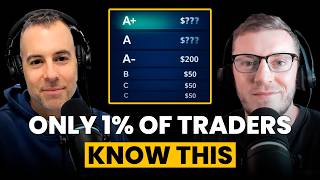
The team uses a risk system with grades (A+, A, A-, B, C) on the x-axis, each representing different risk levels and trade characteristics. This system helps define how to act on each trade.
Risking the same amount on every trade is acceptable for beginners who can't yet differentiate grades, but once you have edge and a playbook, you must start tiering your risk.
Having a daily risk limit (e.g., $1,000) provides guard rails to stop trading in unfavorable environments and serves as an instrument for scaling risk as a percentage of that limit.
When growing, keep the same percentage of max risk. Raise the max risk, but psychologically think you're risking the same 20% as yesterday, avoiding a shift in mindset that could alter trading behavior.
Having a single, targeted goal like 'nailing the grades' is more effective than multiple goals. It becomes the daily decision criterion for success.
The chart is playbook-agnostic, focusing on how to act and feel when seeing a trade. Opportunity profile describes the magnitude: A+ is 'trade of the quarter', A is 'trade of the month', A- is 'high quality core trade of the week', B is 'situational filler', C is 'work on this play'.
B trades are common and dangerous; they can lead to overtrading and cloud judgment. The risk for B and C trades is collapsed to 5% each, while A+ is 80%, A is 40%, A- is 20%.
The frequency of trades forms a triangle: A+ and A trades are rare, A- trades are the most frequent, and B/C trades are common but should be taken selectively.
Tim's catchphrase is 'avoiding leaks'—B trades are leaks that don't push the needle but can cut into winners. He caps his B trades monthly to prevent this.
Each grade represents a different version of yourself (e.g., A+ trader Tim, B trader Tim). Keeping running stats per grade shows that the B trader often has no edge and should be fired.
The grade determines which 'trader' is active. The A+ trader is offensive, takes more stabs, and expresses the trade freely, while the B trader is defensive and selective.
For the gold parabolic blowoff, it was an A+ opportunity. The A+ trader was allowed to get involved pre-market, buy puts on the open as insurance, and trade aggressively.
After a good period, there's a compulsion to grow, leading to overtrading B trades with the A+ mindset. This is a common pitfall that causes drawdowns.
B trades often feel like 'this could be something'—a fantasy of what could happen, whereas A+ trades feel like 'this is happening now' with clear triggers and catalysts.
FSLY was an A-grade trade with an A+ catalyst. Despite a crashing market, the A trader was willing to buy dips to VWAP, use TWAP programs, and swing it, resulting in a 90% move.
For A-grade catalyst plays, price action confirmation overrides market weakness. The A trader is willing to get stopped out if checks don't align, but trades freely when they do.
From poker, 'playing tight' means being selective and accurately grading. It's hard, but strategies like the split-personality approach make it simpler.
Playing tight means taking only A+, A, and A- trades. B trades are not consistently profitable and don't make up the month's P&L.
Use heuristics like 'trade of the quarter' for A+, 'trade of the month' for A, 'trade of the week' for A- to quickly gauge the grade. Then assess checks in favor.
For gold, checks included being above Keltner channels on all time frames, multiple gaps, large extension, huge blowoff in after-hours, and acceleration at the end of the run.
An A+ scenario can be identified the night before (e.g., gap up), but the actual entry may not present itself until the day. These are two different things; don't paralyze yourself waiting for the perfect entry.
In an A+ world, bring your A+ trader to the table and trade freely. Don't obsess over putting 80% risk on one entry; express the trade in multiple ways, letting it come to you.
Recency bias can affect trading, like expecting gold to trade like silver did. Instead, express the A+ trade in multiple ways and listen to the tape, staying open-minded.
Grading correctly comes from playbooking, studying examples, backtesting, and experience. Next week's episode will break down the FSLY trade in detail.
Mastering the art of grading setups is the key to scaling a trading account. By assigning appropriate risk to each grade and adopting the right psychological mindset, traders can avoid the pitfalls of overtrading and maximize their edge on exceptional opportunities.
What is the risk percentage for an A+ trade in the described system?
80% of max risk
14:59
What is the risk percentage for a B trade in the described system?
5% of max risk
14:59
What is the heuristic for an A+ trade?
Trade of the quarter
13:04
What is the heuristic for an A- trade?
High quality core trade of the week
13:18
What is the heuristic for a B trade?
Situational filler
13:33
Why are B trades considered dangerous?
They are common and can lead to overtrading, clouding judgment and cutting into winners.
13:58
What does 'playing tight' mean in trading?
Being selective and accurately grading, taking only A+, A, and A- trades.
35:05
What is the 'compulsion to grow' pitfall?
After a good period, traders feel compelled to grow, leading to overtrading B trades with an A+ mindset.
23:09
What are the checks in favor for the gold overextension short?
Above Keltner channels on all time frames, multiple gaps, large extension, huge blowoff in after-hours, and acceleration.
38:25
What is the difference between an A+ scenario and an A+ entry?
An A+ scenario can be identified the night before, but the entry may not present itself until the day; they are two different things.
39:05
Grading is the Whole Game
This is the core thesis of the episode, emphasizing that recognizing setup quality is the primary skill for trading success.
00:32Risk Grading System
Provides a concrete framework for assigning risk percentages to different trade grades, which is actionable for traders.
03:21Scaling Without Changing Psychology
Offers a psychological trick to scale risk without altering mindset, which is crucial for consistent performance.
07:58B Trades are Dangerous
Highlights a common pitfall that can erode profits, making it a valuable warning for traders.
13:58Each Grade is a Different Trader
A novel mental model that helps traders maintain discipline by separating behaviors by grade.
17:29Idiosyncratic Events Override Market
Illustrates how strong catalysts can justify trading against market weakness, a key decision-making principle.
30:07Playing Tight from Poker
Bridges trading and poker, emphasizing selectivity as a core discipline.
33:00Full Expression of A+ Trades
Encourages traders to trade freely rather than obsess over perfect entries, reducing paralysis.
40:42[00:02] like they're equal. Some trades give us rare windows where the checks in favor line up so perfectly that being conservative is actually our biggest risk. Like the recent parabolic blowoffs in gold and silver and even FSLY
[00:17] earnings today. In these trades, the edge isn't just present, it's overwhelming. There are other trades that have edge that we should be taking, but they're just normal trades. These trades are about quality control. The
[00:32] most undertalked about part of trading is the value of grading your setups correctly. In fact, I'd argue it's the whole game. Today, we're breaking down the mechanics of A+ trades and why your ability to recognize them is the
[00:46] difference between spinning your wheels and scaling your account. Welcome to the Trading Floor Podcast, episode 10. I'm Tim Beldin here with Garrett Dryen and our guy Kurt behind the scenes. So Garrett, why is grading setups
[01:01] important to you? >> All right. Well, first of all, like I think I think that it it is important to everybody whether they realize it or not. And then once you realize that, you can take it to the
[01:14] max, which is like kind of where it should be because everyone knows how to pass on a trade, >> right? And like you said, this is this about entries >> and maybe exits, right? What stocks to
[01:28] buy, what stocks to sell. >> We don't talk a lot about this trade is way better than this trade. I'm risking twice as much on this trade than I am on this trade, right? And you said it's the whole game now.
[01:42] Everyone knows how to pass on a trade. To me, that's one end of the spectrum. To me, that's one end of the spectrum. That's zero risk. Right. And then we have our A+ trades, A++ trades like you just described. They're the magnitude of
[01:56] tons of edge there. It's a rare where you want to be able to push it. And there are various ways to push it, which I'd love to get into, but those are the two ends of the spectrum. So,
[02:10] not taking the trade is actually a way to risk zero, right? And then you have to risk, and that would be your A+ trade. But now there are all these trades in between, right? Like A, B, C, A minus,
[02:26] however you want to call it, however you want to categorize it for yourself. But that's where we like to kind of live and lay out the groundwork for all of these trades, all of these different risk levels, and then get really good at
[02:40] grading these setups because the risk that we put forth on these trades really decides the end of the month how we did. And I like how you think of it in terms of a sliding scale versus just taking a trade or not taking a trade because
[02:53] passing is just risking zero allocation. >> Absolutely. Like you can take every trade. You just take some with zero risk, right? It's easy. >> And we say all the time, you know, passing on a trade is a trade in itself.
[03:05] >> Yeah. 100%. So, I I actually want to I brought a slide that I'd love to show you, Tim, that you've seen it before, but um it's kind of it's something we've been doing for a while that that I tried to kind of put into I tried to I tried
[03:21] right? And this is something our team uses. This is a risk system that that has to use the same risk system, and I would say everyone should be catered to
[03:34] themselves. The key here is that we have different grades, right? You can see there on the on the x- axis on the left, A plus, A, A minus, B, C. We've got different grades. And each of those
[03:47] trades really means a number of different things. And I I tried my best to sort of encapsulate that in this chart to kind done in the past and that we've been doing recently in terms of defining
[04:02] important. At least I know it is for my training and it's something I'm I'm still working on all the time, right? Because like once you have edge, it's like you said, this is the whole game. This is what separates those huge months
[04:17] This is what separates those huge months from like a pretty normal month, right? Um, and this is our main focus for the entire year. Like even going back to our honing in on this year. >> Do you want to sit in on all of our
[04:31] daily and weekly in-house trader meetings? There's no bigger edge retail smbtradingfloor.com to learn more. >> A lot of people that I talk to risk the same amount on every trade. And look,
[04:44] there's nothing wrong with that. Especially, I think like when you're just cutting your teeth and you're getting into it and and you really are unable to separate these different grades out, like if you can't identify
[04:57] the difference, like there's no reason in altering your risk, right? But soon as you start to gain edge and you've got a playbook and you understand those different plays and the variables that go into them that makes one trade better
[05:11] than the other, like we really have to start thinking about what is our tier this trade? And it's like, how do we do that? Well, like at a lot of a lot of
[05:23] prop firms, like we'll have like a daily stop, daily risk limit, right? It's the We might have a weekly risk limit, a monthly risk limit. And for a lot of percentage of their account. I would still like recommend having a risk limit
[05:39] still like recommend having a risk limit because it does two things. It a gives us guard rails, right? So, if we're trading in an environment that we're it's just a really unfavorable environment, we're not just pounding our
[05:52] and drawing down and drawing down. there's a way to kind of stop and say, "Okay, I hit my wrist for the day. Cool it. Clearly, we're not seeing things well. Let's come back tomorrow." Um, but the other thing is that it allows us to
[06:05] scale. It's actually an instrument for us to grow. And that's like more of sort of the the point today that that I want to make with this is like you can see at the bottom left of the chart, Tim say it just says max risk a thousand. So, this
[06:19] is just a hypothetical amount, but let's just say our max risk limit for each day is $1,000. Like, can't lose more than a thousand. Now, we have a benchmark where
[06:31] we can take every trade that we take and risk a certain percentage of that particular risk limit. And when we just when we're trading really well and we want to grow and we want to start risking more, we don't have to think now
[06:45] about, oh, I got to risk more on this trade. Oh my god, I gotta I gotta like I that. It's like no, it's you know what? It's the same percentage of my max risk. It's the same trade I took yesterday. My max risk just changed. So on the left we
[07:00] have the percent max which is for each of these trades and this is different for everybody. This is just a particular process that we use with you know with our joint accounts and stuff like that. And that represents the percentage of
[07:13] our max risk that we will be allowed to get up to on one of these trades. And and if everything aligns and we actually get that entry where we can really push that we should be taking on these trades. And then within that, like
[07:29] throughout this this graph that I created, all the other columns are just trying to describe things about these trades that are really quick and easy and simple so that we can associate
[07:42] >> And that's a great point you're making because if you just increase your daily stop to 2K on your A+ trades, instead of taking 800, you're taking 1,600. And it's not like you're being quote unquote bigger in your A+ where it should feel
[07:58] uncomfortable. It's 80%. Still 80%. >> Yeah. And that that's something Dr. s told me like a while back like he kind of like I you know when I was talking to going through this and and kind of building this process
[08:13] said to me that really stuck with me where it's like when you're growing and you're trading bigger and you're you're performing well so you want to step up to the next level like you really shouldn't be thinking differently
[08:26] sudden changing what you're doing right right you got there for a certain reason anything. You just want to risk more. And so if you start changing your psychology thinking I got to press it more, then that that that can do a weird
[08:42] subtle thing in your head where you might start trading differently. So his suggestion is keep it the same percentage of your max risk. Raise that max risk, but psychologically just think I'm I'm just
[08:55] risking 20% right now. Like the same 20% that I risked yesterday. It shouldn't feel any different. And that's it's just a little mental trick to to be able to >> And I think we might end up talking about this because I I've been wanting
[09:08] you're risking bigger and you might get gunshy because you're like, "How could I get just this risk in one entry?" And again, it's the same percentage. >> Yeah. Exactly. And it's the same
[09:20] percentage. And so, so I mean my my whole focus right now and and just so far this year like we all have yearly goals is is nailing these grades. Like that's the only thing I care about when
[09:33] for me, I know we've talked about this for a lot of people. It's really beneficial to keep your goals like super targeted and like very specific rather than having like 10 trading goals where you kind of achieve none of them because
[09:47] it's like too hard to focus on all of them at once. like, "Okay, I just want to get the grading right. That's it. That's that's how I decide if I did well that day or not." It's the only thing I'm thinking
[10:00] what I'm thinking about. I wake up >> that's my DRC every day. >> Yeah. Yeah. Exactly. Because I mean that that to me this this really is like the curve. You know what I mean? like this is where like I know that if I can
[10:15] improve in this area like I can get to the next level and like you know we have improved in this area but I think there's there's a there's another level focusing so much on it. >> Garrett I have a question because I'm
[10:28] specific entry criteria in this. So you want to just take me through kind of what you are saying with the opportunity >> Yeah. So the reason I did that is because like first of all we all have
[10:41] different playbooks and like a lot of us will have most of us will have multiple playbooks right and every play has different criteria for what might constitute an A+ trade or B trade right variables that go into those
[10:56] could be the market environment like all these different things these things that in the bionic trader meetings inside Access we break down and work on quantifying right so that we can actually get better at this Would you
[11:08] like to gain the biggest edge a retail trader can get? All of our daily and weekly in-house trader meetings are now available to you. Just head over to to find out more. >> What we're doing here in this chart is
[11:26] trying to simplify it because this chart is playbook agnostic, right? So, we're not getting into specifics in terms of variables. We're trying to really talk about like how we're supposed to act when we see a trade like this. How are
[11:41] we supposed to feel? How often does it show up? How special is this trade? Because these are all like mental cues that can sometimes, in my opinion, like that can sometimes, in my opinion, like get us to the grade much quicker because
[11:54] you know how it is. Like you're trading a a play and it's not necessarily like a what do they call like paint by numbers or by the book or black and white. like black and white. Yeah. >> Um where like you have your variables
[12:07] that matter to the play that you know if all are present theoretically it would constitute an A+ setup but nothing is never ex nothing is exactly the same all the time. So you might have a couple variables that are extremely amazing and
[12:21] then it might be missing a few or you might have all of them in kind of a normal way. Right? So there's there's a little bit of a um feel there in terms of like when you're dissecting your the play that's in front of you and you're
[12:35] and and the volume and the price action and and everything that might go into your play. Um it's not necessarily just like a a black and white formula that like a a black and white formula that outputs a grade, right? So I didn't want
[12:49] to pigeon hole that too much because I'm really trying to think like bigger picture. So opportunity profile. So this is just sort of describing the magnitude of the play, right? So obviously like exceptional outlier for an A+ trade,
[13:04] the mental cue for me. It's like when I'm seeing an A+ trade, I'm thinking to myself like could this be the trade of the quarter? And like be honest with yourself, right? Like how common is this? So an A, go down the list, trade
[13:18] of the month, right? It's it's unusually strong. An A trade is still special, but this be the trade of the month? high quality core trade of the week for A minus. And then we kind of go down to the bottom tiers and we see a B trade
[13:33] for me is like situational filler. It's a common trade now. And then a C trade what I'm doing, but let me like work on this play, right? And and and you might
[13:45] look to the left and notice that both of those are 5%. >> like what's going on there? >> Well, we talked a lot about this, right? Like B trades are the most dangerous trades
[13:58] for us, right? This is everyone's going to like find their own, you know, system, but A minus trades have undisputable edge, right? They're not as special as A or A+, but they have undisputable edge. B trades are very
[14:14] common, right? H A A+ trades are rare. They don't occur very often. So, like I but like we don't even get one every day. B trades show up every day. So,
[14:26] that's where like I know personally like I have to be very careful because if I take them all, I I start to get messy. I start to get careless. I start to get um you know, I'm just not I'm not selective enough and it starts to cloud
[14:42] paper cuts and all these things and then all of a sudden you're not seeing the a minus trades as well. And the risk really if we're doing it in like a logarithmic fashion should be 80% 40% 20% and then 10% for B and then 5% for
[14:59] 20% and then 10% for B and then 5% for C. And the reason that we knocked the B trades down to 5% is because they're common enough and common enough and sort of dangerous enough where like 10%
[15:13] and then sort of the ability to overtrade them is sort of in this gray area where at least for my trading it can be kind of detrimental. And so I like to collapse that B risk into C risk. So basically anything under A
[15:25] risk. So basically anything under A minus becomes like that 5%. And what I love about this chart is that frequency on the right where it really becomes this triangle in terms of the amount of trades you take. And again,
[15:38] just mentioning, but it's like the A+ we're going to take every A+ trade. These are A+, but they don't show up that much. A's, they show up a little more frequently. A minus, you know, this is the normal trades. We're saying we
[15:50] have edge in these playbooks. These are the trades we always want to take. And most months they're going to be the trades that we take the most frequently, the most frequently. And that's where the danger of the BNC trades show up
[16:04] C trades. >> Exactly. And that's why we created that sort of triangle effect with the frequency where, you know, you're going to you're going to be presented with a lot more B and C trades when you come to
[16:19] the market. But we like to think of the frequency that we're taking is actually more like a triangle where the center is around a minus. And that's like I'm my best when the most trades I'm taking are A minus trades. I'd love to take more A
[16:34] and A plus trades. They just don't show up as often. And then I'll take less B trades, right? Like I want to be super selective with those and only take the >> I'm right there with you. I mean, you probably heard me say, but my little
[16:46] catchphrase is catchphrase is avoiding leaks. And to me, the leaks are B trades where you look back at your stats. These aren't the trades that make up your monthly P&L. They don't really like push the needle. Um, but they're the trades
[17:01] that if you just take way too many of them, they could cut into a lot of your winners and then you're not making enough P&L on your A+ trades and your A plays. So, for me, I'm putting a cap every month on my B trades that I'm
[17:15] avoiding the leak. >> How'd you figure that out? Like do you so are you tagging your grades and then kind of reviewing like how you're doing month? >> Exactly. Exactly. Where I haven't always
[17:29] done this where you can go like into the end of the month and it's like did me Tim have a good month. But what I've come to find is like it's really not just me as one person. Like each of these grades are different traders.
[17:43] They're different versions of me. So like there's the A+ trader Tim. There's the A trader Tim, the A minus trader Tim, the B trader Tim. So every day my whole entire process is around accurately grading these setups and
[17:59] keeping running stats. So I'm keeping my win rate. I'm keeping the amount of misrades in each grade, the inaccurate grades. I'm keeping the running P&L per each grade. And what I found in the past is the B trader would have been fired
[18:15] long time ago. like he doesn't have edge. Super low win rate and ultimately like just does not have consistently profitable edge. So with that in mind,
[18:28] I'm being super defensive and super cautious of that B trader Tim. >> Well, I want to dive into this multiple personality. So, [laughter] so you're thinking of yourself as a different trader when like
[18:43] okay you come to the market you're presented with a trade you give it a grade right and the way that we do that would be assessing the characteristics of that trade the the variables the attributes right and like I said it it's
[18:57] for every trader because you have your setup and you know what makes a really great version of that setup or what makes sort of a normal or maybe even subpar our version of that setup, right? So, you're you're computing those things
[19:12] in your head, you're coming up with a grade, and then so are you you're then becoming a certain type of trader for that trade depending on the grade. And is that change like how you're acting? >> Exactly. Literally, it's like who's
[19:26] sitting in the seat today? And that could change as the day goes on. Like, you know, you could have trades popping up where on some days though, you're in scanning. We're on our team calls and
[19:38] actionable right now. There's stuff we're watching. It could set up, but nothing's really actionable." And that's the B trader then sitting. So like the B trader's goal at that point is protect risk. We're not just going willy-nilly
[19:53] trying to hit into something. We're waiting very selectively waiting for something to set up. But the vibe is super different because like you don't
[20:05] have an A+ opportunity in front of you. But then like even going to the gold and silver parabolics, those are huge opportunities that the night before, you we're getting excited about these trades. And then the next day, who's
[20:21] sitting in the seat? It's the A+ trader. I allow him to take more stabs, express the trade in different ways. And ultimately, you have your daily stop limit, you have the 80% that you're
[20:34] willing to risk on it, but he gets a lot more offensive than the B trader does when he's sitting there. >> I I love this because this plays into the the approach, the psychology of how you're going to attack the trade. Like
[20:49] trade and it it could be a good trade and it could turn into an A minus trade, but you might not want to just slam into it in the pre-market or off the open discovery. So, you're saying that like on an A+
[21:03] trade, you'll you want to be able to take more steps. Like you're going to give yourself more shots. You're going to be more willing to get in there, get your hands dirty, try things, express yourself, be okay with a loss, right?
[21:16] get back in, right? Like those that that more active resilience. >> Um, this is worth it. There's a lot of opportunity. There's a lot of potential >> The riskreward is probably fantastic in terms of like if you catch it, the
[21:30] reward is going to be great. So, it becomes worth not only, and I think this with these different traders, like not only just in a stark way deciding like, okay, it's an A+ trade, that means I put on 80% of my risk. It's like you might
[21:46] not find that exact spot at least right away, but at the very least you can attack it more freely, give yourself more shots, trade more, and like trading more is sort of a way to to to put on more risk, be more willing to get back
[22:01] in those those types of things. >> Exactly. It's like the mode that you're bringing to the desk every day. And like I we just had a team call about that gold and like this was a huge talking point for us where it's like who was
[22:14] sitting in the desk and how should we have traded that gold opportunity where have traded that gold opportunity where it for us like it was a day and we're talking about the Thursday where gold gapped up and then had a great opening
[22:29] range breakdown parabolic blowoff short. We call it the overextension short. And that was a day where it was okay to get involved in pre-market. It was okay to buy puts right on the open as insurance. And I know you were the one actually
[22:44] too. >> Have you heard this study of tens of millions of traders which shows that only 1% of retail traders actually make only 1% of retail traders actually make it? Don't be a statistic. Visit
[22:57] smbtradingfloor.com to greatly increase your odds. I know that in my like when I think of times where I have struggled or you know
[23:09] periods where maybe I've drawn down or been inconsistent and had to kind of wrangle myself in and get back get back on my feet, get back on into P&L highs. on my feet, get back on into P&L highs. It's it's usually been a case where
[23:24] I have had a compulsion to grow. It's usually after a great period of trading where you have this last fall for me. >> You you like you have this compulsion to grow, right? You're like, I'm ready. And of course, the first thing you see is a
[23:39] bunch of B trades. And you're thinking to yourself, okay, like I'm a I'm a bigger trader now. Like I'm just going to not only that, but it can creep in, at least for me, sometimes it can creep in like not only am I trading these
[23:52] bigger, but you know, I've graduated. Like I'm a better trader now, so I can also trade these more. and maybe even overtrade them, right? And before you know it, you're you're overtrading the B setups. You're you might be oversizing
[24:07] them and you might be trading them with the mindset of that A+ trader that getting in in the pre-market and then you're get you're slamming in at the >> right? And it's like that's where I think you breaking this down is like
[24:21] kind of brilliant because >> you can still reserve. It's like, okay, this is a B trade. I'm still my B trader even though I've graduated, even though I've increased my risk, even though I want to be um at this next level. This
[24:33] is still a B trader. So, I'm going to be the super patient um picky picky trader here. And it's like you have your numbers, you have your stats, and the numbers don't lie. So, even if you're making a lot of money on your A+ and A
[24:48] trades, that doesn't mean the B trader stats are good and worthy of more risk. Not even close. And we were we've talked a ton about B trades. So we mentioned in
[25:00] this graphic like we're saying that they're common trades, but if you think back last year, like there was a couple trades I know we were both involved in that were B trades and we were kind of pushing them a little too much. Like
[25:12] what felt different about those trades to you compared to a gold or silver parabolic? like at the time of of seeing them like >> and even hindsight now, but like both >> which trades you talking about?
[25:26] >> I'm kind of talking about the Tesla and Ethereum in range >> in range. Yeah. So, I would say like the sometimes the feeling of a B trade or even a C or something that you shouldn't be taking, right? We're kind
[25:41] scale and I I think sometimes the the the risk should be zero on these or you the risk should be zero on these or you wait. But the feeling sometimes is like, oh man, like this looks like it could be something
[25:56] like I could really walk into something here. And like when when you're thinking like that, when I'm thinking like that, like I know now that like that means like something's not ready. Like I'm not seeing it. I'm like fantasizing about
[26:11] like what could happen and then you're kind of getting in in case it does which It's that's perfect >> which is totally different than like seeing it like it's happening now. Like this is an event. This is a big op. It's
[26:25] happening now. It's triggering whatever your variables are, whatever your indicators are saying, whatever the catalyst is. like all the all of these types of things that we talk about at Bionic Trader are inputs into this
[26:38] decision- making. But I think that when you trade long enough, those inputs like give you a gut feel, which is why I have like a gut feel column here >> because sometimes you feel like a feeling of like hope or like what what
[26:52] what if this happens or what could happen and sometimes you feel like man I'm totally willing to eat it on this. Like if this doesn't work, touche to the market like you win. But like this is like this is why I'm here. I should be
[27:06] taking this. This is my job. like this is exactly what I've studied for and trained for. And when you have that feeling, you you just know like that's a that's a solid trade. That's a that's at least an A minus trade, if not probably
[27:20] an A or A+ trade. >> I felt that today with FSLY and we took that trade on joint on our personals, but it was a Agraded trade for us. Uh we
[27:32] graded the catalyst as an A+ and it uh was an earnings day one. the market was crashing which made it a little more difficult in the downgrade to the A. But above VWAP where I'm like I'm buying on dips versus the low a day and I'm like
[27:48] I'll let this prove me wrong. Like there's no way if this doesn't break low a day am I lightening up. I'll let it prove that it's not working. this after the close and you were really pounding the table on this play which is
[28:02] great because you we were both looking into different sides of the catalyst and week because this was a this was an interesting topic but um but you got to the point where you had done all the
[28:14] computation that you do on this particular playbook and said like guys this is this is fairly special like we gota we should we should be putting risk on and I noticed >> that you were trading it like that right
[28:27] the market was having a stroke in front of our eyes. Everything was crashing. Fastly was just holding up. Was just holding V up. It couldn't go down. It mind, I'm thinking like I'm in it. I'm long. Our our team's
[28:43] we're getting longer. We're buying it. But, you know, as I'm trading my own account, I'm thinking to myself, man, like I might have to be more patient here. like the market is is really really weak in and heavy selling and
[28:55] it's continued selling and it might put a cap on this thing or at least cause it to like pull in a little bit more than we think. I'm going to I'm going to take I'm going to take my foot off the gas a little bit and then I look over at you
[29:09] and you're just accumulating this thing like I think I got in earlier than you. I think I had bet I had better prices than you. I was in a more of a position of strength than you. And then by the by by the time the thing um completed its
[29:24] move, like you were you were up way more than I was and you were a lot bigger in the trade because you you clearly had that that thing go off where it's like that that thing go off where it's like if this doesn't work then then touche
[29:37] to be buying these things, >> you know. Shout out to you. Great call out. Huge percent Aball in the pre-market. ton in your Bionic meetings, but you know what it comes back to is who was
[29:51] sitting in the seat today and it wasn't the B trader Tim for this Fastly opportunity. Like this was the A trader sitting and the A trader is willing to like willing to just get stopped out on this idea if all the checks in favor. We
[30:07] interpreted the catalyst huge inflection quarter, huge acceleration on this earnings report in the right theme. you've done it. You did a ton of work. It's in edge computing, um, which is a potential theme. And great earnings
[30:23] call. And then we're going into the open and we're like, if price action confirms our interpretation of this catalyst, our analysis, like it's go time. And then we and we're like, oh yeah, this is game on. So at that point, even though the
[30:39] market's crashing, like this is an idiosyncratic event. So, as long as price action keeps supporting this trade, um I was willing to swing it. And that just meant buying on dips to VWAP, um using a TWAP program and
[30:55] trying to really build into this swing trade. And ultimately, you know, we ended up taking a lot of it off because it moved 90% today. >> But it all comes back to who is sitting in the seat and that very much dictates
[31:07] how I would trade it. Because like if this was just any random trade, if this was a B-graded earnings trade, I would be so much more flexible. Where it's like maybe you bid into the VWAP pullback, but then like when it can't
[31:21] make a new high, you're selling some and then you're kind of working into a better average price on the next higher low and like you're really trading around this position and in and out way more. But for an a catalyst play for me,
[31:35] I'm just trying to get size at advantageous prices for the swing trade. >> So I love how you're marrying the psychology to the to the actual great in the trading. This is this is great stuff. And it sounds like you've mapped
[31:49] stuff. And it sounds like you've mapped out also like how those specific traders operate. you know, you're actually describing like different execution describing like different execution tactics for each of these traders, which
[32:01] the trade frequency as well, like the freedom of expression on like an A+ setup, the reservation on a on a B setup. performance coach for quite some time now,
[32:15] >> and it sounds like this guy's great, by the way. >> absolutely awesome. And you know, >> he's a former poker player, plays a lot parallels,
[32:28] >> Yeah. No, that's a that's so many parallels to poker obviously because >> Yes, >> that's this whole that's this whole conversation. So, it is exactly like poker. So, that's great that that he was
[32:43] he was doing that. Um, but it sounds like you're bringing a lot of positive psychology tactics into this work on creating setups and like have you did you get any of this from from talking to him? Yeah,
[33:00] traders in the seat, that was from a couple of our sessions. And the bigger couple of our sessions. And the bigger thing that led to all of this was the idea like in poker they say playing tight. Like the goal is you really do
[33:14] want to play tight and it's super hard. And basically the tra trading parallel is that's being very selective and accurately grading. And like it's so easy to go into it saying like I got this, you know, it's easy, but it's like
[33:29] no, it's super hard to play tight and just understanding that it's super hard. Now you're coming up with strategies that make it simpler. So all that is is like the idea of this like split personality that I'm doing here is just
[33:44] a way of making this simpler for me. >> So playing tight is in general grading correctly. And so therefore, the most of the time you're you're folding
[33:56] or is playing tight >> a mode that you're in when you're seeing hands. Or is it the same thing? Playing tight is just you're always playing tight. >> You and it's most poker players also
[34:09] probably will admit that they don't always play tight because human psychology emotions have a factor. You know, you win a big pot and you're like, the blinds. I'll play the small blind, the big blind." And before you know it,
[34:23] you know, you're just kind of like you're raising, you're, you know, checking a ton, but playing tight to what you said is the former where it's you're going to be folding a lot. Like the idea in poker too, I forgot what the
[34:38] don't add up to like 13 or something like that, it's a pretty bad hand. And those are like our B and C trades. And the idea is like you want to avoid playing those as much as possible. And when you do get the ace ace, that's your
[34:52] when you do get the ace ace, that's your A+. That's when you want to go. Um, it's trading. >> So the like the goal is to be playing the >> Okay, that's the ideal.
[35:05] look like? >> Playing tight really is taking your A+ trades, your A trades, and your A minus trades, and that's it. because I know my trades, and that's it. because I know my stats on the B trades and
[35:20] they aren't consistently profitable. They don't make up my month's P&L. And there's a part of me too that knows every month, every quarter, every year,
[35:33] the trades that make up the bulk of my P&L. And you've heard like the 80% of profits come from like 20% of your trades. Like I would even argue it's like 80 to 100% of your profits come from probably 10% of your trades. Like
[35:48] it's always the A+ and A trades. And in certain market environments, your A minus trades can make a difference. Like definitely see that in good months Like definitely see that in good months for my playbooks. But at the same point,
[36:02] yeah, for me playing tight is really trying to stick to those A-grade trades. >> Okay. So, how how do you think about grading these trades? So, like you've you've covered really I mean
[36:17] like you've you've covered really I mean quite spectacularly how to deal with an A+ trade or a B trade like when you when you've identified that, right? And I you're thinking about this is like I'm going to be I'm going to be doing this
[36:31] now. Um but like how do we get there? like how do we accurately >> identify that something is A and not B or A+ and not not A. Where's the line? I
[36:44] know that it's playbook specific, but can you give an example maybe with the gold trade or the Fastly trade where it's like here's what I'm looking for and this is what would have made it like A+ or or A minus.
[36:57] >> Yeah. And I think the heristics we're using too to like get the overall vibe of trade of the quarter for A+, trade of the month for A, trade of the week for A the month for A, trade of the week for A minus is like a really good um
[37:13] it's foundational for us, but at the same point like what it comes into is your checks in favor for the trade. So every playbook setup you have, you have the checks in favor and it's not black and white. Like it's not like it can't
[37:25] be a plus if it doesn't have a catalyst. That has me thinking of the September >> Yeah. >> But it is looking at all of your checks in favor. You have studied a ton of these past examples and accurately
[37:40] graded those past examples in hindsight. And you're looking to see on this given trade, what are my checks in favor? What are the entry criteria? So like for the gold it was meeting all of our overextended
[37:54] criteria everything and it was gapping up into that Thursday massive gap up into that day. So we were getting the acceleration as well. So before the open we're saying this is the a potential A+ opportunity. It doesn't have to set up
[38:09] that way but it's a potential A+ because it has all of the checks in favor. And you can then look at past trades, past overextension shorts, and you see all and you compare them. >> What were the checks in favor for that
[38:25] trade? It was like above the Kelners on like every higher time frame, like all four time frames, like multiple gaps, large extension, huge huge blowoff in the after hours. Like I'm just rattling, but is was that was that
[38:40] >> ATRs from the fiveday low? Huge. it was well above uh in terms of ATRs all the well above uh in terms of ATRs all the moving averages and you mentioned it too like the biggest thing is that acceleration at the end of the run and
[38:53] would have to even look at the chart again how many days but I believe it was perfect scenario. >> Okay. So, you mentioned something about
[39:05] the night before we're texting about this being an A+ scenario and and and >> you just said something about identifying an A+ scenario
[39:17] and then you just said something about whether or not you're going to find that >> yes. >> So, we're talking about two different >> So, we're talking about two different things. So, we're talking about an A+
[39:31] situation that we've identified. You can even sometimes identify it the night before, like if there's news or a gap up, like in Gold's case. But then you have maybe an an entry, maybe things come together and there's
[39:46] an actual setup on that day that allows you to really see it and control your you to really see it and control your risk and you have an entry where you can actually put all that risk on. These are two different things. Correct.
[40:02] >> Exactly. And honestly, I could answer it, but I kind of want to throw it back to you because just the other day, you called a team meeting for one of our teams. Uh we trade with them every day. It's four of us. And you called the team
[40:15] meeting just about this and the difference. And sometimes when it's scary, it shouldn't be scary, but if you put in your head that like I need to put all of my A+ risk on one entry, it becomes almost uh debilitating in a way.
[40:30] But I want to throw it back to you because I think uh you explained this >> Yeah. So I I think that we talk about with an A+
[40:42] trade and we mentioned it and it's here on the sheet full expression because you've got overwhelming clarity contextually. You've got a situation contextually. You've got a situation where gold for instance is in a zone
[40:56] really high. The riskreward is really high. We don't yet know how it's going to play out. It's the night before. It's the pre-market. We're game planning. We don't know what that that great entry is going to look like yet. We might have
[41:11] some scenarios that we've game planned for. Maybe there there's some crazy didn't game plan for. So, really, we don't know. Nobody knows.
[41:23] Now, what we do know, the only thing we do know is the fact that we're in we're do know is the fact that we're in we're living inside of an A+ world. We're bringing our A+ we're bringing our A+ trader to the table. We don't know what
[41:35] cards are going to come out yet, but we know that we got to bring our A+ trader to the table. >> So, rather than putting all the pressure on, okay, if we've deemed this A+, like now we got to think about slamming
[41:48] into 80% of our stop. That might be a little paralyzing before you're really seeing it play out. And you might not be fully expressing the trade, trading freely. And that EV of the trade, the expected value as that
[42:05] price action develops >> changes throughout the day, right? Because you might have your setup, you might not have your setup yet. Maybe you have a lot of odds against some stop, but it's kind of far away. it's worth
[42:19] some risk, but you haven't really seen it prove itself and it hasn't gotten can like get really big. You know, there's all kinds of like dynamics that might play out that will get you really big or might give you some risk or might
[42:33] maybe there's a spot where you're really seeing it and you can put on that 80% risk. But all of those things are somewhat out of our control because we going to have to give it to us. Like we have to take what the market gives us.
[42:47] have to take what the market gives us. So rather than being so obsessed with So rather than being so obsessed with putting on 80% where maybe it never plays out that way and it like paralyzes you. Just think about okay, we're in an
[43:01] A+ situation. I'm bringing my A+ trader. That means I'm going to play. That means >> What's the A+ trader allowed to do? >> Yeah, you're you're allowed to express yourself. So maybe you're seeing a situation where um there's a trade it's
[43:15] probably, you know, maybe it's not worth 80% risk. Maybe it's worth 20% risk within this overall up and you're going to give yourself multiple tries and maybe it's against some stop that you think is like really solid, right?
[43:27] Because it shouldn't get back up there. Maybe it hasn't gotten tight enough or done something in terms of confirming that lets you really get big yet, but but you want to be short. You want to be in the trade. And so I think that that
[43:39] idea of like bringing your A+ trader and trading freely, letting it come to you, trading freely, letting it come to you, sometimes that in and of itself can get you up to that risk because then when things start working, you're in a
[43:53] seeing it. You're feeling the market. And then by the time that entry comes, like you it's not cold turkey. You're able to add, you know, now you have your feeling it. And I think that that's really productive to just think freely
[44:08] and and be more it I think it's relaxing versus >> like I'm so tense because I need to find the perfect entry. Like I don't I don't like the I don't like the expectations being put on like myself or or anybody
[44:23] never perfect. >> Here's a mindbending stat for you. SMB >> Here's a mindbending stat for you. SMB traders have 20x to 40x higher odds of success than independent traders. Find out why and how to greatly increase your
[44:38] odds by visiting smbtradingfloor.com. Sometimes reviewing puts you in that like you have to get this one perfect spot because like you review a bunch of the past parabolic shorts and like there are really good like spots where you're
[44:54] like this is your last chance to get in or this is the highest EV spot but I know cuz we've traded together a long time on all of those we traded them very freely. We weren't just hitting it one spot. We were trading multiple ways you
[45:08] know getting puts. We are getting short stock different places like it it's a >> Yeah. Different stops, right? Like you might different stops. Yeah. >> You might have a wider trade going on against a wider stop that's more of a
[45:23] idea around this trade and then you might have a spot that kind of lets you maybe that doesn't work and maybe you're hitting out right away but you still have your bigger trade going. Then maybe then it starts to work and then you and
[45:36] then things come together and maybe you get another spot and you add and then [clears throat] you're in everything and then and then the trade happens and you've traded it and it's not going to be like this perfect entry that you can
[45:50] go back to and say, "Yeah, it was an A+ trade and I just waited forever and then I found my perfect entry and I put on 80% of my risk and then it worked and >> those are the ones that look good on a fridge, but I'm good not doing
[46:04] [laughter] that either. >> Yeah. Yeah. And and so I I like that. I like that attitude, that philosophy, and I think that that actually uh works really well with your multiple personality approach to trading because
[46:17] that's not the way I would be attacking a B trade. specific pattern. Yeah. >> You wouldn't be just like buying puts or calls on the open as insurance. You don't need insurance for a B trade.
[46:32] >> Right. Right. >> And it's funny like I like the point too like you never know what's going to happen when the market opens and it does get tricky like with gold and silver the last week of January. Like I know for
[46:46] myself like recency bias kind of came into play because that Monday like the gold trade was on the Thursday. That Monday we had the silver backside day one parabolic short and it played out in a certain way where intraday it got
[47:01] extended like it made a really big move intraday and ended up cracking later in the afternoon and I remember just getting so honed in on Thursday being cautious of like what if gold trades the same scenario and at the end of the day
[47:16] we don't know. So rather than just waiting for that perfect scenario to play out just like silver did, it's express it how like express the A+ trade in multiple ways. Trade freely like listen to the tape and not get so stuck
[47:32] on like the A+ scenario. >> Yeah. The two things that you just made >> Yeah. The two things that you just made me think about to your point is a like I think sometimes it can be detrimental to say things to yourself like oh I would
[47:45] prefer it do this >> like you're you're playing out scenarios and you're saying well I'd really like it to do this because then like you know it's like especially when it's an A+ scenario it might not do that so you
[47:58] can't necessarily bank on it doing that perfect thing like you were kind of I think in your mind you admitting that you were like kind of set on it like trading higher maybe off the open and doing something similar to silver.
[48:11] doing something similar to silver. >> Um that I mean that's I think being open open-minded is always always always a good thing um when we're trading just in general, but I think specifically for for these these A+
[48:25] specifically for for these these A+ scenarios. All right. So clearly a key able to grade these things correctly, right? I think, you know, we've talked a lot about how to how to handle that, the importance of it, um how to set up a
[48:38] process for it, but ultimately like we need to have the skills to be able to grade these things correctly, and that just comes from a playbooking a ton of these, grabbing examples, studying them, back testing, um and and experience,
[48:51] right? Reviewing these particular trades. So, that's a whole other can of worms that, you know, I think we can get into and we're going to talk about this next week, right, with this FSLY trade. We'll break it down. We'll talk about,
[49:07] you know, the things about the catalyst, the things about technicals that made it the grade that it was and why we traded it the way that it was because of these variables. And I think um this was a very particular
[49:19] particular trade that was interesting to me because of how much you pounded the table on it after breaking down the catalyst. So you know there aren't many catalyst like you Tim. So I would love to talk about this next week um if we
[49:36] can. So I'm all for it. >> We'll see everybody next week. Have a >> We'll see everybody next week. Have a great week of trading and uh peace out.

⚡ Saved you 0h 49m reading this? Transcribe any YouTube video for free — no signup needed.