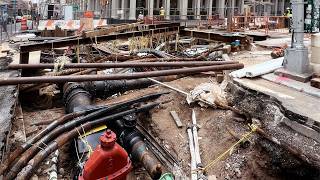

NYC's Hidden Underground World
45sThis opening segment visually and conceptually hooks viewers by revealing the unseen 'root system' beneath NYC, sparking curiosity about what's hidden underfoot.
▶ Play Clip"The title accurately promises a detailed tour of NYC's underground infrastructure, and the video delivers exactly that."
This video explores the vast and complex underground infrastructure of New York City, from water and electrical systems to steam pipes, sewers, and subways. It highlights the engineering challenges and historical layering that make the city function beneath the surface.
Water pipes run underground for structural support, freeze protection, and safety. They form a grid pattern for redundancy and constant flow, preventing stagnation.
NYC's water is gravity-fed from upstate, requiring no filtration due to protected watersheds. Over 900 sampling stations test water quality at the end of the distribution system.
85% of NYC's electrical lines are underground for aesthetics, safety, and reliability. The city uses a secondary network with redundant feeders and network transformers that operate submerged in water.
NYC uses three-phase power for service networks, providing 120V to neutral and 208V between phases, unlike the typical 240V split-phase system elsewhere in the US.
NYC has the world's largest district steam network, mainly in Manhattan, used for heating, hot water, and even air conditioning. Challenges include thermal expansion and condensation.
Natural gas lines are common but newer high-pressure lines require outdoor regulators. NYC has limits on gas in new construction, and old lines are often abandoned in place.
Telecom lines run through standardized ducts managed by Empire City Subway, which rents space to providers. This reduces digging but adds to congestion.
Underground utilities are often unplanned and poorly mapped, creating a 'spaghetti' mess. Vacuum excavation helps safely expose utilities, and a 3D database is being developed.
Sewers are deep and gravity-fed. NYC's combined sewer system overflows during rain, discharging untreated sewage. The city is working on retention tanks and separate systems.
The subway uses cut-and-cover tunnels, with deeper sections using tunnel boring machines. There are also vehicular tunnels under rivers.
NYC's water supply tunnels, like Tunnel 3, are extremely deep (650 ft) to avoid other utilities and stay in hard rock. Tunnel 3 has been under construction since 1970.
The underground of New York City is a complex, layered infrastructure that is essential for daily life. It is a constantly evolving system that requires careful maintenance and upgrades, often visible through surface disruptions.
Why are water pipes typically buried underground?
For structural support (water is heavy), to prevent freezing below the frost line, and to protect from hazards like car crashes.
01:19
How does NYC's water system maintain pressure?
It is gravity-fed from upstate reservoirs at higher elevation, requiring no pumping.
02:53
What percentage of NYC's electrical lines are underground?
Roughly 85%.
04:15
What is a 'secondary network' in NYC's electrical grid?
A system where multiple feeder lines from a substation serve a network of transformers and low-voltage conductors, providing redundancy.
07:04
What voltage do NYC apartments typically get between the two hot wires?
208 volts, because they receive two of three phases (120 degrees apart) instead of the typical 240 volts from split-phase.
08:24
What is the world's largest district steam network?
New York City's steam system, mainly in Manhattan, with about 1,500 customers.
09:54
Why are steam pipes equipped with expansion loops?
To absorb thermal expansion from temperature changes of up to 300°F (170°C) when lines are shut down.
10:39
What company manages the standardized underground ducts for telecom lines in Manhattan and the Bronx?
Empire City Subway.
13:04
What is a combined sewer overflow?
When heavy rain overwhelms treatment plants, causing untreated sewage and stormwater to be discharged directly into waterways.
16:30
How deep is NYC's Water Tunnel No. 3?
Roughly 650 feet (200 meters) below the surface.
19:43
Water Grid Redundancy
Explains why water mains form a grid to avoid dead-ends and ensure constant flow.
00:49Underground Electrical Reliability
Highlights that 85% of NYC's electrical lines are underground, contributing to high reliability but also high costs.
04:03Unique Three-Phase Service
NYC's use of three-phase power for residential service is a notable difference from the rest of the US.
07:36The Spaghetti of Utilities
Describes the chaotic, unplanned layering of underground infrastructure, making repairs a treasure hunt.
13:33Combined Sewer Overflow Challenge
Explains the historical and ongoing problem of untreated sewage discharge during rain events.
16:30[00:01] New York City is unlike any other city in the United States. It’s the most densely populated area in the country by far, absolutely packed with buildings, business, homes, and people. But for all that you can see walking the streets or flying overhead,
[00:16] there’s a whole other world of infrastructure that makes the city possible below the surface. What if you could peel back the paving and soil to see what one of my favorite authors, David Macaulay, called the city’s “massive root system.” Let’s take
[00:32] a tour underneath the Big Apple. I’m Grady and this is Practical Engineering. Let’s pick a generic Manhattan intersection to start this journey.
[00:49] You’ve got cars, buses, bikes, buildings, sidewalks, traffic lights, fire hydrants, hotdog stands, manholes, and more. But open it up and there’s the whole other world below the surface. We’ll start with the water lines.
[01:02] If you think about it, water pipes could run overhead like electrical wires. Digging trenches is a lot of work, after all. And fixing underground pipes is pretty disruptive to streets. Of course, New York isn’t unique in having them run underground.
[01:19] It’s standard practice across most of the world for a lot of simple reasons: water is heavy, so continuous support along the length of a pipe is a structural convenience. Water also freezes, so putting pipes underground below the frost line prevents them from freezing in the cold winters.
[01:36] It also protects them from a whole host of natural and human-caused hazards like car crashes and rogue parade balloons. That’s important because a broken water main can be a big problem. When you see a huge rooster-tail of water spraying from the street, it’s easy to wonder why we need
[01:53] water mains to run at such high pressures. Of course, pressure helps move water through pipes to all the individual places where it’s needed across the city. But maybe more importantly, that pressure pushing out keeps contamination from getting in. You want any crack, hole,
[02:10] or break in a water main to be a one-way street. If anything’s moving from one side of the pipe wall to the other, it’s pretty important that it happens from in to out. Like electricity, water lines typically run in somewhat of a grid pattern. This adds redundancy,
[02:27] so that taking a line out of service doesn’t disrupt the flow to residents. It also makes sure that all the water in the pipes is constantly flowing. If you
[02:39] build a water distribution system like the branches of a tree, you end up with a lot of dead-ends where water can slow down or even stagnate, making it unsafe to drink. New York City’s water system is famously gravity fed, with most of the source water
[02:53] coming from upstate at a higher elevation. It also requires no filtration because the source watersheds are fiercely protected to keep contamination out. But the City doesn’t just assume things are good. Dotted throughout the streets are more
[03:08] than 900 water sampling stations that let officials collect and test the quality of the water at the end of the distribution system to make sure it’s safe to consume. If you could peel back the soil and look at the city’s water distribution system,
[03:22] you’d see water mains down nearly every street; shutoff valves used to isolate individual lines for maintenance or repairs, connections to street and wall hydrants where firefighters can hook up
[03:35] their engines, and service lines that tap into the mains to supply each individual building. You’ll notice that few utilities run under the buildings themselves. The main reason is that we need to
[03:47] be able to access them to fix them if needed. The other reason is that buildings often have their own underground structures, specifically piles, piers, or drilled shafts that serve as their foundation. I have a whole video on deep foundations if you want to learn more after this.
[04:03] Unlike water pipes, it is pretty typical to see electrical distribution lines running overhead on utility poles everywhere across the globe. You won’t see this in most parts of New York City,
[04:15] though. Roughly 85 percent of the electrical lines are underground. Part of it’s about looks: lines clutter up the space and require dedicated rights of way that limits the use of that space. Another part is safety: keeping people and vehicles free and clear
[04:32] of distribution level voltages. And, of course, there’s reliability. When a heavy storm takes out an above-ground utility pole in a suburban neighborhood, the ensuing power outage is an inconvenience. That same outage in Manhattan could affect a lot more people.
[04:49] You can kind of divide the grid into three distinct categories defined by voltage ranges: there’s transmission (where power moves over very long distances at hundreds of thousands of volts),
[05:04] distribution (where it’s carried throughout a populated area at a a few thousand volts), and finally service (the voltage at the plug). Putting service lines underground is pretty straightforward. You might even have an underground line at your house
[05:18] running to a lamp or a detached garage. Putting transmission lines at hundreds of thousands of volts underground is a pretty extreme engineering challenge because of insulation,
[05:30] heat buildup, and capacitance. Undergrounding distribution lines lies somewhere in the middle. One of the big upsides of running lines above ground is the availability of air. Air is free
[05:43] and it works pretty well as an insulator if you keep enough space around energized conductors. You only need actual insulators at the pole. Putting lines at tens of thousands of volts underground requires pretty expensive insulation that prevents arcs to ground or other phases and
[06:00] resists the effects of water, a hazard that is inevitable for every underground utility. We often call an electrical interconnection a “grid,” but that term mostly applies to the high-voltage bulk power system covering whole states or countries. It’s not really a good
[06:16] description at a city scale. Most urban areas use what’s called a radial system for distributing electricity, which is more akin to branches of a tree than a mesh. For a single-family residential
[06:30] home, you might share a transformer with a few houses. That connects to the distribution feeder, and you can follow that line all the way back to the substation. Each feeder is essentially a one-way dead end for power flow. There may be a crossover somewhere for redundancy, but it’s not
[06:47] an inherent part of the radial architecture. In New York City, it’s totally different. Throughout the five boroughs, New York City operates about 70 separate so-called “secondary networks,” each of which is served by somewhere between 8 and 28 feeder lines
[07:04] from an area substation. Rather than individual transformers that serve one or two buildings, there are network transformers dotted around the city, usually in concrete vaults belowground, each connected to one of the redundant feeders from the substation. Because they’re underground,
[07:20] these transformers have to be capable of operating while fully submerged in water. Those transformers drop the voltage to the service-level where a grid of conductors spread out to all the buildings in the area. These are true networks, actual grids of service-level
[07:36] voltage with multiple redundant pathways for energy to take (not like the branches of a tree at all). And there’s another way it’s not quite like the rest of North America. A typical service transformer in the US gives you “split phase power”. It takes
[07:52] one phase from the grid and provides two energized lines we call hots. Each hot leg has a voltage sine wave between neutral that is 180 degrees out of phase. So between one hot and the neutral, you get 120 volts. That’s a typical wall outlet.
[08:07] Larger appliances and EV chargers use both hot lines to get 240 volts. In New York City, the service networks are different. They use a three-phase system just like the rest of the grid. Each phase is offset by 120 degrees. Most individual apartments or houses
[08:24] get two of the three phases. So in the city, you still get 120 volts from hot to neutral, but you only get 208 volts between the hots. Most large appliances are designed to work on both 240
[08:37] and 208 volts in the US because of this mixing and matching with single phase and three phase power. Larger buildings like skyscrapers usually get their power at a higher voltage directly from the feeder and use their own transformers on maintenance floors to provide service
[08:52] throughout the building. So ConEdison maintains basically two power grids, each underground, one for the feeders between 13,000 and 27,000 volts and one for low voltage service. They
[09:06] both run through ducts that travel below streets and sidewalks and are serviced in the thousands of underground manholes and vaults throughout the city. With everything protected underground with lots of redundant paths, New Yorkers enjoy one of the most reliable
[09:20] electrical services in the country, but obviously, that reliability comes at a price. The “service network” architecture is one reason why New York City has some of the highest electricity prices in America. But wires aren’t the only way New Yorkers get power.
[09:38] Looking back at our generic intersection, you’ll see something that is not present in most other cities, and certainly not at the scale we see here. New York City has a district heating network, offering steam as a public utility. It’s not as extensive as the power system,
[09:54] with pipes mainly confined to Manhattan, but it is the largest of its kind in the world by far. There are about 1,500 customers with steam service delivered through the underground lines.
[10:06] It’s mainly used for heating buildings and for hot water, but it can also be used for sterilization in hospitals, cleaning dishes at restaurants, for presses in dry cleaning facilities, and somewhat counterintuitively, for air conditioning through steam-driven compressors.
[10:23] Of course, there are a lot of engineering challenges with running steam pipes underground. Thermal expansion is a big one. If you shut one of these lines down, it changes in temperature by roughly 300 degrees Fahrenheit or 170 degrees Celsius.
[10:39] You need regular expansion loops or heavy-duty slip joints that can absorb the physical movement created by those huge swings in temperature. You also have to deal with condensation. Some of that steam naturally condenses into water, and if you don’t get it out of the pipe,
[10:55] that liquid can act like bullets inside the high speed steam flow. I have a video on that from way back in the day if you want to learn more. Steam traps can discharge condensate while keeping the steam inside the pipe. Occasionally you get a steam leak or just a spot where groundwater is
[11:12] coming into contact with the hot pipes, creating a cloud of steam through a manhole to the street. ConEd puts these orange smokestacks to divert the vapor away from the public until they can fix the underlying issue. Those steam lines are insulated to keep the heat in,
[11:27] and usually deeper than other utilities to avoid heating up the surface or the other lines. One of those lines you definitely don’t want to heat up is natural gas. A large percentage of buildings and households in New York City use natural gas for heating, cooking, and hot water.
[11:43] Some of the gas lines are low-pressure mains that connect directly to buildings through the meter. The newer lines run at higher pressures and require a building regulator. For safety reasons, these are often installed outside, so they’re easy to spot. New York has put limits on when
[12:00] natural gas can be included in new construction, so these lines might become a thing of the past, joining other abandoned lines underground. Because of the cost and complexity of decommissioning utilities, it’s not uncommon to simply abandon them in place. In fact, there are plenty of lines
[12:17] underground that aren’t doing anything at all, including a once-sophisticated pneumatic tube mail delivery system, which spanned 27 miles and delivered mail throughout the city until it was shuttered in the 1950s when the maintenance costs started outweighing the benefits.
[12:33] Also like other places, New York City needs telecommunications: telephone, cable, and fiber lines. And like all their other utilities, these are running below the streets, weaving their way around everything else near the surface. But unlike a lot of the utilities, telecommunications
[12:50] are somewhat standardized. That’s because, in 1891, the city granted a franchise to a company called Empire City Subway. That name uses a more generic meaning of subway, an underground path,
[13:04] rather than the much more famous one you’re thinking of (which we’ll get to soon). Empire City Subway’s whole job was and still is to build and maintain a massive network of underground
[13:16] utility ducts. Anyone wanting to run telephone, cable, or fiber lines through Manhattan or The Bronx has to rent space inside those conduits rather than digging their own paths. But even with that standardization, you can see that things are starting to get pretty cramped.
[13:33] In many cases, especially older parts of the city, very little of this infrastructure was planned out comprehensively. As each service was installed, it had to find space among the others. And because much of it is pretty old, most streets are either imperfectly mapped,
[13:50] or not mapped at all. Making repairs is its own kind of treasure hunt. Utilities workers and engineers often just call it “the spaghetti” because of how big a mess it can be. To combat their proverbial pasta problems, the City is working on a comprehensive, 3D database of
[14:07] underground utilities to help with construction, repairs, and emergency response, but it’s an enormous challenge to combine records that, in some cases, can be more than 100 years old. Vacuum excavation has made a big difference in being able to dig around utilities safely.
[14:24] Water or compressed air breaks up the soil and the truck can suck it up. This makes it a lot quicker to expose buried utilities without damaging them, especially compared to an excavator or backhoe bucket. Often you have to support utilities from above during repairs to
[14:40] keep them from sagging down and flexing, which could lead to breaks and service disruptions. Older materials used for pipes and ducts like cast iron and vitrified clay are brittle and
[14:52] relatively weak. Taking away that continuous underlying support to repair something below requires a lot of care. This is just a ton of work compared to cities where there’s less density in the buried utilities. But that’s still not everything under the street.
[15:09] Of course you have sewers that carry wastewater away. They’re usually deeper than the other utilities, and for a few reasons: Sewers rely on gravity to maintain flow, so the slope carries them further below the ground. You also generally want to have them below water lines,
[15:25] just to be absolutely sure that a sewage leak doesn’t find its way through the soil toward fresh water. Of course, all American cities have sewer lines, but New York has some big ones. They’re not quite like the cartoon-style tunnels with handy ledges that act like walkways for crime
[15:42] fighting reptiles, but some of the hand-laid brick pipes are still in use. This is a big city that produces a lot of wastewater, and when all those lines start to converge and concentrate toward the treatment plants, it takes big pipes to carry it all. They may not look quite like the cartoons,
[15:58] but some actually are cavernous enough to walk through standing completely upright. These big old sewers are made even more complicated by stormwater. Much of the sewer system in New York City was built before modern environmental rules. The goal back then
[16:14] was to get it out of town, not to treat it, so it didn’t really matter that the stormwater was diverted into sewage pipes. It was a good thing, actually, because it diluted the sewage that was just being discharged directly into waterways. The problem is that, now,
[16:30] it matters a lot. On rainy days, the treatment plants don’t have the capacity to clean up both the sanitary sewage (the stuff that comes from sinks, toilets, and showers) and all the stormwater runoff from streets and buildings. So they still have to discharge untreated sewage
[16:46] on occasion. The city has roughly 400 outfalls where these “combined sewer overflows” occur. Of course, dumping raw sewage is highly restricted under modern laws. You can’t
[16:58] pollute natural waterbodies without consequence. But, it’s a practically impossible problem to fix, at least all at once, since these systems were built this way over decades and decades. Instead,
[17:11] the city operates under a consent decree with the state that basically says, “We won’t fine you for the overflows, but you have to implement a plan that puts a stop to this eventually.” Lots of major US cities are in the same boat. And New York City really has been working to fix it. From
[17:28] curbside rain gardens to massive underground retention tanks like the one at Newton Creek, New York is slowly chipping away at the number of sewer overflows. In newer parts of the city, the sanitary and storm sewers are entirely separate. Catch basins line the streets where stormwater
[17:45] is diverted to underground pipes. That’s just one more separate system of underground utilities to find space below these crowded streets. Go a little deeper and there’s more. New York City is famous for its subway, one of the largest and busiest rapid transit systems
[18:01] in the world. They mostly run in cut-and-cover tunnels below the streets. This is a simple idea: dig a trench down from the surface of the road, construct the floors, walls, and roof of the
[18:13] tunnel, then backfill and replace the road on top. It’s disruptive to the street, but much simpler and more cost-effective compared to tunneling methods that don’t disturb the surface. There
[18:25] are many instances of multi-level tracks where one line crosses another that required elaborate steel framing to support everything during construction. Deeper sections of the subway, like those under the East River, required alternative methods. The most recent projects have
[18:41] used tunnel boring machines, which are much more expensive, but increasing the depth helps avoid existing utilities and minimizes disruption at the street level. And you also have the ventilation structures and the elevators and escalators and stairs that connect between subways and
[18:57] the surface. The stations themselves are mostly subterranean, since that’s where the trains are. Of course, there are tunnels for cars and trucks below the surface in New York City too that pass under the East River and Hudson River. Sometimes it makes more sense than building a bridge,
[19:12] and other times it’s necessary for grade separation to keep traffic moving. Go even deeper below the street, and we’re back to water. New York has three primary tunnels that bring the fresh water into the city from upstate. Tunnel 3 is one of the largest and most expensive
[19:30] capital construction projects in the City’s history. Started in 1970, it’s still under construction and will be for at least another decade. It’s really deep, roughly 650 feet or 200
[19:43] meters below the surface. That’s nearly half the Empire State Building! That extreme depth is to avoid the underground traffic jam of all the other utilities we’ve talked about, but also because it keeps the tunnel in hard rock that’s better able to withstand the monstrous pressure inside.
[20:00] The underground of New York is almost a city within a city. We kind of get used to having all these utilities and services that it’s easy to forget the physical space they all take up and the
[20:13] work that goes into installing and maintaining them. Besides what they provide us, there are little signs at the surface as reminders: manhole lids, puffs of steam, metal grates where you can barely catch a glimpse of the machinery below. And then sometimes the reminders are a little more in
[20:30] your face, like when an intersection shuts down for a careful and intricate replacement project, weaving new pipes between those that might be a century old. These kinds of disruptions are
[20:42] hard to love, but they do give you a chance to appreciate everything that’s underneath. You can see in photos of excavations in New York City that just about everything is customized. With such a sprawling collection of utilities built over more than a century,
[20:58] there just isn’t that much standardization. It’s the same thing with a lot of the demonstrations I build for videos: you can’t pick this stuff up off the shelf. Most of my builds have custom, one-off parts to make them work. But you don’t need a multi-billion dollar municipal budget to
[21:14] make custom parts. This video’s sponsor, Send Cut Send, makes it pretty much effortless. You can watch a lot of my videos and see this process in action. Send Cut Send can fabricate practically anything I can dream up in CAD that uses sheet materials like steel,
[21:30] aluminum, or acrylic. They have a huge catalog of materials, and it’s not just laser cutting. They can bend, countersink, tap, and even insert hardware. They’ve also started offering CNC machining. Parts are made in the USA and usually out the door in a few days,
[21:46] which makes rapid prototyping a dream, especially with the instant quotes. I can’t recommend Send Cut Send enough. They are an essential part of my workflow in the shop. If you have projects that could use some fabrication help, the link below is
[22:00] going to give you a discount on your first order. I really appreciate their support, and I hope you give them a try. Thank you for watching, and let me know what you think.




⚡ Saved you 0h 22m reading this? Transcribe any YouTube video for free — no signup needed.