

I-80 Sinkhole Mystery: Century-Old Mines
46sCurrent event with repeated highway collapses creates immediate curiosity about the hidden cause.
▶ Play Clip"Accurate and informative; delivers on the title's promise with detailed explanations and a physical model."
The video explores the phenomenon of mine subsidence, focusing on abandoned underground mines that collapse decades later, causing sinkholes and surface damage. It traces the problem back to historical mining practices, especially room and pillar coal mining, and illustrates the process with a physical model. The video also discusses modern mining methods, regulatory responses, and remediation techniques.
A large sinkhole opened on I-80 near Wharton, New Jersey in December 2024, and again in February and March 2025, causing major traffic disruptions.
The sinkhole is linked to underground iron mines from over a century ago, highlighting the long-term risks of abandoned mines.
A common historical method for soft rock mining like coal, where material is excavated leaving pillars to support the roof. Pillars are often undersized.
A model mine built in the garage shows how subsidence progresses over time with water infiltration, causing sinkholes and general settling.
When mines are abandoned, pumping stops and they flood. Water dissolves minerals, softens rock, and erodes soil, accelerating collapse.
A sinkhole opened in the middle of a sports complex due to collapse of an active underground aggregate mine, demonstrating unpredictability.
Mine subsidence is often excluded from standard property insurance. Eight US states have government-subsidized insurance pools for coal mining areas.
A modern method where the roof is intentionally collapsed after coal extraction, making subsidence inevitable but predictable and manageable.
Repair methods include backfilling sinkholes with graded materials, grouting large voids, and using polyurethane foam to stabilize ground.
While historical mining caused many problems, modern practices are better regulated and include subsidence prediction, monitoring, and reclamation.
Mine subsidence is an ongoing challenge that requires careful prediction, monitoring, and reclamation to balance resource extraction with public safety and environmental protection.
Where and when did a series of sinkholes occur on a major highway, as mentioned in the video?
On I-80 near Wharton, New Jersey, in December 2024, February 2025, and March 2025.
00:01
What historical activity is the primary cause of the I-80 sinkholes?
Underground iron mining from over a century ago.
00:47
What is 'room and pillar' mining?
A method where ore is excavated leaving columns (pillars) to support the roof, commonly used in soft rock mining like coal.
04:35
Why are water and flooding problematic for abandoned mines?
Water dissolves soluble minerals, softens rock, and erodes soil, leading to void formation and eventual collapse.
07:39
What type of subsidence appears as a well-defined hole on the surface?
A sinkhole, usually a sudden collapse of soil into a void near the surface.
08:30
What is longwall mining and why does it cause subsidence?
Longwall mining uses hydraulic jacks to support the roof while coal is cut; the roof is intentionally collapsed afterward, making subsidence inevitable.
12:06
How many US states have government-subsidized mine subsidence insurance programs?
Eight states, primarily those with extensive coal mining history.
11:24
What federal law required modern mines to prevent or control subsidence?
The 1977 federal mining act (Surface Mining Control and Reclamation Act).
11:53
Name two methods used to repair sinkholes caused by mine subsidence.
Backfilling with graded materials (larger at bottom, smaller at top) and grouting with polyurethane foam.
14:05
What instruments do mining companies use to monitor subsidence?
Inclinometers and extensometers to track ground movement above mines.
13:38
Real-world sinkhole impacts
Directly ties the abstract concept of subsidence to actual infrastructure disruptions and commuter nightmares.
00:01Room and pillar mining explanation
Clearly describes the historical method and the economic incentive to make pillars as small as possible, leading to future collapse.
04:35Physical model demonstration
Provides a tangible, visual understanding of how subsidence progresses over time, especially with water infiltration.
05:52Lack of insurance coverage
Highlights a key practical challenge: property owners often have no financial recourse when subsidence damages their land.
11:08Mining's evolution and balance
Offers a nuanced conclusion acknowledging historical problems while recognizing modern improvements and the necessity of mining.
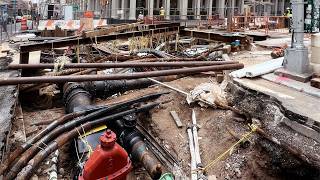
14:49[00:01] In December of 2024, a huge sinkhole opened up on I-80 near Wharton, New Jersey, creating massive traffic delays as crews worked to figure out what happened and get it fixed. Since then,
[00:14] it happened again in February 2025 and then again in March. Each time, the highway had to be shut down, creating a nightmare for commuters who had to find alternate routes. And it’s a nightmare for the DOT, too, trying to make sure this highway is safe
[00:29] to drive on despite it literally collapsing into the earth. From what we know so far, this is not a natural phenomenon, but one that’s human-made. It looks like all these issues were set in motion more than a century ago when the area had numerous underground iron mines. This
[00:47] is a really complex issue that causes problems around the world, and I built a little model mine in my garage to show you why it’s such a big deal. I’m Grady and this is Practical Engineering.
[01:12] We’ve been extracting material and minerals from the earth since way before anyone was writing things down. It’s probably safe to say that things started at the surface. You notice something shiny or differently colored on the side of a hill or cliff and you take it out.
[01:28] Over time, we built up knowledge about what materials were valuable, where they existed, and how to efficiently extract them from the earth. But, of course, there’s only so much earth at the surface. Eventually, you have to start digging. Maybe you follow a vein of gold,
[01:44] silver, copper, coal or sulfur down below the surface. And things start to get more complicated because now you’re in a hole. And holes are kind of dangerous. They’re dark, they fill with water,
[01:56] they can collapse, and they collect dangerous gases. So, in many cases, even today, it makes sense to remove the overburden - the soil and rock above the mineral or material
[02:08] you’re after. Mining on the surface has a lot of advantages when it comes to cost and safety. But there are situations where surface mining isn’t practical. Removing overburden is expensive, and it gets more expensive the deeper you go.
[02:23] It also has environmental impacts like habitat destruction and pollution of air and water. So, as technology, safety, and our understanding of soil and rock mechanics grew,
[02:35] so did our ability to go straight to the source and extract minerals underground. One of the major materials that drove the move to underground mining was coal. It’s usually found in horizontal formations called seams, that formed when vast volumes of paleozoic plants were
[02:51] buried and then crushed and heated over geologic time. At the start of the Industrial Revolution, coal quickly became a primary source of energy for steam engines, steel refining, and electricity generation. Those coal seams vary in thickness,
[03:07] and they vary in depth below the surface too, so many early coal mines were underground. In the early days of underground mining, there was not a lot of foresight. Some might argue that’s still true, but it was a lot more so a couple hundred years ago. Coal
[03:22] mining companies weren’t creating detailed maps of their mines, and even if they did, there was no central archive to send them to. And they just weren’t that concerned about the long-term stability of the mines once the resources had been extracted. All
[03:37] that mattered was getting coal out of the ground. Mining companies came and went, dissolved or were acquired, and over time, a lot of information about where mines existed and their condition was just lost. And even though many mines were in rural areas, far away
[03:53] from major population centers, some weren’t, and some of those rural areas became major population centers without any knowledge about what had happened underneath them decades ago.
[04:05] An issue that confounds the problem of mine subsidence is that in a lot of places, property ownership is split into two pieces: surface rights and mineral rights. And those rights can be owned by different people. So if you’re a homeowner, you may own the surface
[04:20] rights to your land, while a company owns the right to drill or mine under your property. That doesn’t give them the right to damage your property, but it does make things more complicated since you don’t always have a say in what’s happening beneath the surface.
[04:35] There are myriad ways to build and operate underground mines, but especially for soft rock mining, like coal, the predominant method for decades was called “room and pillar”. This is exactly what it sounds like. You excavate the ore, bringing material to the surface. But you leave
[04:52] columns to support the roof. The size, shape, and spacing of columns are dictated by the strength of the material. This is really important because a mine like this has major fixed costs: exploration,
[05:05] planning, access, ventilation, and haulage. It’s important to extract as much as possible, and every column you leave supporting the roof is valuable material you can’t recover. So, there’s often not a lot of margin in these pillars. They’re as small as
[05:20] the company thought they could get away with before they were finished mining. I built a little room and pillar mine in my garage. little model is not a rigorous reproduction of an actual geologic formation. My coal seam is
[05:37] just made of cardboard, and the bright colors are just for fun. But, I’m hoping this can help illustrate the challenges associated with this type of mine. I’ve got a little rainfall simulator set up, because water plays a big role in these processes.
[05:52] This first rainfall isn’t necessarily representative of real life, since it’s really just compacting the loose sand. But it does give a nice image of how subsidence works in general. You can see the surface of the ground sinking as the sand compacts into place.
[06:07] But you can also see that as the water reaches the mine, things start to deform. In a real mine, this is true, too. Stresses in the surrounding soil and rock redistribute over time from long-term movements, relaxation of stresses that
[06:22] were already built up in the materials before extraction, and from water. I ran this model for an entire day, turning the rainfall on and off to simulate a somewhat natural progression of time in the subsurface. By the end of the day, the mine hadn’t collapsed,
[06:39] but it was looking a great deal less stable than when it started. And that’s one big thing you can learn from this model - in a lot of cases, these issues aren’t linearly progressive. They can happen in fits and starts, like this small leak in the roof of the mine. You get a little bit of
[06:55] erosion of soil, but eventually, enough sand built up that it kind of healed itself, and, for a while, you can’t see any evidence of any of it at the surface. The geology essentially absorbed the sinkhole by redistributing materials and stresses
[07:10] so there’s no obvious sign at the surface that anything wayward is happening below. In the US, there were very few regulations on mining until the late 19th century, and even those focused primarily on safety of the workers. There just wasn’t that
[07:24] much concern about long-term stability. So as soon as material was extracted, mines were abandoned. The already iffy columns were just left alone, and no one wasted resources on additional supports or shoring. They just walked away.
[07:39] One thing that happens when mines are abandoned is that they flood. Without the need to work inside, the companies stop pumping out the water. I can simulate this on my model by just plugging up the drain. In a real soft rock mine, there can be minerals like gypsum and limestone that are
[07:56] soluble in water. Repeated cycles of drying and wetting can slowly dissolve them away. Water can also soften certain materials and soils, reducing their mechanical strength to withstand heavy loads, just like my cardboard model. And then, of course, water simply causes erosion. It can
[08:13] literally carry soil particles with it, again, causing voids and redistribution of stresses in the subsurface. This is footage from an old video I did demonstrating how sinkholes can form. The ways that mine subsidence propagates to the surface can vary a lot, based on the geology and
[08:30] depth of the mine. For collapses near the surface, you often see well-defined sinkholes where the soil directly above the mine simply falls into the void. And this is usually a sudden phenomenon. I
[08:43] flooded and drained my little mine a few times to demonstrate this. Accidentally flooded my little town a few times in the process, but that’s okay. You can see in my model, after flooding the mine and draining it down, there was a partial failure in the roof and a pile of sand
[08:57] toward the back caved in. And on the surface, you see just a small sinkhole. opened right in the center of a sports complex in Alton, Illinois. It was quickly determined that
[09:10] part of an active underground aggregate mine below the park had collapsed, leading to the sinkhole. It’s pretty characteristic of these issues. You don’t know where they’re going to happen, and you don’t know how the surface soils are going to react to what’s happening underneath.
[09:24] Subsidence can also look like a generalized and broader sinking and settling over a large area. You can see in my model that most of the surface still looks pretty flat, despite the fact that it
[09:36] started here and is now down here as the mine supports have softened and deformed. This can also be the case when mines are deeper in the ground. Even if the collapse is sudden, the subsidence is less dramatic because the geology can shift and move to redistribute
[09:53] the stresses. And the subsidence happens more slowly as the overburden settles into a new configuration. In all cases, the subsidence can extend laterally from the mine, so impacted areas aren’t always directly above. The deeper the mine, the wider the subsidence can be.
[10:09] I ran my little mine demo for quite a few cycles of wet and dry just to see how bad to speed things along. Let’s say this is a simulation of an earthquake on an abandoned
[10:23] mine. You can see that by the end of it, this thing has basically collapsed. And take a look at the surface now. You have some defined sinkholes for sure. And you also have just generalized subsidence - sloped and wavy areas that were once level. And you can imagine the
[10:40] problems this can cause. Structures can easily be damaged by differential settlement. Pipes break. Foundations shift and crack. Even water can drain differently than before, causing ponding and even
[10:52] changing the course of rivers and streams for large areas. And even if there are no structures, subsidence can ruin high-value farm land, mess up roads, disrupt habitat, and more. In many cases, the company that caused all the damage is long gone. Essentially they set a
[11:08] ticking time bomb deep below the ground with no one knowing if or when it would go off. There’s no one to hold accountable for it, and there’s very little recourse for property owners. Typical property insurance specifically excludes damage from mine subsidence. So, in some places where
[11:24] this is a real threat, government-subsidized insurance programs have been put in place. Eight states in the US, those where coal mining was most extensive, have insurance pools set up.
[11:36] In a few of those states, it is a requirement in order to own property. The federal government in the US also collects a fee from coal mines that goes into a fund that helps cover reclamation costs of mines abandoned before 1977 when the law went into effect.
[11:53] That federal mining act also required modern mines to use methods to prevent subsidence, or control its effects, because this isn’t just a problem with historic abandoned mines. Some modern
[12:06] underground soft rock mining doesn’t use the room and pillar method but instead a process called longwall mining. Like everything in mining, there are multiple ways to do it. But here’s the basic method: Hydraulic jacks support the roof of the mine in a long line. A machine called a shearer
[12:23] travels along the face of the seam with cutting drums. The cut coal falls onto a conveyor and is transported to the surface. The roof supports move forward into the newly created cavity,
[12:36] intentionally allowing the roof behind them to collapse. It’s an incredibly efficient form of mining, and you get to take the whole seam, rather than leaving pillars behind to support the roof. But, obviously, in this method, subsidence at the surface is practically inevitable.
[12:55] Minimizing the harm that subsidence creates starts just by predicting its extent and magnitude. And, problem to solve. Engineers use a mix of empirical information,
[13:09] like data from similar past mining operations, geotechnical data, simplified relationships, and in some cases detailed numerical modeling that accounts for geologic and water movement
[13:22] over time. But you don’t just have to predict it. You also have to measure it to see if your predictions were right. So mining companies use instruments like inclinometers and extensometers above underground mines to track how they affect the surface. I have a whole video
[13:38] about that kind of instrumentation if you want to learn more after this. The last part of that is reclamation - to repair or mitigate the damage that’s been done. And this can vary so much depending on where the mine is, what’s above it, and how much subsidence
[13:53] occurs. It can be as simple as filling and grading land that has subsided all the way to extensive structural retrofits to buildings above a mine before extraction even starts.
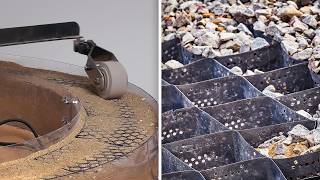
[14:05] Sinkholes are often repaired by backfilling with layers of different-sized materials, from large at the bottom to small at top. That creates a filter to keep soil from continuing to erode downward into the void. Larger voids can be filled with grout or even
[14:21] polyurethane foam to stabilize the ground above, reducing the chance for a future collapse. I know coal - and mining in general - can be a sensitive topic. Most of us don’t have a lot of
[14:33] exposure to everything that goes into obtaining the raw resources that make modern life possible. And the things we do see and hear are usually bad things like negative environmental impacts or subsidence. But I really think the story of subsidence isn’t just one of
[14:49] “mining is bad” but really “mining used to be bad, and now it’s a lot better, but there are still challenges to overcome.” I guess that’s the story of so many things in engineering - addressing the difficulties we used to just ignore. And this video isn’t
[15:04] meant to fearmonger. This is a real issue that causes real damages today, but it’s also an issue that a lot of people put a great deal of thought, effort, and ultimately resources into so that we can strike a balance between protection against
[15:20] damage to property and the environment and obtaining the resources that we all depend on. Mining isn’t exactly construction, but it is construction adjacent: heavy machinery,
[15:32] hard work, and lots of consideration of geology. It’s a fascinating industry that forms the backbone of of modern society, and we don’t really get to see much about how it works. My friend Sam from Wendover Productions put together this awesome documentary about coal
[15:49] mining that really gives you a peek behind the scenes in his “Logistics of X” series. These videos are so good - just deep dives into various industries and how they actually work. I had no idea that so much of the US coal supply comes from a single
[16:04] county. And if you want to check it out, it’s only available on Nebula. You’ve heard me talk about Nebula before. It’s a streaming service built by and for independent creators, including a lot of my favorites like Neo, Wendover Productions, the Coding Train,
[16:19] and Branch Education. I don’t know about you, but independently-produced content is most of what I watch these days. I just like the authenticity and thoughtfulness of videos that haven’t been through a writer's room and ten levels of studio executives. Someone said Nebula’s like Netflix
[16:35] for people who love trains. And I like that comparison, not just because I also love trains. Nebula’s totally ad-free, with tons of excellent channels and lots of original series and specials like the Logistics of X. It’s also a great gift,
[16:49] especially because a yearly membership is 40% of the link in the description. My videos go live on Nebula before they come out on YouTube. If you’re with me that independent creators are the future of great video, I hope you’ll consider subscribing. That’s
[17:04] go.nebula.tv/Practical-Engineering. Thank you for watching, and let me know what you think!
⚡ Saved you 0h 17m reading this? Transcribe any YouTube video for free — no signup needed.