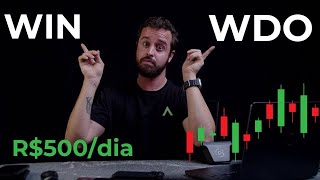

Mini-Index vs Mini-Dollar: Which Wins?
45sDirectly addresses a common trader dilemma with a clear promise to reveal which is more volatile and profitable.
▶ Play Clip"The title promises a comparison to earn R$500/day, and the video delivers exactly that with clear explanations and examples."
This video compares the mini-index (WIN) and mini-dollar (WDO) contracts traded on the Brazilian stock exchange (B3), explaining their differences in volatility, leverage, and trading strategies. The presenter aims to help traders choose the best contract for consistent daily profits of R$500.
The mini-index (WIN) reflects the Bovespa index, while the mini-dollar (WDO) is tied to the dollar-real exchange rate.
The margin for a mini-index contract is R$1,100, while for a mini-dollar contract it is R$50.
With R$1,100 margin, you trade ~R$20,000 in mini-index; with R$50 margin, you trade ~R$55,000 in mini-dollar, making WDO more leveraged.
Mini-index moves in 5-point increments, each point worth R$0.20; mini-dollar moves in 0.5-point increments, each half-point worth R$5.
A 100-point move in WIN equals R$20; a 10-point move in WDO equals R$100.
The index is more volatile, offering more intraday opportunities; the dollar is more trend-following and stable.
The idea that when the index goes up the dollar must fall is false; they are different assets and often move together.
The presenter prefers trading the dollar most of the time due to trend-following behavior, but also trades index when strong opportunities arise.
The mini-dollar offers higher leverage and trend-following behavior, while the mini-index provides more volatility and intraday opportunities. Traders should choose based on their strategy and risk tolerance.
What does WIN stand for and what does it reflect?
WIN stands for mini-index and reflects the Bovespa index.
00:02
What does WDO stand for and what is it tied to?
WDO stands for mini-dollar and is tied to the dollar-real exchange rate.
00:02
What is the operational margin for a mini-index contract?
R$1,100.
01:38
What is the operational margin for a mini-dollar contract?
R$50.
01:38
How much is traded with R$1,100 margin in mini-index?
Approximately R$20,000.
02:10
How much is traded with R$50 margin in mini-dollar?
Approximately R$55,000 (at current exchange rate).
02:37
What is the minimum fluctuation increment for mini-index?
5 points.
03:06
What is the minimum fluctuation increment for mini-dollar?
0.5 points (half a point).
04:09
How much is each point worth in mini-index?
R$0.20.
03:06
How much is each half-point worth in mini-dollar?
R$5.
04:23
What is the profit/loss for a 100-point move in mini-index?
R$20.
05:29
What is the profit/loss for a 10-point move in mini-dollar?
R$100.
05:29
Which contract is more volatile according to the presenter?
The mini-index (WIN).
06:00
What is the common myth about the relationship between index and dollar?
That when the index goes up, the dollar must fall.
08:29
Which contract does the presenter prefer to trade most of the time?
The mini-dollar (WDO).
09:36
Leverage Comparison
Clearly explains how leverage works for both contracts, showing the huge difference in capital required.
02:10Profit per Point Comparison
Provides concrete numbers showing that a 10-point move in WDO yields R$100 vs R$20 for a 100-point move in WIN.
05:29Volatility Differences
Highlights that WIN is more volatile with more intraday opportunities, while WDO is trend-following and stable.
06:00Debunking a Common Myth
Warns traders not to assume inverse correlation between index and dollar, as they are different assets.
08:29Presenter's Strategy Preference
Shares personal trading preference: mostly WDO for trend, but also trades WIN when strong opportunities arise.
09:36[00:02] day, the mini-index (WIN) or the mini- dollar (WDO)? These two contracts are the most traded by traders here on the B3 (Brazilian Stock Exchange), and many people end up which is more volatile, which system fits better – the mini-index or
[00:17] the mini-dollar? Today I'm going to tell you the differences between the contracts, what you need to pay attention to, their value, and how to trade them so that everyone can be consistent and profit trading mini-index or mini-dollar. They
[00:29] have different behaviors, but after you understand all the content of this easier for you to trade. Okay, everyone, welcome! Hey guys, your like, subscribe to this channel, and at the end, if it's relevant, I'll ask you
[00:43] friends. Today I'm going to show you the main differences between the mini-index and mini-dollar contracts. Just so you understand, at its core, the mini- index will reflect the Bovespa index, meaning it will be linked to the
[00:58] behavior of the stocks. Okay, so the mini-dollar on the other hand the mini-dollar on the other hand is tied to the dollar-to-real exchange rate, which is the difference between the two currencies. Every time you want
[01:10] need to compare it to another currency: the dollar against the Euro, the dollar against the Yuan. In this case, in Brazil, which is our currency. So when you say that to buy 1 dollar you
[01:25] need R$5, that's exactly the parity difference. Okay, so PR is for us to understand. The abbreviation for both is Win, and WDO, which we put there
[01:38] to abbreviate and facilitate our operations. Basically, the operational margin for a mini- index contract that the brokerage and B3 require is R$1,100. An operational margin for the mini-dollar is R$50. This is what
[01:55] you need to have deposited to operate a contract, either a mini-index or a mini- dollar. Okay, the big question is the financial value of a mini-index contract, which is the value you will work with and trade on the stock exchange. It's
[02:10] approximately R$ 2. Depending on the asset's price, you'll basically deposit R$1 into your brokerage account and trade something close to R$ 20,000. This effect is called leverage, which
[02:24] allows traders to profit by operating with little capital. The same relationship applies to dollar contracts. To trade a dollar contract, remember I told you that you need R$50? You'll trade the equivalent of R$
[02:37] you need R$50? You'll trade the equivalent of R$ 10,000, which at today's exchange rate would be close to R$55,000. So you'll see that the dollar contract is much more leveraged than the
[02:51] index contract itself; it's double, a little more, right? Because $1,000, if you convert it to reais, becomes R$55,000, depending on the day's price. So yes, the dollar contract has a more significant value, like
[03:06] a mini-index contract, which will fluctuate by 0.20 cents per point. But that's the minimum fluctuation of the mini-index. The index moves in increments of five points, so what
[03:20] happens is that every five points you 'll have a minimum fluctuation in reais of 'll have a minimum fluctuation in reais of R$1. So if the index goes up 100 points, you'll take 100
[03:42] point factor of 20, or you can take 100 points and divide by 5, which is its factor. If you arrive at either of these two calculations, you 'll arrive at a value of R$20 for every 100
[03:54] points. This is the movement of the mini-index. So every time you see a movement of 100 points my computer screen), you can expect a profit or loss of R$20. 200 points, a profit or loss of R$40. The
[04:09] dollar, however, has a different leverage. WDO contracts fluctuate every half point, and each half point in half point, and each half point in the dollar contract is worth R$
[04:23] 5. So if I have a dollar quote of dollar quote of 499.5 to 4... 499.5 to 4... 200 here, in this difference I have R$5,
[04:39] right? So basically, if I have a dollar that goes from dollar that goes from 4190 to 4E2, what will happen here is a difference of 10 points, right? Remember I told
[04:53] you that it oscillates every half point? R$ 5, if it oscillates every half point, 5, if it oscillates every half point,
[05:05] every point it oscillates. So what? R$10, right? If you take R$10 multiplied by 10 oscillation I wrote for you, from 490 to 4200. The dollar would bring a
[05:17] from 490 to 4200. The dollar would bring a financial value of R$100, right? While the mini-index, to move 100 points, will bring you a financial value of R$20. Okay, let me write it down here so you know: the WIN, when it brings a
[05:29] movement of 100 points, this is equivalent points, this is equivalent to R$2, right? While the WDO dollar, when it makes a movement of 10 points, is equivalent to R$1. You can see the
[05:47] difference in the contract, right? By the leverage value, of course, the index is much more volatile. Of course, the index offers many more opportunities during the day, as I'll show you on my computer screen right now. I have
[06:00] two completely different trading strategies here, totally distinct from this compare them here, you'd say, "Ah, Paulinho, you earned R$5,290 trading the index." Yes, but there's another strategy I did with the dollar, which is based on the
[06:14] video description if you want to learn it. It's a free live event. I made R$ 560 because, in the formula, our goal is to make R$500 per day on average. So I use the same strategy, but
[06:28] here with the dollar, I worked today to make that R$560 with much less leverage than with the index. Well, if you look here, a mini-index contract is worth R$ 26.63 at the current exchange rate, and a
[06:40] 26.63 at the current exchange rate, and a mini-dollar contract is R$5.140. The big issue is that in this case, in this strategy, I used many more index contracts. I many more index contracts. I had 50 mini-index contracts, and for the
[06:52] dollar, to achieve that result, I used seven contracts. What leverage there? I would need R$50 for each mini-contract, based on the broker's margins. It 's perfectly possible, as shown on the screen, for you to do. The
[07:06] the difference in behavior. The index is much more volatile. If you look at today's data, it opened, hit a high, came almost to the low again, then broke through the high, came almost to the low again,
[07:19] oscillated, and closed near the opening price. You see a percentage variation opening price. You see a percentage variation of 0.8, right? In contrast, the dollar another direction. What do you learn from this? The best
[07:33] operating system to use with the dollar is to capture large trend movements. Trend doesn't mean you should buy the top, for God's sake, it doesn't mean you should buy the top. Trend means you should capture a large,
[07:47] wide movement throughout the day. While the mini-index will offer you more volatile operations, which means you'll enter and exit more often because it will be moving. The volatility, even with the chart standing still, is
[08:02] when markets are volatile, it really messes with your head. So, working with long-term targets on the index is sometimes a bit more difficult than with the dollar because the dollar is more stable; it's more of a
[08:16] trend follower and will bring you more stability. So, when choosing your trading strategy for both the index and the dollar, you need to keep this in mind. The dollar respects the points more; it stops, it
[08:29] respects the variations of the index. For example, the dollar rose 0.90% today. And there's something very dangerous that you need to pay understand anything about trading who teach this out there, saying, "Oh, when one goes up, the
[08:43] other goes down." That's not true. I've had some tough times when I was learning because they told me that when the index goes up, the dollar has to fall. Don't do that; they are completely different assets. The truth is,
[08:56] most of the time they will behave in and the index falling. There are macroeconomic explanations for this, but it's not a rule. Many people end up getting
[09:08] screwed believing it. This is a rule and it's considered frequent until a fateful day arrives, which won't happen because they are different assets. One will relate to the main actions of Brazil in the future, the other will deal with currency exchange rates; they have
[09:23] do this, you're putting your money at risk. Remember leverage, and remember that one is more volatile and the other is more trend-following. You can capture more points, besides being more leveraged. That's it.
[09:36] points, besides being more leveraged. That's it. the points of variation in the index. My operational strategy fits better most of the time in dollar operations, however, the index appears to me as
[09:49] fewer opportunities but very strong opportunities because the volatility there is very high. So most of the time I'm trading the dollar, but paying attention to the index, I trade there less, but whenever it appears I make some
[10:01] very good moves. That's it. I hope you enjoyed it. Share this that friend of yours who's stubbornly doing it the wrong way so he can learn, and put some good tips for trading these
[10:14] two assets there. That's it. Thanks a lot, I'm going to stop here. Bye.
⚡ Saved you 0h 10m reading this? Transcribe any YouTube video for free — no signup needed.