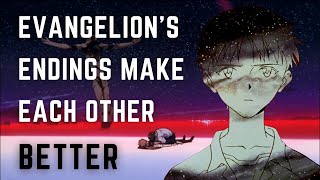

Evangelion's Two Endings Explained
54sThe hook question 'Which ending is real?' immediately engages fans and newcomers alike.
▶ Play Clip"Title accurately reflects the video's thesis that the two endings enhance each other."
Neon Genesis Evangelion is a landmark anime that subverts the giant robot genre into a Freudian coming-of-age story. The series and its film, The End of Evangelion, present two different endings that together capture the ongoing struggle of choosing to live.
Evangelion has two endings: the original TV finale and the film The End of Evangelion, both depicting Shinji's decision to accept life.
The original series ran out of money, so the finale focused abstractly on Shinji's internal choice rather than plot resolution.
Fans hated the abstract ending, leading to death threats, but Gainax later made a movie to provide a more concrete conclusion.
Both endings tell the same story but with vastly different tones: the TV finale is hopeful, the movie is bleak and violent.
In the movie, Shinji's acceptance of life is portrayed as a difficult, iterative process rather than a triumphant moment.
The creator relates the two endings to real-life experiences of choosing to live, sometimes with excitement, sometimes with mere spite.
The two endings together create a dissonance that captures the ongoing nature of the decision to live, unlike a single ending.
The real ending is neither the TV finale nor the movie, but the space between them, representing the continuous middle of the story.
Evangelion's two endings together illustrate that the choice to live is not a one-time event but an ongoing struggle, making them more powerful as a pair than alone.
What is the central question of Evangelion?
Whether Shinji will accept the world with its people and pain or retreat into himself.
0:59
Why did the original TV series have an abstract finale?
The studio Gainax ran out of money to animate the plot.
1:11
What is the title of the Evangelion movie that provides a different ending?
The End of Evangelion.
2:22
How does the movie's ending differ in tone from the TV finale?
The movie is bleaker, grosser, and meaner, while the TV finale is hopeful and abstract.
2:33
What does Shinji do to Asuka in the movie's ending?
He chokes her, then releases her when she caresses his cheek.
4:29
What does Asuka say to Shinji at the end of the movie?
How disgusting.
4:37
According to the video, what is the 'real' ending of Evangelion?
Neither ending; the space between them represents the ongoing middle of the story.
9:22
What metaphor does the video use to describe the two endings together?
An arc of lightning between two poles.
9:35
Evangelion's Two Endings
Introduces the central topic of the video.
0:06Budget Constraints Led to Abstract Ending
Explains the real-world reason for the TV finale's style.
1:11Same Story, Different Tone
Key insight that both endings tell the same story but with contrasting tones.
2:28Personal Connection to the Endings
The creator shares a personal experience that illustrates the duality of the endings.
5:34Neither Ending is Real
The video's thesis: the real meaning lies in the space between the endings.
9:22[00:06] Which of Evangelion’s endings is the real one?
[00:09] Some background: Neon Genesis Evangelion was a
[00:15] still felt today. It took a common trope
[00:20] young boy becomes a man by fighting monsters
[00:24] turns it into a Freudian nightmare.
[00:28] but coming of age in Evangelion
[00:32] violent thing. The robots–biological machines
[00:38] souls of the pilots’ mothers–serve as a potent
[00:43] And the heightened stakes that come from choosing
[00:48] scary and risky that puts you in the path of great
[00:54] stands in for the sudden psychological weight of
[00:59] protagonist Shinji will be a hero: It’s whether
[01:05] world with its people and its pain or retreat
[01:11] In addition to this existential question, there
[01:16] but those take money to animate, and by the
[01:22] episodes, they had none. So instead of wrapping
[01:27] in on Shinji's character and his decision whether
[01:33] his own mind. It presents these questions in
[01:39] solipsism a blank sheet of paper, the pain knowing
[01:45] And it ends with Shinji accepting, wholeheartedly,
[01:52] even when it hurts, to seek love despite
[01:58] applaud and congratulate him. It is, after the
[02:05] Of course, fans hated this. Dropping the plot
[02:10] mildly, a bold move, and the death threats the
[02:16] the worst parts of fandom to come. But because the
[02:22] a movie, titled The End of Evangelion, to provide
[02:28] of it has always been that End of Evangelion and
[02:33] same story, the tone is waaaaay different. The
[02:41] even the most horrific parts of the TV show. It
[02:47] of to be or not to be, but it’s not represented as
[02:53] part of Shinji’s head trip, it is rooted in
[02:59] known is not a series of angry scribbles: It’s
[03:06] his selfishness and cowardice. And the rejection
[03:12] It’s Shinji choking Asuka out.
[03:27] The End of Evangelion follows the same rough
[03:33] He has to decide whether he wants to brave this
[03:38] that world to escape it. And, finally, he
[03:44] agony and ecstasy of other people. But that final
[03:50] is much grimmer in the movie. Instead of
[03:55] cast congratulates him, here Shinji wakes
[04:01] the giant corpse of his friend slash mom slash
[04:08] The scene is quiet and deliberate and surreal and
[04:16] time the real Asuka, not a figment of Shinji’s
[04:22] but her own person and all thrill and terror that
[04:29] relapses. He chokes Asuka again, tries to bring
[04:37] caresses his cheek, and he weeps and loosens his
[04:46] This is the world Shinji has decided to accept:
[04:52] original series but a strange and silent
[04:57] undeserved tenderness and scorn earned many
[05:04] good choice, the brave choice, but the reward for
[05:10] not a sudden unbreakable will to live, not a
[05:16] from here on out, things are going to get better.
[05:23] one where he will stumble and regress,
[05:27] only slightly less terrible than the
[05:34] Most of the time, the choice to continue
[05:38] and survival instincts. But, without going into
[05:44] life where it has had to be a very deliberate
[05:50] like Evangelion’s original ending, and I am
[05:55] that will make my life better. And sometimes it
[06:00] rising to the challenge but lurching towards it,
[06:06] spite just animating enough to keep me going. The
[06:12] of the joys of this world, and it can just as
[06:20] And this is why Evangelion’s two endings enrich
[06:26] than they would be alone. By telling
[06:31] it draws attention to their contrasts while
[06:37] It’s like one image superimposed on the other,
[06:43] replacing the original finale but not entirely
[06:50] ending is and what it is no longer. This is why my
[06:57] is not anything in either ending, despite
[07:02] but the space between them, the push and the
[07:08] similarities and crucial differences. On
[07:14] no matter how effective that thing is.
[07:19] This is novel because most stories, with
[07:24] to extrapolate from the final scene. A moment
[07:30] while a downer ending suggests a whole world of
[07:36] uses this to interesting effect by making the
[07:41] eternal punishment. An ending does not show us
[07:47] and its inhabitants, but by showing us one last
[07:53] But the strange harmony of Evangelion’s
[07:58] extrapolation. That they are at odds with
[08:02] means that one single tone (sopranos joke)
[08:07] That, instead, there is dissonance. There is,
[08:13] to give way to resolution, more conflict.
[08:19] several feelings within its whole,
[08:25] And, given what the ending is about,
[08:30] ultimately, about Shinji’s decision to live,
[08:37] his decision is yes. But that yes is never
[08:44] then go on forever. It is a choice you have to
[08:49] optimism of the series' finale and the weary
[08:56] triumphantly and worn to marrow, beneath blue
[09:03] at once a chorus of congratulations and
[09:09] Either ending, on their own, captures a
[09:14] they hold its exhausting repetition, its ebb and
[09:22] The answer to the question we opened with–which
[09:29] suspected it would be when I started writing
[09:35] For in the space between them, the arc
[09:40] is no ending at all. There is none of an ending’s
[09:47] There is only the story’s middle, stretching
⚡ Saved you 0h 10m reading this? Transcribe any YouTube video for free — no signup needed.