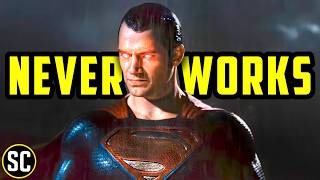

Why Evil Superman Always Fails
45sChallenges a popular trope with a strong, debatable thesis that sparks curiosity and discussion.
▶ Play Clip"The title is highly accurate as the video explicitly dissects the core problems with the evil Superman trope, using specific examples and a clear central thesis."
The video (hosted by ScreenCrush's Ryan Arey) argues that the popular trend of imagining an evil Superman fundamentally misunderstands the character. It claims that these stories (like Injustice, Homelander, and Omni-Man) are less about Superman and more about our own societal cynicism and inability to believe in pure, selfless goodness.
The idea of an evil Superman always falls apart in the long run and has started to change the perception of Superman himself.
Countless iterations like Injustice, Homelander (The Boys), and Omni-Man (Invincible) show a Superman who snaps, goes too far, or was never good to begin with.
The trend says less about Superman and more about our own failure to believe that someone with that much power would choose to be good. These stories are about our cynicism, not about Clark Kent.
People mistake the 'super' part of Superman as his power rather than his restraint. His biggest power is his emotional strength, not his physical strength. He treats people with dignity despite his god-like abilities.
Writing a Superman who kills is easy (he just lets go). It’s much harder to write a Superman who wields his power responsibly and doesn't make his alien nature the most important aspect of his life.
While 'Injustice' started as a fresh take, it quickly declined into shock value. Because the concept was for a video game, it constantly needed new reasons for conflict, making Superman's cruelty feel numb and repetitive rather than dramatic.
Homelander works as a villain because he was never Clark Kent. He is all 'super' without the 'man,' and the audience never believed otherwise. However, the constant need to one-up kills in later seasons loses its impact once the character's morality is known.
Omni-Man (Nolan) works as a villain, but he is not the Clark Kent of his world (Mark is). The story's main theme is that the human experience is what makes Mark good. Nolan eventually returns to classic Superman values by saving Earth.
Zack Snyder's Superman falls into a similar trap. 'Man of Steel' tried to ground Superman in a dark, gritty tone, emphasizing his alien side over his humanity. This leads to a character questioning if humanity deserves help, which fundamentally misunderstands the character.
The climax of 'Man of Steel' (killing Zod) violates the core of the character. If a story gives Superman no other choice than to kill, it has forgotten a key aspect: hope. Superman always finds another way.
Getting Superman to the breaking point is dramatic, but the moment he crosses that line, the tension is gone. He can do it again and again, leading to dictatorship and murder, which loses the very thing that makes Superman interesting.
Evil Superman only works when he stops being Clark Kent. The moment he loses his compassion, empathy, and humanity, he stops being Superman and becomes a different character entirely.
The evil Superman trend rose from our own cynicism and belief that corruption is inevitable with great power. The fantasy isn't about Superman turning evil; it's about proving our cynicism right.
Newer adaptations like 'My Adventures with Superman' and James Gunn's 'Superman' are returning to the core idea that Superman's strength comes from his humanity, not just his power. He represents hope and the choice to do good.
The evil Superman trend reflects our own societal cynicism and misses the point of the character. True Superman stories are about a man who defies all odds and chooses to do good, and we are finally returning to that core idea of hope.
According to the video, what is the real reason the 'evil Superman' trend became so popular?
It rose from our own societal cynicism and belief that corruption is inevitable with that much power, reflecting our own failure to believe in pure goodness.
10:07
What is the key difference between Homelander and Superman that makes Homelander work as a villain?
Homelander was never Clark Kent; he was all 'super' without the 'man.' The audience never believed he was a paragon of good from the start.
3:36
According to the video, what is Superman's greatest power, which is not his physical strength?
His emotional strength and his restraint, demonstrated by his choice to treat humanity with dignity and love despite having the power to dominate them.
1:40
What critique does the video make against Zack Snyder's portrayal of Superman in 'Man of Steel'?
It places too much emphasis on Clark's alien side instead of his humanity, leading to a character who questions whether humanity deserves his help, which undermines the core of the character.
7:21
Why does the video argue that the moment Superman kills Zod in 'Man of Steel,' the tension of the character is lost?
Once he crosses that line, he can do it again and again, losing the dramatic tension that makes him interesting because we know he has no problem with killing.
8:54
How does the video describe the character of Omni-Man in relation to Superman?
Omni-Man (Nolan) has a similar power set and backstory, but he is not the Clark Kent of his universe; his son Mark is. Nolan's turn and eventual redemption highlight that the 'human experience' is what makes a good Superman.
5:22
What does the video say is the key aspect of Superman that the 'evil Superman' stories forget?
Hope. Superman will always find another choice, and if a story gives him no choice but to kill, it has fundamentally misunderstood the character.
8:31
According to the creators (Siegel and Shuster), why did they create Superman?
As a way to tell stories of hope during times when things looked hopeless, as a champion of the oppressed.
0:55
What happens to Superman in the comic 'Superman Exile' after he is forced to kill Kryptonian criminals?
He is so distraught and haunted by his actions that he decides to exile himself from Earth before he can hurt anyone else.
9:18
A Misunderstanding of the Character
It provides the core thesis: evil Superman stories are about our cynicism, not about Clark Kent.
0:39Power vs. Restraint
Reframes the character's power as his emotional restraint rather than his physical might, offering a deeper understanding of heroism.
1:38The 'No Other Choice' Fallacy
Directly challenges a common narrative trope, arguing it violates the character's core principle of hope.
8:31A Reflection of Our Cynicism
Connects a pop culture trend (evil Superman) to a broader societal issue (cynicism), providing a meta-commentary on storytelling and human nature.
10:07[00:00] For more than a decade, superhero fans
[00:01] keep circling back to the same tired
[00:03] idea. What if Superman were evil?
[00:06] Welcome back ScreenCrush. I'm Ryan Arey,
[00:07] and today we're going to dissect the big
[00:09] problem with an evil Superman. We're
[00:11] going to look at the most famous evil
[00:12] Superman in recent years and explain why
[00:15] this idea always falls apart in the long
[00:17] run and how over time it's even started
[00:19] to change Superman himself. From
[00:21] Injustice to Homelander or even
[00:23] Invincible's Omni-Man, we have seen
[00:25] countless iterations of a Superman who
[00:27] just snaps, who goes too far, or who was
[00:29] never even good to begin with. Somewhere
[00:31] along the way, we started to believe
[00:33] that Superman is only interesting when
[00:35] he breaks bad. But that says less about
[00:37] Superman and more about how we
[00:39] fundamentally misunderstood this
[00:41] character. What do you mean? Well, these
[00:43] evil Superman stories aren't actually
[00:45] about Clark Kent. They're about our
[00:47] inability to believe that someone with
[00:49] that much power would choose to be good.
[00:51] Let me explain. We all know the story of
[00:53] the classic Clark Kent Superman. He was
[00:55] created as the champion of the
[00:57] oppressed. Superman's creators, Jerry
[00:59] Siegel and Joe Shuster, are even cited
[01:01] as saying that they created him as a way
[01:03] to tell stories of hope during times
[01:05] when things looked hopeless. For years,
[01:07] we have read stories of a Superman who
[01:09] helps those in need, loves his ma, and
[01:11] says stuff like,
[01:12] >> Golly.
[01:13] >> So then, what happened? How did we go
[01:15] from the Superman who saves cats stuck
[01:17] in trees to one playing judge, jury, and
[01:19] executioner? Well, people started to
[01:21] mistake the super part of Superman as
[01:23] the power that he has rather than his
[01:25] restraint. I mean, think about it.
[01:27] Superman spends his entire life
[01:28] surrounded by people who, by comparison,
[01:31] have the power of an ant. But rather
[01:33] than look down on them, he treats them
[01:34] with dignity, respect, and most
[01:36] importantly, he loves humanity.
[01:38] Superman's biggest power has never been
[01:40] his physical strength. It's his
[01:42] emotional strength. Writing a Superman
[01:44] that kills people is easy. He can just
[01:46] let go, unleash all of his pent-up
[01:48] aggression, and rule the world. We have
[01:49] seen that become the end goal in every
[01:51] single evil Superman story so far. It is
[01:54] much harder to write a Superman who
[01:56] wields that power accordingly and
[01:58] doesn't make the alien god the most
[01:59] important aspect of Clark's life. The
[02:01] idea of an evil version of Superman or
[02:03] an anti-Superman has been around,
[02:06] basically forever. Bizarro, although not
[02:08] necessarily one of the evil Superman
[02:10] we're talking about, was invented just
[02:12] 20 years after Superman. So, a
[02:14] villainous Superman is not a new
[02:15] concept. However, it did gain widespread
[02:18] popularity through the Injustice
[02:20] universe. In 2013, DC released
[02:22] Injustice: Gods Among Us, the prequel
[02:24] comic to the fighting game of the same
[02:26] name. In that comic, the Joker drives
[02:28] Superman insane when he kills a pregnant
[02:30] Lois Lane. Driven angry with grief,
[02:32] Clark kills the Joker and one thing
[02:34] leads to another, leading to Superman
[02:35] declaring to save the world by doing,
[02:37] quote, "Whatever it takes." Injustice
[02:40] was pretty much Superman's one bad day.
[02:42] At first, Injustice worked as a fresh
[02:44] new take on Superman and the DC
[02:46] universe. The comic also validated the
[02:48] audience's growing suspicion of an
[02:50] entirely peaceful Superman. We see the
[02:52] amount of grief that Clark goes through
[02:54] and understand his anger. It makes sense
[02:56] that he would snap like that. However,
[02:58] because the concept itself was for a
[03:00] video game, every comic issue in each
[03:02] game needed to create new reasons for
[03:04] the conflict. When he begins to continue
[03:06] killing after the Joker, we become
[03:08] almost numb to the cruelty of the
[03:10] character or it becomes shock value. So,
[03:12] not only does this snap go against
[03:14] everything we've known from Superman,
[03:16] but it also
[03:17] well, it just gets old. More recently,
[03:19] take Homelander for example. While he
[03:21] obviously doesn't have the same alien
[03:23] history or even human upbringing as
[03:25] Superman, he was created as a satirical
[03:27] parody of Superman. He is a version of
[03:29] Superman that shares the same immense
[03:31] power, but lacks all the morality and
[03:33] compassion. The thing with Homelander,
[03:35] though, is that he wasn't ever a
[03:36] character that we viewed as the paragon
[03:38] of good. Homelander is all the super
[03:41] without the man, and there was never a
[03:43] belief otherwise.
[03:44] >> You're nothing at all.
[03:45] >> Throughout every season of The Boys, we
[03:47] watched as Homelander became more and
[03:49] more depraved. From the second he was on
[03:51] screen, we were aware of his morality.
[03:53] So, it becomes less jarring or out of
[03:55] character when his goal of world
[03:57] domination is finally being pursued. It
[03:59] also works for The Boys because
[04:01] Homelander is not the hero. Homelander
[04:03] made for an interesting villain because
[04:05] we got to see this unstoppable force get
[04:08] taken down by a group of rowdy
[04:09] underdogs. However, like I said, it does
[04:12] come to a point. Towards the later
[04:14] seasons of the show, complaints began to
[04:16] rise about the show's constant need to
[04:18] one-up itself with kills. Homelander
[04:20] worked best in the early seasons
[04:21] because, like Injustice, it feels like a
[04:23] new take on a famously good hero. Once
[04:26] we know, though, that this character is
[04:27] willing to cross that line, the shock of
[04:29] them doing so entirely fades away. Take
[04:32] another, even more similar, evil
[04:34] Superman adaptation, Omni-Man from
[04:36] Invincible. Omni-Man is directly
[04:38] inspired by Superman. Invincible
[04:40] co-creator Robert Kirkman even said that
[04:42] Omni-Man's original name was Supra-Man.
[04:45] Parody names aside, they do have a
[04:47] similar power set. They both come from
[04:49] alien worlds. a badass. And prior to
[04:51] Nolan's turn, they are both beloved by
[04:53] the public. I mean, even Viltrum is
[04:55] similar to some iterations of an evil
[04:57] Krypton with their manifest destiny
[04:59] approach.
[05:00] >> Rule it over the planet as the last son
[05:02] of Krypton. Our most trusted [music]
[05:04] officers were each given a planet to
[05:07] weaken by themselves.
[05:09] I was one of those [music] lucky few.
[05:12] >> So, it's a shock to everyone, both in
[05:14] universe and out, when the real Omni-Man
[05:16] is revealed. This is their world's
[05:18] Superman being revealed as a
[05:20] world-conquering homicidal sociopath.
[05:22] But, see here, it works because, despite
[05:25] their immense similarities, Nolan is not
[05:28] the Clark Kent allegory of that world.
[05:30] Mark is the Clark Kent of this universe.
[05:33] Invincible's main theme centers around
[05:35] the human experience and how that is
[05:37] what makes Mark good, or at least not a
[05:39] conqueror like his father. While
[05:41] Omni-Man has a backstory similar to
[05:43] Superman's, Mark is technically the
[05:45] Superman of this story. However, Nolan
[05:48] does have a face turn and aids Mark in
[05:50] saving Earth from being conquered.
[05:52] Eventually, while he does still kill, he
[05:54] does return to the classic Superman
[05:56] values of being a champion for the
[05:58] oppressed.
[05:58] >> There's a statute where it's Superman.
[06:00] >> Right, but they were still super men.
[06:02] And that's important because this means
[06:04] that the problem isn't just evil
[06:06] Superman. It's the assumption that this
[06:08] much power will make anyone evil no
[06:10] matter what. Like with Injustice, it's
[06:12] the belief that Clark Kent, like anyone
[06:14] else, is just one bad day away from
[06:16] snapping. And while Zack Snyder Superman
[06:18] doesn't become a dictator or take over
[06:20] the world, he does work under some of
[06:21] these same assumptions. Snyder Superman
[06:24] ultimately falls into the same trap that
[06:26] all evil Superman storylines do. Man of
[06:29] Steel is definitely both a product of
[06:31] its time and its director. Coming off
[06:33] the heels of Nolan's Dark Knight
[06:34] trilogy, Man of Steel emulated the same
[06:36] dark gritty tone of that universe.
[06:38] However, you can't really ground
[06:40] Superman in Smallville or Metropolis the
[06:43] same way you can ground Batman in
[06:44] Gotham. Now, while we often compare the
[06:46] two or pit them against each other, they
[06:48] are ultimately built for different kinds
[06:50] of solo stories. Batman can easily take
[06:52] on a gritty and dark tone all while
[06:54] keeping his same motifs. Superman,
[06:56] however, cannot. Unlike Batman, Superman
[06:59] doesn't start his journey in darkness.
[07:01] He begins as the light. To have Superman
[07:03] spend an entire film grappling with
[07:05] himself further alienates him as a
[07:07] character and this is part of what makes
[07:09] Snyder Superman feel so
[07:12] un-Supermanly. The challenge with
[07:14] grounding Superman is that Superman
[07:16] isn't grounded by his powers. He is
[07:18] grounded by his humanity. Man of Steel
[07:21] places a lot more emphasis on Clark's
[07:23] alien side than his human side. Instead
[07:26] of a Superman that feels deeply
[07:27] connected to humanity, we get a Superman
[07:29] who spends a lot of the runtime
[07:31] questioning whether or not the human
[07:32] race deserves his help.
[07:34] >> What was I supposed to do?
[07:36] Just let him die?
[07:37] >> And that is an important difference.
[07:39] Superman has never been inspiring
[07:41] because he's Kryptonian. He is inspiring
[07:43] because, despite being an alien, he sees
[07:45] the best in humanity and chooses to be a
[07:48] part of it.
[07:49] >> You trust everyone and think everyone
[07:52] you've ever met is like beautiful.
[07:55] >> And this is where Man of Steel starts to
[07:57] brush up against the same idea that
[07:59] powers so many evil Superman stories.
[08:02] Not that Superman is evil, but that
[08:03] eventually Superman, like anyone else,
[08:06] will break. When the film reaches its
[08:08] climax, Clark is presented with an
[08:09] impossible choice. Kill Zod or let him
[08:12] laser a group of people. Superman
[08:13] ultimately picks the former.
[08:16] >> [screaming]
[08:19] >> Now, while you can say that he had no
[08:21] other choice, that only emphasizes the
[08:23] misunderstanding of the character. If
[08:25] your Superman story gives Superman no
[08:27] other choice than killing someone, then
[08:29] you have forgotten a key aspect of his
[08:31] character, hope. Superman will always
[08:33] find another choice. As he said, there's
[08:35] always another way. That aside, this
[08:38] breaking point where he does kill Zod is
[08:39] exactly where this fantasy of evil
[08:41] Superman hits a wall. Superman snapped.
[08:43] He lasered someone. He snapped someone's
[08:45] neck. So, now what? See, getting
[08:47] Superman to that point is dramatic.
[08:49] You're on the edge of your seat waiting
[08:51] to see if he'll actually do it. And when
[08:52] he does,
[08:54] that's it. Now that he's crossed this
[08:55] line, he can do it again and again and
[08:57] again. And eventually, every evil
[08:59] Superman story ends with dictatorship,
[09:01] murder, intimidation, etc. This new
[09:03] immoral Superman just lost all of the
[09:05] tension that makes Superman interesting
[09:07] because we now know that he doesn't have
[09:09] a problem crossing that line. There's a
[09:11] great story in the comics called
[09:13] Superman Exile, where it explores just
[09:15] how distraught Clark gets after killing
[09:18] somebody. After being forced to execute
[09:20] three Kryptonian criminals in accordance
[09:22] with Kryptonian law, Superman is haunted
[09:25] by his actions. He decides to exile
[09:28] himself from Earth before he can hurt
[09:30] anyone else. Evil Superman only works
[09:32] when Superman stops being Clark Kent.
[09:35] Homelander can be evil because he was
[09:36] never Clark Kent. Omni-Man can be evil
[09:38] because he was never Clark Kent. But,
[09:40] the moment that Clark loses that
[09:42] compassion, empathy, and humanity that
[09:44] define him, he stops being Superman, and
[09:47] he becomes a different character
[09:48] entirely. For a while, we looked at an
[09:50] evil Superman as the logical conclusion
[09:52] of the character. But, the more popular
[09:54] those stories become, the less they
[09:56] became about Superman, and the more they
[09:58] became about us. Superman is a hero
[10:01] because he chooses to do good with the
[10:03] powers that he has, something that to
[10:05] most of the human race is unfathomable.
[10:07] This evil Superman trend rose because of
[10:10] our own cynicism and our own belief that
[10:12] corruption is inevitable with that much
[10:14] power. But, Superman was never
[10:16] interesting because he had the capacity
[10:18] to destroy the world. He is interesting
[10:20] because he wouldn't. We stopped asking
[10:22] whether or not Superman could ever abuse
[10:23] his power, and as a society, we started
[10:26] assuming that he would. The fantasy was
[10:27] never about Superman turning evil, it's
[10:29] about proving that our own cynicism was
[10:31] right. Evil Superman is easy. Superman
[10:34] is hard. And luckily, I think we're
[10:36] finally coming back around to
[10:37] recognizing that. Shows like My
[10:39] Adventures with Superman are making
[10:41] Clark Kent just as important as
[10:43] Superman.
[10:43] >> Well, maybe he's a nice guy who has
[10:45] powers [music] and just wants to use
[10:47] them to help as many people as he can.
[10:49] >> Clark, if you had powers, you'd do that.
[10:51] >> In the show, we meet a relatively new
[10:53] man of steel. He's just discovering his
[10:55] Kryptonian heritage, but instead of
[10:57] isolating himself and becoming further
[10:59] alien, Clark is actively seeking out
[11:01] human connection. He wants friends. He
[11:03] wants community. He wants to belong. We
[11:06] saw something similar in James Gunn's
[11:08] Superman. Despite being an alien,
[11:10] Superman gets his strength from his
[11:11] humanity.
[11:12] >> But, that is being human, and that's my
[11:15] greatest strength.
[11:16] >> These newer adaptations remind us what
[11:17] Superman was always supposed to
[11:19] represent, not power or invincibility or
[11:21] the ability to rule over everyone else,
[11:23] but hope. The belief that someone with
[11:26] every reason and opportunity to abuse
[11:28] their power would choose not to abuse
[11:31] power. When you have a character whose
[11:32] entire premise is helping people who are
[11:34] oppressed, you fundamentally can't have
[11:36] them be evil. The question was whether
[11:38] or not what happens when Superman snaps,
[11:41] it's why doesn't he snap. We're not
[11:42] looking to see a story about a god being
[11:44] lured to the dark side. We want a story
[11:46] about a man who defies all odds and
[11:49] chooses to do good. After decades of
[11:51] creating characters and plotlines that
[11:53] validate our cynical fears about what
[11:54] someone with that much power would
[11:56] become, we seem to finally be
[11:57] discovering why the man part of Superman
[12:00] is so important. [music] Big shoutout to
[12:02] Lee Mazio who wrote this video, you can
[12:03] find his links down below. And let us
[12:05] know what you think about the concept of
[12:06] evil Superman down in the comments or in
[12:08] our free to join Discord server. And if
[12:09] it's your first time here, please
[12:10] subscribe, smash that bell for alerts.
[12:12] For ScreenCrush, I'm Ryan Arey.
[12:16] >> [music]
[12:22] [music]
[12:28] [music]
⚡ Saved you 0h 12m reading this? Transcribe any YouTube video for free — no signup needed.