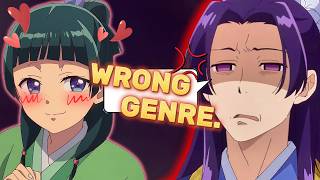

Why Apothecary Diaries isn't a romance anime
45sChallenges viewer expectations by claiming a non-romance anime is the best romance, sparking curiosity.
▶ Play Clip"The title is accurate: the video argues that the best romance anime isn't a typical romance, and the content delivers on that premise."
The Apothecary Diaries subverts typical romance anime tropes by focusing on psychology, history, and realistic relationship dynamics. The show avoids miscommunication clichés and instead explores how two people who understand each other still clash due to conflicting priorities. Through the relationship between Maomao and Jinshi, the series offers a mature take on love that resonates with modern audiences.
The Apothecary Diaries isn't a typical romance anime; it avoids shojo tropes and dramatic love triangles, instead offering a slower, weirder story that has become hugely successful.
In episode 36, Maomao falls on Jinshi and realizes his secret. Jinshi tries to confess, but Maomao stops him, prioritizing plausible deniability over emotional vulnerability. This avoids the miscommunication trope.
Both characters understand each other's intentions; the conflict arises from their different goals: Jinshi wants honesty, Maomao wants safety. This makes the story more mature.
Author Natsu Hyuuga stated in an interview that Maomao and Jinshi 'don't even have time for romance,' highlighting that the story is about why they shouldn't be together, not just if they will.
Historically, love was not prioritized until the 17th century; before that, loving your spouse was considered immoral. In the series, love is a liability, reflecting this historical view.
The romance works because Jinshi is emotionally risky and childish. In a world where duty comes first, only 'insane' characters like Jinshi and Lakan dare to take love seriously.
Modern society worships love but lacks a manual for it. Jinshi's approach aligns with relationship psychology: he commits, works for it, and exhibits 'positive sentiment override'—assuming the best in his partner.
The Apothecary Diaries offers a refreshing take on romance by grounding it in realistic psychology and historical context. It shows that love isn't about perfect moments but about two flawed individuals choosing to understand each other despite the odds.
What trope does the frog scene in The Apothecary Diaries avoid?
Miscommunication trope.
02:16
According to the author, why don't Maomao and Jinshi have time for romance?
Because the story is about why they shouldn't be together, not just if they will.
04:25
How was love viewed historically before the 17th century?
Loving your spouse was considered immoral and stupid; love was not something you chased but made.
04:48
What psychological concept does Jinshi's behavior exemplify?
Positive sentiment override: assuming the best of your partner even when they mess up.
09:53
Why does the romance in The Apothecary Diaries work despite the setting being against it?
Because Jinshi is emotionally risky and childish, and only 'insane' characters dare take love seriously in that world.
05:50
Avoiding Miscommunication
Shows how the series subverts a common trope by having characters understand each other yet still conflict.
02:16Author's Perspective on Romance
Direct quote from the author explaining the core conflict of the relationship.
04:25Historical Context of Love
Provides a historical lens that explains the characters' attitudes toward love.
04:48Positive Sentiment Override
Connects Jinshi's behavior to a psychological concept that supports long-lasting love.
09:53[00:00] The Apothecary Diaries isn't a romance
[00:02] anime, but it might be the one that
[00:04] fixes romance anime. Instead of chasing
[00:06] shojo tropes and dramatic love
[00:08] triangles, this show goes the other way.
[00:11] It's slower, it's weirder, but its
[00:12] success gravels even bigname shownen.
[00:16] So, today we are breaking down three
[00:17] ways the Apotic Diaries flips ramen
[00:19] storytelling on its head and make it
[00:22] better through psychology, history, and
[00:24] the subtle role Romans plays in Nachi
[00:26] Huga storytelling. And through that
[00:28] we'll see that we don't necessarily need
[00:30] more love stories but we need stories
[00:33] that make us better at
[00:35] loving. Technically the apothecary
[00:38] diaries is a san aimed at adult men but
[00:41] you wouldn't be wrong for thinking it
[00:42] borrows a few tricks from shojo
[00:45] especially when it comes to mama and
[00:46] jinshi's relationship. Just look at this
[00:49] bishodon. androgynous, impossibly
[00:51] pretty, wanted by women, men, and
[00:53] because he's that special, he's
[00:55] hopelessly drawn to a flat gremlin that
[00:57] looks at him like looking at a corrupt
[00:59] politician. Normal Shojo stuff right
[01:01] there. But we really need to start
[01:03] thanking Nachu Huga. Because while she
[01:04] bothers the surface appeal of shojo, she
[01:08] completely one of its most brain melting
[01:11] tropes. To understand what I mean, let's
[01:13] talk about episode 36. Yeah, it's the
[01:17] frog scene. In that episode, the mama
[01:19] falls on top of Ginhi. Nice. But Mama
[01:22] then realizes something horrifying.
[01:24] Gingshi is not a new nuke. He is in fact
[01:28] packing substantially big trouble. But
[01:31] Gingshi is fully enjoying the moment
[01:33] because one nice and two he has been
[01:36] preparing to tell Mama who he actually
[01:38] is. So he thinks this is the best
[01:40] chance. And just right when Jyn is going
[01:43] to say it, Mama stops him. The worst she
[01:46] can say is no. And mama be like, "Bet."
[01:48] Mama can even commit ethical war. She'd
[01:51] rather say someone's frog is okay.
[01:53] Detonate a man's soul, possibly stops an
[01:56] entire lineage to be born than
[01:58] succumbing herself into something she
[01:59] doesn't want to know. The burn is so
[02:01] bad. Jini is mad at her for like three
[02:04] episodes. But again, we should be
[02:06] grateful because thank god in the frog
[02:09] scene, they didn't go with the most hair
[02:11] pulling trope in ramen's anime,
[02:14] miscommunication.
[02:16] Ginshi knows exactly why Mama crushed
[02:18] his confidence. Mama knows exactly what
[02:20] Ginshi was trying to do. No one's
[02:22] clueless here. Look, miscommunication,
[02:24] it can work when done right. It can be
[02:26] funny and can make a somewhat meaningful
[02:29] conflict. The apocators also used it,
[02:31] but the tone was more comedic than
[02:33] anything. But if they were to use it
[02:36] here, it would ruined everything.
[02:40] Because this isn't a story about high
[02:42] schoolers not getting each other. It's
[02:44] about what happens when you do
[02:46] understand someone and still clash.
[02:49] Ginhi is ready to close the distance.
[02:51] He's been hiding behind layers of
[02:53] secrets. His name, his status,
[02:55] everything about himself except a couple
[02:57] of slip-ups are a lie. But now he's
[02:59] decided. No more hiding. He wants to be
[03:02] honest. The motive is clear for us to
[03:04] see. But on the other hand, Momo, she
[03:08] wants the opposite. She's in denial. She
[03:10] wants plausible deniability more than
[03:12] anything. She's chasing survival.
[03:14] Emotional distance is how she stays
[03:17] safe. But both of those conflicting
[03:20] attitudes. They're both right in their
[03:22] own way. And that's what makes this frog
[03:25] scene moment a real crossroads. Either
[03:28] Momo opens the door and lets Gingi in or
[03:31] Jini gives up, realizing that for
[03:33] obvious reasons, they're just not meant
[03:36] to be. Juni thinks if he just explains
[03:38] himself, things will work out. Mama
[03:41] thinks if she stays irrational, she
[03:43] won't get hurt. But here's the thing.
[03:45] It's really obvious that emotions don't
[03:47] care about your logic. And that's where
[03:49] the real story between these two begins
[03:52] that can encapsulate the bigger picture
[03:54] of Momo and Gin's romance
[03:58] story. So the Apocaris is blowing up
[04:01] right now, bigger than ever. So
[04:03] naturally, the other Natu Huga is also
[04:06] getting her moment in the spotlight. She
[04:08] gave this really thoughtful interview
[04:10] with Duffini magazine. It was translated
[04:12] to English by Twitter user Kayuzuki. The
[04:15] interview was pretty extensive as far as
[04:17] I know, but I want to focus on just one
[04:20] line that perfectly captures how she
[04:22] fused the romance in her story. In my
[04:25] opinion, they don't even have time for
[04:27] romance. So, it's not just will they or
[04:30] won't they. The bigger picture of Mamo
[04:32] and Ginhi's romance is why would they
[04:35] when everything say don't. So the
[04:38] biggest hurdle in their romance isn't
[04:40] Mamo's reluctance but the logic behind
[04:42] it. And that logic is heavily inspired
[04:45] by the real world history of love. You
[04:49] see love is such a central topic in our
[04:51] modern lives. But historically we only
[04:53] started appreciating love around the
[04:55] 17th century. Before that love wasn't
[04:58] something you chased. You made it.
[05:00] Loving your spouse was considered
[05:02] immoral and stupid. Sounds familiar?
[05:05] Well, yeah, because in the Apothecary
[05:07] Diaries, although it's not that extreme,
[05:09] love is a liability and is especially
[05:12] apparent in episode 12 when Ginshi is
[05:15] supposed to fire Mama from the inner
[05:17] court, we got to see Ghanian's take on
[05:20] Ginsi and Mamo's
[05:26] relationship. Even when Gausan finally
[05:28] admits that, okay, Ginsi is too far gone
[05:31] to treat her like a toy or a pawn
[05:32] anymore, he's not thrilled, but he knows
[05:35] there's no going back. Poor guy is just
[05:37] watching his boss simp himself into
[05:39] career threatening chaos. That also
[05:40] includes his own career, by the way.
[05:43] That's Gaus. Also, look at Momo. Momo
[05:46] gets it. Rationally speaking, it's just
[05:48] dumb. We talked about it before. So,
[05:50] what's the answer to that? What actually
[05:52] moved the ramens here if the setting
[05:54] itself is against it? What they need is
[05:57] a bit of insanity. The Romance works
[06:00] because it's Ginshi and Ginshi is a
[06:02] train wreck. He's childish. He's
[06:04] problematic. He's the inner court's
[06:05] poster boy. But he's also the kind of
[06:07] guy would lose two of the emperor's
[06:10] favorite concubines to poisoning if Mama
[06:12] wasn't around to save his ass. But it's
[06:14] because he's such a mess in the first
[06:16] place that this love story can even
[06:18] happen. Because everyone else in the
[06:20] story, they put duty first, interest,
[06:23] and affection last. So the only people
[06:25] who dare take love seriously in this
[06:27] world are the insane ones. You know who
[06:30] else that dare take love seriously?
[06:32] Lakan. Think about it. Also, Lady Fuo
[06:35] from episode 3. If Natsu Huga played it
[06:38] 100% realistic, this romance wouldn't
[06:41] survive episode 20. There's no happy
[06:43] ending there. Just Mamo and Ginsi
[06:45] growing more and more distant every
[06:47] single episode. Or maybe she would try
[06:50] to salvage it by turning Ghi into one of
[06:52] those stereotypical male leads. Super
[06:54] aloof but somehow only emotionally
[06:56] vulnerable to the female lead types. You
[06:59] know the kind. Cold Duke of the north,
[07:01] black hair, never smiles. His mother's
[07:04] name is Martin. Inside we get Gingshi, a
[07:06] multi-layer childish, conflicted
[07:08] personality which opens up nicely to the
[07:11] opportunity of a romance with MMO. I
[07:14] know it sounds like I'm roasting Gingi
[07:16] right now, like this romance is just a
[07:17] childish love. But plot twist, this
[07:20] chaotic man might actually be the
[07:22] perfect blueprint for real love. Not
[07:25] because of the wealth, not the looks,
[07:26] even the frog's eyes, but it's because
[07:28] Ginshi's love is emotionally risky,
[07:31] weirdly modern, and actually backed by
[07:33] actual relationship
[07:35] psychology. So, we already touched on
[07:37] the history of love before, how love
[07:39] used to be treated like a disease, but I
[07:41] left out the next part of it because
[07:43] honestly, it's just depressing. So the
[07:46] story is in the 1800s people were like,
[07:49] "Hello, we have toilets now." And
[07:51] weirder than that, we also have this
[07:53] human rights thingy. So maybe we can
[07:56] like marry people we actually love now.
[07:58] And so after that, marriage for love
[08:00] started to become the trend. It made
[08:02] sense, right? Until we realized that we
[08:04] screwed up because we didn't just start
[08:07] valuing love, we started worshiping it.
[08:09] We made love into this divine fantasy
[08:12] and marriage because of that become less
[08:15] and less stable because it doesn't
[08:17] fulfill all of society's crazy wish list
[08:19] and all people marry less than ever. One
[08:22] obvious reason is because as individuals
[08:25] people fantasize about love too much. So
[08:28] lots of people just wing it because we
[08:30] don't study fantasy. So love become this
[08:33] DIY thing with no manual whatsoever. But
[08:36] the problem about love, especially
[08:38] marriage, is once it breaks you, you're
[08:41] less happier than ever. But somehow in
[08:44] the middle of all this, Gingshi is out
[08:46] here being a better partner than half of
[08:48] us. Yes, he's dramatic. Yes, he's
[08:50] emotionally unwell. But here's the
[08:52] thing. First, look at the ancient love.
[08:54] Compared to the ancient love where
[08:56] couples act like polite co-workers, the
[08:58] childish Gingi is far better at love.
[09:01] What quote unquote rational love means
[09:03] is distance and suspicion. And now
[09:06] compared to modern love, Chini commits.
[09:09] He knows that for him to go further with
[09:12] Momo, he has to work for it. No
[09:14] fantasizing about happily ever after,
[09:16] it's not going to be pretty. And that's
[09:18] really clear from his side. If we look
[09:20] at the actual relationship psychology,
[09:22] that's exactly how we make love works.
[09:25] This entire video is backed by research,
[09:28] even from the first section. Look,
[09:29] section one, hiding stuff from your
[09:31] partner kills relationship. And then we
[09:33] look at Gingi. Jinshi is literally
[09:35] risking his identity to get closer to
[09:37] Momo. Correct move. But what about his
[09:40] childishness? The second point,
[09:42] ironically, that's also a green flag
[09:44] because love needs insanity. Not
[09:47] full-blown, but if people want
[09:49] long-lasting love, I'm talking about
[09:50] like 50, 60 years of love. It's
[09:53] possible. And that insanity actually has
[09:56] a name. positive sentiment override. It
[10:00] means you assume the best of your
[10:01] partner even when they miss up.
[10:03] Honestly, that's such a green flag for a
[10:05] partner. The biggest green flag you
[10:07] could ever ask. So yeah, this entire
[10:09] video is secretly researchbacked. I just
[10:12] didn't tell you earlier because oh yeah,
[10:14] research. Oh yeah, studies. I want to
[10:17] see people fight. And maybe, just maybe,
[10:19] that's what Natihuga meant by this. In
[10:22] the interview we talked about before,
[10:24] she said that she picked ancient China
[10:26] setting because of its romantic allure.
[10:29] And what's more romantic than loving
[10:31] someone in a place where you're not
[10:33] supposed
⚡ Saved you 0h 10m reading this? Transcribe any YouTube video for free — no signup needed.