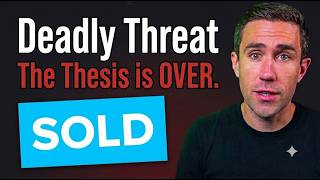

I Sold My Circle Stock: Here's Why
43sThe creator reveals a surprising sell decision made despite market gains, creating curiosity and potential controversy among viewers.
▶ Play Clip"Title is accurate but the video is padded with self-promotion and repetitive points; could be shorter."
Kevin Paffrath explains why he sold his entire position in Circle (CRCL) stock, citing the rapid adoption of the Federal Reserve's FedNow real-time payment system as an existential threat to stablecoins like USDC. He discusses the implications for PayPal, Block, and the broader stablecoin market, and provides a fundamental analysis of Circle's valuation.
Kevin sent a sell alert to his course members for Circle stock, unrelated to short-term market movements.
The NASDAQ 100 turned red after two days of leveraged buy-up, with the alpha report predicting a chill before BLS jobs data.
Kevin sold all exposure to Circle (CRCL) at around $61, with a cost basis around $70, taking a small haircut.
The single existential threat to Circle is the FedNow system, which enables 24/7 instantaneous payments, undermining stablecoins' core value proposition.
Kevin had warned in December 2022 that FedNow could destroy the need for stablecoins for domestic instant payments.
Circle's earnings were boring: revenue missed by 1.6%, USDC circulation up 25% YoY, EPS in line. USDC remains second-largest stablecoin.
OUSD consortium (140 partners) could threaten Tether and USDC by passing reserve income to partners like Visa, but Kevin is less concerned about it.
Kevin received an email from his bank offering early access to real-time payments (RTP) via FedNow, with free instant transfers 24/7/365.
FedNow eliminates domestic need for stablecoins; international and cross-border may follow as FedNow incorporates SWIFT language.
Circle trades at 4-5x book value, ~62x earnings, with only 6.5% revenue growth despite 25% USDC circulation growth, indicating weak pricing power.
FedNow could replace peer-to-peer transactions, threatening PayPal and Venmo. Only 5% of PayPal's revenue comes from Venmo, but the risk is real.
FedNow limits are $100k-$10M, tested $2,500 instant transfer. Zelle has lower limits and slower adoption; FedNow adoption is exploding.
If banks offer instant 24/7 transfers, apps like PayPal, Cash App, and Venmo become unnecessary for banked users.
Real-time gross settlement (RTGS) is enabling T+0 stock settlement without stablecoins, further reducing their use case.
Circle's banking license is a limited trust bank for holding assets, not a commercial lending institution, so no lending revenue.
CEO's bull case is smart contracts and agentic AI, but Kevin argues human-in-the-loop conditional logic in banking apps can replicate this.
7 out of 10 top banks use FedNow, 1,800 banks/credit unions, half of US savings/checking accounts have access, transactions up 85%.
FedNow likely to be used for transfer payments (VA, Social Security) and eventually payroll, making it mainstream fast.
Kevin thinks Circle might end up like Sears, took a small loss, but acknowledges he could be wrong and might be memed as a Jim Cramer inverse.
Kevin sold Circle stock because FedNow's rapid adoption undermines the core value proposition of stablecoins for domestic instant payments, leaving Circle with weak growth and high valuation. He believes FedNow will become mainstream, potentially replacing peer-to-peer apps and reducing the need for stablecoins.
What is FedNow?
A real-time payment system by the Federal Reserve offering instantaneous 24/7 clearing of bank transactions.
06:19
Why did Kevin sell Circle stock?
Because FedNow adoption undermines the need for stablecoins for domestic instant payments, threatening Circle's growth.
01:12
What is the transaction limit range for FedNow?
Limits are $100,000 to $10 million.
12:07
What percentage of PayPal's revenue comes from Venmo?
About 5%.
11:24
How many banks and credit unions use FedNow?
1,800 banks and credit unions.
17:38
What is the average transaction size for FedNow usage?
$101,000.
18:05
What is Circle's banking license limited to?
A limited trust bank for holding assets, not a commercial lending institution.
15:57
What is the CEO of Circle's bull case?
Smart contracts and agentic AI using stablecoins for automated payments.
16:25
What is the growth rate of FedNow transactions?
Up 85% from a small base.
17:38
Existential Threat Identified
Kevin identifies FedNow as the single biggest threat to Circle, which is the core of his sell thesis.
02:42FedNow Adoption Email
Kevin shares a real email from his bank offering FedNow early access, demonstrating its rapid rollout.
06:19FedNow vs Zelle Limits
Comparison of transaction limits shows FedNow's superiority, explaining its potential to replace Zelle.
12:07FedNow Adoption Stats
Key statistics show FedNow's widespread adoption, supporting Kevin's bearish thesis on stablecoins.
17:25Circle as Sears
Kevin compares Circle to Sears, a once-dominant company that failed to adapt, highlighting his conviction.
19:50[00:02] in a very long period of time has gone out, which means yes, I sent a sell alert to everybody in the course live stream, but you are going to learn about it in this video. I hate to say it, but it has nothing to
[00:16] do with the market. Yeah, the market, at least the NASDAQ 100, has turned red today after being green this morning, which is interesting. But it's probably because the last two days we had this crazy leveraged buy up in the markets
[00:31] and so shortterm that euphoria probably wasn't going to last. In fact, this morning our alpha report while the market was still green said quote, "While it's possible the fund keeps going, Monday and yesterday were so
[00:44] strong, it would make sense for the market to chill, especially a day or two before the BLS jobs data. And even if it does move up today, it's a 10point does move up today, it's a 10point schllo to the next line of QQQ at 7:35,
[00:58] which means we have a less ideal outlook for the market. That is just an example of our alpha report. And as you can see, the market did end up bleeding today. You can always join us at meet.com. But this video is actually about selling all
[01:12] exposure to a stock that I was really excited about. And this particular stock also has implications for others. The others being PayPal and Block. I didn't
[01:25] have any exposure to them. But the reason I sold Circle stock is also something that is going to affect these guys. Now did take a small haircut on this. Cost basis was right around the seven number. Okay. So sold around 61.
[01:42] seven number. Okay. So sold around 61. Cost basis around the 70ish number. Um, oh well. The, uh, the stock actually did run up quite a bit after I bought it. Uh, it was all the way up to like 120 for a while, but that short-term
[01:56] momentum wasn't taken advantage of by me because I had a lot of faith in the long-term for this puppy. And unfortunately that long-term got U-turn not by what you might think which would be O USD and not by the banking charter
[02:12] they got which we'll talk about that in just a moment but actually something that the Federal Reserve is doing. So, while I'm a little paperhand or B, long-term still adding, still buying the dip, shortterm,
[02:28] it's normal for the market to move down today after two crazy days yesterday. But let's talk about what happened with Circle Stock. And always remember, if else, come join us over at meetke.com.
[02:42] You get the lifetime access to the alpha membership as well. And most people write this off on their taxes. talk to your CPA and join using that coupon code we've got. Now, the single existential ex threat that I think exists for Circle
[02:57] is the very reason I got excited about Circle in the first place, that Circle would be able to build out infrastructure that would enable 24/7
[03:09] infrastructure that would enable 24/7 instantaneous payments. Now in fairness the new risk that we have doesn't solve international and doesn't solve international and crossborder payments but the new risk
[03:24] totally solves instantaneous 24/7 payments and it's actually a risk that I talked about in this video. I made this video uh in December of 2022
[03:36] back when I still had a really colorful studio instead of this dark soulless studio. Uh but anyway, I wrote crypto to zero the Fed's new crypto replacement. Uh and so we made this little tweet
[03:50] here, Fed Federal Reserve ending crypto. But in this, I talked about how uh the But in this, I talked about how uh the Federal Reserve's Fed Now system has the real potential of destroying the need for instantaneous 247
[04:06] uh transactions from stable coins because you could then just do it within the banking system. Okay, back then I thought it's going to take a freaking thought it's going to take a freaking decade for the Fed to do this. Stable
[04:21] coins will take off before then and they'll even help us settle stock they'll even help us settle stock transactions. So much potential for smart contracts. Unfortunately, I've got bad news on all
[04:35] of this. Regrettably, it means I had to turn into a little paper handing weeny turn into a little paper handing weeny baby. I feel bad about that, but it's the truth. Now, earnings for this company, Circle, were pretty boring.
[04:49] Nothing exciting here. revenue missed by 1.6%. USD and DC in circulation still up 25% year-over-year. EPS was in line. The USDC is still the second biggest stable coin. You know, other launches from companies like PayPal haven't gained any
[05:04] traction at all. Who cares? This actually should be bullish circle, right? It is. Nobody else has been able to hold a candle. O USD which is the consortium of 140 partners creating a pass through income
[05:18] model for the partners where basically the reserves income that circle generates for people holding USDC that money instead of going to circle shareholders if you use OS O USD would just go to companies like Visa or the
[05:33] other institutions partnering with the OSD platform which is probably the biggest threat to Tether and USDC but you know we've seen big threat threats anything. People are used to using Tether. People are used to using uh
[05:47] USDC, but that's not the risk in my opinion. I'm less concerned about earnings. I'm not really concerned about OSD. Uh, you know, OUSD could end up flopping and doing nothing. And who knows, maybe
[06:03] Circle Stock after I make this video will meme and people will make those like Jim Kramer memes and be like, "Ha, inverse Kevin." Fine. But I'm going to have the balls to tell you about what I'm most concerned about. And it is this
[06:19] right here. It's called Fed Now. This is from my video uh well 3 years four coming up on four years ago now. and Fed Now, which offers instantaneous 247
[06:32] clearing uh by the Federal Reserve of bank transactions. Basically, think free 247 wires, I thought would take a very long time to uh come around, but let's just say it's it's already shown up. So, I just got uh
[06:48] this uh email not too long ago, and I'm not going to mention the bank here because they asked me not to. But take a look at this. Hi, Kevin. Some payments just can't wait for the next business day. You now have exclusive early access
[07:01] day. You now have exclusive early access to realtime payments, RTP, a new way to send funds instantaneously, 24 hours a day, 7 days a week, 365 days a year, on weekends and on holidays, just like a domestic wires, except every single day,
[07:18] no wire cut off time frame, and they're free. Now, technically, the back rails aren't free. the banks have to pay for this. So, the banks subsidize this. But been subsidizing this and they pay it for for their customers. So, uh you
[07:34] know, this is kind of interesting. This creates some potential issues. Why? Well, because stable coins were supposed to do exactly this. Now, stable coins internationally. I don't think that's going to change, but I think
[07:52] that won't last. I think we'll get to crossborder with Fed now as well. And it crossborder with Fed now as well. And it really leaves stable coins with hopes that they'll be useful for agentic commerce and uh automated peer-to-peer
[08:09] uh smart contractbased transactions, but I've got concerns for transactions, but I've got concerns for that too. So, uh, my end of 2022 thesis is coming a lot faster than I thought. Fed now is basically very bearish for
[08:23] stable coins. Circle had the chance to become a leading partner for this consortium. Obviously, they got missed because the pass through model would crush Circle's revenue anyway. uh which really leaves stable coins as either
[08:36] instantaneous transaction tools which we just lost all domestic needs for that with Fed now and this is gaining in popularity way faster than I thought. International I suspect will come over time especially since the very language
[08:51] time especially since the very language that Fed now uses is a language that coordinates and incorporates swift transaction language which is what we use for international transactions. Great. Fantastic. So, you know, the
[09:05] coming, right? We're trying to be ahead of this. I feel like I feel like I was holding a Sears here. And so then I'm like, okay, that's not good. So, what's the fundamental value of this? Like, you know, is there is there a book
[09:19] value we could look at? You know, I I always like considering book value. You know, I look at like, hey, what's what's the the market value of the assets they have? And that's when you take the book value and then you mark things to
[09:32] market. So, you know, some things like real estate you have to mark to market. Uh things like securities are already marked to market. So, you look at a what do I think all the office chairs are worth? The stocks they hold, the
[09:46] real estate they hold, right?" Uh I mean, you could cheat. You could look at cash. And then you look and you go, "All right, we got a $14 billion company with maybe $1.5 billion of free cash after
[09:59] bills to pay, maybe $3.5 billion of shareholder equity. Not really any kind of real estate to write up to market. So you're not really paying book value for this company. You're paying a multiple of book value, probably four to 5x
[10:13] multiple of book value for the company. The company's earnings have grown by 6 The company's earnings have grown by 6 and a half% on revenue. But wait a minute, so let me clarify that their their revenue has grown 6.5%.
[10:28] Um, their income has grown 6 and 12%. On USD circulation going up 25%. So we have USD circulation going up 25%. So we have 25% more USDC circulation, but only 6 and 12% more revenue. Some of that is due to the Federal Reserve
[10:44] that is due to the Federal Reserve cutting rates, but that is indicative of cutting rates, but that is indicative of relatively weak pricing power. And so then you get to earnings and we've got about a buck of earnings expected for
[10:56] the end of the year, which means right now you're paying about 62 times earnings, which you could justify if there was a really big growth narrative. But to me, the growth story for stable coins just died, which was instantaneous
[11:11] payments. Fed Fed now is doing it. And and I think this has a red flag risk for and I think this has a red flag risk for companies like PayPal and Venmo as well. Now, in fairness, only about 5% of PayPal's revenue comes from Venmo
[11:24] transactions. It's going to be a little bit more if you add in PayPal transactions. And who who knows? I could be really wrong about all this, but I kind of think what'll happen is Fed Now will end up replacing all peer-to-peer
[11:37] transactions. See, think about Zel for example. Okay, cool. We've got Zel, but you have a $500 limit. He's got a $2,000 limit. They've got a $5,000 limit. It's limit. They've got a $5,000 limit. It's annoying. Zel is really hard to use as a
[11:51] business owner because the transaction limits suck. And then they reset the next day. It's a pain in the butt. A lot of that is because of the banking system, not necessarily the rails, but the Fed now limits are 100,000 to 10
[12:07] million as as like the upper limits. You could send, we just tested it and sent $2,500 instantaneously with it. I was like, damn, that was a whole lot easier than zel. You have to worry about zelos. And not every bank uses zel. Now, in
[12:21] fairness, like 2,600 banks use zel and like 1,800 use fed now. But the zel adoption rate growth rate has really slowed and the adoption rate for fed now is exploding. So I I'm convinced Fed now is going to blow past
[12:37] the uh uh you know zel service. I think zel will end up dying to fed now or they'll just rebrand it and the rails will be fed now. Uh this creates actual real risks for having to use other apps like a cash app, venmore, PayPal for
[12:51] people who do have banks, bank accounts. Yes, there are people who are unbanked who like using the apps. Totally fair. I get that. But if I can instantaneously
[13:04] get that. But if I can instantaneously send money from my bank account 24/7, what do I need to use PayPal anymore and make sure I transfer money from my bank need to deal with that for? It's an extra step. It's an extra app. I don't
[13:16] need that crap anymore. Fed Now cuts it out. Fed now instantaneous peer-to-peer payments no cost right from the bank account. It's literally like you know
[13:28] PayPaling a h 100,000 a million bucks instantaneous. It's it's an instant wire. It's great. Now again it only works domestically and I'm not trying to shill for the Fed, you know. It's not like
[13:45] Reserve shirt on. Ah, people are going to be like, "Kevin, to be like, "Kevin, get off the Fed's payroll. I'm not on the Fed's payroll." Now, if they asked me to be the Fed chair, I
[13:58] would consider it. It would be kind of cool. Uh, but uh anyway, um so so then there's another thesis, you know, what about stable coin usage for like stock
[14:10] settlement? T plus0 is basically already coming except it's coming through real-time growth settlement RTGS basically the legacy banking system catching up. Don't even need stable coins. The problem with
[14:23] dollar turn it into stable coin and then turn it back to US dollar because I don't want your stable coin. I want the dollars, you know, and and and asset. But if dollars depreciate, then so do stable coins. It's technically not
[14:39] fluctuates and stable coins just mirror the dollar. you buy stocks. That's why you buy real estate. You know, whatever whatever floats your boat. So, these instantaneous uh transactions
[14:54] work through um these real-time payments work through the Federal Reserve through work through the Federal Reserve through a language called uh ISO 22200022. It's a basic finance language but uh Fed now is federally regulated. Stable coins
[15:10] now is federally regulated. Stable coins can use this uh ISO 222 as well can use this uh ISO 222 as well but the integration of stable coins still requires fiat to stable coin to fiat and is that necessary?
[15:27] That's the big question. So now we're doing stock settlement T plus0 without stable coins. The banking system is doing instantaneous 24/7 payments without stable coins. So you're left with international,
[15:41] but pricing power for that is already collapsing, at least based on the latest revenue and earnings margins, which isn't great. So then people say, "But Kevin, US well, circle USDC, they just got a
[15:57] banking license. Maybe they can get into lending." False. Their banking license is a very limited trust bank for holding assets, limited trust bank for holding assets, not a commercial lending institution.
[16:11] So then what's the bullcase from the CEO? Well, the CEO's bull case is smart contracts. The Fed Now system doesn't do automation or smart contracts or automation or smart contracts or agent-driven payments. Fair. And that is
[16:25] agent-driven payments. Fair. And that is an issue for now until Fed now deals with it. Why? Because the CEO's bullcase is a gentic AI is going to use the circle stable coin to send money. I don't know about you, but I don't want
[16:38] any AI sending my money anywhere autonomously. And I don't think anybody have a human in the loop. But if you're going to have a human in the loop, then what you're really doing is having agents algorithmically. They're not even
[16:53] algorithms. They're formulas. They're rules-based systems like smart But you would just have those rules or automations inside of banking portals or inside of QuickBooks or SoFi or whatever you're using and then you know you look
[17:09] I'll deny that." Whatever. It's just having like an agent set it up for you and then you approve it. You don't care if the rail is a stable coin or Fed Now. And that's the problem. Bye-bye pricing power for the stable coin because the
[17:25] banks are just going to use the federally regulated system that's up and federally regulated system that's up and running. Fed now. I think I could be Seven out of 10 top banks are using Fed Now already. 1,800 banks and credit
[17:38] unions are using it. Half of all US savings and checking accounts have access to Fed Now, whether you know it or not. Transactions are up 85% coming from a small base. You know, it's like 30,000 transactions a day. Big
[17:51] deal. That's like 11 million a year. But that's the problem. It's growing. You know, Zelda's billions of transactions in fairness, but but I think the growth in fairness, but but I think the growth rate is going to explode for Fed Now
[18:05] to me. May maybe it's early. Maybe I'm wrong. Average transaction size right now for Fed Now usage is 101,000. So right now we're we're doing big transactions with Fed Now. My opinion is it's coming for smalls. I could be
[18:20] wrong. If the average doesn't decline over the next year, maybe I'll be wrong, but the whole sales pitch for stable coins was instantaneous 24/7. Now the Fed's doing it. I actually think because the Fed's doing it is backed by
[18:35] going to start using this for transfer payments, VA benefits, social security, disability, whatever. Here's your automatic instantaneous Fed Now deposit. don't have to wait for the freaking check to clear anymore.
[18:50] I bet you eventually it'll get used for payroll. Hey, boss is sending payroll at 5:00 p.m. I don't have to wait for the check to clear anymore. It's not going to show up on Monday because it's after banking hours. It's there at 5:01.
[19:06] Actually, no, it's there at 5 cuz it's instant. So, I think this is going to become mainstream very fast. Uh I don't think the smart contract argument is very useful. I kind of think that's like saying you know oh well we need smart
[19:20] contracts instead of foundry and ontology at Palunteer. I don't think so. Uh any program programmatic requirements that smart contracts can provide can just be done with human in the loop conditional logic
[19:35] in any banking app or portal or whatever. whatever. So, unfortunately, I think Circle might end up being like a Sears. And I hate saying that. Took a little bit of a
[19:50] haircut. It wasn't huge. Could have sold it for a profit. Could have, would have, should have. Yeah, I'm a little paperhanding pansy. and maybe you'll be able to meme me as a Jim Kramer suit cuz this thing doubles
[20:07] in value and then everybody's going to make fun of me for having sold it. But I'm giving you my fundamental take on it. Um, I guess we'll see what happens. And remember, if you want these alerts and
[20:21] this analysis first before everybody else, come join us over at meetke.com. You pay once, you get lifetime access to the trade alerts, the alpha reports, the courses on building your wealth. You probably write it off on your taxes and
[20:34] you get the fundamental analysis that we do pretty much every day. The market is open as long as I'm not on vacation, but you get the vacation calendars. and goodbye. >> Why not advertise these things that you
[20:48] knows about this. >> We'll we'll try a little advertising and >> Congratulations, man. You have done so much. People love you. People look up to >> Kevin Praath there, financial analyst and YouTuber. Meet Kevin. Always great
[21:00] and YouTuber. Meet Kevin. Always great to get your take.



⚡ Saved you 0h 21m reading this? Transcribe any YouTube video for free — no signup needed.