
What is Kubernetes?
45sThe opening explanation of Kubernetes as an orchestration platform for containers is a perfect educational hook for beginners.
▶ Play ClipThis video explains what Kubernetes is, why it has become a popular tool for managing modern software stacks, and how it works. It covers the core components of a Kubernetes cluster, key benefits like high availability and scalability, and practical concepts such as Pods, Services, and Ingress. The video also discusses the tradeoffs of using Kubernetes and when managed services or alternative approaches might be more suitable.
Kubernetes is an open-source platform designed to automate the deployment, scaling, and management of containerized applications. It acts like a conductor for applications composed of hundreds or thousands of containers.
The rise of microservices architectures led to applications being broken into smaller, independent services packaged in containers. Managing these containers manually becomes a nightmare as applications scale, which is where Kubernetes' container orchestration comes in.
Kubernetes ensures high availability by distributing load across multiple instances and offering self-healing capabilities. It also enables easy scaling of applications up or down in response to changing demand, ensuring optimal performance and resource utilization.
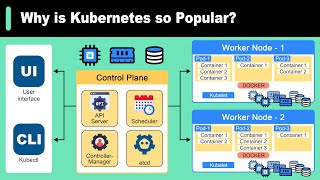
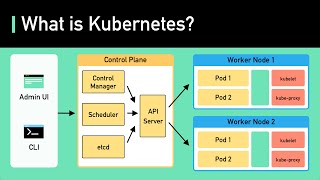
A typical Kubernetes cluster consists of a control plane and multiple worker nodes. Worker nodes run the containers, while the control plane acts as the command center, orchestrating and managing the entire cluster.
The control plane runs critical processes including the API server (communication hub), etcd (a key-value store for configuration and state), and the scheduler (distributes containers based on resource availability).
Kubernetes uses a virtual network to interconnect all nodes, presenting the cluster as a unified computing resource. Worker nodes typically have more CPU and memory because they handle the workload, while control plane nodes are critical for cluster operation and often deployed redundantly.
A pod is the smallest deployable unit, an abstraction over one or more containers. Services provide a stable IP address and DNS name, acting as an internal load balancer for a group of pods, ensuring consistent communication even if pods are rescheduled.
External Services expose applications to the internet, but Ingress acts as a smart reverse proxy, allowing you to define routing rules based on URL to direct external traffic to specific services.
ConfigMaps store non-confidential configuration data like database URLs, while Secrets store confidential data like passwords and API keys.
Deployments manage stateless applications where replicas are interchangeable, ensuring the desired number of replicas is always running. StatefulSets are for stateful applications like databases, offering stable storage and data consistency.
Kubernetes Volumes abstract storage from the pod lifecycle, allowing external storage to be mounted into pods so data persists even if a pod is deleted and recreated.
Running databases in Kubernetes can be complex and require specialized knowledge. Many organizations opt to use external database-as-a-service platforms and connect their Kubernetes applications to those databases instead.
Pros: scalable, highly available, self-healing, automatic rollbacks, horizontal scaling, portable across on-premise, public cloud, or hybrid environments. Cons: complexity is the number one drawback, high upfront cost, and requires a minimum level of resources, making it overkill for smaller organizations.
Managed services like Amazon EKS, GKE, and AKS offload control plane management, scaling, and maintenance, making Kubernetes more accessible for mid-size organizations. For small organizations, the complexity and resource requirements might outweigh the benefits.
Kubernetes is a powerful container orchestration platform that offers significant benefits in scalability, availability, and portability, but its complexity and resource demands make it a tradeoff. For many organizations, managed Kubernetes services or alternative approaches like external databases may strike a better balance.
[00:00] What is Kubernetes? Today, we're going to unpack this powerful platform and understand why it's become a popular tool for scaling modern software stacks. At its core, Kubernetes is an open-source platform designed to automate the deployment,
[00:16] Think of it as a conductor for your applications, especially those composed of hundreds or even thousands of individual containerized components.
[00:28] Kubernetes is a popular solution for managing complex, - from physical machines to virtual ones, Now, why has Kubernetes become so essential?
[00:45] Well, it all comes down to the rise of microservices architectures. developers have started breaking them down into smaller, independent services. These microservices are typically packaged in containers, which provide
[01:00] But here's the catch: as applications scale up, managing all these containers manually becomes a nightmare. That's where Kubernetes steps in. It offers a streamlined approach to container orchestration.
[01:14] Let's break down the key benefits that Kubernetes brings to the table: First, there's High Availability. Downtime is costly. Kubernetes helps our applications to remain accessible with minimal interruptions.
[01:27] distributing load across multiple instances, and offering self-healing capabilities. Next, we have Scalability. As our user base grows, the applications need to handle increased load.
[01:42] Kubernetes makes it easy to scale our applications up or down in response to changing demand. This flexibility ensures optimal performance and resource utilization. Kubernetes to understand how it provides these benefits.
[01:58] A typical Kubernetes cluster consists of the control plane and multiple worker nodes. They're responsible for running the containers that make up our applications.
[02:10] factors like resource requirements and overall workload distribution. local agent that enables communication and coordination within the cluster.
[02:25] The control plane, on the other hand, serves as the command center. It orchestrates and manages the entire cluster. It runs several critical Kubernetes processes: Think of this as the central communication hub of the cluster.
[02:40] including user interfaces, APIs for automation, and command-line tools. This component maintains the desired state of the cluster.
[02:54] identifies any deviations from the desired state, and takes corrective actions. It distributes incoming containers across the worker nodes based on
[03:06] resource availability and specific requirements. It’s a robust key-value store that serves as the persistent memory of the cluster. It securely stores all configuration data and the real-time status of each node and container.
[03:23] Kubernetes uses a virtual network that interconnects all nodes within the cluster. physical infrastructure and presents the cluster as a unified computing resource.
[03:38] In terms of resource allocation, worker nodes typically have more CPU, memory, This is because they bear the brunt of the workload Control plane nodes, while running fewer processes, are critical for cluster operation.
[03:56] it's common to deploy multiple control planes for redundancy and fault tolerance. together using a practical example of a web application that uses a database.
[04:10] A pod is the smallest deployable unit in Kubernetes. It is an abstraction layer on top of one or more containers that logically belong together.
[04:22] In our web application scenario, we'd have an "application pod" hosting the web server and a "database pod" managing the database. If a pod fails or needs to be rescheduled,
[04:35] However, this new pod might have a different IP address, To address this, Kubernetes introduces the concept of Services.
[04:49] A Service provides a stable IP address and DNS name that acts as an internal load balancer for a group of pods. IP address remains constant, ensuring consistent communication.
[05:04] outside the cluster, we need to expose it to the internet. It opens up a specific port on the cluster's network and routes
[05:16] While External Services technically expose our application, the default URLs they provide can be complex and not very user-friendly. Ingress acts as a smart reverse proxy, allowing you to define rules for routing
[05:34] external traffic to specific services within the cluster based on the request's URL. Kubernetes also provides mechanisms for managing application configuration data. ConfigMaps stores configuration data like database connection URLs or API endpoints,
[05:50] while Secrets stores confidential data like passwords and API keys. To enhance the resilience and availability of our web application, we can leverage Kubernetes' ability to create multiple replicas of our pods.
[06:03] replicas: Deployments and StatefulSets. like our web server, where each replica is interchangeable.
[06:15] We can define a Deployment that specifies the desired number of replicas for our application pod, and Kubernetes will ensure that number is always running. Now, let's talk about keeping your data safe and sound in Kubernetes.
[06:28] Kubernetes Volumes provides a mechanism for abstracting storage from the lifecycle of pods. It allows us to mount external storage directly into the pods. be persisted even if a pod is deleted and recreated.
[06:43] For stateful applications like databases, Kubernetes provides StatefulSets. These build upon the functionality of Deployments but offer additional features storage and careful management of data consistency across replicas.
[06:59] While StatefulSets offers a way to manage stateful applications like databases within Kubernetes, setting up and operating databases in Kubernetes can be complex and require specialized knowledge. Instead of running databases directly in Kubernetes,
[07:16] perhaps on dedicated database-as-a-service platforms. They then connect their applications running within Kubernetes to these external databases. It allows organizations to leverage the benefits of container orchestration for their applications
[07:35] like databases within the Kubernetes environment. especially when they have particularly demanding database requirements.
[07:48] As with many things in software engineering, it's all about tradeoffs. On the upside, Kubernetes is scalable and highly available. It’s packed with features like self-healing, automatic rollbacks, and horizontal scaling.
[08:04] It allows us to quickly scale applications up and down as needed to respond to changes in demand. Kubernetes is also portable, enabling consistent and reliable deployment and management of applications regardless of the underlying infrastructure,
[08:18] whether on-premise, in a public cloud, or in a hybrid environment. On the downside, complexity is the number one drawback. It comes with a high upfront cost, especially for organizations new to container orchestration.
[08:34] set up and manage a production environment. as Kubernetes requires a certain minimum level of resources to run in order to support all its features,
[08:48] likely making it overkill for many smaller organizations. One popular option that strikes a reasonable balance is offloading the management of the control plane to a managed Kubernetes service,
[09:00] Some popular ones are Amazon EKS, GKE on Google Cloud, and AKS on Azure. These services allow organizations to run Kubernetes applications without
[09:12] They take care of tasks that require deep expertise, scaling the cluster, and providing ongoing maintenance and support.
[09:24] This can be a reasonable option for mid-size organizations. For small organizations, the complexity and resource requirements of Kubernetes might outweigh its benefits for smaller-scale deployments.
[09:37] If you like our video, you might like our system design newsletter as well. Trusted by 1,000,000 readers. Subscribe at blog.bytebytego.com

⚡ Saved you 0h 09m reading this? Transcribe any YouTube video for free — no signup needed.