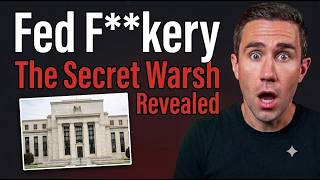

Fed's Giant Middle Finger: Goodhart & Lucas Explained
54sExplains why the Fed is ignoring historical data, a controversial and educational take that sparks debate.
▶ Play Clip"Title suggests a rug pull, but video provides solid analysis of Warsh's market-friendly stance; slightly oversold."
Kevin Warsh's first Fed meeting signaled a shift towards Austrian economics, with the Fed relying on the bond market to tighten policy rather than direct rate hikes. Warsh emphasized that the market has already priced in two rate hikes, reducing the need for immediate action. The video analyzes the implications for gold, jobs, AI, and the risks of a liquidity crunch.
Kevin Warsh introduced the Goodhart law and the Lucas critique, essentially telling the market to stop expecting Fed guidance.
When measures become the target, they cease to be a good measure.
Predicting policy effects using historical data is naive because expectations change.
The bond market has effectively raised rates by two Fed hikes, doing the Fed's job.
Warsh stated the primary tool is interest rates, not the balance sheet, and the Fed should not spoon-feed the market.
The market's reaction over the last 6 weeks is in the top decile of historical responses, comforting the Fed.
The Fed will wait to see if memory/chip prices and jobs data confirm trends before acting.
Warsh's Austrian approach leads to more extreme cycles, while Powell was more Keynesian and countercyclical.
Gold is expected to have a long bear market since Warsh won't print money, calling the top when he was picked.
Market pricing for a September rate hike fell to 57.4% from 80%, yet stocks still declined.
Noobs think politics drove the Fed; pros understand the bond market already tightened, and the Fed is watching weakening jobs.
Warsh's Fed is letting the bond market do the heavy lifting, but this risks a sudden panic if leverage unwinds. Long-term opportunities exist, but short-term caution is warranted.
What two principles did Kevin Warsh mention in his first Fed meeting?
Goodhart law and Lucas critique.
01:12
What does Goodhart law state?
When measures become the target, they cease to be a good measure.
01:41
What is the Lucas critique?
Predicting the effect of policy using historical relationships is naive because expectations change.
01:54
According to Warsh, what is the primary tool of the Federal Reserve?
Interest rates (policy rates), not the balance sheet.
03:46
What was the market's reaction function percentile over the past 6 weeks?
Top decile.
05:15
What was the probability of a rate hike in September after the meeting?
57.4%.
19:01
Stop Being Impatient
Warsh tells markets to stop expecting immediate action, a key shift in Fed communication.
02:06Primary Tool is Interest Rates
Clarifies that balance sheet is secondary, guiding market expectations.
03:46Top Decile Market Reaction
Quantifies how aggressively markets already tightened, justifying Fed inaction.
05:15Austrian vs Keynesian
Explains the philosophical shift from Powell's countercyclical approach to Warsh's procyclical stance.
12:25Noob vs Pro
Highlights common misconception about political influence vs. actual market dynamics.
22:25[00:02] back to another review of what Kevin Warsh just said. I have to apologize up front. This was the first Fed meeting that I didn't live stream, I feel like in like 8 years. I have literally rearranged vacations to make sure I
[00:18] could stream on Fed day and it wasn't possible for this one. But, here is my you need to know about what Kevin Warsh just said and I actually think he gave important for future meetings. In addition to that, one of the reasons why
[00:35] I missed today was because Disney was so generous to give me a tour of the bridge of this Disney treasure in October of 2024 ship.
[00:47] They didn't charge me for it, they're just super nice. I can't believe it. The entire family super happy about it. If you want to see a picture of us, follow me on Instagram. I'm posting an image there, a picture of us on the bridge
[00:59] with the captain. totally honored, super exclusive and shoutout to Disney, man. They've been really, really cool and it's been an amazing trip. So, with that said, let's get into the Kevin Warsh topic. So, I'm going to start reverse
[01:12] Reverse order, he mentioned two principles. He talked about the Goodhart principle and he talked about the Lucas critique. Both of these are really important and the clear bottom line of what these are
[01:26] is basically a giant middle finger to the Fed telling you what to expect or what data they're looking at. Okay? Here's what this means. Goodhart the Goodhart law means when measures become the target, they cease to be a good
[01:41] measure. And the Lucas critique suggests that predicting the effect of an economic policy change using historical relationships is naive because as soon as we look at history, people just end
[01:54] up changing their expectations. And basically, the old data isn't useful anymore because people just modify their behaviors in anticipation of what the Fed or whomever might end up doing. In other words, like in the simplest
[02:06] other words, like in the simplest English, Kevin Warsh basically says, "Listen, folks, stop being freaking impatient. Although, in fairness, it has been 63 months of y'all being impatient about inflation getting back to two
[02:19] about back to 2%. So, in fairness, you're kind of right to be impatient, but don't be impatient on a acting now because we are a new Federal Reserve. We are a Federal Reserve that is not going to, quote, fog up what the market should
[02:34] respond to with. And we think because we've been so dark in terms of what we should be doing or what is going to happen with bad policy, we think the market is already doing our job for us." This was a massive takeaway from the
[02:49] that we've been talking about over the last few days. If you've been paying because this is important. If you've been paying attention over the last few days, you will have seen me say the market has already increased rates by
[03:06] two Fed rate hikes. You've already seen me and heard me say that multiple times before this meeting. The market has already acted on behalf or or maybe on behalf of market implications or market, uh, you know, occurrences. Like, what's
[03:20] happening in Iran? Market prices in. What happens with oil prices? Market prices it in. That reaction function is exactly what Kevin Warsh wants because he is essentially a pure market kind of guy.
[03:33] essentially a pure market kind of guy. This is a laissez-faire laissez-faire of market free hand, right? The invisible hand guides the market, not somebody's speeches, approach. This is also considered an Austrian economics
[03:46] approach where we're not going to print our way out of problems. If the market collapse because what did Kevin Warsh tell us? He told us that the primary tool that the Federal Reserve should use is not the balance sheet. He literally
[04:00] told us this in this meeting. He said the primary T tool we should use or interest rates, policy rates. We should not spoon-feed the market. And
[04:12] right now, we do not need to act. We can patiently think, but we can save acting for the future if that becomes necessary. In other words,
[04:24] "Listen, the market already priced in essentially two rate hikes on the yield curve. Borrowing costs have gone up for artificial intelligence already. Why don't we wait to see if those higher
[04:36] borrowing costs now slow down or compress some of the inflation that compress some of the inflation that we're seeing in memory prices, chip prices, semiconductor equipment, server racks, or whatever, and let's see how
[04:49] much of that actually passes through to the real economy." In English, listen, folks, we don't need to do jack crap, because the market already made everything more expensive. So, why don't
[05:01] now that things are more expensive than they've ever been before? In fact, the reaction function, he said, over the last 6 weeks has been to show Dude, it is too hot out here. WE GOING INSIDE. WHO'S GOING
[05:15] INSIDE? IT is wet. I'm going to sweat my something off if I stay out here. It's all right. Welcome to Jamaica. Uh but anyway, he actually said the Uh but anyway, he actually said the reaction function over the last 6 weeks
[05:29] uh by markets has been in the top decile of market reactions. So, think about what that means for a moment. What he's essentially saying is markets have responded to the Fed telling us nothing
[05:43] in the most aggressive manner uh that they have ever responded to, you know, Fed commentary or market forces to uh as they have in or in the how should I say they've responded in the most extreme way
[05:58] extreme responses. I probably honestly butchered how I said what he's basically saying is, "Hey, look, we already have a market that is
[06:10] responding to us saying nothing. And it's just responding to the data just like it should. Market should respond to the data, not to what we're saying, and it's doing that. So, what more do you want from us? It's the market already
[06:23] priced it in. We're good." Now, while that was useful and the market actually during the commentary popped up because Kevin Warsh did not set up a rate hike, right? He didn't come out and say I mean, he did imply
[06:38] that we might have to act in the future, but he didn't come out and say, "Hey, we're going to raise rates, uh you know, in the next meeting." Even Jerome Powell used to sort of forecast, "Yeah, you know, we might have to make a move in
[06:51] the yield curve would predict which direction that move was, and then that way it wasn't a surprise. Even Warsh said, "Hey, we're not in a business of surprising markets, uh but basically we're going to kind of throw our hands
[07:05] us." Now, this is kind of cool if I can get this to work cuz I kind of want this out of the background. How cool is that? Freaking TV just disappears. I have to say that's one of the coolest features because if you ever notice if you have
[07:19] windows off your bed, it's hard to put a TV there, right? And when you're not it's in the way. Oh, stay stay get down stay down. Get stay down. Oh. stay down. Get stay down. Oh. Maybe a kid dropped something in there.
[07:34] that was really cool when I came in here, and I think it it looks better in the Apple Watch. Thank you, Apple. bit, but honestly, I don't think you guys care. Uh and the five girls that
[07:47] Some people in the comments earlier said I'm too much of a clown and I should would join the courses and they would actually use the coupon code uh dearcruzred uh if I wasn't such a clown.
[08:00] And I'm like, well, I guess that's just what I am. Uh but anyway, during the discussion, we actually saw the Nasdaq 100 uh reject actually saw the Nasdaq 100 uh reject 675, the QQQ's, rejected 675
[08:14] during his commentary, briefly broke out of 675, rejected 680, and then of 675, rejected 680, and then essentially collapsed into the close. Uh collapsed is because you essentially have
[08:28] uh the Federal Reserve saying, "Look, you're not going to get anything from us we're not going to tell you we're going to hike or not. In fact, we're kind of happy with what the market is reacting with." That's actually exactly what
[08:41] Kevin Warsh said. He said, "I was comforted the market did what it did between meetings." He says, "We will know in the coming months essentially if opinion where he says, "Look, we are going to wait to see what happens with
[08:56] memory and chip prices and jobs." Remember, both price stability and maximum employment. Uh duh, so does every single Fed chair. It's not supposed to be an either/or, it's supposed to be a both.
[09:09] Problem is, he previously said we're only going to look at the left side of the decimal when it comes to inflation. That was a big mistake, and he basically walked that back in this meeting. He's like, "Look, we're going to 2% and
[09:21] maximum employment. That's our goal. Okay, that's when people go, 'So, why aren't you hiking?' Oh, well, the bond market basically hiked for us." Let's be real. Even though he's saying, "Hey, jobs are stable, the unemployment
[09:36] "Hey, jobs are stable, the unemployment rate is stable. You and I know that the ADP weekly jobs data had a boost in Q1. Actually, it was the beginning of Q2. It was like April and May, but it's already curving down. So, now the question is
[09:50] does it stop or does it keep curving down? That's a big issue, right? And hiring in artificial intelligence. You know, I think somebody misunderstood me when I said that in another video that we are seeing more technology layoffs or
[10:03] have seen more technology layoffs in 2026 than all of 2025 together. They're like, "Oh, but Kevin, you know, there's more hiring." I know. But just because there is more new hiring in the field of engineering does
[10:15] not mean there can't be more layoffs also in different parts of engineering that way offset that hiring. So, for some people it could feel like we're actually be losing more jobs, which I think is true. I mean, I look and this
[10:28] isn't a pitch. You know, this this we're not doing a fundraise now. Um but, you what we're doing with Reinvest in the artificial intelligence that we're building, which I think gets better on a daily basis. I think it'll be really
[10:41] good by the beginning of next year. You know, it takes time. Then that'll have put us on about an 18-month roadmap for having a really good product. That's our real estate AI software. You can see that at househack.com or reinvest.co.
[10:53] cruise red on that. Although I have I don't pitch that that much. Uh that's going to get a whole lot more expensive as I go, "Oh boy, this is getting really good." Um and I think it's already very good. But anyway, the point is I see us
[11:05] good. But anyway, the point is I see us hiring, but I see us hiring in AI, but we've laid off a lot of people outside of AI because we just don't need them anymore. We can be just as productive, in fact more productive with
[11:18] a smaller team, smaller ship so to speak, uh but then also build out the AI people you can add to an AI team. All if you have too many people on an AI team, you actually get less
[11:31] I would almost argue based on, you know, what I hear talking to industry professionals, that it's sort of like a bell curve on AI teams. You know, you people working, you kind of start
[11:44] getting more gains, more gains, but then let's say you have a team of 30 people, you're actually getting less productive because people are stepping on each other, disagreeing, or whatever. Which is important because I think Kevin
[11:56] Warsh knows that the ADP data in the jobs market isn't that freaking stable. And while great, the bond market is doing some work to be overly aggressive right now, you also have to be careful because what you
[12:10] could end up running into is a sudden panic. You get a liquidity crunch driven by people getting wiped out because of leverage, leverage ETFs, highest margin debt in ever, right? All that can get wiped out. We've started to see some of
[12:25] that wipe out in semiconductors. Uh and a a Federal Reserve that wants to be less involved can actually make some of those things worse. So, what happens is if you get to the zero lower bound on interest rate
[12:38] policy, and then you don't have a Keynesian Fed basically who wants to be you could actually make the crisis worse. And that's kind of what we have with Kevin Warsh. Let me explain that in like a little bit more of a simple way.
[12:52] Usually the market cycle is you go up and then you come down, you go up and a little bit. Oops, that was in for a second, sorry. Uh there we go. Okay. So, the market cycle, up, down, up, down.
[13:05] Uh a Keynesian would argue that as the market goes up, you want to raise policy rates and restrict spending, and you want to reduce growth so you don't hyperinflate. Uh on the downside, a Keynesian would
[13:18] accelerate money printing and support stimulus, uh support the economy up. not taking sides on it. An Austrian is going to take more of the approach of get the government out. Uh less regulation, which means by very
[13:34] by the virtue of this, you're likely to have more of a run up because there's less of a restriction on how much debt companies can take on or what companies can do. So, you tend to actually have more of an extreme up. Uh and then you
[13:48] also tend to have more of an extreme down because there's no real bailout So, uh the Keynesian approach, which is probably more of a Powell approach, is typically what's called countercyclical.
[14:02] And an Austrian approach is usually considered procyclical. So, whichever know, when we're going up, we're going to pump it up. to pump it up. When we're going down, we're going down.
[14:15] gold has been suffering. People keep asking me to make like a specific gold video. I don't know what more to say about that, but you know, it's no fact, I called it. I called it when Kevin Warsh got picked. I said, "This is
[14:28] the top for gold." Uh and I think it could be an 8-year top for gold. Like for gold. We've seen long bear markets for gold before. going to run the money printer. His people that he has on his task forces
[14:41] are not going to run the money printer. Uh so, what does this mean in the near Uh okay, let's let's try to break that down. Long term, I still maintain train
[14:53] America. I still think there are 10-year bets that you can make. You know, we're sectors that we think are going to do really well over the next 10 years. We the uh Alpha membership, and then of course you get the Daily Wealth with
[15:06] get the Course Member Livestreams. And you get every single course on building your wealth all in one package. Like lifetime access. So, that's a really Uh and uh get in before we raise the price Friday night. Then,
[15:20] uh so, long term, buy. Short term, the coddling. Remember, in the middle of June, we had a lack of coddling. We would typically get coddled by Jerome Powell, and we
[15:35] didn't get that. We uh got Kevin Warsh. And Kevin Warsh almost matched with the top of the market. I don't think that was a surprise. So, it's no surprise to me that the market kind of sells off after Warsh over here.
[15:49] through a digestion, and the time to be bullish is actually between now and like Monday. I'm hopeful that in the short-term, we could bounce next week once we get through earnings, and we digest the Fed, and everything chillaxes
[16:03] a little bit. More likely next week in my opinion. Okay. Now, what else do I have on the Fed? Uh then, uh let's see here. Oh, I also will probably have another run. My thought. Just something to keep in
[16:18] I'm trying to be more clear in the videos, even if that makes them a little hear something and and then they're like, "Well, how does that fit in with I'm trying to make more of those connections for us. Although, it's kind
[16:32] But, I do try my best. And I write down a lot of my thoughts, too. Uh you know, whether it's on uh in the Meet Kevin app or wherever. In fact, you could see a Fed in the Meet Kevin app. We have this This is totally for free, by the way.
[16:45] You go to app.meetkevin.com. You have to have already signed up for an account in the Android or Apple uh app store in the Meet Kevin app to access this. But, then you could get access to desktop. And what's really
[16:58] cool is even though I wasn't live, a lot of you were using the Reinvest AI tool, and were listening uh basically to what the Fed was saying uh on the call by
[17:11] looking at the wire feed. So, the wire feed kind of looks like this. Let me zoom in a little bit. Uh and then you'll get a little bit of a glance at this. But, this is the wire feed. And so, you can see this.
[17:23] Uh breaking Warsh. This is seeing whether new ideas can catalyze a better households and businesses. Deliver it already. We are focused like a laser on minute-by-minute
[17:37] updates on not just Kevin Warsh, but also earnings that are coming out. So, Microsoft, Meta, whatever. I can scroll up and then I can see earnings uh for Microsoft or Meta. Meta, expect full year 2026 total expenses to be in the
[17:52] range of 165 to 169. This is literally what the news companies use to put news together for you. And you get it for free in the Meet Kevin app. That is, you know, you can download the Meet Kevin app for free and never buy the courses
[18:05] You can still use this. Uh the Alpha membership is all the other So, I think this is kind of cool. Okay. So, uh let's keep going just on Powell here or sorry, not Powell, on uh Kevin Warsh. Obviously, rate markets are
[18:18] Warsh. Obviously, rate markets are pricing in a hike in September. In my this, uh they are waiting for more data. And he said this. He says, quote, "We are not relying on any individual data. We
[18:33] want trends. And that is what our task forces are helping us analyze. The trends of what is actually occurring." Uh and in my opinion, we're going to get a lot of data uh and geopolitical developments between now and the
[18:48] September 16th meeting. So, if I know and now take a look at what pricing is for September 16th, we were at about an 80% chance of a hike. If I go to 80% chance of a hike. If I go to September 16th right now, wow, we've
[19:01] actually gone to about a 57.4% chance of a hike. So, we have actually chance of a hike. So, we have actually lowered rate hike expectations. Let me make sure I got that right at rate hike. If I said rate cut, I meant make it rate
[19:13] Uh rate hike expectations, we've lowered those by 23% and the market still went down. Wow. Um that is also very interesting. I of like people are like, "Dang, we thought there
[19:26] was a king in the room guiding everything. Now it's all onto the bond market, but the bond market can, even though people say the bond market incorporates a lot of information, the bond market can truly
[19:38] lead a recession because you make borrowing costs really, really high and then defaults get worse and the bond market can flip rapidly. We can see that and the two. The bond market can move in a very volatile manner. And right now
[19:53] the bond market is is pretty aggressive. Dude, holy smokes. The 10-year ended up Dude, holy smokes. The 10-year ended up 9.2 basis points. Basically 4.7, we've broken out of the 4.57 resistance. That's not good. Uh that is
[20:07] you know, keeps us a little bit bearish because of the uh geopolitical crisis. because of the uh geopolitical crisis. Uh Brent uh up 7.8% at nearly $91. These things are bad. You know, these things are inflationary. Bond market responds
[20:20] to that. Worst kind of throws his head up his hands up and says, "Let them." Which is probably why futures are pricing in, "All right, whatever. We anything." The bond market essentially is doing it itself. That does increase
[20:33] costs for hardware businesses. They can pay those costs. Uh the big mega caps companies can't. And so eventually those higher rates will hurt. So far though, the economy's been holding up. Let's look at the
[20:48] Atlanta Fed real GDP now. Uh so at a GDP izzle now, I have a 1.5% estimate for Q2. Uh and I mean frankly, if it weren't for
[21:01] AI, I would almost bet we would be in a recession. But um the goal is keep that hard work spending cycle going because at this point, especially with rates this high. So, there is a limit to how
[21:15] long our economy can sustain. I'm not turning bearish that we're going to go into a recession soon, but I do think we should be prepared for it over the next few years. Uh, so that's why we've been buying because we think there are
[21:29] opportunities over the next decade, but I also look like the way the buying that I'm doing, I look in go Okay, the long-term buying I'm doing, I'm buying recession, I want those companies. So, if we go through a recession, fine,
[21:43] don't go through a recession, we think those companies will do amazing as well. a recession. And so, those are some thoughts here. So, if I gave this a bottom line on the Fed, like if I really sort of noob first pro'd this, okay, I
[21:58] everyone. People are going to be like, that's it, done with the video, I'm exiting out. I'm not a noob, don't call me a noob. to sort of I feel like it the more I could
[22:11] we talk about, the less complicated this can get. Uh, and so, it's also good for get to this. So, uh, a noob is going to say, uh, the following.
[22:25] zoomed in. There we go. A noob is going to tell you that the Federal Reserve did not cut the rates today because Donald Trump pressured Kevin Warsh not to cut rates. And while
[22:41] Kevin Warsh not to cut rates. And while that Donald Trump did do, the pro knows exactly what has happened. The pro knows that if the Federal Reserve raised rates today, it would almost be like a one rate hike would equal three. Why?
[22:56] rate hike would equal three. Why? Because the bond market already priced Because the bond market already priced Treasury yields up by an average of two rate hikes. So, in other words, rates have already gone up because of Iran and
[23:09] have already gone up because of Iran and oil prices. The market is already doing its job, making things more expensive because there are more inflationary pressures. And Jerome Powell was the opposite of this. Jerome Powell would
[23:22] we're going to do this. We're going to do this. Kevin Warsh is the opposite. He's the guy who says, "Market handled it. We don't need to do anything." And the Fed. It's kind of part of the thesis
[23:36] of Project 2025, anyway. Crazy to think about, huh? Anyway, okay, Crazy to think about, huh? Anyway, okay, so that's uh that's a newb vs. pro one. so that's uh that's a newb vs. pro one. Uh let's do another one here. Uh timing.
[23:48] A newb is going to say the Federal Reserve uh did not hike rates today because oh, uh all of the I screwed myself up. Sorry about that. Uh what I really want to talk about is
[24:00] them to actually get the data on on that. A newb is going to say the Federal A newb is going to say the Federal Reserve did not cut rates today because
[24:12] Donald Trump pressured them not to, but a pro looks at yet another equation and says, "No, the Fed knows that memory prices and AI prices skyrocketing are
[24:24] temporary. Eventually, supply chains will catch up and those memory prices that are sky high will come down, just like they've always come down historically. Those Nvidia chips that have doubled in value over the last uh
[24:37] year, that's not sustainable. Those prices are going to come down. So, we're not going to overreact to AI driving up inflationary prices or war, things that could be seen as temporary. We're not going to overreact to that. Instead,
[24:51] market do its thing and we're just going to sit around and watch." Now, some people would argue that's just making the same transitory inflation mistake. It's also a fair criticism, frankly.
[25:05] Uh and then let's let's see if we could do one more here. like a oh, the market's handling it for us. We don't have to do anything. It'll that. June CPI was not heavily our basis. The
[25:19] June CPI was not heavily our basis. The jobs market is stable. So, I honestly kind of think that's a lie. So, I'm going to call it out. A noob says the Federal Reserve didn't need to change interest rate policy
[25:31] today because the jobs market is stable and inflation will eventually come down. The pro says, "No, the Federal Reserve actually knows that the jobs market is a weakening." If you look at the Meet Kevin app, you could see we have a chart
[25:45] Kevin app, you could see we have a chart of ADP weekly job gains starting to roll over. And if that chart keeps rolling over, the Federal Reserve is going with an employment crisis sooner rather than later. And they don't want to be caught
[26:00] in a hiking cycle making those job losses worse if they don't have to. Instead, they throw their hands up and say, "The market raised rates." In the backrooms, I almost guarantee you they're saying, "We need to watch what's
[26:15] actually happening in the labor market. We could end up having a whole lot more job loss than we're anticipating." Okay, cool. I think all of that was really useful. Kevin, I I I kind of like those summaries. Again, they help me put
[26:27] my thoughts together in a an elevator pitch manner, too. enjoying my vacation. Go check out my BRIDGE TOUR PHOTO. MAN, I'M still stoked about that. Oh, it is really cool.
[26:41] Disney does not do bridge tours like ever. So, I I feel really blessed. Thank you. Uh I I actually seriously thank the don't know if that has anything to do with it, but I I can't be anything but
[26:56] grateful to to those who regularly come back and watch these videos. Especially to like the two of you that actually make it to the end of the videos. Cuz I'm going to get gathered. You're rambling.
[27:08] anyway, thank you so much for being here. See you in the next one. Goodbye here. See you in the next one. Goodbye and good luck.

⚡ Saved you 0h 27m reading this? Transcribe any YouTube video for free — no signup needed.