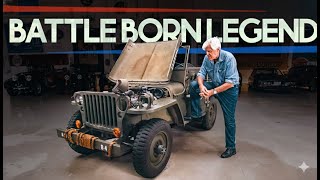

Jeep Off-Road Thrills
45sImmediate action and off-road driving capture attention with visceral excitement and nostalgia.
▶ Play Clip"Title accurately reflects Leno's enthusiastic praise, though 'greatest ever' is subjective."
Jay Leno showcases his 1942 Ford GPW Jeep, a WWII-era vehicle built on a Willys chassis. He highlights its historical significance, rugged design, and enduring appeal as a simple, bulletproof off-road machine.
The 1942 Ford GPW Jeep was based on a Willys design. Ford produced it under government contract, initially using Willys chassis, and eventually stamped their own grills.
After WWII, surplus Jeeps were sold in wooden crates coated with cosmoline for about $100 (equivalent to ~$1,200 today). They were common on farms before becoming collector items.
The Jeep has a 134-135 cubic inch flathead engine, about 60 horsepower, top speed 55 mph (60 downhill). It's designed for off-road terrain, not speed.
Features include fold-down windshield, blackout lights (slit glass to avoid aerial detection), and a machine gun mount. Ford produced about 275,000 units during the war.
Headlight doubles as a work light via wing nut. Fan belt can be loosened to avoid water damage when fording rivers. Mechanical brakes (rods instead of fluid) for durability.
Tires have non-directional tread for quick installation. The vehicle is designed for easy field repairs, with accessible components and a primer cup for direct fuel injection.
Gas tank is under the driver's seat. The engine runs on any octane fuel, emphasizing its ruggedness.
Lightweight (about 2400 lbs), easy to steer, and fun to drive. Mechanical brakes require more foot pressure but are reliable. Top speed around 48 mph comfortable.
Leno notes the Jeep is nearly indestructible, easy to fix, and patina adds character. Current prices range $15,000-$28,000, but cheaper if you find a barn find.
The Ford Jeep remains a beloved classic due to its simplicity, historical significance, and off-road capability. Leno emphasizes its bulletproof design and the joy of driving a piece of history.
What engine does the 1942 Ford GPW Jeep have?
A 134-135 cubic inch flathead engine with about 60 horsepower.
02:36
How many Ford Jeeps were produced during WWII?
About 275,000 units.
03:06
What was the purpose of the blackout lights on the Jeep?
To allow convoy following without being visible from aircraft; the glass is black with a small slit.
03:33
How did the Jeep's headlight double as a work light?
By loosening a wing nut, the headlight comes out and can be used as a portable work light.
04:50
What is the top speed of the Ford Jeep?
About 55 mph, possibly 60 mph downhill.
02:36
Why did Ford use mechanical brakes instead of hydraulic?
Mechanical brakes (rods) are more durable in rough conditions and less likely to fail than hydraulic lines.
09:33
What was the approximate cost of a surplus Jeep after WWII?
About $100, equivalent to roughly $1,200 today.
02:10
How did the fan belt help when fording rivers?
The fan belt could be loosened to stop the fan from throwing water onto the electrical system.
05:23
Wartime Collaboration
Explains how Willys and Ford collaborated under government pressure to mass-produce Jeeps for WWII.
00:45Bulletproof Engine
Highlights the simplicity and reliability of the flathead engine, a key reason for the Jeep's legendary status.
02:36Ingenious Work Light
Demonstrates practical design thinking: headlight doubles as a work light for field repairs.
04:50Indestructible Vehicle
Leno's claim that the Jeep is nearly impossible to break underscores its ruggedness and appeal.
10:15[00:09] road, but all right, here's some dirt. Here we go.
[00:23] This is the way this thing really feels at home. like 10 miles of bad road to get you in the mood.
[00:45] Welcome to episode of JLo's Garage. The car featuring today, my 1942 GPW Ford Jeep. This is based on a Willys design. You know, Henry Ford was a bit of a involved in war, but the government came to him and said, "Listen, we need a lot
[00:58] fast." Willies had the patent for the Jeep and developed it, but they they government needed them because Ford was famous for turning out a car every 15 don't you do this? Why don't you go work
[01:12] have the chassis in time. They could they couldn't do the chassis. Willie still had a bunch of chassis. So in a coming together for the sake of war, Willies gave Ford their chassis. Ford
[01:26] built it their Ford on the Willys chassis. Uh and then eventually they did get their own chassis, but for a while there was a lot of back and forward. Uh things quickly. When you look at the Willys one, it has a a little different
[01:41] grill and each bar is welded in. And Ford just decided, "No, let's just stamp these grills out. And they did that with the whole car. [snorts] These are just wonderful vehicles. You know, when I was 15 or 16, the back of Mechanics
[01:55] Illustrated or Popular Mechanics, even comic books, had these for sale. You'd you know, still packed in the original Cosmoline, World War II leftovers because when the war ended, it just ended and there was stuff being ready to
[02:10] over. Okay, we'll leave it on the dock. and and they would sell these and you would buy the Jeep in a wooden crate covered with cosmoline which is like a they were about a hundred bucks. I mean it was amazing. Now 100 bucks back then
[02:24] it was amazing. Now 100 bucks back then would probably be like 11 or $1,200 now certainly certainly in the 40s and 50s they were all over the place and then one day they just kind of disappeared and then they became collector's items.
[02:36] You know a lot of guys use these as farm vehicles. Oh they're just wonderful. 134 135 cubic inch motor. Flathead, just bulletproof, about 60 horsepower. Top speeds about 55. You might get 60 going downhill, but that's not they were for.
[02:52] just meant to go over terrain. You had into four-wheel drive whenever you wanted. There were so many cool things about these. The windshield folds down. Machine gun would be would be right here
[03:06] and a guy would stand and just fire it. I mean, the the brave guys that that used these during the war, it's pretty amazing. Europe was littered with these. I think Ford made about 275,000 of them and they banged them out, you know, two
[03:20] or three an hour and just put them on the boats and sent them to Normandy Beach and every other place. And a lot of people think this is the vehicle that could move around a lot quicker because there were so many of these jeeps and
[03:33] there and you need help over here, go over there. I mean, it was pretty amazing. Has a lot of the features. The blackout lights like this here. This is a blackout light. The the glass itself is black with a little slit. And there's
[03:46] another blackout light down here. The idea being if you were following a convoy from an airplane, you couldn't see the light because of this, but you because it had the small lights in the back. And that's how how you got around.
[03:59] It wasn't to light up the road. It was just to so people could see you if they we have here? Well, you got your your jerry can back. They called these jerry they didn't want to say you're German, so they called them jerry's. Uh this is
[04:13] a antenna of some sort. You got all kinds of boxes back here for ammo and kinds of boxes back here for ammo and tools. Three-speed transmission. You know, it's it's really the original dune buggy. They're they're really so
[04:26] much fun. When I was a kid growing up in New England, you had a lot of veterans who then were in their 40s and 50s. And they all got these because it reminded of them of their war days. And they're just they're just so much fun to drive.
[04:38] Easy to steer, lightweight. I think this is about 2400 lb. Let me show you the motor on these. This is uh just I'll show you some fascinating
[04:50] ideas that this thing incorporates. This comes up. Okay. As you can see, everything is easily accessible. Now, something that's kind of cool, like you see this headlight here? Well, here you got a wing nut. You loosen that wing nut
[05:07] and then the headlight comes out and you got a work light should the Jeep break them. So, you can light up this whole area to see. There's your fuel pump down there with your glass. Here's your carburetor here. Horn, oil filter.
[05:23] Everything is easily accessible. So you could work on it. And the fan, the cool you're foring a river with this, if or just high water and the fan is spinning, it could throw water all over
[05:36] the electrical system. So you'd loosen that, you'd move the generator forward, you wouldn't get the electrical system all damaged. You push it down again, the belt would tighten, and you go back to driving and cooling. But the idea being
[05:51] bulletproof. And that that was pretty, you know, if you had a fluid system here your brakes. But chances of breaking one of those rods, probably not going to happen. You got a primary cup here on your engine. So you could you open that,
[06:05] you put a little gas in, it sends gas directly to the combustion chamber. So carburetor is clogged or something like that, you know, you got your oil can right here. All kinds of neat things on this vehicle. Fan shroud. You got some
[06:21] rope up there. This had turn signals obviously put on later. Brakes are hydraulic. There's no brake fluid, just a rod to the brake and you takes a lot of foot pressure to stop it. You notice the tread pattern on these tires, which
[06:36] wrong. You can't put on backwards because they they're not really most tires have to go one way or the tread. Whereas these, the idea was out just get the get the tire on there
[06:50] any way you can. And that's really what these are. I think these original tires, this thing, I've had this thing a while. Just wonderful vehicles. Brilliantly simple and just runs in any kind of situation. They they did a lot of hit
[07:04] Rat Patrol because we used to have these in every episode. You know, guys have machine guns on. They never seem to get hit, which was pretty amazing. Uh the rear seat folds down as well. I mentioned the storage units back here.
[07:17] Here you can put a shovel, a pick, whatever. Uh, you've got a a kind of a seat belt that goes here. And the idea is if you It's not really a getting thrown out of the vehicle if you're going around a sharp turn. Gas
[07:33] tank is under the seat. Hey, don't smoke when you drive this under. Hey, you know, put this cigarette. Yeah, be careful. But your gas tank is right under there. And it runs on any o any octane. If you got one octane, believe
[07:46] me, it'll run on this thing. You know, there are an awful lot of Jeep guys that know every bit of minutia and detail about these. I'm sorry I'm not one of them, but I I just I just enjoyed driving it so much. People got a real
[07:59] kick out of seeing it. Not so much now, but when I first got it, they always you a war story, you know, and it's and sadly we we lose about, god, I remember for a while we were losing 1500 World War veterans a day. And I don't know how
[08:13] many of those guys are left. You'd have to be in your late 90s or 100 years old. So, God bless them. But, uh, this is what they protected us with. Pretty amazing. You, it had a top. I don't have the top for it, but uh, yeah, pretty
[08:26] bulletproof. And so many of them were left over in Europe, Frenchmen and Englishmen. They have a huge following over there because we left them behind and they managed to utilize them. And a lot of them been have been preserved,
[08:40] which is really kind of cool. But, uh, let's take a ride. I'll show you what let's take a ride. I'll show you what we're talking about.
[09:04] more fun to drive than these things. You know, they're so light. They're only about 60 horsepower. They're light. They're not that light, but it it feels really light on its feet. I've got it in two wheel drive now. Don't really need
[09:20] four-wheel drive. I keep two wheel drive because that's how you get the highest because that's how you get the highest speed out of it. I think
[09:33] brakes. You have mechanical brakes because obviously they're probably more durable in rough conditions. you know, you you rupture a a brake line and you probably not going to break the rod that goes to the to the brake drum. I'm sure
[09:49] goes to the to the brake drum. I'm sure that's the thinking anyway. bag of, you know, popular mechanics and boys true adventure. I don't know what's
[10:03] going through the magazine. They also have these for sale packed in the have these for sale packed in the original Cosmoline, you know, $100, something like that. And they're pretty bulletproof.
[10:15] This is probably the only vehicle I have that I would valet if I went to a restaurant because the the guy can't break it. There's nothing you can do. You scratch it, nobody's going to notice other than flipping it over and breaking
[10:29] your neck. Yeah, there's not much else can go wrong.
[10:43] just assume you're going a lot faster than you really are. And I said before, you can fold down the windshield, get the full uh wind in your windshield, get the full uh wind in your face with these things.
[10:56] And there's still a ton of these left over in Europe. You know, if you had one of these, a couple of Hershey bars, nylon, lot fewer, too. Just makes you smile driving this thing.
[11:16] It's a classic turbo using all the power all the time. Put that pedal all the way to the floor. Just keep it there.
[11:29] going about 48 miles an hour, which is a comfortable speed. speeding tickets. That's what I love about California. If
[11:42] you're not on the freeway, 5 miles from my garage in the middle of nowhere,
[12:04] Going off road, you feels like you're on road, but All right, here's some dirt. Here we go. Here we go. All right. There we go.
[12:28] Ah, this way. This thing really feels about like 10 miles of bad road to get you in the mood.
[13:01] about these. Uh if you don't know that name, he ran for president about god 30 name, he ran for president about god 30 years ago. Uh nice guy. He was a wounded veteran. He had a bad arm that was kind of permanently sort of incapacitated. He
[13:16] used to carry a hold his hand like this. He couldn't really use the hand, but but he was a real veteran and and and a good guy. Good guy.
[13:36] Motorcycles wave. People in Rolls-Royces wave. People in Mustang. Great. Hey, if you had some experience with these or maybe your dad did and he passed it on to you. Let me know in the comment section. I'm curious to see how
[13:48] many people, you know, these things are still pretty reasonable. I imagine, well, just looking on uh online, you seem to be in looking on uh online, you seem to be in the 15,000 to $28,000 range.
[14:02] yourself, you probably get a lot cheaper than that. I hope you got a kick out of seeing this thing. We didn't go really very far, but
[14:16] you know, they're just so much fun. They're inexpensive, easy to fix. You to wash them. In fact, the more patina you get out, the better it looks. Uh,
[14:28] you get out, the better it looks. Uh, this one is an authentic one from 1942, right? This is built during the heat of battle. And uh yeah, I'm sure there's a lot of history with this thing. Anyway, listen, hey, thanks for checking us out
[14:44] and uh we'll see you next week with something.
⚡ Saved you 0h 14m reading this? Transcribe any YouTube video for free — no signup needed.