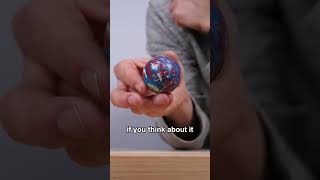

Why Bouncy Balls Bounce Back Weirdly
45sThis segment explains a common, relatable frustration with a surprising physics twist, making viewers curious about the science behind it.
▶ Play Clip"The title promises a physics explanation and delivers exactly that—concise, accurate, and engaging."
The video explains the physics behind why it's difficult to bounce a ball under a table, focusing on the role of spin imparted by surfaces. It breaks down how angular momentum and friction cause the ball to reverse direction, making the second bounce unpredictable.
The ball wants to bounce back the same way it came in, making it hard to pass under a table.
The ground imparts spin on the ball during the first bounce, causing the second bounce to be weird and unexpected.
A wall swiping a stationary ball makes it spin; when the spinning ball hits the underside of a table, it has backspin.
Backspin causes the ball to come back in the direction of the spin, as seen in slow motion.
Angular momentum makes the ball want to keep spinning; friction forces it to roll during collision, reversing its direction.
The final bounce is predictable, but the bounce that sends the ball back out is the interesting one.
What causes the second bounce of a bouncy ball to be unpredictable?
The ground imparts spin onto the ball during the first bounce.
00:12
What happens when a ball with backspin hits a surface?
Backspin causes the ball to come back in the direction of the spin.
00:42
Why does a spinning ball reverse direction when hitting a surface?
The ball has angular momentum and friction causes it to roll during the collision.
00:56
Spin from the first bounce
Explains a common observation (unpredictable second bounce) with a simple physical cause.
00:12Backspin behavior
Connects a familiar sports concept (backspin) to a general principle of motion.
00:42Angular momentum and friction
Provides a clear, intuitive explanation of a core physics concept using a relatable example.
00:56[00:02] мячик под столом. Мяч всегда стремится отскочить в том же направлении, в котором прилетел , что довольно странно. Итак, предположим, что мяч вообще не вращается, когда впервые ударяется о землю, но когда он ударяется о землю, земля придает мячу некоторое вращение
[00:16] понятно. И на самом деле, это то, с чем вы знакомы по повседневной жизни. Например, второй отскок прыгающего мячика часто бывает странным и неожиданным. Это происходит мяч получил с первого отскока. Если у вас есть неподвижный мяч,
[00:31] его, мяч, естественно, начнет вращаться. Но посмотрите, что происходит, когда вращающийся шар ударяется о нижнюю часть стола. У мяча есть обратное вращение, а вы по опыту знаете, что происходит, когда мяч с обратным вращением ударяется о поверхность.
[00:45] Оно возвращается в направлении вращения. И это кажется вполне логичным. Если мяч, приближающийся к поверхности моментом. Иными словами, оно стремится продолжать вращаться, когда касается
[00:58] поверхности. Но из-за трения ему придётся перевернуться во время столкновения. В результате мяч возвращается тем же путем, которым прилетел. И действительно, удар снизу стола приводит к тому, что мяч начинает медленно вращаться в
[01:10] противоположном направлении. Финальный отскок довольно скучный и предсказуемый, но именно он it's the bounce that takes the ball back out again.


⚡ Saved you 0h 01m reading this? Transcribe any YouTube video for free — no signup needed.