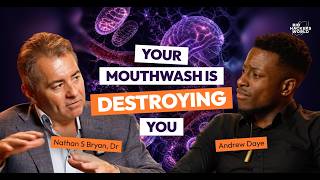

The Shocking Truth About Nitric Oxide Decline
60sReveals the alarming statistic that nitric oxide production drops by 50% by age 40-50, sparking curiosity and concern.
▶ Play Clip"The title promises a breakdown of nitric oxide's impact, and the transcript delivers exactly that with detailed explanations and practical advice."
In this interview, Dr. Brian discusses the critical role of nitric oxide in overall health and performance. He explains how this simple molecule affects the mind and body, the factors that deplete it, and practical ways to maintain optimal levels.
Nitric oxide is foundational for optimal body performance, longevity, and disease-free living.
High sugar diets lead to vascular dysfunction by glycating enzymes like nitric oxide synthase, reducing nitric oxide production.
Intermittent fasting (18-hour daily fast) improved body composition, energy, and metabolic flexibility at no cost.
Nitric oxide production declines 10-12% per decade, and habits like mouthwash, fluoride toothpaste, and antacids can further reduce it by 50%.
Nasal breathing and humming (15-fold increase) boost nitric oxide production.
Nitric oxide is a hormone; supplementation can provide benefits regardless of age or lifestyle.
Most beet powders are ineffective due to processing that removes active nutrients; oral microbiome and stomach acid are crucial for conversion.
Nitric oxide is vital for brain health, preventing cognitive decline and Alzheimer's by regulating blood flow and glucose uptake.
What is the average rate of nitric oxide decline per decade?
About 10-12% per decade, leading to about 50% of youthful production by age 40-50.
03:18
What common habits can reduce nitric oxide production by up to 50%?
Fluoride toothpaste, antiseptic mouthwash, and antacids can eliminate up to 50% of nitric oxide production.
03:44
What simple activity can boost nitric oxide by 15-fold?
Humming can increase nitric oxide production by about 15-fold.
04:59
How is nitric oxide classified, and how can it be supplemented?
Nitric oxide is a hormone, similar to testosterone or estrogen, and can be supplemented directly if the body cannot produce enough.
08:46
Why are most beet powders ineffective for boosting nitric oxide?
Most beet powders are 'dead' products with no nitric oxide activity due to processing that removes water-soluble nutrients.
11:24
How does nitric oxide affect brain health and cognitive decline?
Nitric oxide regulates blood flow, glucose uptake, and prevents insulin resistance in the brain, which is linked to Alzheimer's as 'diabetes type 3'.
13:30
Nitric oxide decline with age
Quantifies the average loss of nitric oxide production per decade, providing a clear benchmark for understanding age-related decline.
03:18Habits that halve nitric oxide
Reveals that common habits like using mouthwash or antacids can cut nitric oxide production by 50%, which is surprising and actionable.
03:44Humming boosts nitric oxide 15-fold
Offers a simple, cost-free technique with a dramatic effect, making it a practical biohack for anyone.
04:59Nitric oxide is a hormone
Challenges conventional understanding by classifying nitric oxide as a hormone, which has implications for supplementation and treatment.
08:46Most beet powders are ineffective
Exposes a common misconception in the supplement industry, saving consumers from wasting money on ineffective products.
11:24[00:00] Biohackers are about first, we, not giving to you, genetics, energy, community, technology, bio, bio, bio, bio, bio, bio, biohackers world podcast. Welcome everyone, this is Andrew Day, we are here at Biohackers Conference New York, and today we are going to be speaking about the topic of,
[00:18] a lot of people think that performance begins in the mind, whether it's mindset, whether it's influencing the brain, other people believe it starts in the body, at a molecular level. So today we have an amazing nitric oxide researcher, entrepreneur who's been in this space for over 25 years,
[00:34] who has a really great breakdown of how this simple molecule has such a complex breakdown of how it impacts the mind, the body, whether you're an athlete, entrepreneur, etc. So help me in welcoming Dr. Brian.
[00:46] Thank you. Thanks for having me. It's my pleasure. I want to start this off super quick, rapid fire. What would you say is one key biohack that you think no one should be living without? Well, it's certainly nitrocoxibone. I mean, I have a very strong personal bias on that,
[00:59] but I think that bias is corroborated by both the basic science and the clinical data because your body cannot perform optimally where everything we know about longevity and living a healthier, longer, better life, free of disease is dependent upon adequate nitrocoxibone production.
[01:12] So nitrocoxibone is foundational. And people who want to live healthier lives, whether mentally and physically, what do you think is one of the biggest hindrances of that lifestyle? I think it's sugar, and I think it's diet, because everything we know about chronic disease and diet is, you know, related to vascular
[01:28] dysfunction. And what we're finding is that people who eat a high-carbohydrate, high-sugar diet, leads to an increase in blood sugar, and then that sugar sticks to proteins, right? It sticks to hemoglobin. We call that hemoglobin A1C. It also sticks to enzymes and locks them in a conformational change, and one of those
[01:43] is nitric oxide synthase. And when you do that, you can't make nitric oxide. That leads to decreased blood flow, increase in blood pressure, sexual dysfunction, insulin resistance, metabolic disease, and eventually Alzheimer's. And what would you say is your biggest hot take in the biohackers space?
[01:59] You know, for me, I think it's intermittent fasting and course restriction. You know, I started doing an 18-hour fast every day for the past probably four to five years. And for me, I think I'm always trying new things, like how can I optimize my own health
[02:11] and performance? And I think that's been the biggest bang for the buck for me. I saw my body composition change. I saw my energy levels improved 100 pence per way. and it just really changed my entire what we call metabolic flexibility.
[02:24] Improved my nitroxide production, really all that fixed performance. And that's something that's cost-saving. You know, we can get really sophisticated, especially introducing all these biohacks. Some are really expensive and some are cost-saving.
[02:37] But intermittent fasting for me is kind of the biggest biohack out there that anybody can practice and it doesn't cost anything. For the average person at home who's interested in their own health, is there a time in your lifetime where it starts to decline or is it always on the right?
[02:51] Tell me about the life cycle of nitric oxide. Well, first we have to understand how the human body makes it and then once we figure out how the human body makes it, then we can start to figure out what leads to loss of its natural production. So we have to separate them because there's an enzyme founding a lining of the blood vessels
[03:06] and typically the data show the older we get, the less functional that enzyme becomes. And it can start in our 20s or we could delay it until our 30s, 40s, and 50s. So we know how to modulate the function of this enzyme.
[03:18] But if you look at the clinical data that's published, on average, the general population lose about 10 to 12 percent per decade. So by the time we're between 40 and 50 years old, we have about 50 percent of the nitropoxide
[03:30] being produced as we did when we were younger. So that's one pathway. The other pathway is dependent upon the food we eat, the bacteria in our body, and stomach acid production. So what that means is you could be 15, 16, 18, 20 years old taking antacids and completely
[03:44] shutting down 50% of your nitric oxide production. Or you could be using fluoride toothpaste or antiseptic mouthwash and eliminate 50% of your body ability to produce nitric oxide So now if you practice those oral hygienic processes like use fluoride toothpaste use mouthwash use antacids and in the order you get the less nitric oxide you making from the enzyme in the lining of the blood
[04:06] vessels, then by the time you're 40 or 50 years old you have maybe 10% of the nitric oxide production. By the time you're 60, 70 you have less than 5%. So all of these variables weigh and mean something. So that's why it's important that people
[04:20] understand the importance of maintaining good endothelial function and and maintaining a good, healthy oral microbiome, eating a balanced diet in moderation, getting good moderate physical exercise, sunlight exposure, nasal breathing, deep breathing exercises,
[04:34] because all that has been shown to improve micro-oxidant production. I want to actually, as you bring up the nasal breathing, I practice from a best-worth mental performance coach, and I can't even tell you how many times I tell people the importance of nasal breathing.
[04:47] People are like, oh, I know how to breathe. Don't tell me how to breathe. but I'm not sure there's so much value with actually sitting down with that. For example, a lot more nitric oxide production, humming improved nitric oxide by about 15-fold.
[04:59] Could you walk me through a little bit of insights of how breathing does naturally impact nitric oxide? Well, there's an enzyme, nitric oxide synthase, that's found in the lining of the blood vessels in our endothelial cells. But the highest concentration of that enzyme is actually in our epithelial cells, in the upper climaces.
[05:14] So when we do nasal breathing, there's mechanoreceptors that turn on nitric oxide production. So if this enzyme is coupled and functional, every time we do nasal breathing or deep breathing, it's producing nitric oxide, delivering it into our lower airways,
[05:27] dilating the bronchioles, dilating the pulmonary arteries. So we're getting better oxygenation. We're matching ventilation to perfusion. So that's the importance of nasal breathing. The problem is when mouth breathers who don't know because they have maybe had an obstruction
[05:40] or an anatomical issue or a small mouth, then they're forced to breathe through their mouth. And now you're not only bypassing the microcluster production pathways, but you're completely changing the ecology of the oral microbiome
[05:54] and creating an environment which is conducive to cavities, bad breath, complete dysbiosis. So it's one of the most important things you can do is, you know, I see people all the time flying on a plane or walking around,
[06:06] and their mouth is open, they're breathing through their mouth, and I'm going, you don't know, that's probably the worst thing you can do. So we have to teach people, we have to remind people how to breathe. the mouth is part of our digestive system it's not part of our respiratory system
[06:18] and it should be used as such so it's the survival mechanism if you want to stay in survival then keep no breathing yes and you cannot thrive by doing this if you were to someone doesn't even know the value of nitric oxide if you can come up with
[06:30] like just quick bullet points of like what benefits come from really upregulating nitric oxide well it's better blood flow better circulation better performance and when we talk about performance it could be sexual performance it could be cognitive performance it could be physical performance
[06:42] but in order for the human body to optimize its performance you gotta have a blood supply you gotta have oxygen delivery you gotta have to be able to divide a country where you guys convert convert the oxygen into cellular energy and all that's controlled by microplexing
[06:55] i was listening to your talk earlier today and i took a note because i'm like this is so fascinating to me the side note of it is i realized that there's a lot of mechanisms that when used in tandem with biohacking start to really yield its fruits. And you mentioned that the amount
[07:12] of nitric oxide in the body will help the stimulation of mitochondrial biogenesis. How does nitric oxide help with existing biohacks that people use? Well, I think nitric oxide is foundational. So just talking on mitochondrial biogenesis,
[07:27] the cell has to be able to make nitric oxide. So the cell always responds to the environment. So if we do intermittent fasting, caloric restriction, physical exercise, that's an adaptive response that the cell makes. And so it turns on PGC1-alpha to induce mitochondrial biogenesis.
[07:42] But that nitric oxide is actually upstream of that. So if your body can't make nitric oxide, you don't get mitochondrial biogenesis from exercise, from intermittent fasting, caloric restriction. So we have to understand these signal transduction pathways So once we normalize cellular nitric oxide production the exercise is going to get a better adaptive response If you using hyperbaric oxygen you going to get a better clinical outcome
[08:05] If you use red light therapy, if you practice nasal breathing, all these biohacks that you do, you can improve the efficiency and the outcome of those if you first normalize microchip production. So through your research, what have you created to help with,
[08:19] because again, I'm assuming there's a lot of people that have A, hit those age brackets where they're already losing nitric oxide, have lifestyles where they're getting reduced nitric oxide. What is your approach? How have you allowed people to now have more access to nitric oxide?
[08:34] Well, we create nitric oxide product technology that actually produces nitric oxide gas. And this was based upon my discoveries in 2007. We published a paper showing that nitric oxide is actually a hormone.
[08:46] So similar to testosterone in men or women, if a man is low in testosterone, we give you testosterone. Right? We don't give you DHA or pregnenolone. Same thing with estrogen. We give you the SMR to your mission.
[08:58] If your body can't make it, we provide it for you. So it's not a situation where someone's like, okay, I'm 50 years old and I haven't been living a healthy lifestyle. They can still begin to get some benefits regardless
[09:10] of... For sure. I think there's only two people in the world who need my micro-coctain. It's people who are healthy and don't want to get sick, and it's people who are sick and want to get healthy. So if you follow in one of those two, you're going to get benefit from it.
[09:23] Because I've been taking my nitric oxide for probably more than 25 years now. Early proto-toxin. And I'm 52 now, but I take it not because I need it, I take it because I don't want to need it. Because the world we live in is toxic.
[09:37] We're exposed to 5G, environmental toxins, food depleted of most nutrients, food that's contaminated with herbicides and stuff. So the world we live in is continuously derating or decreasing our ability to naturally produce nitric oxide.
[09:50] So we need a daily nitric oxide support, like we need maybe a daily vitamin C or vitamin D or other nutrients because the world we live in is compromising our body's ability to make it on its own. So I'm around a lot of athletes just by trade,
[10:05] and as you probably realize, a lot of people are eating powders and beetroot juice and pomegranate and all that kind of stuff. What is your take on that? Is it useful, partially useful, unuseful, or better mechanisms that would influence what they're looking for?
[10:18] Now, look, it's mostly not useful at all because the companies who are spending tens of millions of dollars on advertising on TV are producing a beet powder that doesn't produce any nitric oxide.
[10:30] And this field started with good intent because there were some really good clinical studies showing that through the nitrate-standardized beet juice that when consumed, that if metabolized into nitrite by the oral bacteria, then it could improve exercise performance, normalize blood pressure.
[10:46] That's how the field started. So then when these studies were published, a lot of these companies out there would go, oh, I can sell beet juice now, or I can sell beet powder. So then they were just buying desiccated beet powder,
[10:58] putting it in a capsule or tub, and calling it nitric oxide. But this is where people, consumers, and even companies don't understand. How do you take beet from the soil and make a beet powder out of it? There's a process, right?
[11:11] So the beet depends upon the soil conditions. How much nitrogen is in the soil? Is it actually having nitrate in it? Then number two, when you take a high-bricks concentrate and make a deep powder out of it, it goes through high heat, high pressure to make a powder.
[11:24] And most of these are water-soluble nutrients, so they come out in the drying process. So what you're left with is a dead beef product. We can provide no nitric oxide benefit. And that's what 99% of the products on the market are.
[11:38] It's dead beef. There's no nitric oxide activity whatsoever. And how do I know? Because I've tested every single deep product on the market. it's a long way to get the Bs to nitric oxide because number one you have to have nitrate
[11:50] which most don't number two you must have the right oral bacteria to metabolize it 9 out of 10 Americans 99 Americans are using fluoride toothpaste 2 out of 3 Americans use antiseptic mouthwash 3 out of 4 Americans are on antacids.
[12:03] So all of these, even if you're taking a beet powder that has nitrate in it, you're disrupting its metabolism into nitric oxide. Interesting. Okay, so let me see if I'm getting this clear. Yeah, there's a lot going on there. Yeah, no, I love it.
[12:15] I want to unpack from the experts a little. No. So even if you are getting more nitric oxide or nitrates, you still have to ensure that your gut health and microbiota... It's the oral health. It's your oral microbiome.
[12:27] Because when we consume nitrate in the form of vegetables or even the nitrate that's produced endogenous from the oxidation of nitric oxide, it's concentrated in our salivary glands. So now each time we salivate, there's nitrate in the saliva.
[12:40] So then these bacteria, if you have the good bacteria, they perform this two-electron reduction of nitrate to nitrite. So now our saliva is enriched in nitrite. Then we swallow our saliva. As long as it's stomach acid, we get nitric oxide produced in the stomach.
[12:53] Gotcha. You must have the right foods. You must have the right oral bacteria. And you must have sufficient stomach acid production. So it's completely shutting down every step of nitric oxide production. And we wonder why people have high blood pressure. 93% of Americans are metabolically unfit.
[13:06] They're obese. And Americans are unhealthy. And to me, it's no wonder. I know exactly why Americans are unhealthy. so this is lack of my knowledge here semen which is a lot of body based benefits are there any
[13:18] brain based benefits when it comes to nitric oxide as well for sure you know the brain operates it's the most metabolically active organ so when we develop mild cognitive disorders or mild cognitive impairment NCI
[13:30] then dementia then Alzheimer's there's a progression of disease so it's a vascular metabolic disease so we need to get glucose into the cells it's dependent upon microplastic we've got to regulate blood flow to the brain that's dependent upon nitric oxide.
[13:44] So if you make adequate nitric oxide, you're a high performer. You can have good memory recall. Your executive performance is unlike any other. But then when you start to lose the ability to make nitric oxide,
[13:56] you start to become challenged, right? You lose your memory. You may not be as sharp as you used to be. You develop insulin resistance in the brain. It's called diabetes type 3. And then you lose regulation of blood flow, and you can't perfuse certain regions of the brain.
[14:08] There's focal ischemia, and that's the onset of neurological disease. so it can all be traced back to insufficient nitric oxide production. Oh my gosh. I thought, transparently, I thought it was again a very body-based mechanism
[14:21] but it's literally the whole being is involved. You've got to look at the human body as a system and then you've got to look at individual organ systems and then the tissue and then cellular level and then even subcellular. We've got to improve
[14:33] oxygen delivery, which is dependent upon nitric oxide, not just on the regulation of hemoglobin delivery of oxygen, but dilating the blood vessels so you can actually deliver the cargo to the cells, and then it's activating our stem cells so we can repair and replace dysfunctional
[14:48] cells, preventing the end of our telomeres from getting shorter. And so everything we know about subcellular energetics to organ perfusion to organ function to the performance of the intact human is dependent upon oxygen delivery, ATP production,
[15:04] and good circulation. Now, I want to leave you with one question here, which is, if you had a loudspeaker to speak to every single human on Earth right now, what would be the one message? And hopefully everyone could listen to it.
[15:17] What would be that one message? Well, you have to understand what nitric oxide is in your human body, in your own body, because it may be contributing to your disease, but it could also be the solution to your issue. And so if you don't know what nitric oxide is and you don't know how your body is producing it
[15:31] or what you may be doing to inhibit its production, then it's a problem. And it may be the reason why you're sick and tired of being sick and tired is that no doctor or healthcare practitioners have been able to figure you out. Wow. Metric oxide may be the cause, but also the solution.
[15:45] Wow. Thank you so much, Dr. Matt. I am now going to do even more research on metric oxide and even have some more table talk conversations with you about this. Thank you. Thank you so much. Thank you. It was a pleasure.


⚡ Saved you 0h 15m reading this? Transcribe any YouTube video for free — no signup needed.