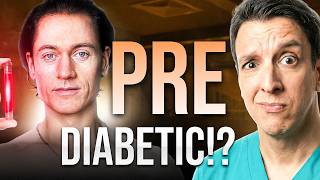

His Fasting Glucose Is Pre-Diabetic?!
46sSurprising that a health fanatic has a pre-diabetes marker, challenging assumptions about optimal health.
▶ Play Clip"Accurate title: doctor genuinely reacts and provides detailed analysis of the blood work, neither overselling nor misleading."
A medical doctor analyzes Bryan Johnson's publicly shared blood work, highlighting both impressive biomarkers and concerning outliers. The doctor questions the value of expensive interventions when basic lifestyle factors may explain most of the results.
Fasting glucose of 103 mg/dL is technically in the pre-diabetes range.
Bryan Johnson calls it maybe the best comprehensive biomarkers ever measured, but the doctor suggests skepticism.
Epigenetic clocks measure DNA methylation but can be misleading due to supplements affecting methylation.
Blood work shows very low visceral fat and intra-hepatic fat, which is good.
Fasting glucose 103 is high, but A1C of 5% is great; A1C is more reliable as an average.
Intense workouts or supplements may cause elevated fasting glucose.
CRP and TNF-alpha are very low, reducing heart disease risk.
Total cholesterol 100, LDL 35, triglycerides 42; attributed to lipid-lowering medication (Repatha).
He is on evolocumab (Repatha) which lowers LDL. Previously on ezetimibe.
With low baseline risk, adding medication provides marginal benefit; personal choice but not widely recommended.
Going from ApoB 80-90 to 52 reduces risk from very low to even lower; valid if side effects absent.
Vitamin D high from supplements; ferritin low indicating need for iron adjustment.
Ox-LDL and ApoA1 tests provide little additional information.
Taken as longevity intervention, but evidence in healthy individuals is weak.
Many expensive interventions lack compelling evidence; basic lifestyle may be sufficient.
While Bryan Johnson's blood work shows many excellent markers, the doctor argues that his expensive interventions may not provide additional benefit beyond a healthy diet, exercise, and sleep.
What is Bryan Johnson's fasting glucose level?
103 mg/dL
What is the name of the PCSK9 inhibitor Bryan Johnson takes?
Repatha (evolocumab)
06:24
Why might epigenetic clocks be unreliable?
Supplements can affect methylation without changing true aging rate.
01:01
What is Bryan Johnson's A1C level?
5%
02:20
What medication does he take that is usually for diabetes but he uses for longevity?
Jardiance (SGLT2 inhibitor)
12:42
Which of his biomarkers are considered unnecessary tests?
Ox-LDL and ApoA1
12:14
What is the doctor's overall conclusion about Bryan Johnson's expensive interventions?
Many lack compelling evidence; basic lifestyle may be enough.
13:30
Pre-diabetic fasting glucose
High fasting glucose despite low A1C shows complexity of glucose regulation.
Use of PCSK9 inhibitor
Aggressive lipid lowering in low-risk individual is controversial.
06:24Marginal benefit of medication
Reducing already low risk may not justify cost and side effects.
07:38SGLT2 inhibitor for longevity
Using diabetes drug for longevity in healthy person is experimental.
12:42Lack of evidence for expensive protocols
Emphasizes that expensive doesn't mean effective for longevity.
13:30[00:00] This is technically in the pre-diabetes range. Wow. That's a reason to take it as a human? Not something that would be widely recommended to everyone because... Bryan Johnson spends millions of dollars every year trying to reverse aging and dodge death. He shared his complete blood work on
[00:17] social media and he called it "maybe the best comprehensive biomarkers ever measured". Pretty bold, but a number of people had concerns. So, we're going to take a look, see what we can learn. Now, this is 14 pages long of blood work. So, we're going to look at the main things and we're
[00:31] mainly going to focus on the values that are not normal, that are outside of the normal range. So, he has some markers on here that he calls speed of aging. I think these are epigenetic clocks. They measure DNA methylation essentially. And the language he has on here is pretty hyperbolic. So,
[00:48] these metrics are pretty tricky. They do correlate with disease and death statistically, at population level. But we don't really know how reliable these things are. Whether these things actually measure rate of aging, how specific they are is a bit up in the air.
[01:01] So if I start taking a pill like a supplement that affects my methylation machinery so that there's more or less methylation, but my rate of aging hasn't changed, my decline hasn't changed,
[01:14] these clocks will still be misled, and it'll look like I'm aging faster or slower, but that might be an artifact. So I think we want to take these with a grain of salt. There isn't that much validation. The other thing is there's some evidence that weight loss itself makes these clocks look
[01:29] better. And Bryan Johnson is very lean for his age. He's what, mid to late 40s, maybe early 50s, something like that. Very unusual for a Westerner to be this lean at that age. That's good, of course, but I don't know if all these expensive machines and expensive drugs that he takes and all these
[01:44] millions of dollars are actually providing any benefit on top of just eating a healthy diet, exercising, being lean, and keeping all your basic metrics in the normal range. Now, the blood work shows he has very low visceral fat and liver fat, so intra-hepatic fat, which is good.
[02:02] Hemoglobin A1C, 5%, which is great. Insulin, this is fasting insulin, I'm assuming, 2.8, which is extremely low. This all tracks with low body fat and it's good news. Now fasting glucose is 103 which is a little surprising because 103, this is technically in the pre-diabetes range.
[02:20] That's if that's reproducible, right, bunch of measurements, does he always get similar values. Normal fasting glucose is under 100. That's milligrams per deciliter. So this is one caveat
[02:32] of looking at blood work in one point in time. You want to look at things in context. Is this a significant change from before? Because if it's a one-off, maybe it's a lab error or something like that. But if this is his normal, then it's interesting. And it's a little surprising because
[02:48] his A1C is very low. 5% is a great A1C, but then the fasting glucose is a little high. What does that suggest? If these metrics are indeed validated, it would suggest that his fasting
[03:03] glucose is a little higher than normal, but then post prandially the rest of the time there isn't that much elevation. So that overall the average, which is what A1C represents, is still pretty low. And we should also say for fairness that A1C is a more reliable measure because it's the average of
[03:21] so many measurements. So I would give more weight to the A1C than the fasting glucose everything else being equal. Okay, that said, why would the fasting glucose be a little high in a guy who's so lean and exercises so much? One question I would have is, is he completely fasted? If you've had
[03:38] any food to eat, then this is a completely normal postprandial glucose. Another possibility is very intense workouts can cause the release of stress hormones and those can cause fasting glucose to go
[03:50] up a bit. So, that's one possibility. if he worked out a lot in the morning before getting this blood measurement. Although cortisol levels are normal, so that lowers that possibility. Normally, if
[04:02] you see elevated fasting glucose, the most common thing in Westerners is excess fat mass, especially around the organs and inside the organs like the liver. Liver insulin resistance leading to this
[04:15] elevation in the morning. It's not necessarily something you ate the day before. It's more the liver overproducing glucose, but his visceral fat and intrahepatic fat are quite low. So
[04:27] that's unlikely to be the case. Also, he's famous for taking like a hundred supplements every day, like a pile of pills, right? So, it's entirely possible that one or more of those supplements or a combination have this effect, raise glucose a bit. Okay, moving on. Inflammatory markers like
[04:44] C reactive protein, tumor necrosis factor alpha, those are very low, which is great, good sign, lowers risk of heart disease. And that also goes hand in hand with leanness. Leaner people have
[04:57] lower inflammatory markers. More overweight people tend to have them higher. Blood pressure is great, 11 over 7, completely normal. Calcium score, zero. That's good. You want to see a zero. Although at
[05:11] this relatively young age, in your 40s, I'm guessing he's mid to late 40s. Yeah, it says he's I think 48. He's exactly my age. So yeah, in this age, it's normal to have a calcium score of zero. Even in western populations, most people in their 40s still have a calcium score of zero, even
[05:28] though heart disease is the number one cause of death. So that means that a number of people that have a calcium score of zero go on to have heart disease problems and even die of it. So, at these relatively young ages, it's good, It's better than if the calcium score was higher, but we
[05:44] take that with a grain of salt. It's not a get out of jail free card, let's put it that way. Does not mean that in the future you're not going to have problems or that the calcium score is not going to go up later in life. They even have a name for that. They call it conversion. Someone has a
[05:57] calcium score of zero in their 30s or 40s and then later in life it becomes non zero. Okay. Okay, lipid panel. Total cholesterol 100, LDL 35. Okay, these are super low. He's probably on a statin.
[06:10] He's probably on lipid lowering medication, almost for sure. ApoB 52. Yeah, he's on some lipid lowering meds. Some people have genetic variants where they have these very low lipids, but it's
[06:24] unusual. Triglycerides 42. Very low. Good. Lp(a) normal. That's good. Okay. He does write down here he's on Repatha. So that's evolocumab. It's a PCSK9 inhibitor. So it is a lipid-lowering
[06:38] medication. Same general end result as statins. The mechanism of action is a little different, but at the end of the day, very similar to statin. He says he used to be on zetia. That's ezetimibe.
[06:50] It's another class of these lipid-lowering drugs. But now he's on repatha. So he switched. Okay. That explains the very low lipids. The repatha does. It's slamming his apoB and LDL. Yeah. Repatha unlike statins usually does not raise glucose levels. Statins can have that effect in
[07:08] some people. Others don't see that, but Repatha usually does not. It has been reported a very small percentage of people. So it's not impossible that his slightly elevated fasting glucose is
[07:21] being caused by the evolocumab. But I think it's unlikely. Okay, this is a little controversial right? So we have a healthy individual, normal lp(a), blood pressure low, very lean. I don't know exactly what his ApoB was prior to all of this, but if it's 50 now, 52, it probably wasn't
[07:38] sky-high. It probably was 80 or 90, which is a pretty decent ApoB for a healthy individual. So, he had a quite low risk of heart disease, and yet he's on lipid lowering meds. It's a bit
[07:50] controversial. So, is this a good idea? I think it's a valid personal choice. It's not something that would be widely recommended to everyone because medication has some drawbacks. One
[08:02] is cost, obviously. Two, potential side effects. Some people, a percentage of people on each med, any med, are going to experience side effects. So you wouldn't recommend medication for everyone
[08:15] with these metrics in his position because you're going to create some side effects and it's going to have a monetary cost associated when the benefit is extremely small because the risk is very small to begin with. So the reduction there is marginal. Now here obviously he doesn't care
[08:31] about the cost, it's not a problem for him, and assuming he doesn't have side effects then it's a personal choice to go for it. The difference in the ApoB from 80 or 90 to 52 with all the other
[08:44] metrics so under control means that you go from a very low risk of heart disease to an even lower, it's a small absolute difference, but I guess if you're trying to slam everything to near zero,
[08:59] it's a valid personal approach. This basically means with a very low ApoB of 50, low blood pressure, low body fat, low lp(a), means his risk is so low that either there's no plaque growing
[09:13] or if there is plaque growing, it's so slow, it's not going to be a problem in his lifetime. people ask about these lipid lowering meds like statins and these other classes are hormones.
[09:28] Does that impair your ability to produce hormones and brain function, cognitive function? Hormones are not a problem for most people because your glands can produce their own cholesterol. So lowering cholesterol in the serum is not an issue, if the glands that produce hormones
[09:44] need some extra cholesterol for some reason they can get it from HDL particles in the blood. So this is usually not a problem. And in fact, his hormones, testosterone, thyroid hormones, all in the normal range. The brain also produces its own cholesterolm doesn't get it in any meaningful
[09:59] amount from the blood. So reducing serum levels of cholesterol is not a problem for the brain. Now some of these drugs can penetrate into the brain and lower cholesterol production there. But the
[10:11] evidence we have doesn't point to any cognitive deficit. If anything, they suggest a benefit. We have more studies for statins than for these other drugs. But in general, we actually see, if anything, lower risks of dementia and Alzheimer's in people on statins versus people without in
[10:27] long-term studies that are observational, so some caveats, but if anything, that's the direction of the signal. For Repatha, this evolucumab he´s on, we have trials, randomized trials specifically
[10:39] looking at cognitive ability. Now, they're shorter duration, I think it's a couple of years, they don't see a deficit. So, at least over that time scale, doesn't seem to be a problem. Okay,
[10:51] moving on. His vitamin D is super high. He's taking supplements, I'm guessing, especially because I think he's on a plant-based diet, either vegan or close to that. And so, he's almost certainly taking a supplement. And finally, his ferritin is actually low. A little surprising.
[11:06] Ferritin reflects iron storage. I wonder if that's from his diet, he's not getting enough iron. Oh, it says here he is supplementing iron and he had lowered the dose and now is going to increase given this ferritin level. Yeah, iron is something you can get plenty from the diet. Even vegetarians
[11:22] and vegans if you plan it accordingly, lots of vegetable sources of iron. Now, it is a different type of iron. In animal foods you have both heme and non-heme. In plants you only have non-heme and the absorption of non-heme is more regulated. The absorption of heme iron is
[11:38] more passive. So sometimes you absorb a little bit less iron from the plant sources. There are tricks to get around that like vitamin C, having some vitamin C, having like some lemon on legumes or whatever plant source of iron you're eating or having some orange for dessert, that boosts
[11:55] non-heme iron absorption a lot. Actually, also coffee and tea, they contain some compounds like tannins that inhibit non-heme iron absorption. So having the coffee and the tea away from meals like before or after, like an hour apart from your main meals is another trick to optimize non-heme
[12:14] iron absorption. Now there is a lot of tests here that are unnecessary, that don't give us that much information clinically. Ox-LDL, this doesn't tell us much when you already have a basic lipid panel
[12:26] and kind of lipid and lipoprotein measurements. ApoA1, that's another one that doesn't tell us that much because it's not really causal for anything. Anyway, he's got a bunch of tests here that tell us very little. So, these are kind of a waste of money, but again, I guess he doesn't
[12:42] care. I don't know how much he's paying for all these blood tests. Can't imagine it's cheap. Oh, and he's on an SGLT2 inhibitor, Jardiance. So, this is a diabetes drug. It's usually given to people with diabetes and it tends to lower blood sugar levels which is interesting because his
[12:57] fasting glucose is actually a little high. He says the reason he takes that is there's good evidence as a longevity intervention and caloric restriction mimetic from animal experimentation. Wow. That's a reason to take it as a human? Yeah I haven't seen any compelling evidence that this is
[13:13] beneficial in a healthy individual without glucose issues. I don't know exactly why he's taking it, this rationale that he typed on there seems a little weak. So overall, a lot of this stuff, and this is my general impression of him and his programs and all of this adventure he's on,
[13:30] a lot of this stuff is random, very experimental. Some things have strong bases like controlling blood pressure, body fat, exercising a lot, healthy diet, ApoB. Obviously, those things are important. A lot of the other stuff and honestly the more expensive stuff, all the stuff
[13:46] that costs millions, the expensive machines and the hundreds of supplements, a lot of that stuff doesn't have compelling evidence behind it. And some of the prescription drugs he's taking also, is that going to provide any benefit? Who knows? In general, is he going to be any better off
[14:02] because of all the fancy expensive stuff than if he just had the healthy lifestyle, healthy diet, exercise, good quality sleep? I haven't seen any compelling evidence of that. We recently covered
[14:15] everything we know about lifespan extending drugs and all the hype, including the metformin and the rapamyin and all that. So, check it out, this video right here, and I'll see you in there.




⚡ Saved you 0h 14m reading this? Transcribe any YouTube video for free — no signup needed.