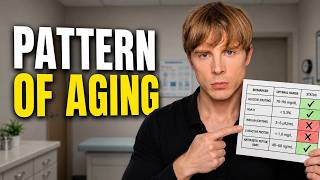

The 5 Bloodwork Patterns That Reveal Your True Health
45sThe promise of uncovering hidden health patterns from 500+ blood tests is intriguing and educational, appealing to viewers' curiosity about their own health.
▶ Play Clip"Delivers on the promise of revealing bloodwork patterns, but the title oversells 'matters'—it's more of a general overview than a deep dive."
The video analyzes over 500 blood tests to identify common patterns in bloodwork, revealing that most people fall into recognizable categories that indicate their metabolic health, biological age, and disease risk. It emphasizes the importance of combining bloodwork with functional tests and focusing on optimal ranges rather than just normal ones.
The speaker has analyzed over 500 blood tests and noticed repeatable patterns that reveal metabolism, biological age, inflammation, and cardiovascular risk. Most people fall into a few recognizable categories.
Bloodwork alone is misleading; functional tests (push-ups, pull-ups, running speed, memory) provide a fuller picture. Optimal health requires both good bloodwork and good functionality.
Wealthy individuals often spend thousands on tests and procedures (e.g., plasma exchange, MRIs) but neglect core lifestyle fundamentals like diet, exercise, and sleep, wasting money and time.
Health declines in stepwise bursts, not gradually. A 2024 Nature Aging study found two massive aging bursts around ages 44 and 60. Blood markers worsen in lockstep at these ages.
More effort doesn't always equal better results. The body maintains equilibrium; overtraining or over-strictness can backfire. Optimal bloodwork comes from balance, not extremes.
A constellation of blood markers indicates faster biological aging: high blood sugar, high fasting insulin, high triglycerides, high inflammation (hsCRP), low albumin, high liver enzymes, high cystatin C, high ApoB, high Lp(a), and low lymphocytes.
Recognizing these bloodwork patterns allows for targeted improvements, but the fundamentals—losing body fat, exercising, eating well, sleeping, and targeted supplementation—remain the foundation for optimal health and longevity.
What are the two major aging bursts identified by a 2024 Nature Aging study?
Around age 44 and age 60.
04:04
Why is bloodwork alone misleading for assessing health?
Because it doesn't reflect functional performance, which is crucial for longevity.
01:07
What is the 'signature of aging' in blood markers?
A constellation including high blood sugar, high fasting insulin, high triglycerides, high inflammation (hsCRP), low albumin, high liver enzymes, high cystatin C, high ApoB, high Lp(a), and low lymphocytes.
06:31
What is the cost range for therapeutic plasma exchange per session?
$5,000 to $10,000.
02:43
What is the exception to age-related health decline?
If you were unhealthy in your 30s and then got healthy in your 40s.
05:15
Bloodwork Alone is Misleading
Emphasizes the need for functional tests to get a complete health picture.
01:07Aging Happens in Bursts
Cites a 2024 Nature Aging study showing aging bursts at 44 and 60, challenging the gradual decline view.
04:04The Aging Signature
Lists specific blood markers that indicate faster biological aging, providing actionable targets.
06:31[00:02] and analyzing the biomarkers of hundreds of people I've worked with. Over that time, I've gone through well over 500 blood tests. And after a while, you start noticing something. The same patterns keep showing up again and
[00:14] tell a lot about the person's metabolism, their biological age, their cardiovascular disease risk. And what's interesting is that most people don't have just good or bad blood work. They tend to fall into a few recognizable
[00:29] to break down the most common blood work patterns I keep seeing, what they usually mean, and the key things you can do to improve those markers. Also, if percentile to know what level of health you're at with various different types
[00:43] body composition, and blood work, what are your bottlenecks and biggest weaknesses, then take the health assessment in our top 1% health community. Link in the description. Number one, decent blood work but poor
[00:55] functional tests. Blood work reflects your inner health and it can tell you a lot about your future risk of heart disease, kidney disease, or diabetes. in isolation, you're not getting the full picture of someone's health. Blood
[01:10] work without looking at more functional performance tests is misleading. How well your body and mind function in the real world can tell you a lot more about someone's health, at least to a certain extent. Ideally, you want to look at
[01:22] both, both the blood work and functional performance tests. Functional tests you can do, how many pull-ups, how fast you can run 1 km, how high can you jump, how fast can you sprint, etc. Also,
[01:34] things like processing speed, visual acuity, memory, how well does your mind work. Optimal health is part optimal blood work and good functionality. If exercise, they can't do a single pull-up, and can't run any longer than 1
[01:48] minute without gassing out, but you have normal blood work, then that's not good you're super strong and fit, you can do 30 pull-ups, run a 4-minute mile, and work is a mess, then that's not good for longevity either. It's better to be good
[02:02] with your blood work and maybe slightly less fit than to be super fit, but with bad blood work. The worst case is obviously having bad blood work and also bad functional tests. Number two, spending thousands of dollars on tests,
[02:14] you're spending thousands of dollars on expensive tests and medical procedures, fundamentals of your lifestyle like your diet and exercise or sleep, then you're most commonly your wealthier people who can afford to spend thousands of dollars
[02:30] and health scans, but they're also slightly overweight and with bad lifestyle habits. Famous CEOs and entrepreneurs who want the mental something good for their health, but without putting in the real effort.
[02:42] Think of this, you're getting therapeutic plasma exchange, which costs 5 to 10,000 dollars per session, but you're insulin resistant and you have a big belly. Yes, the therapeutic plasma exchange, it can help to eliminate
[02:54] microplastics and you can clean your blood, so to say, but your blood is already diabetic. Or you spend 3,000 dollars on full body MRI or other blood tests. You measure your epigenetic age, your telomere length, your cell
[03:07] thousands a month on peptides and other treatments. Each of these tests have useful, blood work is obviously very useful, even peptides can be useful in some situations, but they're only worth it if you have covered the core
[03:21] lifestyle fundamentals first. It doesn't matter how many plasma exchanges or overweight, you don't sleep enough, you're not moving enough, you're stressed out, and you're vitamin D deficient. Number three, change happens
[03:33] suddenly. It's obvious that the younger you are, the easier it is for you to get, the harder it is to do so. That's because of biological aging. As a teenager, you can have perfect blood markers while eating cookies and chips.
[03:46] All you had to do was not become overweight and maybe do some sports. You could easily out-exercise anything as a teenager. That changes the older you get, especially after your 40s. The conventional view is that your health
[03:58] is true if you just look at the beginning of the decade and the end of the decade. But, rather than being a gradual decline, it's more about like a stepwise decline. It walks down in steps. A 2024 study in the journal
[04:11] Nature Aging found that human aging happens in two massive bursts, around age 44 and then at age 60. Data from multi-omics profiles shows two steep declines in metabolomics, proteomics, and clinical laboratory tests around
[04:24] those ages. What I've seen from analyzing other people's blood work is that the decline in blood markers worsens almost like in lockstep at those same ages, in some of their mid-40s or early 40s, and then later in their 60s.
[04:37] disease states. You might have normal blood markers for many years, but then suddenly you've dipped into the sub-optimal territory, something like diabetes or high blood pressure. How is it possible? Your blood
[04:50] {unquote} normal before. That's why it's important to not only focus on normal blood ranges, but also what's more optimal. What are the ranges associated with lowest risk of disease and greatest longevity? Because being normal is only
[05:03] You want to be optimal, which is two means that if you want to have good blood work in your 50s and 60s, you need to have excellent blood work in your 30s and 40s. There is an age-related decline
[05:16] and you do everything right. Your health will decline over time. The only unhealthy before, like you were unhealthy in your 30s, and then you got exception. But, if you're already very healthy in your 30s, you can't get
[05:31] linearly more healthy in your 40s and 50s. Number four, the most strict people would expect that the more effort you put into your lifestyle, the stricter you are with the diet, the harder you exercise, the more supplements you take,
[05:45] not the case. More effort doesn't always or even your fitness status. The body works more so in like an equilibrium. It tries to maintain inner balance. If you get too far out of balance, then your
[05:59] body responds by trying to put you back into balance, but it oftentimes lead to overtraining or some under adaptations. The best way to think about it is to do more, try to do more, but not so much that it becomes overbearing for your
[06:12] body. Even then, there's no requirement to be super strict and perfect with your routines. Truly optimal bloodwork comes from eating a bit less, keeping body fat carbohydrate and fat intake, not too high with either of them, exercising
[06:25] regularly, and using targeted supplementation. Number five, the signature of aging. After doing a lot of research on blood markers and longevity, patterns. Certain blood markers that correspond to faster biological aging
[06:38] and reduced longevity. You can think of it as a constellation of aging or a certain pattern of blood markers that's worse for your longevity. Here's an high hemoglobin A1C. This leads to the formation of more advanced glycation end
[06:51] products and a higher risk of kidney disease and diabetes. High fasting development of insulin resistance and metabolic syndrome. High triglycerides. and more visceral fat. High inflammation, specifically high hsCRP.
[07:06] for your longevity, which is why it's called inflammaging. Low albumin, the This often reflects malnutrition or This indicates stress on the liver, metabolic stress such as with insulin
[07:21] resistance or metabolic syndrome, and high visceral fat. High cystatin C plus low EGFR. This indicates weak kidney function and declining kidney health over time. High lipids, like high apoB and triglycerides. This indicates a
[07:34] higher risk of atherosclerosis. High Lp(a). This is a secret heart disease attack in their 50s or 60s while being otherwise normal health, then it's in most cases because of LPDLA, low lymphocyte percentage, and low white
[07:47] immune system function and a higher burden of infections because of weaker All of these blood markers contribute to aging in some shape or form, and the optimized. There's no single blood marker that reflects your biological
[08:01] aging or your longevity in its complete form. It's more of a constellation, it's a pattern, it's a combination of multiple markers that's more informative recognizing these patterns, you can start fixing your blood work one step at
[08:13] a time. But fundamentally, it comes down to the fundamentals. Losing body fat, better diet, sleeping, sleeping at the same time, and taking a few target watching. If you want to discover your health percentage and get your road map
[08:28] to top 1% of health, then join the community using the link in the community using the link in the description. I'll see you there.
⚡ Saved you 0h 08m reading this? Transcribe any YouTube video for free — no signup needed.