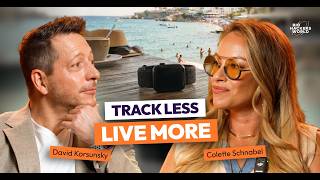

Stop Tracking Your Health If It Causes Anxiety
45sRelatable and counterintuitive advice that challenges the biohacking norm, offering relief to those overwhelmed by data.
▶ Play Clip"Delivers exactly what the title promises—a thoughtful discussion on health data, with no bait-and-switch."
In this episode of the Biohackers World Podcast, host interviews David Korsunsky, founder of Heads Up, about the challenges of health data overload. They discuss the importance of Heart Rate Variability (HRV), common mistakes biohackers make, and how to use AI to synthesize health information. Korsunsky emphasizes developing a healthy relationship with data, prioritizing intuition, and starting with simple metrics like sleep and blood sugar.
David Korsunsky, founder of Heads Up, is the guest. He helps practitioners and health-conscious individuals bring health information together.
Korsunsky's favorite metric is Heart Rate Variability (HRV), which he calibrates to every day.
HRV came from elite athletes to assess recovery and decide when to push or back off. It's now accessible to everyone.
A common mistake is overreacting to data points in isolation. He challenges people to become comfortable with bad readings.
If you're getting anxiety about data, it's okay not to track for a while. Ask yourself why you're anxious.
Korsunsky's journey started with a sleep sensor (Zio) in 2012, which revealed he was significantly under-sleeping, leading to a career change.
AI is a good use case for synthesizing years of health data and acting as a co-pilot to figure out what to focus on.
Even clinicians are overwhelmed with data. AI helps synthesize data faster, moving from overload to utility.
Wearables are a daily compass for course-correcting. Diagnostics like blood work are insightful, especially when run more frequently.
For beginners, master sleep and blood sugar first. Use a sleep tracker and a CGM for a few months to learn how lifestyle affects blood sugar.
Your body and intuition are the supreme intelligence. Listen to that signal over the data any day.
His point of no return was quitting his job after someone offered $100,000 to build his system full-time.
He's less dogmatic now. Some of the most important biohacks are spending time with family and loved ones.
Kids should have access to CGMs to learn about their bodies early, as food is engineered to be addictive.
The key takeaway is to use health data as a tool for optimization, not a source of anxiety. Start with sleep and blood sugar, leverage AI to synthesize information, and always prioritize your body's intuition over the numbers.
Overreacting to Data in Isolation
Highlights a common pitfall and the need for a healthy relationship with data.
02:26Using AI to Synthesize Health Data
Presents a practical, modern solution for dealing with data overload.
05:54Body is the Supreme Intelligence
Emphasizes the importance of intuition over raw numbers.
11:00Most Important Biohacks are Family and Fun
Reframes the ultimate goal of biohacking as living better, not just tracking more.
13:09Food is Engineered to be Addictive
Explains the challenge kids face and the need for early prevention.
14:39[00:00] If you're getting anxiety about the data, it's okay not to track for a while. Your body is the supreme intelligence. I would listen to that signal over the data any day. Food is developed with fMRI brain scans to light up our reward circuits.
[00:16] Like, that's what kids are up against these days. Biohacking. We're about science. Sleep. Not GVT. Genetic. Energy. Cleaning. Technology. Bio. Bio. Bio. Bio. Bio. Bio. Biohackers World Podcast.
[00:29] Biohackers love data. We track our sleep, monitor our glucose, wear smart rings, check our labs, and collect more health information than ever before. But here's the real question.
[00:41] Are we actually using that information to improve our lives, or are we simply collecting more numbers? Today's guest is David Korsunsky, founder and CEO of Heads Up. After spending decades building technology solutions for major healthcare organizations, Dave saw firsthand how disconnected health information has become.
[01:03] Today, he's helping practitioners and health-conscious individuals bring all that information together and create a clearer picture of health. Dave, I'm excited to talk to you about health data, wearables, and how people can use this information to make smarter decisions about their health.
[01:18] but first I would love to know what's your favorite health metric or to track oh that's an easy one it's heart rate variability really yeah and having done this for many many
[01:32] years and worked with tens of thousands of users and hundreds of clinicians and dove into it all personally myself heart rate variability is the one number I calibrate to the most every single
[01:46] day hands down by none. Fascinating. And when do you think people should start doing that? That's a metric that is independent of age and more important of your goals. Okay. So real true heart rate variability came out of the world of elite athletes.
[02:02] And really, really top tier performance trainers were basically figuring out how to use heart rate variability to assess the athlete's level of recovery and how hard to push the athlete
[02:14] when to back off, when to push harder, when to back off, when to push harder. Now that number is something everybody can measure. So I think the sooner you start learning about it and optimizing towards it, the better.
[02:26] So a lot of people are already tracking their sleep and their glucose, the HRV, and dozens of other health metrics. So what's one mistake that you think firehackers make when it comes to the health data? People tend to overreact to certain data points in isolation.
[02:41] and I think the lesson for everybody there is actually to learn how to develop a healthy relationship to data. What I would challenge people to do is become comfortable with the bad readings.
[02:57] That's hard. So that's taken me a while. But whether the number is good or bad, you're going to learn from it. And the other thing I would say is like, if you're getting anxiety about the data,
[03:11] it's okay not to track for a while. And maybe ask yourself why you're getting anxious about the data. You know, what we're talking about in the biohacking world now
[03:23] is moving beyond the numbers. I like that you said that because I do agree and I personally don't wear trackers because it was, you know, getting me to that point of, you know, am I hitting it, you know, and then you're not focused on the other parts of your life
[03:35] and living. Totally. You know. I want to talk about how we can actually make better use of all this information. But first, I'd love to understand your own health journey that led you here. I was always someone who was physically active as a kid,
[03:48] always growing up playing tons of sports and being super physically active You know as I grew up I always noticed just objectively that even though I was lifting more than my friends and training harder than my friends I didn
[04:01] see the same results in my own body composition. So there was something that was like not right there but I still was very physically active. In my
[04:14] professional life I was working as a data analyst so I was really good at crunching numbers they were not necessarily health numbers I was working on computer systems so I got really good at that I believe I was living in San
[04:28] Francisco and I saw on the cover of the newspaper with Dave Asprey and this was like 2012 he had this band on his head with like these LEDs glowing out of it I'm like what the heck is that and it was like one of the first consumer grade
[04:43] health, sorry, sleep sensors on the market. It was called the Zio and you wore it and it gave you some good biofeedback on your sleep. So I bought the Zio and I wore it and my understanding of my
[04:59] sleep was not matching up with the data and I actually started feeling the data was more accurate and it showed me that I was significantly under sleeping. Five, six hours a night and I was
[05:11] training hard. So I was creating a sense, a little bit of burnout. And just those numbers, even as a layperson, helped me change my behavior. And then I'm like, oh, that was fun. What
[05:24] else can I measure? So that kind of sent me down the path. And then I was like, okay, where's the tools to help me crunch all this information? And they didn't exist. And that's when I made a career change. So I've always been really interested in my own health optimization
[05:40] and now I've decided just to make it my life's work. And so many people are collecting health data every day. How do you know which information actually matters? I think knowing which ones to focus on is a really good use case for AI.
[05:54] To be able to put those tests that you've accumulated over years that are sitting somewhere in Google Drive or Dropbox or patient portals and ask a large language model.
[06:06] This is my goals health-wise, and these are my results. And then it becomes your co-pilot. And I think AI is a good way to figure out what to focus on. I think the AI is extremely important, you know, and it is helpful,
[06:20] especially for just getting into this space, you know, wanting to understand their body, understand their life, and take control of that health sovereignty, you know, why a lot of us are in this industry.
[06:32] So at what point does tracking become useful versus overwhelming? Well, that kind of goes back to our previous point. Even the clinicians I speak to nowadays, they're overwhelmed with data. So it's not just us biohackers in this room or who are listening to this interview.
[06:48] It's quite common for me to speak with a clinician who says, wow, a new patient came in, a very complicated situation, brought in 15 sets of blood work, five years of ORAD data, six years of MyFitnessPal logs, right?
[07:01] Everybody's overloaded right now. One of the applications where AI is very helpful is helping us synthesize data. lots of it faster and quicker. So I think it's another use case for where it moves from being overload to becoming useful.
[07:17] We, as humans, need help crunching all this information. It's too much. And it can become completely overwhelming. And if it's overwhelming, it's not useful. It's actually having the opposite effect of what you're trying to achieve.
[07:31] So if you're feeling that way, well, first of all, you can work with clinicians who are open to helping. but oftentimes the clinicians who want to sit down with you and really go deep on the data are not the ones taking insurance So then you working with an out expense So they can be helpful with your data
[07:52] Coming to these events can be really helpful. And using LLMs can be really helpful to shift it from, like, overload to utility and value add. So you already covered, like, how your sleep helps you, you know,
[08:05] start tracking that. We talked about the HRV. What are some of the most valuable insights people can learn from wearables and biomarker testing? besides those two? When I first got into this back in 2011, 2012, there was no such thing as a wearable.
[08:19] Honestly. None of this stuff even existed. So the only way we could measure our health at that time was the lab results and the diagnostics. For wearables, that helps us calibrate every single day.
[08:33] And if you're investing time and money and energy into your health, and you can get instant feedback, that's kind of like your compass. So I think for the wearables, just think of them as your daily compass,
[08:47] and they're just constantly course-correcting you. You know, if you're a little off with one thing, and the data shows you, you need to kind of like come back to the middle. Think of the wearables as your daily compass. And then for the diagnostics, maybe we run blood work.
[09:01] Well, this is Biohacker's world, so maybe we run it more than once a year. Maybe some people do it quarterly or biannually. and with a lot of chronic conditions you have to test really really quite often as well that data is also very insightful a because it's easier for individuals to run their own labs now
[09:18] it's easier for individuals to run exploratory tests that would be hard for the doctor to run because there's no billable code for it so you can be much more exploratory now with your
[09:31] diagnostics and try the test and run it through your favorite AI and see what it tells you. Right. And so for someone new that's getting into biohacking, health optimization, where would you recommend that they actually start?
[09:44] Well, these conferences are amazing places to learn. There's so many amazing educators through the biohackers world and through the sessions and through the companies that are here and the entrepreneurs that are bringing the products
[09:58] to market. So I think that's a great place to start. If I was going to encourage someone to start measuring their health who's really never measured before, I would say that the two things to master first are your sleep and your blood sugar.
[10:14] Obviously heart rate variability, but the reason I don't put that one first is because it's a little bit more of a nuanced metric. I would say that's my personal number one, but I've been deep in the weeds on this for a long time.
[10:27] If you're coming in fresh, optimize your sleep or a ring or whatever you want to use. And then, like, wear a continuous glucose monitor for a few months. And just learn what food and stress and poor sleep does to your blood sugar.
[10:44] And correct your lifestyle towards blood sugar. Start there with those two. I personally, like, when I first started my journey, you know, I had to pull those onion layers back, right? I wasn't listening to my body or anything like that. So how do you balance objective data with listening to your body?
[11:00] Your body is the supreme intelligence. Your cells are the supreme intelligence. Your intuition is the supreme intelligence. I would listen to that signal over the data any day.
[11:12] You and I were sitting down at dinner last night and someone made a comment about how horrible they feel when they're fasting. That's your body telling you, hey, you might not be ready for this yet.
[11:24] or there might be something else there. Listen to that signal. When we override those signals, we get ourselves into trouble. We push too hard. We ignore something that actually is your body kind of screaming at you So I love that question and I would say listen to your intuition first If you built an entire company around solving a problem that you experienced yourself
[11:47] what was the one point of no return for you on this journey? And, you know, you live in this information age, and there's new tests, new companies coming out all the time. So where would you say there is this no return point?
[12:01] When I quit my job. Somebody said, I'll give you $100,000. It was one of the people on the early beta versions of my system. This was literally 10 years ago.
[12:14] And one of the individuals testing my system was very successful. And he said, we want to give you $100,000 to go build this full time. And so I had to quit at that point.
[12:28] That was a moment of no return. Wow. Yeah, there was no going back at that point. that's every entrepreneur, right? You jump off a cliff with no parachutes. Yeah. And you figure it out before you splat on the ground.
[12:41] Yeah. One foot in front of the next, right? Yeah, well. Yeah. So looking back at your own biohacking journey, what's one thing you've changed your mind about? I'm less dogmatic about anything these days.
[12:54] I'm going to give you a bunch of answers, and then I'll probably land on one. Some of the biggest changes we make in our health have nothing to do with data. Mm-hmm. Some of the biggest changes have to do with understanding ourselves and looking inside of ourselves.
[13:09] I think the one thing I've learned, and I don't know if I've changed my mind as much as it's been in evolution, is some of the most important biohacks are actually spending time with family and with your loved ones.
[13:23] Like, that's the stuff you really want to focus on. And I realize that a lot of people don't have access to that. Right. But you can create it. Think about the people around you. Mm-hmm.
[13:35] Think about how you actually have fun in the world. Think about how you play. Mm-hmm. The data and the biohacking just allows you to do more of that. Right. But that is the goal.
[13:47] Right. And that's kind of like how I've just evolved in my own personal journey as well. I want to leave you with one question. You know, my personal platform is for biohacking mamas and teaching families about longevity parenting. So the many mothers and families want to be more proactive about their health.
[14:02] What role do you think data can play in prevention rather than simply reacting to the problems? What comes up with me on that question is the number of children that are dealing with metabolic diseases at a young age.
[14:14] Kids should not have freaking diabetes at a young age. What are we doing? And I think the way we empower kids, empower families, is help them capture some data.
[14:27] I would love to help younger kids have access to a CGM. They can figure out tech faster than we can. Oh, my gosh, for sure. So, like, hey, get them learning about their bodies earlier
[14:39] because food is engineered to be highly addictive. You know, food is developed with fMRI brain scans to light up our reward circuits. Like, that's what kids are up against these days.
[14:52] So, for me, it's like, how do you empower families and kids to do this together? in ways that can not only start prevention earlier,
[15:04] but start optimization earlier. And then your whole life gets better from that point. That was my biggest regret. Like, I didn't start figuring this stuff out until I was, like, in my late 30s.
[15:17] So I wish somebody would have showed me this stuff earlier. And I just want to say thank you so much, Dave, for sitting here with me. I'm looking forward to hearing more from you. Thank you for a great interview, and also thank you to Biohackers World for all the amazing work that you guys are doing.
[15:31] Awesome. Thank you.
⚡ Saved you 0h 15m reading this? Transcribe any YouTube video for free — no signup needed.