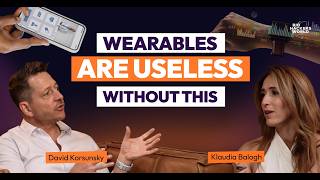

AI can reverse aging?
45sThe provocative opening statement about reversing aging immediately grabs attention and challenges conventional beliefs, making it highly shareable.
▶ Play Clip"The title promises a solution to the wearable data problem, and the video delivers a solid discussion on that exact topic, though it's an interview rather than a step-by-step guide."
In this Biohackers World interview, Claudia Balogh speaks with David Korsunsky, CEO of Heads Up Health, about the challenge of turning vast amounts of personal health data into actionable insights. Korsunsky explains how his platform aggregates data from wearables, labs, and PDFs, and discusses the role of AI in synthesizing this information. He offers practical advice for beginners, emphasizing baseline testing and self-experimentation.
The story in health data is too complicated for our brains, but AI can help people make sense of all the information we're collecting.
David Korsunsky, CEO of Heads Up Health, created the platform after working in Big Tech and seeing a gap: there were no tools to measure before and after health interventions. He had four different patient portals and just needed to see a trend line.
Heads Up Health aggregates data from consumer-grade wearables (Dexcom, Libre, Oura, Whoop, Garmin, Apple Watch), patient-generated data (scales, blood pressure cuffs, glucometers), patient portals (Quest, LabCorp, UCSF, Stanford), and PDF files (DEXA scans, microbiomes).
The platform cleans and standardizes data, as there are about 30,000 different names for cholesterol across health systems. The system must be intelligent enough to build intuitive ways to look at that data.
AI is exciting because it can analyze 10 reports holistically, including 300-400 SNPs on a genetic report, 150 tests on a microbiome, and 150 biomarkers on a function report. A large language model can find patterns between an Oura ring, genetic report, and blood work.
Traditional healthcare professionals often can't handle the volume of patient data. A quote from Amy Bot (FDA) highlights that patients bring 5 years of data, but it's too much for doctors to review, especially with 100 patients.
David's 75-year-old father uses ChatGPT to synthesize his health data into a one-page analysis, including blood pressure and HRV summaries, and questions for the doctor. This empowers patients to have more productive visits.
Heads Up Health helps users take action by giving them the next steps to try. Users can log daily data (Oura stats, training logs, body composition) and the system helps interpret it, acting like a 'super coach in your pocket.'
Start with a baseline snapshot: get a DEXA scan, blood work, and a wearable. Then start self-experimentation, focusing on sleep and heart rate variability. Try one experiment at a time and use daily biofeedback to understand what works.
The time needed to see results depends on what you're trying to change. For example, microbiome testing might be repeated after a few months, blood work quarterly, but daily biofeedback (HRV, sleep, activity, blood sugar) provides immediate feedback.
Every calendar year, try to get your labs better than they were the year before. If you're 40, 50, or 60, look at your labs from 20 years ago and try to be better than those.
In 5-10 years, the hard stuff will be automated. People will just feed data in, and AI will have full context (microbiome, genetics, lifestyle) to figure out what each person needs. Technology will help sift through variables and make the process easier.
The key takeaway is that while we have an abundance of health data, the real challenge is making it actionable. With platforms like Heads Up Health and AI, we can translate data into insights that trigger lasting behavioral change, making health management more personal and preventative.
What is the main problem with health data according to David Korsunsky?
The story is too complicated for our brains, but AI can help people make sense of all the information we're collecting.
00:01
What types of data does Heads Up Health aggregate?
Consumer-grade wearables (Dexcom, Libre, Oura, Whoop, Garmin, Apple Watch), patient-generated data (scales, blood pressure cuffs, glucometers), patient portals (Quest, LabCorp, UCSF, Stanford), and PDF files (DEXA scans, microbiomes).
02:19
How many different names for cholesterol exist across health systems?
About 30,000 different names.
03:45
What is the recommended approach for beginners in biohacking?
Start with a baseline snapshot: DEXA scan, blood work, and a wearable. Then start self-experimentation, focusing on sleep and heart rate variability, trying one experiment at a time.
09:49
How often should blood work be done according to David?
Quarterly, though some people do it annually.
12:10
What is the 'yearly improvement goal' David suggests?
Every calendar year, try to get your labs better than they were the year before. If you're 40, 50, or 60, look at your labs from 20 years ago and try to be better than those.
13:06
How does AI help in the future of health data according to David?
AI will have full context (microbiome, genetics, lifestyle) to figure out what each person needs, sifting through variables and making the process easier.
13:38
AI Can Make Sense of Health Data
This sets the core thesis of the video: AI is the key to unlocking the value of health data.
00:0130,000 Names for Cholesterol
This illustrates the massive challenge of standardizing health data across systems.
03:4575-Year-Old Father Uses ChatGPT
This is a concrete example of how AI can empower patients, even seniors, to communicate with doctors.
07:16Yearly Labs Improvement Goal
This is a simple, actionable principle for long-term health optimization.
13:06[00:01] story's too complicated for our brain. AI can help people make sense of all the information we're collecting. [music] Every calendar year you age, try to get your labs better than they were the year before. We have access to
[00:14] so much information and so much technology and AI, [music] there is no good reason why you cannot age in reverse. reverse. >> [music]
[00:31] >> Biohackers World Podcast. >> Hey everybody, this is Claudia Balogh and I'm here at Biohackers World Los Angeles where we are walking amongst each other with either wearing an Oura Ring or a Whoop or some
[00:45] type of wearable to track and quantify various aspects of our health, but today I want to talk to David Korsunsky, the CEO and founder of Heads Up Health, a platform that helps you make that data
[00:58] clear and be able to interpret in a way to make it actionable for your life. First of all, you created this before the science or the population was even >> Yeah. >> You have worked in the space with the
[01:11] biggest health care systems and saw a gap. Let's dive into a little bit about what did you see and why you wanted to resolve that and bring a solution to. >> I was working for Big Tech and part of my job was to
[01:25] capture lots of data from all of the computers running their business and just figure out where were the op- opportunities to make those computer systems run better. What I really wanted to know was, "Okay, there's all these
[01:38] things I can try." I read Tim's book. I read Dave's blog. It's like, "Okay, I'm going to go make the changes. I want to measure before and after." But I didn't see the tools existing to help me do that. I had four different patient
[01:51] >> Mhm. >> Just cuz I'd moved around a bit, changed jobs, changed insurance. I just needed to see a trend line. Actually, other industries have figured it out. Why can't we do this for human health?
[02:04] And then just building from there. >> And then you're aggregating data from a lot of different wearables and a lot of different data points. How did you choose what to bring in to provide the value that your audience,
[02:19] the individuals tracking, can get >> Our customers tell us what they want us >> Okay. Can you give us a few examples of what are some of those data points that >> First is what I would call consumer-grade wearables.
[02:33] Dexcom and Libre continuous glucose monitors Oura, Whoop, Garmin, Apple Watch. These are monitoring activity levels, sleep, resting heart rate, those kinds of things. Um, scales, blood pressure cuffs, glucometers. So, this is
[02:49] typically called like patient-generated data. Like, what are we measuring at home? So, we focus a lot on those kinds of integrations. Then it's like, how do we connect all the different patient portals out there? So, maybe I've been
[03:03] to Quest and I've been to LabCorp and in my case, UCSF, Stanford. You know, there was four or five systems that had my blood work. So, can we integrate to those systems? Then there's actually a lot of health data that's in PDF files.
[03:19] Our DEXA scans and our microbiomes and all of these reports. So, how can an individual or a doctor upload 10 PDF files? Can we get the data out of
[03:31] those PDF files? And so, that's step one. And then step two is, how do you one. And then step two is, how do you clean it all up? Cuz every every PDF is a different Let's just take cholesterol.
[03:45] There's probably 30,000 different names for cholesterol from all the different health systems. And our system has to be intelligent enough to build the intuitive ways to look at that data. How can you take someone who's low-tech,
[03:59] >> a senior citizen that's trying to not be on five medications, and take action on it? >> And I love that you mentioned it because I think a lot of people who have been tracking understand how things can get
[04:13] >> [clears throat] >> Things can get misinterpreted if you don't have the right tools to look at trends over time, or you don't have the >> Mhm.
[04:25] >> So, what do you see is the assumption that missing in the consumer space about I just want more and more and more data as opposed to getting the right insights? >> For people at Biohackers World,
[04:40] we're interested in the data. Each data set gives us different windows into our microbiome data. >> Mhm. >> I have my in-body Dexa. I have my genetics. I have my blood work. I have
[04:54] my Aura data. It's a lot. And that's actually a hard problem. That's one of the areas I'm most excited about AI because I could take these 10 reports that would be hard to analyze holistically.
[05:07] You know, there's three or 400 SNPs on the genetic report. There's 150 um tests on the microbiome, every >> Yeah. >> There's 150 biomarkers on the function
[05:21] report. And there's a story in there, but the story's too complicated for our But it's not too complicated for a large language model. I'm optimistic, Claudia, that AI can help people make sense of all the information we're collecting. It
[05:36] can find the patterns between your Aura ring and your genetic report and your blood work. And it'll be like, "Hey, we saw this over here, and I've seen that pattern before." I'm hopeful that we're we're going to have
[05:49] the ability not only collect more data, but make sense of it. >> And then what do you see in the industry, the gap with the healthcare professionals, with traditional medicine, when the patient goes to your
[06:01] doctor with all of this data and they sometimes they get looks like they have two heads because why are you collecting all of this much? So it's it's experience is with the traditional healthcare system when the patient comes
[06:16] doctors done to ask for ask for. >> Yeah, I just actually on stage I presented a quote from this woman Amy Bot and she's on the FDA's she's the >> Okay. >> And she articulated your exact
[06:33] statement. She's like, "Man, I got patients coming in. They got 5 years worth of data. You know, they got seven sets of blood work. You know, they've they've researched They want to look at it.
[06:46] >> But they can't for two reasons. One, it's too much in She's like, "It's too >> Mhm. >> And that's just one patient. >> Now she's got a panel of 100 patients. Even if they wanted to look at it, it's
[07:00] >> Yeah. >> And the panel that she was on was about how do we move the synthesis to the AI layer can do it. My father, I trained him on how to use
[07:16] Chat GPT. He's got a lot of complicated health conditions and what he does is he feeds it all into Chat GPT and he says, >> Yeah. >> So at 75, a senior, he's walking in with
[07:32] >> So at 75, a senior, he's walking in with the most concise one-page analysis of everything from seven doctors, his ring, his scale and it's It's "Hey doc, I did >> Yeah. >> Actually, AI did the work for you, and
[07:45] questions. And by the way, here's my blood pressure for the last year >> Here's my HRV for the last year summarized. >> Here's my questions, and it's on a one-page report. So, the patient can do
[08:01] that for the doctor with the LLM. >> That's beautiful. Because how many times know, once or twice a year? >> Sure. And the right questions to ask. >> Mhm. >> You know, I've synthesized all my
[08:14] biohacking data for the whole year with AI. These are the four things I need you >> How are you able to help weather is practitioners help their patients or the or customers themselves take action on what they're seeing? How
[08:28] what they're seeing? How can insight turn into actionable steps? can insight turn into actionable steps? >> I think that's also where we can use really good about giving you the next
[08:40] And then you can go back to it the next day and say, "Did it work?" So, like, you know, for me personally, I put my aura stats in on a daily basis. I put my training logs in. I put my body composition data in. And we're working
[08:55] each day towards my goals. A lot of the times it actually helps me interpret my >> Mhm. >> So, I'll upload some data. I'm like, And it's [laughter] like, "Actually, no. Let's step back. You've been doing
[09:09] really good, and here's why this one data point in isolation doesn't matter." >> So, it's like your super coach in your pocket, and it can give you the next things to try. And then you come to Biohacker's World, and you get a whole
[09:21] >> Yes. >> And you go listen to more So, it's also acquire information, put it through our filter, and we should >> Yeah. >> And then use the LLM to figure out,
[09:35] >> Mhm. >> Is my health improving? Is this the like wellness stuff. I'm not talking about like real medical stuff. That you go to the doctor for. >> And then if somebody is new to
[09:49] biohacking, they are on the beginner phase, 1 2 to maybe even 3 years into this whole journey of health optimization, what do you think is the smartest way for them to start
[10:01] >> The first and most important thing is to have your baseline snapshot. >> Like, where are you when you start? And then I would also recommend getting a >> Yeah. >> And start optimizing sleep and heart
[10:16] rate variability. And then the way I do it is I try it one experiment at a time. >> How do you know, based on your trends, >> Okay. >> Um the daily biofeedback will help me
[10:31] understand. So, let me give you an example. Um at my condo building, they now added a cold plunge and a sauna. >> Yeah. So, I'm I'm trying to figure out, how do I use these in the right time of
[10:46] >> and in the right order to optimize my Oura stats. >> And I finally cracked it. >> Nice. >> So, now I know like how long to be in the cold at how long before bed. This
[11:00] didn't happen in one time. Like, I've probably done it 50 times. >> You know, to figure out when to do it, when to stop eating, when to stop training, how to train based on different patterns.
[11:12] But for the beginner person, to your question specifically, start with a good >> Mhm. >> Uh start with a DEXA scan. Get that blood work that that baseline in there. Get a wearable. And then start
[11:26] the process of self-experimentation. >> How long should they be tracking before they have a clear a solid picture like okay is this is working or this isn't working? Is it 4 weeks? 2 weeks is enough?
[11:41] >> It depends on what you're trying to change. So for me I'm working on some >> Yeah. >> And I ran a test from Viome Trakt. And I got my results and there were a lot of species that I was completely
[11:56] functionally deficient in. My micro diversity was this big and it's like hey dude, all these super important species that are you need, they're like non-existent. So now I'm working to rebuild that. I'll probably test again
[12:10] >> Okay. >> Um blood work quarterly. Uh there's some people that do it >> Yeah. >> There's some people that do it annually.
[12:23] is you get biofeedback every single day. And if your heart rate variability is improving and your sleep is improving >> and your activity is improving and your blood sugar is improving
[12:39] get better when you retest. >> Yeah. >> And you don't need expensive diagnostics to do that. So that's like the between the visits stuff. Just keep optimizing those.
[12:51] >> And odds are the next set of diagnostics >> So in retrospect, it's really interesting to see how certain environmental changes cuz also play a role in how your body is working.
[13:06] Okay, one last question. >> Uh one thing I want to say Clara is also um every calendar year you age try to get your labs better than they were the year before. And if you're listening to this and you're 40, 50, 60
[13:23] look at your labs from 20 years ago and try to be than those. >> And we have access to so much information and so much technology and >> Yeah. >> There is no good reason why you cannot
[13:38] at this point in the game. >> So, what do you see in terms of looking into the future 5 10 years ahead? How does health data and just health management will look like? >> I think a lot of the hard stuff is going
[13:53] >> I think all we are going to have to do as people is feed the data in. >> Yeah. >> It's going to have our full microbiome. >> Mhm. >> And figuring out what this person needs
[14:09] versus this person is still really hard because it's it's genetic, it's it's lifestyle, it's environment. There's so many variables. What I want to see is that the technology helps us sift through all
[14:22] that stuff and kind of just like makes the process easier to figure out what to do next. >> But on that note, what I'm hearing is there is an abundance of information and health data we're all collecting,
[14:35] especially if you're here at Biohacker's World, and it can get overwhelming. The translation can be difficult, but I think with what you're building with Heads Up Health, there are ways to make it actionable and insightful so you can
[14:48] trigger behavioral change that will last a long time and make your health journey a lot more personal and preventative than it's been before. Thank you so >> Appreciate it. >> [music]
[15:07] [music] >> Biohacker's World podcast.
⚡ Saved you 0h 15m reading this? Transcribe any YouTube video for free — no signup needed.