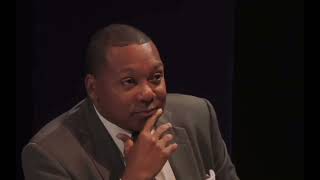

Why You Must Listen to Old Jazz
39sEncourages viewers to explore jazz history beyond contemporaries, a common blind spot for musicians.
▶ Play Clip"The title accurately reflects the content: Wynton Marsalis provides direct advice on improving improvisation skills through listening and learning solos."
Wynton Marsalis shares advice on improving improvisation skills, emphasizing the importance of listening to a wide range of musicians and learning from historical masters. He highlights specific solos and artists that exemplify excellent solo construction.
Marsalis learned from his father and trumpet players like Clark Terry, Sweet Setterson, and Blue Mitchell, as well as recordings of Miles Davis, Clifford Brown, and Freddie Hubbard.
He encourages expanding listening to include earlier generations like Louis Armstrong and Roy Eldridge, gaining a historical perspective on the instrument.
Marsalis recommends learning specific solos: Louis Armstrong's 'Tight Like This' (1928), Charlie Parker's 'Embraceable You', Miles Davis's 'Francing' on 'No Blues', and studying Thelonious Monk's album 'Monk's Time'.
He suggests reading Bix Beiderbecke's thoughts on Louis Armstrong to understand solo construction.
Marsalis advises aspiring improvisers to study the masters, learn their solos note-for-note, and gain a historical perspective to develop their own solo construction skills.
Wynton Marsalis
person
Clark Terry
person
Sweet Setterson
person
Blue Mitchell
person
Miles Davis
person
Clifford Brown
person
Freddie Hubbard
person
Louis Armstrong
person
Roy Eldridge
person
Charlie Parker
person
Thelonious Monk
person
Bix Beiderbecke
person
Louis Armstrong - Tight Like This
link
Charlie Parker - Embraceable You
link
Miles Davis - Francing (No Blues)
link
Thelonious Monk - Monk's Time
link
Which three trumpet players did Wynton Marsalis listen to on recordings?
Miles Davis, Clifford Brown, and Freddie Hubbard.
00:24
What solo does Marsalis recommend learning from Louis Armstrong?
Tight Like This from the Hot Seven recordings (1928).
01:18
What Charlie Parker solo does Marsalis suggest for studying construction?
Embraceable You.
01:45
What Miles Davis solo does Marsalis recommend?
Francing on No Blues.
02:32
Which musician does Marsalis call 'the real master of construction'?
Thelonious Monk.
02:47
What album by Thelonious Monk does Marsalis recommend?
Monk's Time.
02:59
What did Bix Beiderbecke realize after hearing Louis Armstrong?
He realized how to construct a solo.
02:47
Learning from Mentors
Marsalis emphasizes the value of direct mentorship and listening to experienced musicians.
Regret of Not Listening Earlier
He shares a personal regret about not respecting older musicians, highlighting the importance of historical perspective.
00:49Learning Solos Note-for-Note
Marsalis advises playing solos rather than just listening, revealing the difficulty and value of deep study.
01:18Charlie Parker's Melodic Approach
He quotes a fellow musician saying Parker's entire solo was melody, contrasting with typical fast runs.
02:07Monk as Master of Construction
Marsalis identifies Thelonious Monk as the ultimate example of solo construction.
02:47[00:00] How do you get better at learning how to tell a story through your improvisation and just how can you help do that? First, who I listen to, because my father's a jazz musician, I was always listening to live.
[00:12] First, I listened to him all the time. Then, the musicians I heard, Clark Terry, Sweet Setterson, Blue Mitchell. Those were trumpet players that were like mentors to me. I knew them, so I was always hanging around them when they came to New Orleans.
[00:24] On recordings, Miles Davis, Clifford Brown, Freddie Hopper, or the main three that I listened to on recording. Of course, as I grew older and learned more, that expanded to Louis Armstrong,
[00:37] and musicians from earlier generations who I would not have listened to as too ignorant to listen to them. I began incorporating him, Roy Eldridge, who I also met when I was in high school, but he was so much older than me, I didn't have the proper respect.
[00:49] I wish I could go back to that time and reclaim the time and the opportunity to talk with him and learn from him. So, in that way, I want to encourage you to expand your circle of listening from contemporaries to the entire history of our instrument.
[01:03] And it's important to get a historical perspective on instrument, and it's fun. So, I would say that in terms of developing your solos in the construction of your solo. I'm going to tell you the name three or four of the greatest musicians in construction.
[01:18] Louis Armstrong, I want you to learn a solo by Louis Armstrong on something called tight, like this. It's from the hot seven or something. I think it's recorded in 1928.
[01:30] First, just if you could play that solo alone. Try to play it. Don't just listen to it because he's playing it. And you can give you the illusion you can play it. Because when he's playing it, it sounds real easy. When you start playing it, you're going to say, hmm.
[01:45] A great solo for construction is Charlie Parker, Embraceable You. But it's the one that starts going.
[02:07] Bird is such a poet, so check out how Bird constructs his phrases. And don't learn like what I call generic beach. Go to the source. once told me something about Charlie Parker. He said, man, when all the rest of us play,
[02:20] what we call be about, we play fast runs, and then we finish with a melody. When Charlie Parker played, the whole thing was melody. So that way of construction. Another good thing is a good solo to learn
[02:32] is Miles Davis solo off of some day my prince will come, a blues called Francing on No Blues. It's a good to get you give you a sense of construction. Also, it's good to read Bigs Byterbick on Louis Armstrong.
[02:47] If you read what Bigs Byterbick says, he realized when he first heard Louis Armstrong play, he's talking about how to construct a solo. Finally, the real master of construction in our music is the Lonious Monk.
[02:59] Get an album called As Monk's Time. Just check out Monk's compen and his solo because he knows how to construct a solo. Thank you. Yes, sir. Great question.
⚡ Saved you 0h 03m reading this? Transcribe any YouTube video for free — no signup needed.