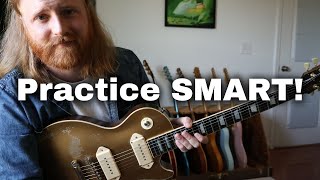

Write Down Your 10-Year Guitar Goal
30sMany guitarists lack direction, and this clip gives a simple yet powerful goal-setting strategy that resonates with those feeling stuck.
▶ Play Clip"The title promises 5 actionable steps and the video delivers exactly that, with clear explanations and exercises."
Nicky V, a Nashville producer and studio musician, shares five actionable steps to improve guitar playing and achieve creative freedom on the fretboard. He emphasizes the importance of structured practice, setting long-term goals, and embracing the lifelong learning process. The video provides practical exercises for ear training, fretboard knowledge, rhythmic vocabulary, genre exploration, and singing solos.
Nicky V introduces himself as a producer and studio musician in Nashville, asking viewers to subscribe to help grow the channel.
It's okay to take time to improve; the most accomplished musicians still feel they are barely scratching the surface.
Write down your 10-year goal on the instrument and figure out actionable steps to achieve it, just like in business.
Practice falls into two compartments: things that can be done to completion (e.g., learning pentatonic positions) and things that cannot (e.g., rhythmic accuracy). The latter requires consistent, segmented practice over time.
Your playing is only as good as your ear. Three actionable exercises: sing intervals as you play them, transcribe songs by ear without your instrument, and transcribe other instruments besides guitar.
Learn the fretboard diatonic harmony top to bottom in any key so you can play freely anywhere. Nicky mentions a course he designed for this.
Increase rhythmic vocabulary and accuracy using a metronome. Practice quarter notes, eighth notes, triplets, sixteenth notes, and attack each subdivision (downbeat, 'e', 'and', 'uh').
Write down 5-7 genres you like or are curious about, then spend 3-6 months deeply studying each to extract its defining characteristics and apply them to your playing.
Spend 5-10 minutes a day singing melodic guitar solos to teach voice leading, consonants, dissonance, and chord tone addressing.
By consistently applying these five steps—ear training, fretboard mastery, rhythmic practice, genre exploration, and singing solos—you will significantly improve your guitar playing and creative expression over time.
What are the two compartments of practice according to Nicky V?
Things that can be done to a state of completion (e.g., learning pentatonic positions) and things that cannot (e.g., rhythmic accuracy).
02:04
What is the first actionable step to improve guitar playing?
Ear training: sing intervals as you play them, transcribe songs by ear without instrument, and transcribe other instruments.
04:46
How should you practice rhythmic vocabulary with a metronome?
Practice quarter notes, eighth notes, triplets, and sixteenth notes, and attack each subdivision (downbeat, 'e', 'and', 'uh').
09:01
What is the recommended time to spend on each genre deep dive?
3 to 6 months.
12:11
What is the fifth step to improve guitar playing?
Spend 5-10 minutes a day singing melodic guitar solos.
14:21
Why is ear training considered difficult?
Because it is a slow-going process that really takes time.
05:13
Write Down Your Goals
Emphasizes the importance of setting and writing down long-term goals, a principle often overlooked in creative pursuits.
01:12Two Types of Practice
Provides a clear framework for structuring practice by categorizing exercises into completable and non-completable tasks.
02:04Ear Training is Key
Stresses that your playing is only as good as your ear, offering three specific exercises to improve it.
04:46Deep Dive into Genres
Encourages exploring multiple genres to develop a unique musical voice, a strategy for creative growth.
12:11[00:00] Hey gang welcome back to the channel. My name is Nicky V. I'm a producer and studio musician here in Nashville I'll try to get the annoying part out of the way right away. Most of you guys watch this stuff haven't subscribed yet So please hit that subscribe button if you don't mind trying to get these videos at as many people as we can try to grow the channel a little bit
[00:15] So I keep doing these things. So say I thought about how to practice smarter and it's okay to embrace the learning process guys This is not a problem that's going to be solved overnight. I know you guys know that but sometimes it's good to hear it, right?
[00:29] Allow yourself the time that it takes to really get this kind of stuff down We're going to dive in deep on some things today and actually give you guys some actionable steps you can take to Start expressing yourself a little more freely on the neck. We are all students for life
[00:41] Okay, the most accomplished musicians that you look up to and aspire to play like still feel like they're barely scratching the surface And that's normal. There's a handful of individuals who have been touched by the universe so to speak like the the box of the world right that have
[00:55] transcended this realm that most of us live within and That doesn't really apply to such a small minority So I'm going to talk about things most of us mere mortals can do to try to get better at this thing So it's very important to have a goal that we work towards and everybody's goals look different and that's okay
[01:12] But it's but it's absolutely imperative that you have it and it's important to write it down I know that sounds like the cheesiest thing ever but like literally get a piece of paper out right down what you want to do Like what is your 10-year goal on this instrument? Where would you like to see yourself in 10 years?
[01:25] What is the player that you aspire to play like look like? Write it down and after that figure out actionable steps to get you to that point just like you do in business or any other aspect of life
[01:37] And you're wanting to get better at something but for some reason people just lack the focus and And don't really know where to turn to try to keep getting better at this and progressing on the instrument So we're going to talk about that in the last video I put out called stuck in a rut
[01:50] A lot of great questions came up in the comments. I do my best respond everybody and so likewise for this video if you have any questions Put them down there and I'll do my best. I try to respond to every single one of them Sometimes depending on volume I can't get to everyone but I really try to and that last video the stuck in a rut video
[02:04] I Mentioned that there's I typically put practice into two different types of compartments and the first compartment being things that can be done to a state of completion And then the second compartment being things that cannot be done to a state of completion
[02:18] And so two examples of this would be if it can be done to a state of completion It would be something along the lines of practicing, you know, five positions of your major penatonic scale up and down the neck Sending and descending and a particular key for that day. You can do that exercise to its completion
[02:32] On the other side of that coin something like rhythmic accuracy or playing with the metronome Cannot really be done to a state of completion because there's so many different tempos different subdivisions It's just too vast to sit down in one setting and practice everything
[02:45] It just doesn't really work like that and so You have to divide it out into segments of time and do it consistently over a long period of time That is where the gains come from or at least what I typically see
[02:57] so for example if you have Say you have a normal, you know, job and you can't just sit down and practice, you know seven hours a day You know like like a college student with this going to school from music say you practice
[03:09] 45 minutes a day three to five days a week take and you're wanting to get your pocket more settled in Take 10 minutes a day for the next three years out of that practice routine That's 45 minutes and sit there with a click and just walk in doing different rudiments and subdivisions and things like this
[03:24] and over three years I can guarantee you that your pocket is going to get more settled in your accuracy It's going to be there your phrasing is going to start to open up a little bit some rhythmic variety So it's important as we dive into the rest of this video to be able to be self-aware enough
[03:38] That when you are structuring your own practice routine and everybody looks a little different depending on what your goals are You have you understand which compartment the different types of exercises are going to fall into so you can structure it properly And so organize with it
[03:51] So I know this isn't like the most fun stuff to talk about right when you're talking about it. It's music This is a fully creative thing right and that's true and it's artistic and it needs to be beautiful and fun but A lot of the time you want to have gains and any
[04:04] You know, really anything alive It helps to have structure to it in an attack plan and a game plan So that's we're going to try to do here today a little bit Everybody has different goals But the common one that comes up that I see with most of my students actually we get talking to them kind of really figure out
[04:18] What it is what it generally boils down to is creative expression Most people want it just to be able to pick up this instrument and express themselves freely Within You know multiple genres or whatever they're into if they're really into one thing even that
[04:31] um So depending on what your goals are you know your your actionable steps to achieve those goals you may different I'm just going to do one as an example and you can apply this to whatever you're into so say it's creative expression I'm going to list out what do I get written down here. I actually took some notes this time. I got five things
[04:46] I'm going to talk about so This is not an all-encompassing You know Thing to get to creative expression because that's such a huge you know end goal that's we never really get to anyways right We're just kind of scratching out like I said
[04:58] But there's some things we can do to get us a little further down the road and Number one is your only as good as your ear and that is a very tough pill to swallow and The reason it's so difficult is because ear training is such a slow-going process that really takes time
[05:13] As a teacher the worst answer I can give somebody so man it just takes time right my job is to expedite that process and so There's a couple of things with ear training you can do Like I said actionable steps, right
[05:25] And I mentioned this in that last video the stuck-in-a-run video, but saying each interval as you play them This is the best ear training exercise you can do on this instrument So I'm a terrible singer, but here we go So play a take that G on the fifth fret right there and sing it
[05:40] But don't sing G sing one because intervals range superior right so One two one one three one one four one one five one then break it up
[05:52] One two one one four three two one five six five four three two And just do that painful crap for the next three years and your ear is going to get better
[06:05] You're going to be able to hear into the line before you play it all the stuff that we generally like starts to kind of happen if you do this type of work The other thing is So mention this before is to chart out songs by ear without your instrument force yourself to do it keep a record of it
[06:17] Do it in pins you can track your progress I sound like a broken record, but this is important stuff try to break out of just listening to guitar music And it's easier whenever you're picking out songs by ear you start to hear
[06:29] What that chord sounds like you hear that third kind of get being wobbly in the top voice and it kind of gives a unique identifier to that particular shape Not necessarily, you know the actual note being indeed, but that shape whether it's k-poped up, you know Brother of the neck
[06:41] We start to pick up on on the new ones of each one of those shapes start to hear what a G Sounds like with no third in it versus the softers you with the thirds and
[06:53] That almost acts as a cheat code a lot of the time which is great because we tend to listen to a lot of guitar music If we're guitar players whenever you start branching out it's really nice to be able to hear a pianist sit down and play at one four five six And be able to pick out those that chord structure like that
[07:06] Without relying on the very guitaristic stacks where's used to hearing with these particular chord shapes So that's the first one three actionable things you can do for each one sing the intervals transcribe by ear and transcribe other instruments other than guitar
[07:19] It's gonna just kind of pricing harder than you play on that third one So number two we're moving on to is Having this fretboard diatonic harmony down top to bottom and any key where you can put your hand down on the fretboard and play freely
[07:34] I have a whole course design specifically to target this so if you put your hand down in the instrument and I said play in C sharp Okay, now switch to G Whichever direction you're going to climb up the neck now we're switching to C
[07:49] Okay, now we're going to E major So wherever I am in the fretboard being able to play freely in any key is such an incredibly valuable tool to have your disposal if you want to express yourself on this instrument and
[08:02] I try to keep this stuff as unsalezy as I can and people in the comments like always just trying to sell this course, right and they're exactly right The sales from the course or what justify me taking the time to make these videos and put them out there
[08:14] And 90% of the video guys is not that and it's free content. I'm just trying to help people out and pull more people in So those of you that have bought the course it really means a lot. I'm so glad you're enjoying it. Thank you for the Overwhelming amount of very kind emails you've sent
[08:29] It means a lot. Thank you And if anybody's interested in the course, it's basically a system for organizing this neck top to bottom in a way that Disolves everything positionally to where you just view this neck as one big template that you can express yourself creatively within any key anywhere
[08:43] That's the very broad stroke or review of it. Okay, so enough the sales pitch. Let's get back to our actual steps We just covered two of them ear training number two being learning this neck top to bottom moving on number three Increasing our rhythmic vocabulary and this goes pretty hand in hand with variety and phrasing as well
[09:01] But one aspect of it you could think of as rhythmic subdivision and accuracy and this is not the fun work, right It's not as fun as sitting down ripping a cell of this is something that you have to consistently over time to have very subtle gains, right
[09:14] So it's a difficult thing. This is kind of what separates out great players from good players And you really need to spend the time with the metronome so I'm gonna give you one thing you can do with it right now I'm gonna fly through this and this needs to be a more in-depth video at some point, but here it is. I'm gonna put a metronome on 75 bpm
[09:29] So we start off with a quarter note And try to make that click disappear like I said then you move on to eighth notes
[09:42] One and two and three and four then you go to triplets. So it's gonna have three attacks per click
[10:03] Okay, and that's a little trick is it flips up and down every time then you go to sixteenth notes one and a two and a three and a
[10:17] Okay, and most people okay cool. I can do that Then you attack every one of those different subdivisions So quarter notes sister quarter note eighth note just do the ups one and two and three and four and five right
[10:31] Then you go to triplets Everybody can usually feel the third of attack of a triplet the let part the triplet triplet triplet Because it's kind of like that shuffly bluesy thing trippo let trippo let trippo let trippo let trippo let
[10:43] But the second attack is a difficult rhythm for most people to feel because it's not a part of most of our commercial music We listen to a group with So the pub the triplet Sounds where to say that so
[10:55] triplet triplet triplet triplet triplet triplet triplet triplet It's a harder one to feel and then you move to sixteenth notes and you got Attack the downbeat 20 and a two the end of three the end of right then you have the e
[11:11] one e and two e and three e and four e then you have the and one e and two the end of three e and four e and then you have the uh one e and uh two e and uh three e and uh four e and uh
[11:24] How many command of those is important and then there's a ton of other you know Variations and combinations you can do but it increases your variety and you're phrasing Because say just take a pentatonic scale now and I do the ease of a sixteenth note one
[11:42] Right, it just sounds cool do triplets throw a triplet against a sixteenth note so you got That kind of feel so do that type of metronome work
[11:55] You know every time you sit down with the guitar consistently for the next three years and You're gonna be a much more accurate player You're gonna have more variety in your rhythm playing more variety in your lead playing in the way you phrase It's just really gonna open up the fretboard and give you a lot more mileage out of some of the patterns than things you already know
[12:11] number four Write down Five to seven different genres right that you like or might be slightly interested in or just curious about And do the deep dive on them like spend three months to six months
[12:24] Kind of really digging into you can extract its DNA and figure out what what what what is the makeup of that music What is the defining characteristics of it and then apply some of that to your own playing This is how we start to develop our own musical voice and if you want to be an individual
[12:39] It's great. You know if you love Joe wash or Brian May or somebody like Brian May is from my favorite guitar player um But I don't sit down and necessarily transcribe a lot of Brian mad just enjoy listening to him and I absorb some of it But I would rather pull my own influences and have my own unique voice on my instrument and
[12:55] Typically I think a good way to get that without sounding like your heroes is to go and pull from different styles You know dig into Motown for six months and figure out how to make stabs on two and four feel really good
[13:07] That pulls right back into a rhythmic accuracy thing or you know do the marming a thing Just how to make very simple things feel amazing in the pocket was it would be just one of the many things you can learn from like doing a deep dive on Motown
[13:25] And then you might want to go down the the classical rabbit hole for six months and I'm not talking about You know Taking a college course and buying an island and learning the repertoire and all that I'm talking about understanding the harmony Figuring how counterpoint works have voice leading connects the neck and instead of playing a G
[13:41] D over F sharp E minor like that you can play it in two voices like Bachwood And that's kind of interesting because yeah one voice descending One voice us sending half the speed
[13:55] There's your counterpoint to meet the middle So So being able to see music like that would completely change the way you see harmony on the neck because you
[14:08] dug outside your blues rock comfort zone and pulls some extra influences into this And you know G D over F sharp E minor comes up a lot so the more ways you can express that on the instrument Beautiful number five is very cut and dry
[14:21] spend five to ten minutes or however long you want to a day A set amount of time for the day singing melodic guitar solos It's going to teach you voice the name is going to teach you consonants and dissonance
[14:33] It's going to teach you how certain things release across the fretboard is going to teach you addressing chord tones There's so much value in doing this If you do that along with those four other things I mentioned You know for the next five years or so I can guarantee you're going to be a different guitar player
[14:46] I think you're very much happier with your level of freedom on this instrument doing those types of exercises or those actionable steps Everybody's musical journey is different and everybody has different goals and we all have to walk our own path You're going to figure out what works for you
[15:00] Um, there's no one size fiddle fits all method right when I put these videos out You know hundreds of thousands of people are watching some of these videos and one video like a million people watched it It's impossible to keep everybody happy. I have to make some broad strokes here guys
[15:13] And that's the beauty of YouTube the comments are always fun But um, let me know if you guys have any questions I do truly appreciate taking the time to check this stuff out If you're interested in that guitar course, I'll put a link down in the description really appreciate you guys. Thanks
⚡ Saved you 0h 15m reading this? Transcribe any YouTube video for free — no signup needed.