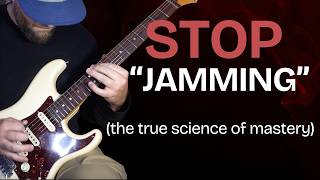

Talent is overrated: 3 habits to cheat guitar
42sChallenges the common belief in innate talent, offering hope to struggling guitarists.
▶ Play Clip"The title is slightly exaggerated ('feels like cheating') but the content delivers three neuroscience-based hacks for accelerated guitar skill development."
This video reveals three neuroscience-backed habits that can dramatically improve guitar playing, moving beyond talent. The speaker shares personal experience and the concept of myelination to explain how deliberate practice builds expert-level skills.
Muscle memory is built through myelination, a fatty layer that insulates neural pathways. Expert guitarists build this through perfect and focused repetitions of specific movements, not mindless jamming.
Experts focus on solving very specific technical problems, such as pick slant on string transitions or left-hand pressure during legato. This micro-level attention builds strong myelin layers.
The speaker demonstrates practicing a harmonic minor run by isolating the difficult pick transition, adjusting pick slant, and repeating at the edge of ability to avoid bad habits.
Practicing multiple skills simultaneously increases cognitive load and wires in bad habits. Isolate skills like alternate picking and legato, practicing each separately before combining them.
Break down a skill (e.g., alternate picking) into core building blocks (grip, pick slant, hand anchoring) and master each from the ground up. Examples from Roger Federer, Michael Jordan, and Jake Workman.
The speaker shows how expert flatpicker Jake Workman isolates forward-leaning pick slant exercises to master fundamental motions, then combines them with other sequences.
Mastering guitar is not about innate talent but about deliberate, focused practice that builds strong neural pathways through myelination, skill isolation, and first principles thinking.
What is myelination?
A fatty layer that insulates neural pathways, making signal transmission faster and cleaner.
02:12
How do expert guitarists build strong myelinated pathways?
Through perfect and focused repetitions of specific movements over a long period.
02:37
What is the key difference between deliberate practice and mindless repetition?
Deliberate practice involves focused problem solving at the micro level, while mindless repetition is casual and often with the brain turned off.
04:19
Why does skill isolation help learning?
It reduces cognitive load, allowing the brain to give full attention to correct movements of each individual skill.
10:13
What is 'first principles thinking' in guitar practice?
Breaking a skill down to its most basic core building blocks and mastering them from the ground up.
11:04
Give an example of a first principle component of alternate picking. (any three)
How you hold the pick, how you anchor your hand, or how you slant the pick during string transitions.
11:19
What did Michael Jordan practice first?
Shots from close range, focusing on perfect form before gradually moving further away.
12:01
For pentatonics with two notes per string, what pick slant is required?
Forward leaning pick slant so the pick escapes away from the low string.
13:03
Myelination Explained
Introduces the core neuroscience concept that talent is built through biological insulation of neural pathways.
02:12Mindless vs. Deliberate Practice
Critically distinguishes between casual repetition and focused problem solving, a key insight for effective practice.
04:19Cognitive Load Reduction
Explains why focusing on one skill at a time reduces errors and builds correct neural wiring.
10:13First Principles in Athletics
Uses examples from Federer and Jordan to show how top athletes break skills into components for mastery.
12:01[00:30] If you've ever felt like some people just have it and you don't, I get it. The truth is, is that talent is overrated. There are three habits that make you so good at guitar that it feels unfair.
[00:43] And they're not sexy, they're not some new trick or gimmick. They're straightforward and very practical, but the thing is, is almost no one doesn't. I myself use these three hacks over the last three or four years to go from this.
[00:55] To this. And this isn't a sales pitch or anything, I promise, but I want you to take this seriously
[01:12] and know that it works and that it can work for you. So I'll tell you that this actually worked not only for me, but for my students as well. So with that said, let's dive in.
[01:47] Hack number one is something called Milano Genesis. This one sounds complicated, but it's the real cheat code, if you will, that your brain uses to get super good at something. So just stick with me for just a second.
[02:00] At the most basic level, every time you do something like play a guitar lick, your brain sends an electrical signal through a network of nerve cells. That network is called a neural pathway. You may already know this. And when those pathways get used a lot, your body starts coding them with something called Milano.
[02:16] This is a fatty layer that acts like an insulation on a wire. And the thicker the Milano, the faster and cleaner the signal travels. So an expert guitarist actually has, on a neurological level, has stronger, faster and better Milanoated neural pathways than most other guitarists.
[02:34] So how is that? Is it just because they were born with it? No, it's because a strong Milanoated neural pathway is built by performing perfect and focused repetitions over a long period of time.
[02:46] Expert guitarists have done thousands of perfect and focused repetitions of very specific movements. An average guitarist spends most of their time just jamming or mindlessly going through a solo over and over which builds weak signals.
[03:01] Whereas an expert guitarist, for example, would specifically focus on something like correct wrist movement of their picking hand when transitioning from one string to another inside the string picking.
[03:14] And they do these perfect repetitions of these single movements over years. And this is what makes them so good. That's why some people, like, backstee, can shred and talk in a second language all at the same time. The Spanish, so this is weird for me, but I'm still playing this and keeping my mind with you.
[03:32] It's one of the most important things. So when I practice it, I'll be able to do this. No, I'm not. Great, I can talk with you and use my brain when I play. That is nice, right? But here's the issue.
[03:44] You can't execute perfect repetitions if you're practicing incorrectly. So here's how they practice. They focus on solving very specific problems at a micro level.
[03:56] Like, for example, the way that they slant their pick on a two-note-per-string sequence compared to how they slant their pick on, say, a three-note-per-string sequence. Or how much pressure they're applying in their left hand when they're doing legato technique.
[04:10] This is the attention to detail that they have. And they obsessively work at this micro level of problem solving every day. Whereas the average guitar player who doesn't have strong, myelinated, neural pathways, whether they like to admit it or not, they don't engage in deliberate focus practice.
[04:29] Most of us for years and years have actually been doing mindless repetition, casual repetition, casual jamming. You know, you repeat something from beginning to end over and over. The brain is kind of turned off.
[04:41] And you're just hoping that the repetition itself will make you a guitar hero. That's why 90% of lead guitar players are average, and only 10% are experts. When sometimes they actually even put in the same amount of time.
[04:55] So let's take a real life example to specifically show you the difference between mindless repetition and deliberate practice, which is focused on problem solving at the micro level.
[05:07] And the difference is important because the line can get blurred very quickly. You can think that you're practicing effectively when in reality your brain is turned off and you're just chronically repeating something over and over. So something that I'm working on is this harmonic minor run, where you have to go five notes up and then three notes back and then repeat that.
[05:25] And this back and forth between strings can be very difficult. The old me would have just mindlessly repeated this over and over at random speeds, probably too high of speeds, and never really got it. And that's what I did for years.
[05:38] Let me show you what it looks like to practice this deliberately and problem solve effectively, so that my neural pathways can become stronger. And once I lock in the correct motions, then I can start repeating it a ton of times to make sure that my neural pathway is myelinated with a thick coat of myelin.
[05:55] As you can see, what we have is five notes up and actually two notes back.
[06:09] Okay, so after working with this, I realized that the most difficult part is what's happening with my pick as I go from the last note on the G string,
[06:21] down stroke on the G string, to up stroke on the D. Right there. And this gets difficult at fast speeds. So to effectively work on this, I'm not just going to repeat the whole sequence over and over.
[06:36] And it's not enough to know that that's where the issue is happening. You have to know why it's happening. And for me, why it's happening is because I have a down stroke here on the G, and then I have to go backwards to the D and up stroke on the D.
[06:49] And it's hard to miss the G that I just hit as I go to the D. So my focus here is tilting my pick or slanting my pick slightly upwards so that the tip of my pick escapes away from the strings as I go to the up stroke on the D.
[07:08] So I do a down stroke on the G and then I have to tilt my pick at an upward slant so it escapes away and misses the G on the way the D. And that's the motion that I'm focusing on. Not only that, but I have to focus on this specific motion at a speed that I consider to be the edge of my ability.
[07:27] If the speed is too fast, for example, I'm going to start developing bad habits and I'm not going to get a solid myelinated neural pathway going. I'm going to start myelinating bad habits actually.
[07:39] So I want to be at the edge of my ability right where things start to fall apart so that I can properly fix the issue which is this pick slanting thing. And then then I can start really drilling in the repetitions once I get the movement.
[08:09] And that's the specific motion I'm going to be focusing on here.
[08:21] I zoomed into a very specific mistake. My pick was getting caught and trapped and on that very specific down stroke on the G up stroke on the D. And I realized I needed to tilt my pick so that my pick escaped away from the G string on the way back to the D.
[08:37] And this is the motion I'm working on. I'm working on staying relaxed and I'm working on this very specific inside the string movement. And this is what all expert guitar players do. They focus on this very micro stuff as opposed to just repeating something obsessively and chronically at random speeds.
[08:54] I'm at a very specific speed at the edge of my ability and that's what's going to cause my neural pathways to become very insulated or myelinated so that I can play clean without thinking about it.
[09:07] So the thing you have to be careful of too with this the last thing I'll say on this is you have to be careful of getting sucked into mindless repetition. I may start out knowing exactly what I'm working on with this very specific pick slant as I transition strings from the G to the D.
[09:21] I may know that but as I repeat it, it's very easy to get sucked into just sort of just hitting your head against the wall and then repeating it over and over without thinking. That you turn the brain off the brain turns off and then you're just you know obsessively repeating it. That's what you want to avoid.
[09:38] You want to stay very mindful as you're working on these very specific details. Then you can start sort of mindlessly repeating it once you get the motions down correctly. Okay, so hack number two skill isolation. Here's the thing that most people get wrong when trying to improve. They multitask.
[09:56] For example, they practice a guitar solo that contains several different techniques like legato and alternate picking and hybrid picking and maybe even sweet picking as well. And they just play the whole solo over and over. When in reality, they should be practicing each of these skills separately.
[10:13] And cognitive science makes this really clear focusing on one skill at a time reduces what we call cognitive load, which lets your brain give full attention to the correct movements of each individual skill.
[10:25] Daniel Coyle, the author of the talent code, clearly demonstrated this in his research from his book. When you try to learn multiple skills at once, your performance slows. Error creeps in and your brain wires in bad habits. So I suggest you start out with one skill like alternate picking.
[10:41] Dedicate at least 30 minutes to an hour of deliberate practice to just that one skill. If you have more time, then dedicate another 30 minutes to an hour to another skill like legato and then combine them together.
[10:54] This is what we do in our guitar program that I have online. We focus on one skill at a time and it works. Hack number three. Think from first principles. Thinking from first principles means breaking a problem or skill down to its most basic core building blocks and then building the skill up from there.
[11:14] Example the first principles of alternate picking are right hand mechanics, how you hold the pick, how you anchor your hand on the guitar, or how you slant the pick when you do certain string transitions.
[11:26] So the idea would be to isolate each of these skills and master them one at a time separately before combining them. World class athletes are well known for thinking from first principles in this way. Roger Federer, tennis legend for example is famous for breaking strokes down to the simplest mechanics.
[11:46] When learning or refining one of his shots, he isolates grip, swing path, and footwork separately before combining them. He practices slowly and deliberately to perfect each component before playing full speed.
[12:01] Or Michael Jordan, who was well known to practice shots from close range first, focusing specifically on perfect form before gradually moving further away from the basket and then incorporating pivoting in fadeaways.
[12:15] So in short, experts break down a skill into the simplest form possible and master it from the ground up. Good example that I have is Jake Workman, he's a legendary flat picker, incredible alternate picker, and we had him on one of our calls that we do every month in our guitar program, and he talked about alternate picking.
[12:34] This thing, and I could do it fast, or whatever, and I was thinking, I can do that, but I'd rather do that.
[12:53] And he talked about how there are specific sequences, like pentatonics for example, that require a forward leaning pick slant. So here's what I mean by that. The way he was talking about is with pentatonics two notes per string specifically.
[13:14] So the last stroke before the new string is an upstroke, which means you have to lean your pick forward like this, so that the tip of the pick escapes away from the low E and clears it on the way to the A.
[13:27] Same thing here on the A, you do it down up, the pick has to escape away from the string and then go to the next one. So this sort of sequence requires a downward or forward leaning pick slant as opposed to an upward leaning pick slant, and this is what he was talking about.
[13:42] And then he went on to talk about how to work on this, he specifically creates exercises to isolate this forward leaning pick motion. I spend most of my time forward leaning on an electric, but it's hard for me because of that, I spend most of my time doing stuff like that.
[14:03] You know, where it's really forward lean, it's a sequence of only forward leaning necessary positioning, you know what I mean? So I do a lot of that type of thing in practice, and I would love to just sit here and go, I don't have to think about that.
[14:18] I don't have to think about that, but doing this versus that's just so at home. So he's an example of someone who thinks from first principles because he recognized that there are two fundamental picking motions, forward leaning or upward leaning or backwards leaning, and he worked on those picking motions separate from each other and then combined them.
[14:42] And if you really want to understand this whole thing about leaning or pick slanting, go to my channel and watch the top three worst alternate picking mistake video. I also use this concept of thinking from first principles to finally hit my top alternate picking speed.
[15:03] I realized that my right hand was fumbling a lot, and at these top speeds, I was starting to tense up and I couldn't make the string transitions. I isolated the right hand, and I started practicing just at my top speed, which was 126 beats per minute.
[15:19] I started getting used to that relaxed wrist movement on one single string first, and then I added one string at a time until I could do the right hand only, just right hand isolated the entire sequence with the right hand isolated.
[15:40] So just to recap, the first hack is mylonogenesis, it's deliberately focusing on and drilling perfect repetitions on a specific problem at the edge of your ability. Problem solving at the edge of your ability to get the movements down perfect and then doing repetitions is what builds strong myelinated neural pathways.
[15:59] The second hack was skill isolation, isolating skills reduces cognitive load and expedites the process of mastery. And lastly, thinking from first principles, this is breaking skills down to their most basic components and mastering them from the ground up.
[16:15] Breaking things down to first principles is a huge part of mastery. And lastly, speaking of pentatonics and pickslanting, if you want to learn a killer way to play pentatonics fast and clean, like Eric Johnson for example, click this video right here, and we'll see you in the next one.
⚡ Saved you 0h 16m reading this? Transcribe any YouTube video for free — no signup needed.