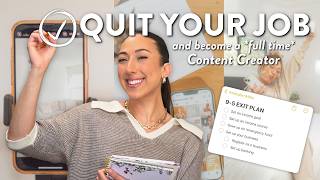

AI Summary
This video from Modern Milly is a practical guide for aspiring content creators who want to leave their nine-to-five and become full-time creators. She shares the mistakes she made during her own transition, the benchmarks that told her it was time to quit, and a clear financial checklist covering income goals, income sources, emergency funds, and business setup.
Chapters
There is no perfect magical moment. The creator waited two years for one before realizing she had to design her own benchmarks.
Before leaving, determine how much you want to earn as a creator, how much to save, and what lifestyle changes you'll accept. She saved 10–20% of her corporate salary and wanted to make half her income ($2,000/month) for about 3 months.
Use this sentence: 'Once I hit X amount of dollars per month for X months, I will feel comfortable leaving my job.' It can be full income replacement or a lower target.
As a self-employed creator, set aside roughly 30% of income for taxes. Overestimate so tax season doesn't catch you off guard.
Money won't appear by itself. Choose brand deals, UGC, TikTok Shop, digital products, or coaching, and build a system that earns while you grow.
They're passive income: create once, set it up to sell, and keep making sales with content around the same topic.
Stan is her favorite tool for a link-in-bio and hosting/selling digital products, so payments and withdrawals stay in one place.
Feed ChatGPT your niche, audience, desired transformation, timeline, and voice. Ask for a viral-style product idea, high-converting title, subtitle, and bonus ideas.
Use Canva free templates to create the guide outline, export as PDF, upload to your Stan store, set a price, and hit publish.
She took on two social media clients at $1,000/month each to replace her income while she grew her own creator business.
She skipped this step and regretted it: after quitting in October, inconsistent income drained her savings and forced her back to a job. Use a calculator to find your number.
Set up a separate business bank account and register an LLC (she used LegalZoom). She uses the Profit First method to allocate income.
Quitting to create content full-time works best when it's a planned exit, not an emotional leap. Build your income stream, tax buffer, emergency fund, and legal structure first, then quit with confidence instead of chaos.
Mentioned in this Video
Tutorial Checklist
Study Flashcards (10)
What income goal did the creator set before quitting her job?
medium
Click to reveal answer
What income goal did the creator set before quitting her job?
$2,000 per month (half of her ~$4,000 corporate income) for about 3 months.
02:20
What phrase format should you use to write an income goal?
easy
Click to reveal answer
What phrase format should you use to write an income goal?
'Once I hit X amount of dollars per month for X months, I will feel comfortable leaving my job.'
03:29
What percentage of self-employment income should be set aside for taxes?
easy
Click to reveal answer
What percentage of self-employment income should be set aside for taxes?
About 30%.
04:12
What is the easiest first income source recommended for new creators?
easy
Click to reveal answer
What is the easiest first income source recommended for new creators?
Selling digital products.
05:50
What tool does she recommend for link-in-bio and selling digital products?
easy
Click to reveal answer
What tool does she recommend for link-in-bio and selling digital products?
Stan.
06:32
What should you ask ChatGPT for when brainstorming a digital product?
medium
Click to reveal answer
What should you ask ChatGPT for when brainstorming a digital product?
A viral-style product idea, a high-converting product title, a subtitle, and bonus ideas to stack the value.
07:39
How do you make a digital product quickly?
medium
Click to reveal answer
How do you make a digital product quickly?
Use Canva free templates to create an outline, export it as a PDF, upload to Stan, set a price, and publish.
08:08
How much should an emergency fund ideally cover?
easy
Click to reveal answer
How much should an emergency fund ideally cover?
3–6 months of living expenses.
12:13
What happened because the creator skipped the emergency fund step?
hard
Click to reveal answer
What happened because the creator skipped the emergency fund step?
She used all her savings when traffic to her income stream stalled, and had to find another job and restart.
12:53
What two actions legitimize your content creation as a business?
medium
Click to reveal answer
What two actions legitimize your content creation as a business?
Set up separate business bank accounts and register as an LLC (e.g., via LegalZoom).
14:27
💡 Key Takeaways
No perfect moment — create your own
Reframes the common waiting-for-signs mentality into an actionable benchmark system.
01:26Half-income benchmark
Using a concrete income target (e.g., 50% of salary) makes the quit decision data-driven, not emotional.
02:20Tax buffer of 30%
A practical, often-overlooked number that prevents creators from being blindsided at tax season.
04:12Digital products as passive income
Explains why creating once and selling repeatedly is the fastest passive income strategy for beginners.
06:06The cost of skipping an emergency fund
A real failure story showing why 3–6 months of expenses is non-negotiable before leaving a job.
12:53Full Transcript
[00:01] started your content creator journey so that you could leave your nine-to-five. when you're ready to leave your nine-to-five? In this video, we're going over how you know when it's the right time to quit your job, the mistakes that
[00:15] I made when I went from my nine-to-five to self-employed, and the exact financial checklist I would recommend to my students who are in my BSP Slack community who want to quit with confidence and not chaos. As always,
[00:29] timestamps are below. Use them if you need them, and let's get into it. First, the right time to quit. The right time is going to look different for everyone. saying that in the sense of like, "There's never going to be a right time,
[00:44] so just quit right now." That's not what I'm saying. I say it that way because I was waiting for the perfect time. I had been thinking about quitting my corporate job for two years before I actually did it. In that waiting time of
[00:59] two years, I was waiting for like that magical perfect moment where the heavens would open up, the doves would fly, and the heavens angel choir would start singing, and I'd be like, "Oh my gosh, it is time. This is my moment. I should
[01:13] that I was waiting for. And then, after two years of waiting for that perfect moment, I realized I wasn't going to have one. There was no perfect moment. There wasn't going to be like a heavens gates open. I realized I had to make
[01:26] that moment for myself happen. So, what I did is I decided to set benchmarks job. It wasn't because I didn't enjoy my job. I loved my corporate job. It was simply because I knew it wasn't what I was meant to do. It wasn't my purpose
[01:41] here on this earth. It didn't fill that deep creative desire that I've always had in me. And I knew content creation was like, that was what I was meant to the benchmarks that I set for myself were things like, how much money did I
[01:53] want to make as a content creator before I quit? Do I want to save up a certain amount before quitting? What sort of lifestyle changes was I willing to sacrifice or make to make that transition easier? For me, I started
[02:08] transition easier? For me, I started saving I think 10 to 20% of my corporate job pay. I moved it to a savings account. I knew that I wanted to make at account. I knew that I wanted to make at least half of my corporate income before
[02:20] month-to-month income was. Let's say it was like $4,000 a month. So, I knew I wanted to be making $2,000 a month as a creator, maybe consistently for 3 months because my corporate job 40 hours a week, but in addition to that extra
[02:34] drive time. And I knew if I could make half of my income with weekends as a content creator, imagine what I could do with that extra time. So, that was kind make half and then I'll put in my 2 weeks so that with that extra time I
[02:48] that. For lifestyle changes that I really needed to just eat out less and usually buying my lunches or buying breakfast on the way to work, dinner on the way home. So, instead I needed to be more intentional with like making my
[03:03] breakfast at home, taking lunch and dinner to work and saving money that way. If I were able to hit all of those things, to me I was like, "Okay, I feel like I have all my ducks in a row to quit my job." So, to help you identify
[03:16] when that right time is and make a proper plan, here is the checklist that I would recommend. This is exactly what I would recommend to my BSP Slack students. So, let's talk about each of these things in this video. First, set
[03:29] an income goal. Now, this isn't I want to land paid collaborations. We want to what you're going to write is you're going to write once I hit X amount of dollars per month for X months, I will feel comfortable leaving my job. What is
[03:45] that number going to be? Well, do you want to fully replace your 9-to-5 income before quitting? If yes, put that number. If no, what number are you willing to hit? So, for me it was half of my corporate income, $2,000 a month.
[03:58] Now, when you are writing down your income goal, you want to make sure you are calculating or thinking about taxes. Because right now, likely, your job your paycheck. You don't have to worry about paying those taxes or most of
[04:12] those taxes. But, as a creator and being a self-employed, basically, business owner, you're going to have to pay those taxes when tax season comes around. And this is probably going to be about 30% of the money that you're making. So,
[04:25] let's say you want to make $1,500 a month from content creation, keep in month from content creation, keep in mind 30% of that is $450. So, really, you'd have 1050 that goes to you and then 450 that you have to set aside for
[04:41] taxes. It is best to set that full 30% aside because tax season comes around, you're going to pay your taxes. Let's say you don't have to pay the full 30%. Let's say you just owe 20% or 10%. You get basically your own tax return. You
[04:56] savings, you pay whatever is left over in your savings, wahoo, you get that money back, and then you keep saving for future tax season. But, it's best to just overestimate, put the full 30% aside. So, write down your income goal,
[05:10] and once you have your income goal set, the next checklist item is to set up your income source. If you want to make $1,500 a month, where is that money going to come from? Do you want to make it working with brands, making UGC,
[05:24] making money on TikTok Shop, selling digital products, offering coaching? How Because, let me say this to you, you do not have to wait for that money to come to you. You don't have to wait for people to slide into your DMs or brands
[05:37] to slide into your DMs and ask to collaborate. You don't even have to be on YouTube yet, or I'm not even monetized on TikTok. I can't make money yet." No. No, no, no, no, there are plenty of ways to make money as a
[05:50] zero. You want to set yourself up for success so that as you're growing, you're making money with your growth. So, let's just talk about the easiest weekend or less and that's selling digital products. The reason I love love
[06:06] number one income stream that I recommend to all of my students in my Slack community is because it's passive income. You do the research, you title it, you create it one time, you set it up to sell, and then if it's living in
[06:20] content around that same topic, you are making passive sales. It's that easy. So, to keep everything as easy as this as fast as possible, you really only need one tool to set up your
[06:32] going to create a link in bio and you're going to do that using Stan. I have been talking about Stan for years, years, years, years. I've loved them since the beginning of time before I've ever like
[06:44] sponsored videos here on my channel. Now, they are a sponsor of this video which is really cool, but I have seen so many of my students have great success list, making money. This is what you're going to do. You're going to put this
[06:59] prompt into Chat GPT, okay? You're going to tell Chat, "Hey, I want to create a $47 digital product that solves a huge pain point for my audience and gives them a clear transformation that they can achieve in a short time frame like
[07:12] get X results in Y days. Can you help me come up with a viral worthy idea and little bit more info about yourself. So, you're going to say, "Here's some info to help you. Here's my niche. My audience struggles with this. They
[07:26] desperately want this. The transformation that they should have by be this. I could help them achieve that in this amount of time. I typically voice is blah blah blah." Like you're going to give as much info as possible
[07:39] to Chat and then you're going to say, "I am looking for you to give me a viral style product idea, a high-converting product title, and a subtitle, and bonus ideas to stack the value." Chat is going to give you some great options, as long
[07:52] don't know. As long as you give it all of the information, you are set. There authentic to you and the creator that you want to be known for. And then, if title, I don't know what to do. How do I make the outline?" One, go to Canva.
[08:08] Click free templates. What do you put in the template? Ask chat. Hey chat, can you help me create an outline for this guide? Here's what I usually teach. Fill teach them. He's going to give you an example outline. You're not going to use
[08:21] it exactly. You're going to take that outline, plug it into Canva, customize actually teach, but it's a great starting point. Then, literally, this is so easy. Export the PDF from Canva, add a digital product to your Stan store.
[08:35] You upload the PDF, set your price, press publish. Boom shakalaka, you're selling a digital product that easily. People can buy the digital product on Stan. You make your money through Stan. You can withdraw your money from Stan.
[08:48] It's literally keeping everything in one place for you. The final step that you have to do is put a call to action in your bio telling people to go buy your digital product. Just put like a short, catchy version of your title in your bio
[09:01] your link. If you like can't think of a short version of your title, ask chat version that I could use in my bio as a call to action?" He'll help you along the way. To make sales even easier, what you're going to do is create content
[09:16] around the digital product. What sort of content should you create? Ask chat GPT. "Wow, great. Thank you so much for helping me. Can you give me 20 video ideas that I could use as reels or TikToks to lead people to this digital
[09:31] of ideas. You're going to pick ones that feel authentic to you, of course, paraphrasing, using your own verbage, making it your own, and in each video let's say the product that you're creating is like a 30-day gut reset, get
[09:46] know. Let's say that's the digital product you're creating. You're going to say at the end of every video, comment reset and I'll DM you a link to my could set up an auto DM where every time somebody says reset, they'll
[10:00] product. They'll be able to purchase it right there off of Instagram and you're making bank. I know, I just like blew a lot of info at you, but I have like full that. Like literally go to my channel,
[10:13] go to the search on my channel and look up digital products. Look up auto DM. to create the digital product, how to set up your auto DMs to make passive sales. I have it all. I have it all for you. If you need the deep dives, go to
[10:26] my channel and check it out. You can do all of that in a weekend. Just follow all the little videos. I think they're like maybe 10 to 20 minutes. Follow them step-by-step and you'll get it done 24-48 hours. Okay, we talked about
[10:38] your income stream when you're setting up an income stream before you leave your job. Something else that you want to consider or an alternative for income is doing some freelance work or getting a part-time job. That's something that I
[10:51] did to help me with my transition. I did seek out and find part-time social media assistant jobs. I found two clients that helped me make $2,000 a month. So one client was $1,000 the other one was $1,000 a month, and I was running their
[11:06] social media for them, but I was able to do that work mostly remote. With one of the clients, I had to go in twice a week, but still worked out. I was way less than what I was doing before. So I had two freelance jobs where I was like,
[11:18] okay, I made $2,000 a month as a content creator, as an educator, and now I have clients that are helping me hit $2,000 a month. That is my full-time income. I am set. I can leave my job. It doesn't have to to client work. It could really be a
[11:31] part-time job just locally around your city. That way you have somewhat of a reliable income source while having that extra time to work on content creation. Okay, now that you have your income source set up or on track, next on our
[11:45] checklist is saving up an emergency fund. As you're building up your income goal, start setting aside a portion of your income to build up an emergency fund. If you aren't able to set aside more of that check, then what I
[12:00] recommend is looking at your current spending habits and asking yourself, "Can I replace my Postmates expenses this month? Can I cancel my Netflix subscription for a few months and allocate that money to my savings
[12:13] account?" This emergency fund ideally will end up being a total of 3 to 6 months of living expenses. And if you want, you could save up more, like 6 to you're like desperate to get out of your situation, 3 to 6 months. For me, this
[12:28] is a step that I skipped. So, it is skippable, but it's something that I wished I didn't skip. I was saving money, but it wasn't 3 to 6 months fully. It was more of like a dollar amount. I think I was like, "Oh, I just
[12:40] want to save up $5,000." And I didn't look at what my current expenses were before I set that amount, so I didn't do anything very strategic about this, and it kind of came to bite me in the butt after because I did leave my corporate
[12:53] after because I did leave my corporate job in October, and then October through February, I was working for myself, but it was very hard, made a few mistakes. Money wasn't coming in as consistently as I thought because I set up my income
[13:06] stream, and then I didn't drive traffic to my income stream. That was my traffic to my income stream, and I was just like posting photos, like, "Wow, I'm self-employed." I dipped into my savings and used up all my savings and
[13:19] find another job. So, even though I skipped this step, it came to get a job again, and then restart the whole process over. So, if you're able thing to save you in the future. What you want to do is you want to make sure
[13:34] you think about any living expenses that you have, and even you could calculate benefits that you might be losing after leaving your job if you have benefits with your job. So, if your job right now covers health insurance, will you be
[13:46] taking that on as an expense? So, you'll want to think of all of your expenses months of those expenses in a savings account. Now, to calculate this, I made a simple plug-and-play calculator for you to use. I'll leave it linked down
[13:59] on the link and plug in your numbers. Plug in your expenses. You'll have to you could change it because other people will have access to this link. So, go to Google Sheets, duplicate the template, and then plug-and-play your expenses. At
[14:13] the very bottom, it'll tell you how much your emergency fund should be. Okay, our final checklist item is to set up your business. If you have the intention to make money as a content creator, it's going to be a good idea to legitimize
[14:27] content creation as your actual business. So long as the intent to make money is there, you want to legitimize. So, to do this, we are going to set up a separate your business and personal expenses and income, and this also makes
[14:41] tax season less of a headache with those split bank accounts. And then you're also going to register yourself or your business as an LLC. Now, disclaimer, this is not legal advice. I'm not a professional in this field. Always
[14:54] consult a professional CPA or legal professional of any sort if you have questions about this. This is simply me sharing with you what I did, what worked for me. Okay, this is what I did. So, what I did for setting up an LLC was use
[15:07] LegalZoom. No, not sponsored. LegalZoom was so freaking easy. I literally just "Oh, I'm in California and want an LLC." Just for letting you know, we did an escort, but focus on LLC. That's for you. Ask a professional.
[15:22] So, you want an LLC, right? Click LLC. You start. You fill out all the blanks. It's like a little form. Oh, what's your name? Milly. What's your address? This. name? It's Modern Milly. Right? So, you just fill it out. You send it. They're
[15:34] packet's going to have a checklist that you follow. You must love checklists. folder of like, "Hey, here's what you need to do. You're going to go to this you're going to fill it out. And then you're going to mail it to this
[15:48] step. Just focus on one checklist at a time and your business will be set up. I have that in mind. But, you're going to be a full-time content creator. You're going to be making full-time money. So, what's $350 if you're making $50,000 a
[16:02] year? No biggie, right? So, we're going to do it. We're going to legitimize our business. Then, for business banking, what we did was we just went to our banking at. We just went to our bank and we're like, "Hey, do you have business
[16:16] account?" And we talked about that process, what that would look like. We because we're like, "Cool, we can do all of that." For us, when we set up the business account, we created multiple like we created a checking account, a
[16:29] savings account, right? We had a savings account in our business just for taxes. income would come into and then we had an account where it's like, "Okay, we're everything." And then we had the savings and that's where we save our taxes. Then
[16:46] we had other accounts. Basically, we set it up following the Profit First method. Amazing book. 10 out of 10 recommend. I'm pretty sure This is the method that we use to organize our finances as a business and
[17:01] what we currently use every 10th and 25th of the month when going through our income. So, 10 out of 10 recommend this book. You don't accounts if it's confusing, but just get out a business bank. I've heard if you
[17:14] "This is crazy. I don't love all these steps. I've heard nowadays there are better alternatives for content creators, that's online banking. There's recommend checking them out. No, not sponsored. And if you're somebody that
[17:27] the US, you're going to have to do your own research. I don't know what it would own research. I don't know what it would look like outside of US. So, I just know like US, just look up how to get an LLC in state on Google and follow the steps.
[17:41] If you follow this checklist to a T, you're going to be able to quit your job and be a full-time content creator. If you need more tips for making money, how to set up your digital products, how to do all of the things, of course, make
[17:54] sure to subscribe to my channel because I create free content like this for you every single week. I want to help you grow and monetize your career as a content creator in the digital space. So, be sure to subscribe. If you have
[18:07] any requests for upcoming videos, let me know down in the comments. And before video next because YouTube thinks you'll like it. Thanks so much for watching. like it. Thanks so much for watching. I'll see you in the next one.