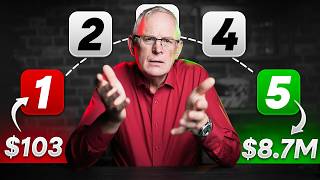

The $10,000 Coffee Habit
45sShocking math on small daily expenses adds up to big money, relatable and eye-opening.
▶ Play Clip"The title promises a method to become a millionaire, and the video delivers a detailed financial plan, though results vary."
This video presents a step-by-step financial framework for saving, investing, and building wealth, based on the speaker's personal journey to becoming a millionaire. It covers budgeting, reducing expenses, paying off debt, and investing in tax-advantaged accounts and index funds.
Small daily expenses like coffee, transport, and subscriptions can add up to $10,000 per year.
List all monthly expenses and split them into wants and needs. Needs include bills and utilities; wants are non-essential purchases.
Add up all needs to get your baseline. Ideally, this should be under 50% of income, but aim for 25%.
If baseline is too high, cut costs (e.g., move to cheaper apartment) or boost income via promotion or side hustle.
After subtracting expenses, put 20% of paycheck into a high-interest savings account (e.g., Ally Bank at ~4% APY).
Save 3-6 months of baseline expenses in a separate account for emergencies like job loss or car repairs.
Use the avalanche method (highest interest first) or snowball method (smallest balance first) to eliminate debt. Avalanche saves more interest.
After debt is paid, invest 50% of income in tax-advantaged accounts (ISA in UK, Roth IRA in US) and buy low-cost index funds like S&P 500.
Set up auto-investing in an S&P 500 accumulation fund. Example: investing $6.50/day grew to 13.68% return.
Use 20% of paycheck to start a side hustle, and 5% for high-risk assets like Bitcoin.
By following this structured approach—budgeting, saving, debt elimination, and investing—you can systematically build wealth and achieve financial independence.
What is the financial baseline?
The total cost of needs (bills, utilities, etc.) per month.
02:26
What percentage of income should the financial baseline ideally be?
Under 50%, but aim for 25%.
02:41
What is the avalanche method of debt repayment?
Pay off debts with the highest interest rate first.
08:28
What is the snowball method of debt repayment?
Pay off the smallest debt first for psychological wins.
09:42
How much should you put into a high-interest savings account each paycheck?
20% of your paycheck.
04:52
What is the recommended size of an emergency fund?
3 to 6 months of your financial baseline.
07:02
What type of account should you use for tax-advantaged investing in the UK?
An ISA (Individual Savings Account).
10:46
What is the average annual return of the S&P 500 mentioned in the video?
8-10% per year.
11:16
How much would investing $250 per month for 45 years at 8-10% return yield?
Approximately $1.3 million.
11:31
What percentage of your paycheck should go to a side hustle?
20%.
15:56
Small expenses add up
Illustrates how seemingly insignificant daily costs can amount to $10,000 annually.
Financial baseline concept
Introduces a key metric for budgeting: the minimum cost of needs.
02:26Debt as a parasite
Metaphor emphasizes the urgency of paying off high-interest debt.
07:42Tax-advantaged investing
Highlights legal ways to avoid capital gains tax and grow wealth.
10:21Side hustle allocation
Suggests dedicating 20% of income to starting a business for faster wealth building.
15:56[00:00] If you spend $5 on a morning coffee on your way to work, $4 on overpriced transport, and $1.40 on unwanted subscriptions every day,
[00:16] then that's the same as spending $10,000 every single year. As soon as they get paid, the money just seems to disappear, because being careful with my money in my late teens
[00:33] to become the first millionaire in my family. I did every time I got paid, so you can apply them too
[00:45] This will not only help you save extra money, and the beauty of all of this, you won't have Right, let's imagine you've just been paid.
[00:58] Believe it or not, this is one even though it sounds simple, especially nowadays, that they find it hard to cut down
[01:12] These might seem small and insignificant, these little pleasures are actually robbing you I still want you to do this exercise.
[01:26] that are draining your money. and split it into two columns, so you've got wants and needs.
[01:39] It's probably best to get around six months worth you repeatedly spend money on every month. Unless you are repeatedly buying a lot of random stuff,
[01:54] I'm more interested in focusing on those little purchases it's time to sort them into the correct column. bills, and other utilities.
[02:09] then it's not a need. restaurants, bowling, golf, whatever floats your boat. out how much each column costs per month.
[02:26] and utilities add up to $1,200 a month. also known as your financial baseline.
[02:41] to see how much you've got left over. under 50% of your total income, I think it should be closer to 25%.
[02:57] as something you can't change as there are things you can do You might need a car, for example, that costs so much?
[03:12] Some apartments can be mega expensive nowadays, but this is where you need to start weighing things up. So consider moving somewhere that you can actually afford.
[03:28] to save up some money that you can invest, Look, maybe you don't want to cut back anymore, but it's worth seeing if there are some areas
[03:42] without impacting the quality of your life too much. you're gonna have to increase your income, by getting a promotion or start a side hustle.
[03:55] than your saving potential. of your paycheck might sound a bit impossible right now but I really do understand
[04:10] I didn't grow up wealthy to boost my income to hit a financial baseline but trust me, if I can do it, so can you,
[04:24] especially with all the online side hustle opportunities then just earn more money. Just treat my 25% rule as a target to work towards.
[04:40] add them all up and subtract them from your wage. Ideally, this should be below 25% of your paycheck to start getting you ahead.
[04:52] into a high interest savings account. of your paycheck left at this point. However, that's not gonna help you build your wealth.
[05:08] into a high interest savings account. it's just too tempting to spend it. an Ally Bank in America.
[05:23] on when you're watching this video. around 4% interest a year, which is around 0.05%.
[05:37] "I know a bank account with 7% interest." to lock away your money for a set amount of time to act as a safety net
[05:53] It's not there to make you money, so locking it away against the point of doing this. to have a safety net.
[06:06] but that's because it's great advice. and at some point, an emergency will come your way. for you when you need it.
[06:20] or the car broke down, you'd be able to cope I must reiterate that this money's only and not just something to dip into when you're running low
[06:34] It's just shocking to me as of May 2023, So if something went wrong, which it will, and would most likely have to take out a loan,
[06:49] with them paying crazy interest rates So how much should your emergency fund be? to five months of your baseline figure
[07:02] Even better if you can stretch that to six months. So once you've put by 20% of your paycheck for enough months to the next places we're gonna be talking about.
[07:16] of your paycheck left by this point. Well, next is the only place Let me explain.
[07:29] a guaranteed profit, then I'd say run away It's normally the grift that's feeding people this garbage. However, in this instance, it's 100% true
[07:42] I mean, why bother investing in stocks for a possible eight to 10% return when you can have a guaranteed 25% return that's constantly eating into your wealth every single day?
[07:58] to eat and exercise routines inside their body sucking away all the nutrients. of that parasite as it's pretty much guaranteed
[08:14] then I would recommend putting the remaining 30% There are two really common methods that you can use The first way is the avalanche method,
[08:28] because you pay off the debt So let's see how this will work in the real world. Debt A is for your credit card
[08:40] and it's $5,000 with an interest rate of 20%. Debt B is a loan from your family of $1,500 And debt C is a car loan for $2,500
[08:54] If you decide to pay $500 per month towards your debts using the avalanche method, this would firstly all go towards debt A until it's paid off
[09:06] and you'll end up paying $515 After this, your $500 payments would go into debt C,
[09:18] which would include $98 and 13 cents of interest. as your family are probably getting a bit impatient
[09:30] and obviously you'd pay no interest. you'd be debt free in 21 months and pay approximately $613 in interest.
[09:42] This is the psychological way to tackle debt The thinking behind this is it makes you feel So you'd pay debt B first,
[09:56] However, if you use this method, and cost approximately $1,700 in interest payments.
[10:08] and over $1,000 more than using the avalanche method. it'll be worth it in the long run. and paid off any high interest debt,
[10:21] you can put that combined 50% towards growing your wealth. is a tax advantaged investing account. of it right away, go to the store and buy something
[10:34] If you own a property, you'll pay property taxes every year. you'll be hit with capital gains tax.
[10:46] but luckily, there's a legal way If you're in the UK, and if you're in the US, you should get the equivalent,
[11:00] which I've discussed in past videos, to invest without worrying about taxes. of your excess money into one of these accounts
[11:16] and invest it in a low cost index fund like the S&P 500. around about eight to 10% tax free per year. and this shouldn't be taken as financial advice.
[11:31] so it's important to understand the risks involved. Just imagine if you invested $250 per month, you'll have 1.3 million in 45 years time
[11:47] Feel free to head over to do the math for yourself. However, if you're consistent,
[12:00] One of my favorite investing platforms is Trading 212 Since I was planning to talk about their app anyway,
[12:12] in sponsoring this portion of the video. worth up to 100 pound to anyone that uses the code Tilbury when they create an account.
[12:25] Both of you will get a free share to set things up on autopilot. between you and your investments.
[12:41] That's why it's best to just set up auto investing. and most of the time, you don't even notice it's gone and have a nice surprise.
[12:54] on Trading 212. which is about six and a half US dollars, of a coffee a day into the S&P 500.
[13:07] since he started its experiment, and as you can see, he's actually invested 1,503 pounds and his investment is now worth 1,707 pounds,
[13:21] which is a 13.68% return on investment. that he completely forgot about this experiment It was a lovely surprise.
[13:33] I'll walk you through it now. to get your free fractional share worth up to 100 pounds, just head over to the portfolio icon
[13:46] and then click on pies and finally create a pie. then click on build a custom pie, add instruments, and then search for S&P 500.
[14:00] that offer essentially the same thing. of the oldest and most trustworthy companies in the game. I also prefer the Accumulation Fund, which is this one here,
[14:17] which is essentially a reward the company gives you So just click on the fund, add to pie, and then make sure to select auto invest
[14:33] Here you can choose how many years you want to automatically invest for, how often you'd like to invest, The longer you can keep this going, the better.
[14:45] if you keep your money invested for over 10 years. on actual stats. but of course, take it with a grain of salt
[15:00] what the stock market is gonna do. However, I think for 99% of people, I used to think of this style
[15:14] even though your capital is always at risk I knew I wanted to be a millionaire one day, I'd have to wait until I was old and gray.
[15:27] through different businesses, at the same time as building those businesses. high reward plays.
[15:42] so if you're happy waiting years to make your first million, However, if you're anything like me when I was younger, Most people online will either teach you the slow lane
[15:56] just discussed, or the fast lane, of getting greater rewards. as I've traveled down both of these paths.
[16:09] of my paycheck towards starting a side hustle You may think that doesn't sound enough but I have a different opinion.
[16:24] especially in the early days of starting a side hustle, which lets you find gaps in the market that most people Now with the final 5%, I'd make the riskiest investment
[16:42] I've avoided talking about this that it's gaining popularity year after year. I've got about 5% of my investment portfolio in Bitcoin
[16:56] However, I'm very aware this is very risky So as long as you are okay with that, If you wanna know why net worth goes crazy
[17:10] but don't click on it just yet. Okay, I'll see you over there.



⚡ Saved you 0h 17m reading this? Transcribe any YouTube video for free — no signup needed.