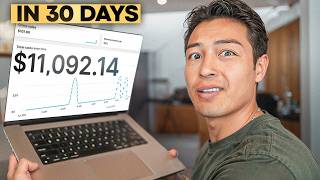

You didn't fail at dropshipping, you quit
45sThis confronts the viewer's past failures directly, creating a strong emotional hook that makes them want to watch the real solution.
▶ Play Clip"A genuinely useful step-by-step dropshipping plan, but the $11,000 profit headline is a hook, not a guarantee."
This video presents a 30-day dropshipping blueprint, breaking down the process into three weekly phases: product research, store setup, and ad testing. It emphasizes building systems over chasing winning products, using data to guide decisions, and the importance of execution over endless learning.
Real dropshipping is about building systems that consistently produce results. Beginners fail because they treat it as an endless cycle of starting over with each new product.
Jumping into store building or ads without validated products is the biggest mistake. The entire first week is dedicated to product research.
Set aside $200 for ads, $100 for tools and apps, and $200 as buffer. If starting with less, cut in half and be more tactical with testing.
Focus on profitability, genuine demand, and whether you can handle selling it. Products that solve active problems people have are best.
Create a fresh Instagram account and engage with sponsored product ads—like, save, and click through—to trigger the algorithm to show more product ads.
Save everything that catches your eye. Read comments for desperation like 'I've been searching everywhere for this'—these signal real demand.
Search for ads running 3+ weeks. If someone is spending money on the same ad for weeks, they're proving it's profitable.
Identify where customers hang out (e.g., dog owner groups, Reddit forums) and observe their constant complaints and requests.
For each product, calculate product cost, selling price, realistic ad cost per sale, and fees. For a $50 product, expect $15-25 in ad costs starting out.
Read 2-3 star reviews on similar Amazon products to learn what's missing from current solutions.
Pick three products that have real profit potential, genuine demand, and are manageable for you. If you don't have three validated products, stay in week one.
Successful dropshippers spend 80% of their time on product research and only 20% on everything else.
Use an AI business name generator (like Design.com) to create a brand name, check domain availability, and generate a logo quickly.
Don't spend weeks perfecting your store. Move fast to launch and test; a functional MVP beats a pixel-perfect store that launches late.
Use the AI store builder Draw Magic with Shopify to generate a professional store in under an hour. Shopify offers $1/month for 3 months.
Paste an AliExpress product link and a competitor's store URL. Draw Magic analyzes the competitor's market positioning and generates copy and design.
Adjust colors, copy, reviews, and mobile view directly in the editor. Publish and connect to Shopify.
Don't just grab supplier videos. Find 3-5 competitor ads in Meta Ad Library that have run for months and analyze their structure.
Create three angles: problem-solution, pure demonstration, and social proof/trending. Test them to see which resonates.
Use the winning ad as a control video. Copy its flow—hook, product demo, benefit, CTA—with your own clips and messaging.
Use CapCut or any free editor. Keep ads around 15-20 seconds, include text overlays of main benefits, and show the product working.
Ugly ads with the right message will outperform beautiful ads with the wrong message every time.
Launching ads is about buying data, not gambling. The data you collect is what makes you profitable.
Start with $25-50/day total via CBO, one ad set with broad targeting, three ad creatives, and optimize for purchases.
Don't touch campaigns for the first 3-4 days minimum. Excessive tweaking prevents the algorithm from optimizing.
Kill an ad if you've spent 2-3x product price with zero sales, CTR is below 0.8%, or zero add-to-carts after spending 1.5-2x product price.
If you get add-to-carts but no sales, it's usually a price or shipping problem scaring off checkout.
Turn off losing ads and allocate the budget to the ad with the best response.
If no ad is profitable, still look for signals like $100 in spend generating $80 in revenue—that shows potential worth optimizing.
Don't view ad spend as a loss; it's buying data on creatives, customer acquisition cost, and market feedback.
Most people never launch. The ones making money are the ones who actually implement what they learn.
The 30-day dropshipping blueprint is a practical, data-driven process: validate products thoroughly, launch a functional store quickly, and test ads systematically. The key to success isn't talent—it's executing consistently and learning from real market feedback.
What is the suggested budget allocation for a $500 starting budget in dropshipping?
$200 for ads, $100 for tools/apps, and $200 as buffer.
01:34
What are the three key criteria for evaluating a dropshipping product?
Profit potential, genuine demand, and whether you can handle selling it.
01:49
What type of comments on product ads indicate strong demand?
Desperation comments like 'I've been searching everywhere for this' or 'This would have solved my biggest problem.'
03:22
Why should you look for ads running 3+ weeks in Meta Ad Library?
Because if someone is spending money on the same ad for weeks, they are making money.
03:35
What should you look at on Amazon to improve a product?
The 2-3 star reviews to understand what's wrong with current solutions.
04:55
What are the three ad angles recommended for testing?
Problem-solution, pure demonstration, and social proof/trending.
15:43
What is the recommended daily ad budget testing structure?
$25-50 per day total via CBO, one ad set with broad targeting, three creatives, optimizing for purchases.
20:54
When should you kill an ad?
If you've spent 2-3x product price with zero sales, if CTR is below 0.8%, or if you get zero add-to-carts after spending 1.5-2x product price.
21:53
What does it mean if you get add to carts but no sales?
Usually a price or shipping problem scaring people off at checkout.
22:33
What percentage of time do successful dropshippers spend on product research?
80% of their time on product research and 20% on everything else.
05:48
Why does the creator recommend using a fresh Instagram account for product research?
Because your personal account is trained on your own preferences; a fresh account lets you train the algorithm to show product ads.
02:30
Build Systems, Not Shiny Objects
This reframes dropshipping from product-chasing to sustainable system-building, a core principle for long-term success.
00:58Research Is 80% of the Game
A concrete time-allocation rule that shows where dropshippers should focus most of their effort to avoid failure.
05:48Speed Beats Perfection
Launching a functional MVP faster than competitors allows you to gather real market data earlier, a critical edge.
10:02Message Over Polish
A practical reminder that ad performance is driven by compelling messaging and structure, not cinematic production value.
18:25Execution Is the Ultimate Differentiator
Most people never launch; this highlights that implementing the blueprint is what separates winners from the rest.
24:39[00:01] some easy way out, some shortcut, please skip this video. But if you're still about you. You're watching this at some ungodly hour, probably after seeing another 19-year-old posting screenshots of their 50k month, and you're sitting
[00:14] Now, here's my second assumption. You've already tried drop shipping before. spent a few hundred bucks on ads, or you never even launched because you got product. Either way, it didn't work. And now you're wondering if this whole thing
[00:28] actually happened. You didn't fail at drop shipping. You failed because nobody people think drop shipping is about finding one winning product and riding happens to most beginners. They find something that works, they ride it until
[00:43] find the next shiny object. That is not a business. That is an endless cycle of starting over. Real drop shipping, it's about building systems that consistently going to show you the exact process, the same 30-day blueprint that took me from
[00:58] counting change for gas money to having absolute freedom to book a flight on a Now, this isn't about overnight success. You're probably going to test products that fail, and that is a part of the process. But if you actually follow what
[01:10] real business by the end of it. So, let's stop watching other people's success stories and build your own. All right, so week one, this is where a big chunk of people completely screw up. Even from the beginning, they jump
[01:22] straight into building a store or running ads without having any idea what they're actually selling or who they're selling to. So, this entire first week, research. Now, before we start, let's talk money. If you've got, let's just
[01:34] say $500 to start with, here's how you should think about it. $200 we're going to set aside for ads, $100 for any tools and apps, and $200 buffer for any total, cut everything in half and be more tactical with your testing. Now,
[01:49] understand what separates products that make money from ones that don't. Now, most people, they get excited about cool gadgets or trendy items, but that's not what matters. What matters is very simple. Will this be profitable? Is
[02:03] there genuine demand? And can I actually handle selling this? Now, when I'm evaluating products, here's what I focus on. Can you make decent profit per sale product cost, shipping, ads, transaction fees, all of it. You need to have enough
[02:16] time. Now, the products that work, they solve problems people actively have, not necessarily problems you think that they should have. Because if people aren't not going to create some sort of demand from scratch. So, the first thing that
[02:30] you're going to do is create a fresh Instagram account specifically for your personal account. It's already trained on what you like, not what other scrolling through your feed and look for any sponsored content or videos that are
[02:44] that include a product. Every single engage with it. I want you to like it, save it, click through to see where that or the learn more button, click through
[02:56] here is we're telling the algorithm, I'm someone who wants to buy products is that within the next 20 to 30 minutes, your feed will start showing you more and more product ads. Now, here's the thing. For the first few
[03:09] days, I just want you to collect. Save everything that catches your eye. And potential products before you start filtering. And for each product, you really want to read every single comment. You're looking for desperation,
[03:22] example, comments like, "I've been searching everywhere for this." Or, "This would have solved my biggest problem." These are great examples. Now, these products successfully. So, for each of your products, use the meta ad
[03:35] you want to be looking for ads that have been running for 3 plus weeks. Now, if someone's spending money on the same ad for weeks, they are making money. It's spend money on an ad if it's not making the money because Facebook ads are very
[03:49] ads, read those comments. Are people sharing stories about needing the product? Are they tagging friends? That's going to be real demand that you need to be looking for. Then you want to find where your customers actually hang
[04:02] out. So if you're selling, for example, pet products, you want to find dog owner groups, pet training forums on Reddit, wherever it may be. Just try and observe what problems are people constantly complaining about. What solutions are
[04:15] they desperately asking for? Now, here's where we get into the math. You need to figure out which of these products are actually worth pursuing and which ones you should just forget about. So, for each remaining product, I want you to
[04:27] calculate your real profits, your cost, your selling price, what you're realistically spending to get each sale, and all the fees and other costs. So, If you're selling something for $50, you might spend anywhere from $15 to $25 on
[04:41] ads to get that sale when you are starting out. So, add in your product and you need to make sure that there's still decent money left over. If the margins, move on to the next product. Now, go to Amazon and find the exact
[04:55] product or something very similar. And you want to read the two and three star exactly what's wrong with the current solutions. And that right there is going decision time. I want you to pick your top three products. You don't need some
[05:08] like crazy complex scoring system. Just pick three that have the following, have real profit potential, have people genuinely wanting them, and you can there. That's it. Look, you might be tempted to speed through this. Don't do
[05:21] make money or you lose money over the next month. Now, by the end of week one, you should have three validated products that solve real problems for people who Now, if you don't have that, stay in week one. Don't move forward until you
[05:35] do. The key is completing each task thoroughly. Whether that takes you 7 days or 4 days, rushing through this without doing all the actual work is drop shippers spend 80% of their time on product research and 20% of their time
[05:48] on everything else. All right, so week two, you've got your products. Now, we where I'm going to save you weeks of headaches. Most people overcomplicate perfect setup before they even know what works. We're going to keep it simple.
[06:02] This entire setup is really about two things. Getting your store live and creating the content that's going to be driving sales, and that's pretty much Amazon here. We're trying to build something functional that can start
[06:14] making money, aka your MVP, your minimum a product to build this brand around, the next step is setting up a store that actually converts. But before we build anything, we need a solid brand name.
[06:28] the most creative person when it comes to coming up with a brand name or really anything creative. So, I prefer to use AI towards my advantage. If you are, then all power to you. But I like to use this website right here called design.
[06:44] So, I like to use this AI business name generator. So, all you have to do is type in some keywords related to the products that you want to sell or within the niche that you want to sell. So let's just say I do CrossFit
[06:57] let's just say I do CrossFit gym workout and then we'll generate from there. All right. So we have iron forge powerhouse crossfit zone. We can also toggle between the length if we want it to be short, medium, long, various
[07:09] styles. Let's do something creative and then update. All right. So let's just say for example that I like this iron pulse name right here. It's going to populate logos for us. But before that we need to make sure that the name is
[07:21] websites and then domain names. And then we could type in iron pulse. And what we're looking for here is the dot domain. And we can see that iron pulse is not available. Iron and pulse is available. So if we wanted this iron
[07:36] pulse name really bad, we could just do something like iron pulse official or shop iron pulse. So we can see that Iron Pulse official is in fact available. So all you really have to do is press buy now. It's going to be $16 for the year.
[07:49] so that anytime someone types in ironpofficial.com Shopify store. So definitely something that we are going to want. So now that that we are going to want. So now that we have the domain secured to get a logo
[08:03] it's super simple. We just go to logos and then from here uh we don't need the official. We just do like iron pulse and then we can play around with the styles. You could go fitness. Let's try and see what corporate looks like. Corporate
[08:17] what corporate looks like. Corporate looks pretty good. wordmark corporate. So, this actually looks pretty solid. It's clean. It's basic. Don't really need the slogan right there. Just like that. And you can play around with the
[08:30] customizations. And if I want this domain, all I have to press is download. So, within a matter of minutes, I was able to come up with a brand name that sounds like a legit company. I was also able to get that.com so that anytime
[08:44] someone types in the brand name.com, they're going to get redirected to my website and then a high-quality logo to make my brand feel fresh, to make it feel like a legit company. Now, here's the thing. Having a solid brand name
[08:57] isn't just about looking professional or sounding cool. It's actually about the lands on your store, they're making split-second decisions about whether to trust you with their money. With that said, a well-branded store just converts
[09:10] better. It's that simple. People feel more confident buying from a brand that sounds legit than they do from a random website that looks and sounds like it perfection every single time. Now, most people treat store building like they
[09:23] They want everything pixel perfect before they launch. While you're spending 3 weeks perfecting your homepage, someone else just launched a already making money. And I learned this the hard way. Now, my first store took
[09:36] me a month to build because I was obsessing over every little detail. And had already been saturated by someone who moved faster than me. Now, the market doesn't care if your store wins design awards. It cares if your store
[09:49] confident buying from you. Now, here's what I wish someone had told me, and that speed is your biggest competitive advantage when you are starting out. The store live, the faster you can start testing what actually works. And the
[10:02] crazy part is that the tools that we have now make this stupidly easy. What used to take me weeks can literally be done in under an hour. And I'm going to walk you through exactly how to do that. And this right here is the best AI store
[10:14] builder at this time of recording. The first thing that you need to do is sign up for Shopify. You can go down to the description and I'll leave this discount free trial and then it'll only be a dollar a month for the next 3 months.
[10:27] that after you've signed up and paid that $1 for the store builder itself. It's called Draw Magic and I'll link it in the description of this video. All you have to do is pick an AliExpress product or you can get the website from
[10:41] wanted to sell this product. I have the AliExpress link here and I also have the brand that I want to replicate or emulate. We recommend that you actually copy the competitor solo link because it's going to do its market research.
[10:57] figure out why it's working, and then use that as inspo. So, all you have to do is copy and paste, and it's analyzing the store. It's doing its market research, and it's trying to figure out how this company has angled this product
[11:10] based on the current copy that's on the website. From here, obviously, I want to selling to? So, here we're trying to find our target audience. So, now it's to choose from. So, let's go the anti-aging angle right here. So, we'll
[11:26] select that and then we will select all the other images as well. And then we're as you can see, it's starting to build out the template. And off of first glance, look at how good that it looks. It's doing its market research and it's
[11:41] coming up with a copy. And my favorite part about this builder specifically is how interactive they make this. You can see that we can make adjustments on screen simply like this. The UI is just so clean. And so if I want to change
[11:55] this color scheme to blue, I can do it just like that with the click of a button. And then we have the various color palettes, primary, secondary, accent, the icons, the border radius, so on and so forth. It's structured
[12:07] extremely well, and the copy is in line with what we initially chose, targeting our ICP, our ideal customer profile, along with that hook angle that we chose, which is anti-aging. It's also been able to pick up reviews and add in
[12:20] real reviews from the product. Of course, when you're editing, you do want to see how this looks on mobile. So, most of your editing, you want to edit on this screen, mobile screen. And if you want to see how the store looks like
[12:34] this QR code with your phone, and you can see how it looks. So, if you want to add in any other product, all you have to do is press add a new product, insert the AliExpress link of that product, and then it's going to be added to your
[12:47] product catalog. So, I've went ahead and already built out the store. This is the homepage. I basically just inserted some more images. I played around with a copy and some of the structure, but we can see it looks pretty similar to the
[13:02] original, but the main structure does look a lot better. Then I add the before look a lot better. Then I add the before and after just like that. Some imaging, scarcity, social proof, and this is what it looks like on mobile. Images look
[13:15] pretty clean. You have the drop downs, images, sliders, and here are my ICP African-American person cuz that's how my competitor was going about their targeting as well. And so, if I am currently happy with all the adjustments
[13:30] publish, all you have to do is press this publish button, connect your store, if you guys don't already have a Shopify store, we have a $1 offer linked for 3 months. So, Shopify for $1 for 3 months. Really, really good deal. You're not
[13:45] So, you can sign up there. If you do already have a Shopify store, you can simply press existing Shopify store. Link up your Shopify account. All right. So, the new store has been published. I personally like to do all my changes on
[13:59] the Drop Magic editor just because I think it's a lot easier to do it on rather do on Shopify and move around these sections, that's totally fine as well. If we go on to the product page itself, it's going to be here. It's
[14:11] going to look exactly how we just had it. So any adjustments that you want to make to either the title, the media, so any of the images, you can rearrange them, you can change them out, you can delete them, and the price, you would
[14:23] all do on the product page specifically. You wouldn't do it on the Shopify theme main thing is that you're not trying to trying to build something functional so that you can focus on what actually
[14:36] gets people to buy. All right, so now need to create the content that's actually going to drive sales. And this because most people think that they can just grab some random video from the
[14:49] supplier, throw it up as an ad, and immediately start making money. That is not how any of this works, at least anymore. Maybe in 2018 when people were less hesitant purchasing online, but not now. So, the first thing that you need
[15:02] to do is understand that successful ads follow specific patterns and well, spending thousands of dollars a day on ads have figured out what works and we their approach. So, here's exactly what I want you to do. I want you to go back
[15:17] to the meta ad library and I want you to find your top three to five ads for similar products or the same product that you're selling from your competitor a ton of different videos, images, text copy, but we're looking for ads that
[15:30] months. Now, if someone's spending money on the same ad for that long, they are making money. Now, I want you to watch these ads and take notes on the following. What problem do they lead with within the first 3 seconds? How do
[15:43] What is the main benefit that they keep hammering? What is their call to action? Now, here's what we are going to create. We're going to create three different ad angles for the exact same product. And you're probably wondering why three. And
[15:56] message is going to resonate with your audience until you test it. Angle number one is going to be your problem solution. So you want to start with the problem being absolutely terrible, then show your products solving it perfectly.
[16:09] products that solve obvious pain points. So angle two is going to be pure demonstration. So just show the product working. And in this one, there's going to be no need for you to do any fancy storytelling, no elaborate, crazy
[16:22] setups. Just here's the product, here's what it does, here's how it helps you. So I want you to lead with an audio. Like for example, this product is trending everywhere right now. You've probably seen that before. Or see why
[16:35] thousands of people can't stop talking about this. So show multiple real customers actually using and enjoying the product. And in the end, you can create some sort of urgency with phrases like almost sold out or limited
[16:47] your video editor or you have someone do any editing for you, here's what you those winning ads that you found in the meta ad library and use it as your control video. And I'm talking about literally having your phone out while
[17:02] you are creating your version or give this specific video to your editor. Now, you're not copying it word for word, but you're using it as a template for structure. So, things that you should be thinking about are how long is their
[17:16] hook, when do they show the product demo, where do they put their strongest me show you exactly what I mean. So, if their ad goes problem, product, demo, benefit, call to action, then yours should follow that exact same flow just
[17:31] with new clips and messaging. So, for the actual creation, you can use Cap Cut or honestly any free editor that out there on the internet. Don't overthink formula. I want you to keep them short. So, around anywhere from 15 to 20
[17:45] seconds. This also depends on how long your control video is. So, if it's 10 seconds, then run it as 10 seconds. If it's 45 seconds, then run it as 45. text overlay calling out the main benefit. Show the product actually working, not
[17:58] just sitting there looking pretty. And the main thing is you're not trying to reinvent the wheel here. This is something that a lot of you guys need to try and get in your head because someone has already figured out what works. Just
[18:11] adapt their structure with your product. And that's going to be way easier than starting from scratch trying to do this from absolute ground zero. Now, here's the thing. Ugly ads with the right message will outperform beautiful ads
[18:25] with the wrong message every single time. So focus on the message, not making it look like a Hollywood production. So we are at the end of week two and let me tell you what you should have by now. You should have a
[18:38] professional looking store that doesn't scream drop shipping. Three different ad creatives ready to test. Everything set up and ready to launch. Now is your Are your ads going to be the best thing that anyone has ever seen? I doubt it.
[18:53] something functional that can actually start making money. And that's way further than 90% of people ever get because most people are still watching product while you're about to start collecting real data from real
[19:08] you guys are thinking, "This makes sense, but what if I mess up on the ad testing the wrong way?" Here's the thing. I've already burned through tens works and what doesn't. Now, the difference between me now and me 5 years
[19:22] ago isn't talent. It's that I've made nearly every expensive mistake already. one-on-one mentorship program. So, instead of you figuring this out over the next 6 months of trial and error, we fasttrack everything for you and give
[19:35] you the proper guidance and resources to get the best possible result. Now, our team works directly one-on-one with you. We find products together. We review your ads before you launch. look at your data and tell you exactly what to
[19:47] optimize. It's like having legit a figure partners guiding you for 10 weeks and we can only work with a few people because we're actually in there with and being like figure it out yourself. So, if you're interested and have the
[20:01] take this serious, there's going to be a link below for you to apply. But whether you work with us or not, the main thing is that you've got to actually execute week three, this is where everything that we've just built gets put to the
[20:15] three, this is where the rubber meets the road. You've got your store built. you're actually going to start spending money on ads. Now, I get it. This is for most of you. You're scared you're going to lose money. You're scared your
[20:30] you've picked the wrong product. And that is completely normal. You are not the only person. But here's how I want you to think about it. You're not spending money. You are buying data. And that data is what's going to make you
[20:42] profitable. So this entire week is about getting campaigns live and collecting real market feedback. And we're not going to be going crazy with budgets. I see a lot of beginners launching with $200 a day budgets on their very first
[20:54] campaign. That's not testing. That's basically gambling. So here's exactly how you structure your testing this week. So, first a $25 to $50 a day total budget via a CBO, campaign budget optimization. That's it. One ad set with
[21:10] broad targeting because Facebook's algorithm is way smarter than your guesses about who your ideal customer profile is. Three ad creatives testing adset. And I want you to optimize for purchases from day one because we want
[21:25] buy things, not just view things. And the main thing is that don't touch anything for the first 3 to 4 days minimum. Seriously, I see too many people tweaking their campaigns, touching things after 8 to 12 hours and
[21:39] isn't working." Well, it's because you keep touching things. And that's because you're not giving the algorithm enough time to actually optimize. So, after 3 to 4 days of data, here's when you know that an ad is dead. So, if you spent two
[21:53] zero sales, kill it. So, if you're selling a product, for example, for $40 and you spent already $80 to $120 with nothing, it's done. If your nothing, it's done. If your click-through rate is below a8%
[22:07] after you've spent a decent amount of money, kill it. That means that people just aren't interested in your creative, so they aren't clicking through from interested enough to. And if you're getting zero ad to carts after spending
[22:20] 1.5 to two times your product price, kill it. That's just a clear signal that your product or your messaging isn't connecting. Now, if you're getting add to carts but no sales, that's usually going to be a price or shipping problem.
[22:33] People, they clearly like the product enough to add it to cart, but there is something that's scaring them off of the checkout. So, by midweek, you're going to have some data to work with. Maybe one ad is completely dead. Maybe another
[22:47] one got a few clicks, but no sales. And maybe, just maybe, you have one that got Here's what you're going to want to do. Turn off all the losers and put all that budget into whichever ad is getting the best response. So instead of three
[23:01] different ads spending $15 each or however much money being allocated to those adsets each, you've got one of those ads with the $45 $50 a day budget. So the same total spend, but now you're feeding the ad that's actually getting
[23:15] thinking. But Andy, what if none of my ads are profitable yet? And that's totally fine because you're looking for signals of life, not for immediate is, let's just say for instance that you spent $100 and you've made $80 in
[23:30] revenue. So you're still technically losing money. It's not a winner yet, but it's showing some potential because people are actually buying your stuff. That's what you optimize and work with, not the ads that are getting zero
[23:42] response. And what I really want you to do is not to get emotional with this stuff because these losing ads are most likely dead unless you make any major changes to them. So the main thing is that identifying which creative is
[23:55] connecting with people even if the numbers aren't profitable yet. So by the few sales and you're close to breaking even. More realistic, you've probably got one or two sales and you know exactly what needs fixing. Worst case,
[24:08] you have no sales, but you know why. And that is not a failure. That's just what I want you guys to realize. Your first campaign is probably going to lose money. And that's totally normal. When you spend $200 on ads this week, you're
[24:24] not losing $200. You're buying data on which creatives work, what your true customer acquisition cost is, and real market feedback. Now, here's what is who quits after seeing some red numbers. Most people watching this will never
[24:39] actually implement it. They'll watch, take notes, maybe bookmark it, and then I get it. It's way easier to keep watching videos than it is to actually do the work. It's way more comfortable to stay in learning mode than to risk
[24:53] your $200 on ads that might not work. But here's the thing about staying in planning mode is that you'll never know if this works for you until you actually about drop shipping, but none of that matters if you never launch your first
[25:05] campaign. The people making real money in this space, they're not the smartest most resources. They're the ones who actually implement what they learned. you actually follow this plan, I mean, really follow it, not just think about
[25:19] by the end of this month. Maybe it's $500 in revenue. Maybe it's $2,000. even profitable. The exact numbers don't matter. What matters is that you'll have a real business foundation, real data, real experience, and that's worth way
[25:33] watch. Most importantly, you'll know if this works not because someone told you it works, but because you've proved it to yourself. So, stop planning and start executing. Your first product research session starts today. And when you've
[25:47] profitably, that's when you can come back for the scaling playbook. But you've got to earn that conversation first. Let's get to work.


⚡ Saved you 0h 25m reading this? Transcribe any YouTube video for free — no signup needed.