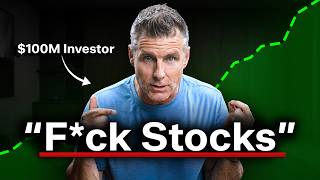

Rich People Don't Start with Stocks
60sChallenges the common belief that investing in stocks is the first step to wealth, offering a contrarian perspective that intrigues viewers.
▶ Play Clip"Solid wealth-building advice, but the '2026' angle is just a hook — the content is timeless, not time-sensitive."
Dan Martell, a multi-millionaire entrepreneur and angel investor, shares his four-stage framework for building wealth. He argues that most people skip the critical early stages of trading and buying back time, which keeps them from reaching true financial freedom.
There are only two things you can trade to get more money: time and money. Rich people don't start with stocks; they start by trading their time.
Use your time to invest in yourself—get around mentors, show up, work late, stack skills, and build reps. Time is the first resource you ever have.
Once you have money, you hit a wall: you have a shortage of time. Hire experts and assistants to do work you don't need to learn, so you can focus on higher-value activities.
Audit everything you've done over the last two weeks. Highlight energy-draining tasks in red and mediocre tasks in yellow, then delegate the low-value ones to others.
Dan's executive assistant and house manager buy him back 100 hours a week, allowing him to focus on revenue-generating activities and innovation.
The 1% don't get rich from stocks; they get rich from buying back time and then deploying money into assets. Dan became an angel investor and made a multi-billion-dollar return with zero time invested.
Money sitting in a bank account is not working for you. Your job is to be a professional capital allocator and put dollars to work.
Invest in what you know, keep it simple enough to explain in one sentence, and only invest in things that will always be true. Play the long game.
Wealth is created by owning equity, not by working. You can't work enough hours to create real wealth; you must own a business or equity in other companies.
Put 50% of your money in a 'don't lose it' pile and invest the other 50% in yourself, your companies, and things you own where equity grows.
The best investment Dan ever made was building a company he could sell. A company that is sellable is a great company to run.
The path to wealth is a four-stage stack: trade your time, buy back your time, put your money to work, and own equity. Each stage feeds the next, and the higher you go, the bigger the swings.
What are the two things you can trade to get more money?
Time and money.
00:28
What is the first stage of wealth building?
Trade your time: invest time in skills, mentors, and reps.
00:15
What is the 'buyback loop'?
Audit your last two weeks, highlight red (energy-draining) and yellow (mediocre) tasks, then delegate low-value tasks to others.
01:34
How many hours a week do Dan's two assistants buy back for him?
100 hours a week.
03:14
What did Naval Ravikant say about wealth?
Wealth is created by owning things, not by working.
09:32
What are Dan's three investment filters?
Invest in what you know, the investment must always be true, and play the long game.
06:22
What should you do if you can't explain an investment in one simple sentence?
Stay away from it.
07:29
What is the only asset with uncapped upside?
Equity.
10:51
What is the best investment Dan says he ever made?
Building a company he could sell.
12:56
What does Dan say your bank account is a lagging indicator of?
Who you are and what you believe.
13:23
The Buyback Loop
A practical, actionable audit-and-delegate process that lets anyone free up hours of their week.
01:34Three Investment Filters
Simple, memorable rules that protect investors from fads and overcomplicated scams.
06:22Wealth Is Created by Owning
Naval Ravikant's core insight that equity ownership, not labor, is the true engine of wealth.
09:32The Best Investment
Reframes investing as building a sellable company, which is both a great business and a great asset.
12:56[00:01] money to turn cash into more cash. And it doesn't matter how much experience building and exiting three companies, becoming a multi-millionaire at 28, and Canada, here's what I've learned. Rich people don't start with stocks. [music]
[00:15] There's actually two more stages before that that most people completely skip, and that's what keeps them broke. Starting with stage one, trade your time. There's only two things you can trade to get more money, time and money.
[00:28] You got all the time in the world. You get around mentors, you show up, you work late, you stack skills, you build reps. Essentially, you use your time to invest in you to get a return. Time is the first resource you ever have. You
[00:43] can waste it or you can invest it. Do what I didn't have all the money, I used my drive time to learn, listen to audiobooks. I got around other people that were smarter, and I got curious and quiet, and I executed so they'd want to
[00:55] pour more into me. I took on projects where I didn't necessarily get paid a lot so that I could get exposed to bigger ideas. I took my time, and I put myself in a place where the time got me a return. You can make decent money
[01:07] going to hit a wall because you won't have a shortage of money, that'll start to pile up, but you will have a shortage of time. Stage two, buy back your time. Think about it, when I hire a stock broker to invest for me, I'm buying
[01:20] their expertise to invest in a market that I don't have to go learn so that I can get the return without doing the time. Warren Buffett is literally deploying billions of dollars into companies, and he's buying all that time
[01:34] it took to build that company using his money. One of the best ways to figure a process I call the buyback loop. The first thing we have to do is audit our we've done over the last two weeks, and really write it down. Then you highlight
[01:50] everything in red that takes your energy, and then yellow's kind of mediocre. And right next to it, I write down, is this a $1 sign cheap to pay somebody else to do for me, or is it a $4 sign if I had to pay somebody to do
[02:03] everything that is a one or two dollar sign in cost that's red or yellow, and you make a bucket, and you put it in a bucket. What you do with that bucket is to transfer your task, delegate [music] the red stuff, the yellow stuff, the low
[02:18] value stuff to anybody else. You want to invest your money to get all those things out of your calendar to other people so that you can go to three, leverage work. These are the things that light you up, that make you a ton of
[02:32] revenue generating activities, things when you're out there talking to people, product, the innovation. It's not getting bogged down in emails and scheduling and purchasing stuff that other people could easily do for you.
[02:45] just hire people to grow your business, you want to hire people to buy back your time so that you end up not overwhelming yourself, and you can make more money. I Ann, who is my executive assistant, now chief of staff, she handles everything.
[02:59] My calendar, my appointments, my emails, all the interactions with different manages the professional side. Then I have Betty, who manages our house, all my real estate, all my vehicles, and she reports to Ann. Those two people buy me
[03:14] literally 100 hours a week that allows me to invest my time in things that make you're hiring an executive assistant, but have no idea how to work with them, teaches everything. It's what I use with
[03:28] my assistant, every template, every workflow, everything my EA uses daily. If you want it, just go to Instagram @danmartell and DM me the word YouTube will say to me like, "Dan, I can just do this better myself." And I say, "Of
[03:41] course you can." The problem is is that you'll always be stuck being the person that can do this. You never learn how to work through somebody. The next level for most people is actually learning to let go. See, most people like to spend
[03:53] time to save money. I will drive 20 minutes all the way to save 3 cents on gas. I like to spend money to save time. And because I'm a good time trader, it's in my life. >> So, now that you bought back your time,
[04:06] money work for you. >> I just learned a simple concept when I do the work where it makes me enough money where I don't have to work. think that's what they're supposed to do and that's
[04:20] >> They start investing in funds and stocks and real estate because they got a rich. So, now I'm investing. >> The problem is is they're not good enough, they haven't learned how to buy back their time and that's why they stay
[04:33] >> [music] >> to have our money make money for us. >> See, the 1% don't get rich from stocks, [music] they got rich from stage two. >> They got rich from understanding how to buy back their time so they can make
[04:45] to invest in things where they have equity, where they own things. to pile up my cash, >> I realized that I had enough money to when I became an angel investor. [music] >> One of those deals, for example, was a
[05:00] >> So, the founder shows up at our office. I'd met him at an event. >> He shows me this new product. I think it's cool. I've got money saved up to telling me he's going to meet with Marissa Mayer from Google and Jack from
[05:13] Twitter. So, I invest. >> That company became a multi-billion >> And when you ask me how much time >> I put in, the answer is none. >> I deployed my money, my money grew. >> And I got really good at making those
[05:26] number one angel investor in Canada because I bought back my time to learn the skills to find the entrepreneurs to invest in that allowed me to have my >> I've learned that having money in a bank account doing nothing for me is not how
[05:42] I get my money to work for me. And what my job is is being a professional capital allocator. I got money, I want to allocate it. What do you got? Here's my portfolio, here's what I know, I stick to what I know, and I put my money
[05:55] to work. To me, dollars are like little potential workers that need to be put to work. If you leave them in your bank account cuz you're like, oh, this feels safe, they're not working for you. There should not be money just sitting around
[06:07] waiting. Waiting, yes, to be put to work, but not just like lazily hoarding here's a few things that I think about to make sure I know where to put my money. First, I like to invest in what I know. My new philosophy is, unless I
[06:22] something because of my background experience, I'm not going to do it. I investments like the S&P through an index fund with low fees, or I invest in software and technology cuz that's what
[06:35] said to me, he said, "Dan, making money's easy, keeping it is hard. When you get a lot of money, take half, put that in the don't lose it pile, to reinvest in yourself, in your business, in growing things. You know,
[06:49] hilarious. I'm not an idiot, but sometimes I can act like one. Guy comes to me and he's like, "Hey, I got this investment where if you invest in medical supplies through this nonprofit, we can give you a triple return receipt
[07:02] on your money to write off on your taxes." And I was like, "I hate taxes, tell me all about it." And he even brought me to a seminar, and I went to people in the room, and they're talking about this investment strategy, and
[07:15] you this. So, we did it. Seven years later, I end up paying hundreds of because I listened to somebody explain something I couldn't explain. So, make sure that you can explain your investments in one simple sentence to
[07:29] somebody that doesn't know a lot. If it's too complicated, stay away from it. The second is the investment has to always be true. See, if you're always chasing fads, you will get burned by the fads cuz essentially all you're doing is
[07:41] playing a lottery game. I'm a software guy. I'm an innovation guy. I look for where the future is going. But in my decisions to invest, I'm still following the human part of it. I'm not sitting here going like, "Oh, I think in the
[07:54] I think they'll just beam things through their brain." That might happen. But if I'm investing today, I'm not investing at that level. I'm investing in things humans always need? They'll always need housing, they'll always need food,
[08:08] always need clothing. These are things that will always be true. They might change in the vehicle that it's delivered, right? It used to be delivered on a horse, then a car, and now it's over the internet. But humans
[08:20] will always buy stuff. Those are like the fundamentals. And then the third is play the long game. If somebody came to me and said, "Hey man, I can make you 10x on your money in the next 6 months." I say, "Cool, no thanks." They're like,
[08:32] rich?" Good news is, I'm already rich by not playing that game. I like to my money, I want it to make me a lot of money over a long period of time. Why? Cuz then I'm saving my time. I know some people that actively manage their
[08:47] portfolio that do worse than shitty managers, and they lie to themselves, refreshing, checking the stock, doing this. I'm like, "Bro, why don't you go money, and put your money in this thing that averages 10, 12% a year, and has
[09:02] for 100 years, and go stock more cash into the vehicle?" Don't play short-term games, especially short-term people. All right. Stage one is where you got your back your time. Stage three is where you put your money to work, and stage four
[09:18] is where you build real wealth. Stage four, own the thing. One of my early mentors, when I moved to San Francisco, this guy named Naval Ravikant, told me this and was very clear. Wealth is created by owning things. Wealth is not
[09:32] created by working. You can't work enough hours to create the kind of wealth that anybody in Silicon Valley was talking about. You have to get there by owning equity. Now, you either own equity in the business that you built or
[09:44] you own equity in other companies like we talked about in the last stage. The stock market may get you 10% a year and it may even make you a millionaire, but where you can do anything with anybody at any time. That is rarefied air and
[09:59] people do you know that invested in the stock market and still aren't rich, back to work because the market went like this right when they're about to retire. I know a lot of 70-year-old people that are still working because
[10:12] solve the problem for them. You can become a millionaire investing in the stock market. Cool. But if you want to get to a place where you have millions of dollars being generated every month when you're not working, you have to own
[10:26] your own thing. You have to own equity in other people's things. See, rich people don't rent wealth, they own it. If you look at the Forbes list, 100% of them made that money because they own the business they were in and then they
[10:38] took the cash and they invested in other businesses that they also own. Because equity is the only asset where the upside is uncapped. Even in real estate, like, "Hey, I bought a 32-unit multi-family building." Cool. Guess
[10:51] you can do some value add. Sure, you can get some rezoning. Sure, you can try to there's some tax benefit, but at the end of the day, a business that's growing without you there can grow as big as it possibly can. My dad doesn't understand
[11:06] why I still do what I do because his perspective is that if you show up, you work. He doesn't know how I work. So, every time I've sold a company, he Okay, you're going to retire. Okay, you're Why are you still creating?"
[11:19] just shared with you guys is that I've used my money to invest in people so the companies I'm involved in, I don't operate them. I've taken my money to invest it in things I know because I will bet on me every day, all day more
[11:32] than some money manager in the market. So, yes, 50% of my money. Don't lose it. I have a great team. They battle test it, legal, insurance, and infrastructure, and all that stuff, tax, capital gains, awesome. Don't
[11:45] lose my money. Over here, I invest in me. I invest in the people. I invest in my companies. I invest in things that I own, where the equity continues to roll in and grow a lot faster. So, if you're good at something
[11:58] and you know how to do something, not investing in that more, align other people around it, that ecosystem, is a huge missed opportunity. And that's why I built Martel Ventures. Essentially, it's a studio for me to build tools like
[12:13] Apex that helps me build other tools within Martel Ventures. And the whole ecosystem of talent and people in my world, I get a place to go create with them. For me, that is my empire. When I wrote in my book, Buy Back Your Time,
[12:28] Build Your Empire, that's what I meant. There's a world where you could create for yourself that you almost feel guilty for how you interact and work with the everybody's building something, and from an equity point of view, you have big
[12:43] haven't watched my video on how I'm check it out. I show you the people, the process, the whole thing. I'm building it in public. The best investment I've ever made wasn't a stock. It wasn't real
[12:56] estate. It was building a company I could sell. Even if I never wanted to sell it, a company that I could sell is a great company to run. And maybe your next stage is hiring that person to help you run it so that you can go work on
[13:08] bigger things. So, don't just graduate from one stage and get really good at buying back your time, and then chilling out on a beach. Stack all four. Each stage feeds the next one. And the higher you go, the bigger the swings.
[13:23] Now, if you're still trying to make some money, let me share this with you. Your bank account is a lagging indicator of who you are, what you believe you're >> [music] >> right? And you'll never get what you
[13:36] want, you get who you are. And if you don't realize that you got to become the it, then the money will never catch up. So, understand, these are tactics and strategies, but the best way to invest [music] is by looking at the person in
[13:49] the mirror. So, just leave me a comment below and let me know what you needed to hear most. What resonated with you most today that you can take with you to if you want my full executive assistant playbook that I use with my own EAs,
[14:02] Instagram and I'll send it right over. Now, if you've ever wondered why dumb people make more money than you, click here and I'll see you on the other side.


⚡ Saved you 0h 14m reading this? Transcribe any YouTube video for free — no signup needed.