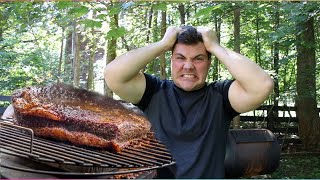

Cooking at the wrong temp ruins brisket
46sDirectly addresses a common frustration with specific temperature advice for different smokers, sparking debate and saving viewers from ruined meat.
▶ Play Clip"The video delivers exactly what the title promises: a thorough breakdown of 12 specific brisket mistakes with actionable advice."
Jeremy Yoder from Mad Scientist BBQ lists and explains 12 common mistakes people make when smoking brisket. The advice covers temperature control, rub selection, timing, resting, and trimming, with specific recommendations for different types of smokers.
Different smokers require different temperatures. Small offsets: 250F, big offsets: 275F, ceramic cookers and pellet grills: 225F, Weber Smoky Mountain/Kettle: 225-250F (up to 275F if rushing).
For high-smoke offsets, simple salt and pepper is best. For pellet grills, a more complex rub can supplement flavor, but avoid over-covering the surface to allow smoke penetration.
Always add 2.5 extra hours to your estimated cook time. Brisket can stall or finish early; resting longer is better than serving undercooked meat.
Rest allows rendered fat to distribute. For cooks under 8 hours, rest in cooler immediately. For 8-12 hours, cool to 180F then rest. For 12+ hours, cool to 165-170F then rest. Minimum rest 1 hour, aim for 2+. Serve at ~145F.
Change only one variable at a time to understand its effect. Since outdoor cooking has many uncontrolled factors (humidity, wood moisture), controlling changes helps consistency.
Five signs before wrapping: 1) Color (dark = good smoke), 2) Bark formation, 3) Sweat (brisket shrinks ~40%), 4) Fat render (yellow and soft), 5) Temperature (usually 175-185F). Use temperature as a fail-safe.
Spray only the meat to protect it; the fat needs to get hot to render. Spraying fat is counterproductive.
Know your cooker. Offsets rarely over-smoke; smokers with smoldering wood chunks can. Use color and bark as clues to adjust smoke amount.
Keep temperature consistent (within 20F for most smokers, 10F for offsets, 5F for large pits). Drops cause brisket to cool and lose cooking time; spikes cause burning.
Buy the best brisket you can afford – at least Choice grade, Prime from Costco is affordable. Wagyu is optional but not necessary for great results.
Wrap tightly – foil should trap steam, paper should be snug. Loose wrapping allows steam to escape and defeats the purpose.
Do not remove all fat (brisket will dry out) but be merciless on thin parts of the flat. Trim off pieces that could burn and use them for burgers or sausages.
What temperature should you cook brisket on a pellet grill?
225°F
01:03
What are the five signs to look for before wrapping a brisket?
Color, bark, sweat (40% shrinkage), fat render (yellow and soft), and temperature (175-185°F).
08:47
Why should you spray the meat and not the fat when smoking brisket?
The fat needs to get hot to render; spraying it is counterproductive.
12:45
What is the minimum recommended rest time for brisket?
At least 1 hour, but 2 hours is better.
06:29
For a cook that takes 10 hours, what rest protocol does Jeremy recommend?
Pull the brisket, let it cool to about 180°F, then rest in a cooler.
05:33
What grade of brisket does Jeremy suggest as a minimum for good results?
Choice grade.
15:19
Why should you change only one variable at a time when cooking brisket?
Because outdoor cooking has many uncontrolled factors; changing one variable helps you know its effect.
07:47
What temperature range does Jeremy typically wrap a brisket?
175 to 185°F.
11:13
Temperature by Smoker Type
Provides specific temperature ranges for different smokers, a key variable often overlooked.
00:09Rest Times Are Critical for Moisture
Emphasizes that professional pitmasters rest brisket for 6-12 hours, a practice many backyard cooks ignore.
04:24Five Signs Before Wrapping
Offers a multi-sensory checklist (color, bark, sweat, fat, temp) rather than relying solely on temperature.
08:14Meat Quality Matters
Advises buying at least Choice grade brisket, with Prime being an affordable option at Costco.
14:57Be Merciless When Trimming the Flat
Practical tip to remove thin parts of the flat that would dry out, and use them for other purposes.
17:14[00:00] hey guys welcome to mad scientist
[00:01] barbecue i'm jeremy oder and today i'm
[00:02] going to tell you about the 12 most
[00:04] common brisket cooking mistakes
[00:09] brisket mistake number one cooking at
[00:12] the wrong temperature
[00:13] now this happens all the time because
[00:17] usually people aren't cooking on the
[00:19] same type of smoker
[00:20] as they might see somebody else cooking
[00:21] on in a video for instance
[00:23] there are probably very few people out
[00:25] there who cook on a thousand gallon pit
[00:26] like aaron franklin does
[00:28] he's going to cook at 275 285 and he's
[00:31] going to get very different results than
[00:32] if you try to cook at those temperatures
[00:33] on your weber kettle so the point is
[00:36] this
[00:37] figure out the right temperature for
[00:38] your smoker and you're going to have
[00:40] much better results now
[00:42] franklin can cook a lot hotter on his
[00:44] pit because he has so much convection
[00:45] moving through there that it's
[00:46] constantly cooling the brisket and as a
[00:48] matter of fact if you tried to cook a
[00:49] brisket at 225 it would take him
[00:51] 27 28 hours so this one isn't quite as
[00:55] extreme
[00:55] but it's pretty close so for me i gotta
[00:57] cook it 275 or else my brisket's going
[00:59] to take forever to get done
[01:01] now if you have say a pellet grill if
[01:04] you cook at 275 you're probably going to
[01:05] burn your brisket
[01:06] so it's usually smarter on a pellet
[01:08] grill to cook at 225
[01:10] or if you have a green egg i would
[01:12] suggest something like 225 because
[01:14] there's not tons of air rushing past
[01:16] that brisket to cool it down all the
[01:17] time so
[01:19] basic guideline okay a small offset 250
[01:22] is good
[01:22] a big offset 275 is good ceramic
[01:26] cooker like a kamado joe or big green
[01:27] egg i'd recommend 225
[01:29] i'd also recommend 225 for pellet grills
[01:31] and then on a weber smoky mountain or a
[01:33] weber kettle i would say
[01:35] 225 up to 250 if you're really trying to
[01:37] rush it you can go hotter up to 275
[01:40] and you probably won't burn anything but
[01:42] the best temperature for flavor and
[01:44] results would be
[01:44] the 225 to 250. mistake number two
[01:48] using the wrong rub when people cook
[01:51] barbecue
[01:52] they either tend to go in two directions
[01:54] there are two extremes
[01:55] one is they want to use a rub that has
[01:58] tons of flavors in it and they may even
[02:00] combine two or three different rubs just
[02:01] to try to pack as much flavor on the
[02:03] exterior surface
[02:04] of the brisket as possible and then
[02:05] other people will go to
[02:07] ultimate simplicity just salt and pepper
[02:09] now
[02:10] the correct answer depends on the kind
[02:12] of cooker you're using again
[02:14] so if you're using a big offset salt and
[02:16] pepper you're going to be totally fine
[02:17] there's going to be so much flavor that
[02:19] accumulates on the exterior surface of
[02:20] that brisket that you're not going to be
[02:22] wanting for anything else
[02:23] now if you're using something that
[02:25] doesn't produce a ton of smoke flavor
[02:26] don't hate me pellet grill users but
[02:28] pellet grills just don't produce as much
[02:30] flavor as a big offset
[02:32] it can still produce great flavor and it
[02:34] can still produce a good amount of that
[02:35] flavor
[02:36] but you may want to supplement with more
[02:38] things more spices
[02:39] in that rub but i would caution you
[02:41] against using
[02:43] too much and covering the whole surface
[02:45] so that smoke flavor doesn't really
[02:46] penetrate
[02:47] so i would say find a happy medium so
[02:51] if you're using a big offset then you
[02:52] add salt and pepper all the way to go or
[02:54] even a small offset salt and pepper
[02:56] you're going to be totally fine but if
[02:57] you're cooking on another kind of smoker
[02:59] i would say keep the rub simple so you
[03:02] can add more things like
[03:03] onion and garlic maybe dry mustard
[03:04] powder things that you like
[03:06] or some chilies but don't go so heavy
[03:08] with the rub especially with the fine
[03:10] particles
[03:10] that it covers up the surface and you
[03:12] don't get the smoke flavor that's the
[03:13] whole reason
[03:14] you're barbecuing in the first place all
[03:16] right mistake number three and this
[03:18] is a big one and it's true no matter
[03:21] what kind of smoker you're using
[03:22] okay it is not allowing yourself enough
[03:24] time before you have to serve the food
[03:27] this has inevitably gotten everybody who
[03:29] barbecues well i would presume
[03:31] almost everybody who barbecues if not
[03:32] everyone because a lot of times you'll
[03:35] say
[03:35] you know what i think it's going to take
[03:36] about you know 10 hours to do this cook
[03:39] and then i'll let it rest for an hour
[03:41] and then the guests will be there about
[03:42] 30 minutes after that it's all going to
[03:44] be fine
[03:44] but the problem with doing outdoor
[03:46] cooking is that you can never
[03:48] really predict exactly how the cook is
[03:50] going to go sometimes you'll have a
[03:51] brisket that stalls out forever and
[03:53] doesn't want to finish sometimes you
[03:54] have a brisket that gets done two hours
[03:55] early
[03:56] so what i would say is if you're trying
[03:57] to feed guests make sure you give
[03:59] yourself
[04:00] more than enough time so you could
[04:02] calculate exactly how long you think
[04:03] it's going to take
[04:04] i would say add an extra two and a half
[04:06] hours to that
[04:07] and then you're safe because you can
[04:08] always let the brisket rest for a little
[04:10] longer
[04:11] but if you don't give it time to finish
[04:13] then you're going to have hungry guests
[04:15] and you're either going to make them
[04:17] wait too long
[04:18] or you're going to serve something
[04:19] that's not quite done both circumstances
[04:21] provide
[04:22] less than ideal results mistake number
[04:24] four not allowing your brisket to rest
[04:26] long enough now this is something that
[04:28] gets overlooked a ton
[04:30] in backyard cooks but it's something
[04:32] that's very important to the
[04:33] og pit masters if you go to places like
[04:36] memphis or
[04:37] the central texas region as a matter of
[04:39] fact when i went to austin the last time
[04:41] when i was hanging out with the guys who
[04:42] were running pits
[04:43] most of the time they didn't give a crap
[04:45] what what i was using they didn't care
[04:47] about the rub i was using you know what
[04:48] they talked to me about they talked to
[04:49] me about
[04:49] rest times and how i rest my brisket and
[04:52] a lot of those guys are resting for six
[04:54] eight 10 even 12 hours before they serve
[04:57] the meat
[04:58] and there's good reason for it because
[05:00] resting it allows
[05:01] the rendered fat inside the meat to
[05:03] distribute really well you're going to
[05:04] have
[05:05] brisket that's more moist and it's going
[05:07] to be the right level of tenderness if
[05:09] you rest it properly like that so what i
[05:10] would suggest for most backyard smokers
[05:13] is this if you cook is eight hours or
[05:15] less
[05:16] say you have a small cooker and it just
[05:18] cooks quickly and you
[05:20] finish up in eight hours what i would do
[05:22] is upon removing that brisket
[05:24] i would take it put it in a cooler and
[05:26] allow it to stay hot in there and slowly
[05:29] come down in temperature
[05:30] if your cook takes between 8 to 12 hours
[05:32] what i would suggest
[05:34] is you pull the brisket you let it come
[05:36] down to about 180 degrees then
[05:38] allow it to rest in a cooler if your
[05:40] cook takes 12 hours plus
[05:42] i would suggest pulling the brisket
[05:44] allowing it to cool to
[05:46] 165 170 and then place it in the cooler
[05:49] to slowly come down to a serving
[05:51] temperature of about 145 degrees or so
[05:54] and the reason that i give different
[05:56] rest protocols for different times of
[05:58] cooking is because
[05:59] the longer the cook takes the more time
[06:01] that brisket is spent at a high
[06:02] temperature
[06:03] which is kind of the reverse of resting
[06:05] for a long time afterward
[06:07] so if you have a long cook time you
[06:09] already have some rest period built in
[06:11] but you want to make sure that you have
[06:13] ample time for everything to distribute
[06:15] and everything to kind of equalize in
[06:17] that brisket before you actually slice
[06:19] it
[06:19] you don't want to cut into the brisket
[06:20] too hot and you don't want to let it
[06:22] cool too much
[06:22] but if you serve it at about 145 degrees
[06:25] with a nice long rest
[06:26] minimum of one hour you should really
[06:29] strive for at least two hours of rest
[06:31] then you're going to be pleasantly
[06:32] surprised with how much better the
[06:34] product is
[06:34] than when you just pull it out let it
[06:36] cool down quickly and slice into it
[06:38] big mistake number five is making
[06:40] changes that are too big
[06:42] what i mean by that is this when you're
[06:44] doing a brisket
[06:46] right unless the last time you did it
[06:47] was a complete horror show and
[06:49] everything was a complete disaster
[06:51] don't change everything so i know some
[06:53] people will do a brisket one way and
[06:55] then they'll change
[06:56] everything about how they did it so
[06:58] they'll change the temperature that they
[06:59] were cooking at
[07:00] they're gonna change the rub they're
[07:01] going to change the injection or they're
[07:02] going to
[07:04] not inject when they did the time before
[07:06] and they're going to do different wood
[07:08] everything is different they're going to
[07:09] go with a water pan when they didn't
[07:11] have one last time
[07:12] so essentially what you're going to find
[07:14] out is if you make those big changes
[07:16] you're not really going to know how to
[07:18] deal with all those changes at the same
[07:19] time
[07:20] and then also if it turns out that you
[07:22] do one and it's good or it's bad
[07:24] you're not going to know what thing
[07:26] affected that cook
[07:27] so if you make small changes and you
[07:29] kind of have a slow progression toward
[07:31] the exact kind of brisket you want to
[07:32] make you're going to be much more
[07:34] successful
[07:34] than doing wild and crazy things each
[07:36] time because you're not going to have
[07:38] the consistency or the experience with
[07:40] all those different changes to make sure
[07:41] that you produce the best brisket
[07:43] possible
[07:43] now from a science perspective we want
[07:45] to control as many things as possible
[07:47] because when you're doing outdoor
[07:48] cooking there are a lot of things that
[07:49] you don't have control over
[07:50] you don't have control over the
[07:52] temperature outside you don't have
[07:53] control over the humidity outside
[07:54] you don't have control over every aspect
[07:56] of what's in each piece of wood
[07:58] because they're all a little bit
[07:59] different the moisture content might
[08:01] vary from one piece to the next
[08:02] so in order to have as much control over
[08:05] your final outcome
[08:06] as possible only change one tiny thing
[08:09] at a time
[08:10] so that way you don't have wild swings
[08:12] in the quality of what you make
[08:14] brisket mistake number six looking for
[08:16] the wrong
[08:17] signs in your brisket what i mean by
[08:19] that is people are going to look for
[08:22] usually one of two things before they
[08:24] wrap and they usually
[08:26] look at the temperature and for most
[08:28] people that's the only thing that
[08:29] they're really checking
[08:30] and the second thing that they'll look
[08:31] for is time so a new brisket smoker
[08:34] might think
[08:34] oh i should leave it on the smoker for
[08:37] four hours before i wrap it or
[08:39] whatever they have been told it's not
[08:41] about time
[08:42] and then it's also not ultimately about
[08:44] temperature even though that's a part of
[08:45] it
[08:45] what i would suggest is there are five
[08:47] things to look for
[08:49] before you wrap your brisket and i'm
[08:50] gonna break them down pretty simply as
[08:52] simply as i can
[08:52] for you right now number one color
[08:56] this is going to be your proxy for how
[08:59] much smoke flavor
[09:00] you put on the brisket so the darker the
[09:01] brisket generally speaking
[09:03] the more smoke flavor you have on it so
[09:05] you want to make sure you have a good
[09:06] amount of smoke flavor because that's
[09:08] the whole reason you put it in a cooker
[09:09] and not in an oven anyway
[09:11] number two we'll look at the bark itself
[09:13] so if you have a build up
[09:15] of stuff on the exterior surface where
[09:17] you have a combination of the rub that
[09:18] you use
[09:19] the fat render and the meat itself
[09:22] kind of all turned into this delicious
[09:25] covering on your brisket
[09:27] when you have a good bark on the
[09:28] exterior and once you've had good bark
[09:30] you'll know exactly what i'm talking
[09:31] about
[09:31] once you have that on the outside that's
[09:33] one of the necessary conditions before
[09:35] you wrap
[09:36] number three is going to be this despite
[09:39] what you may believe
[09:39] you actually want your brisket to sweat
[09:41] out a bunch of water in the cooking
[09:43] process
[09:44] so you lose a bunch of the water and the
[09:46] brisket shrinks down in size
[09:48] so for me when i see that the brisket
[09:50] has shrunk about 40
[09:51] that's the sign for me telling me it's
[09:53] time to wrap now what can happen is
[09:55] if you don't allow it to sweat out
[09:57] enough water before wrapping
[09:58] it will fill the wrap itself with lots
[10:01] of moisture and you get the soupy stuff
[10:03] that washes off all the bark that you
[10:04] worked so hard to create
[10:06] you don't want that make sure that your
[10:07] brisket loses enough water
[10:09] and as a consequence concentrates that
[10:12] flavor
[10:12] and then you're going to have a better
[10:14] bark and a better brisket in the end
[10:16] number four fat render this is something
[10:18] i get asked about all the time
[10:20] what i talk about when i say rendered
[10:21] fat is when the fat on top of the
[10:23] brisket turns yellow and when you poke
[10:25] it
[10:25] there's not resistance it doesn't bounce
[10:27] back like rubber
[10:28] it goes and your finger just pokes in it
[10:31] you look at it it's yellow it's soft
[10:33] that is rendered fat when the fat has
[10:35] rendered that's another key
[10:36] you have to look for before wrapping
[10:38] your brisket and then finally number
[10:40] five
[10:40] is temperature now temperature isn't the
[10:42] be-all end-all
[10:44] of when it's time to wrap but it's one
[10:47] component that i look for
[10:48] and it's usually the one that i look for
[10:49] last so basically i'll check those other
[10:52] four things
[10:52] and when they're all the way i want them
[10:54] then i'll check the temperature
[10:56] and it just tells me that i'm not crazy
[10:59] you know it's just a kind of a fail-safe
[11:01] for me to make sure that
[11:02] i'm not just way off base with where i
[11:04] think this brisket is in its cooking
[11:06] process
[11:06] so i will tempt the point and i'll tempt
[11:08] the flat and usually the temperature
[11:10] that comes up
[11:11] is anywhere between 175 to 185
[11:15] that's when i usually end up wrapping
[11:16] briskets i've wrapped them as low as
[11:18] 161.
[11:19] i've wrapped them as high as 195 but
[11:22] usually
[11:23] the way it works out when i've got to
[11:24] cook everything's going right it's
[11:26] between 175 and 185
[11:28] that all those four other things show up
[11:30] and so if you're not
[11:31] super confident about identifying those
[11:33] other four characteristics
[11:34] you can use temperature as a best guess
[11:36] to figure out when it's time to wrap
[11:39] bonus tip if you don't have a digital
[11:41] instant read thermometer
[11:43] get one it will save you money in meat
[11:45] that you don't ruin
[11:47] so a lot of people like to use leave-in
[11:48] probes when i'm cooking say 20 briskets
[11:50] on here
[11:51] i'm not going to stick in 20 probes but
[11:54] what you get with a digital instant read
[11:57] thermometer that you just poke in
[11:58] is two things number one is you don't
[12:00] have to deal with a bunch of wires and a
[12:01] bunch of
[12:02] hassle to use it it's very simple it's
[12:04] very compact
[12:05] number two is when you actually poke in
[12:07] the probe
[12:08] you can get a feel for the texture of
[12:10] the meat so there are going to be times
[12:12] when you poke a brisket you're like oh
[12:13] that feels great it's like
[12:15] softened butter this guy is done then
[12:17] other times you try to poke it in you're
[12:18] like oh this is still really tough this
[12:20] is going to need more time
[12:21] i don't even care what the thermometer
[12:22] says i know by virtue of the feel of
[12:24] this brisket
[12:25] that it's not ready yet and by the way
[12:27] my favorite digital instrument
[12:28] thermometer is the thermapen
[12:29] i've had a bunch of them in the past and
[12:32] i've spent more money
[12:33] on those other cheap ones because they
[12:34] break or they rust
[12:36] or they get wet then i spent on one
[12:38] thermal pen that has lasted me
[12:40] without any problems at all so if you're
[12:42] interested in one of those i'll put a
[12:43] link in the description down below
[12:45] brisket mistake number seven this is a
[12:46] quick one when you're spraying your
[12:48] brisket
[12:49] don't spray the fat because you want the
[12:51] fat to get hot you want it to render
[12:53] you spray the meat to protect it the fat
[12:55] doesn't need any protecting so spray the
[12:57] meat if you get some of the spray on the
[12:58] fat it's not the end of the world
[13:00] it's just counterproductive to the
[13:01] ultimate ends of rendered fat and moist
[13:03] brisket
[13:04] without burning any of the meat so spray
[13:06] the meat not the fat
[13:08] brisket mistake number eight over
[13:09] smoking or under smoking
[13:11] the meat now this comes down to knowing
[13:14] your cooker and how much wood you can
[13:15] use
[13:16] before you get too much smoke flavor and
[13:19] it starts to taste
[13:20] bitter and not enjoyable so on something
[13:22] like an offset like this
[13:24] there's no amount of smoke flavor that
[13:25] i've ever had come off of this thing
[13:28] that i would say is too much or
[13:29] anything other than oh that tastes
[13:31] really good i want more of it
[13:32] there are other smokers so if you're
[13:34] using something that kind of smolders
[13:35] wood chunks you can
[13:36] definitely oversmoke the meat i know
[13:38] when i first started barbecuing i did
[13:40] that because i thought if smoke is good
[13:41] more smoke is better
[13:43] but that's not always the case so use
[13:45] those other clues
[13:46] like the color of the brisket and the
[13:48] kind of bark you're forming to figure
[13:50] out how much smoke you're actually
[13:51] putting on the meat and don't over smoke
[13:53] it
[13:53] mistake number nine wild temperature
[13:56] swings now they're going to be some
[13:57] cookers where this isn't a problem if
[13:58] you've got a pellet smoker
[13:59] you're not going to be having huge
[14:01] temperature swings you're good you can
[14:02] skip this one move on to the next tip
[14:05] but if you have an offset smoker it's so
[14:08] so important that you
[14:09] keep the temperature consistent because
[14:12] if you let your fire die down
[14:13] not only are you not cooking during that
[14:15] time the brisket is cooling off
[14:16] so say you fall asleep for an hour not
[14:18] only were you not cooking that brisket
[14:20] for that hour
[14:20] for an hour the brisket was going down
[14:22] in temperature so you've lost more than
[14:24] just the hour you fell asleep
[14:25] so keep the temperature consistent for
[14:27] that reason number two
[14:28] is if you have wild temperature swings
[14:30] way up and way down
[14:31] you're going to end up burning parts of
[14:33] the brisket and you're not going to get
[14:34] the consistent level of doneness from
[14:36] one side to the other
[14:37] that you want so if you can stay you
[14:39] know plus or minus probably
[14:41] 20 degrees you'll be good right on uh
[14:44] 500 like this you can stay
[14:45] plus or minus 10. uh on a thousand
[14:48] gallon you could probably stay plus or
[14:49] minus five
[14:50] but the smaller the smoker the harder
[14:52] that battle is but the more you work at
[14:54] it the better your results are going to
[14:55] be
[14:56] brisket mistake number 10 getting low
[14:58] quality meat now
[14:59] as in many things in life you get what
[15:02] you pay for
[15:03] when you buy meat so get the best
[15:06] brisket you can afford now if you can
[15:08] afford
[15:09] you know wagyu beef then by all means
[15:11] get wag view beef
[15:12] but that's really expensive you don't
[15:14] have to get wagyu beef to make great
[15:16] brisket
[15:17] so i would say get at least choice
[15:20] because otherwise you're setting
[15:21] yourself up for failure if you get
[15:22] select brisket it's going to be really
[15:23] really really tough to make great
[15:25] brisket you have to really know what
[15:26] you're doing
[15:27] and so these are common mistakes to
[15:28] avoid so i'm guessing that the people
[15:30] who are watching this
[15:31] don't have tons and tons and tons of
[15:33] experience cooking brisket so i'd say
[15:34] get at least choice if you can get prime
[15:37] get prime
[15:38] so most people have access to a costco
[15:39] where they live and at costco you can
[15:41] get prime briskets for
[15:43] not too much money so you can probably
[15:44] spend about 60 bucks and get a prime
[15:47] brisket now with that you can actually
[15:49] make tremendously good barbecue
[15:51] and you don't have to feel like you're
[15:53] sacrificing or compromising on meat
[15:54] quality
[15:55] and you give yourself the best chance to
[15:56] make a good brisket in the end by
[15:58] starting off
[15:59] with the best meat from the beginning
[16:02] now that rule for meat quality
[16:03] generally holds true for all kinds of
[16:05] meat no matter what it is
[16:07] but sometimes there are exceptions for
[16:08] instance the best beef rib that i've
[16:10] ever made and my wife's favorite that
[16:11] i've ever made
[16:12] was a choice beef rib but we had the
[16:14] benefit there of it being a beef short
[16:15] rib that's already packed with fat and
[16:17] it just happened to be
[16:18] the stars aligned to make that a perfect
[16:21] beef rib so
[16:22] you don't have to give up on making
[16:24] great brisket if you can't find prime
[16:26] but prime is going to give you the best
[16:27] chance of making good stuff in the end
[16:29] mistake number 11 is wrapping improperly
[16:32] and what i mean by that is
[16:34] pretty simple when you wrap the brisket
[16:36] whatever you're using to wrap
[16:37] do it well so if you're using foil make
[16:40] it nice and tight you don't want a bunch
[16:42] of steam escaping
[16:43] because if you're using foil you're
[16:45] doing it specifically to trap all that
[16:46] steam in there
[16:47] don't let it escape or else the wrapping
[16:49] isn't going to do exactly what you want
[16:50] it to do
[16:51] with paper a lot of times people will
[16:53] wrap it loosely the first time i tried
[16:54] to wrap it in paper i just wrapped it
[16:55] loosely and
[16:56] it was leaking everywhere and it didn't
[16:59] really work
[17:00] it kind of protected the meat a little
[17:01] bit but it was awful i would not
[17:03] recommend it so i'd say
[17:05] wrap it tightly and wrap it well because
[17:08] that way you're going to achieve exactly
[17:10] what the purpose of the wrap
[17:11] is in the end last but not least
[17:14] mistake number 12 improperly trimming
[17:17] your brisket now there are two extremes
[17:19] with this one as well
[17:20] some people try to trim off every bit of
[17:22] fat on the whole brisket
[17:23] and then they put it in the smoker and
[17:25] it comes out dry and they can't figure
[17:26] it out
[17:27] they're like what is wrong because maybe
[17:28] they saw somebody else do it don't
[17:30] do that if you're trying to smoke your
[17:32] brisket that's a bad idea also some
[17:34] people
[17:34] are very very reluctant to trim off
[17:37] parts of the brisket
[17:38] because you spent good money on this
[17:39] thing you don't want to waste any of it
[17:41] but what i would say is this
[17:42] you're going to be better off trimming
[17:44] pieces off and then using it for burgers
[17:46] or sausages
[17:46] or some purpose where it's really going
[17:48] to shine instead of leaving it on the
[17:50] brisket
[17:50] where it could burn or dry out in the
[17:52] end you don't want to have any part of
[17:53] that brisket
[17:54] be something that's dried or crusty or
[17:56] burnt what you want is delicious
[17:58] succulent brisket in the end and one
[18:00] more thing i want to say about people
[18:01] who are too reluctant to trim
[18:04] my advice to you is be merciless when
[18:07] you're trimming the flat
[18:08] so if you see a big chunk of meat that
[18:10] juts out from the flat and you think i
[18:12] can probably survive i would say be
[18:14] merciless take it off
[18:16] and you're probably going to have a
[18:17] better result in the end i hope these
[18:18] tips helped you guys out
[18:20] and good luck if you're smoking a
[18:21] brisket for labor day i'm going to be
[18:23] doing it too
[18:24] and maybe i'll post some pictures on
[18:25] instagram also you can follow me on
[18:27] instagram
[18:27] mad scientist barbecue and if you
[18:29] enjoyed the video hit the like button
[18:30] subscribe down below and turn the
[18:32] notifications on so you get updated
[18:33] every time i put out new content
[18:35] i'll see you guys next time hey reggie
[18:39] the 12 most common brisket mistakes
[18:43] now i'm trying again the thing in the
[18:45] way
[18:48] there are lots of things that are
[18:49] changing the him okay
[18:51] ready this is number six okay
[18:54] okay okay okay but prime is gonna get
[18:58] okay last but not the knees try again
[19:02] ready
⚡ Saved you 0h 19m reading this? Transcribe any YouTube video for free — no signup needed.