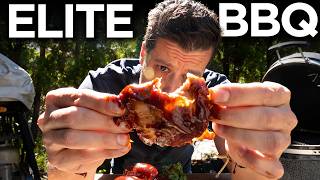

You've Never Had Great BBQ Chicken
35sOpens with a bold, controversial claim that challenges common perceptions, instantly grabbing attention.
▶ Play Clip"The title accurately promises a method for juicy, tender BBQ chicken, and the transcript delivers a detailed competition-style technique."
This video reveals the secrets to making competition-style barbecue chicken, focusing on achieving perfectly rendered 'bite-through' skin and tender, juicy meat. The host demonstrates professional techniques for trimming, scraping fat from the skin, and a two-phase cooking method involving low smoke followed by a hot braise.
Most people have never had truly great barbecue chicken because they haven't used competition techniques.
Scrape the subcutaneous fat from the underside of the skin to ensure it renders properly and becomes 'bite-through'.
Clean smoke is thin, blue, and sweet-smelling; dirty smoke is thick, white, and bitter. Always wait for clean smoke before cooking.
The cook has two phases: 30 minutes of low smoke at ~275°F, then a hot braise at 375-400°F in chicken stock and butter until internal temp reaches 190°F.
The stall is caused by evaporative cooling, where the meat's temperature plateaus. Patience is required to push through to the tender zone (185-205°F).
After braising, the chicken is glazed with barbecue sauce in multiple layers on the hot grill to create a lacquered finish.
What is the key step to achieving 'bite-through' skin on barbecue chicken?
Scrape the subcutaneous fat from the underside of the skin to allow it to render properly.
1:54
What is the difference between clean smoke and dirty smoke?
Clean smoke is thin, blue, and has a sweet aroma; dirty smoke is thick, white, and bitter.
4:17
What are the two phases of cooking competition-style barbecue chicken?
The two phases are: 1) Low and slow smoke at ~275°F for 30 minutes, and 2) Hot braise at 375-400°F in chicken stock and butter until internal temp reaches 190°F.
9:41
What is the 'stall' in barbecue cooking?
The stall, caused by evaporative cooling, where the meat's temperature plateaus.
11:40
What is the target internal temperature for competition-style chicken thighs?
190°F.
10:01
Scraping subcutaneous fat for bite-through skin
This is the critical, often overlooked step that transforms chewy skin into perfectly rendered, tender skin.
1:54Clean vs. dirty smoke
Understanding the difference between clean blue smoke and bitter white smoke is fundamental to good barbecue.
4:17Two-phase cooking: smoke then braise
This method ensures both deep smoky flavor and fall-apart tenderness, a hallmark of competition chicken.
9:41The stall explained
Explains the science behind the temperature plateau (evaporative cooling) and why patience is key during the cook.
11:40[00:00] Now, I'd bet my last dollar that you've
[00:02] never actually had great barbecue
[00:04] chicken. Not because you haven't tried,
[00:06] but because what most people think of
[00:08] barbecue chicken is not even close to
[00:10] the real thing. The real standard comes
[00:12] from competition pit masters, where a
[00:14] single bite can win or lose a trophy.
[00:17] Competition style barbecue, where the
[00:19] skin is so perfectly rendered that it
[00:21] breaks clean when you bite through it.
[00:23] No pulling, no tearing, just a perfect
[00:25] bite mark through the skin and the meat.
[00:28] both perfectly tender and juicy. That's
[00:31] what we're making today. This is
[00:32] competition style barbecue chicken. And
[00:35] it starts with chicken thighs. But
[00:36] before we get started on that, I need to
[00:38] make a simple barbecue rub for them.
[00:41] Now, we're going to omit salt and add
[00:42] that directly to it. To our barbecue
[00:44] rub, we're going to add about a
[00:45] tablespoon of chili powder. Then about a
[00:47] teaspoon of everything else. cumin,
[00:49] coriander, garlic powder, onion powder,
[00:52] a good bit of paprika for that color,
[00:54] maybe a tablespoon, maybe a half a
[00:56] teaspoon of cayenne for the heat. Then
[00:58] about a teaspoon of mustard powder,
[01:00] about a teaspoon of sugar, black pepper.
[01:03] Give that a stir. Going to get that into
[01:05] a little empty spice bottle where I'll
[01:07] store my little spice blend for when I
[01:09] need it. People make you buy this when
[01:11] everything is just in your pantry. Now
[01:13] that we have that ready, we can get into
[01:15] our chicken. What we have here is some
[01:18] nice bone in skin on chicken thighs.
[01:21] First thing we want to do, we have this
[01:22] little knuckle sticking out here. And
[01:25] take my knife and just square off that
[01:28] edge.
[01:30] I'm just going to trim up the bottom.
[01:35] Then we've got all this skin here, which
[01:36] I don't need all that excess. So, we're
[01:39] just going to remove it.
[01:41] Now I'm going to take where the skin is
[01:43] starting to kind of pull away. And then
[01:46] it's just sort of barely staying
[01:47] attached to the chicken down here. And I
[01:50] want to take my knife and I want to
[01:52] start to scrape the inside of the skin.
[01:54] There's this subcutaneous fat under the
[01:57] skin that doesn't render at low
[01:59] temperatures. And so scraping it is
[02:02] what's going to give us that bite
[02:03] through skin. Now you can take that skin
[02:06] and we're just going to wrap it. And now
[02:08] they should hold on their own, but if
[02:10] you want you can stick a little
[02:11] toothpick in there and that'll hold it
[02:13] together. Once it cooks it sort of
[02:15] congeals and stays that way. Now we're
[02:17] going to take them season with salt.
[02:20] Then our rub and then get only the meat
[02:22] side on the top. Try and avoid getting
[02:25] the skin too seasoned. Now we're just
[02:27] going to assemble them back up. And
[02:29] again, you don't have to do this, but
[02:31] you can kind of cinch them closed with a
[02:34] toothpick. Now you don't have to do all
[02:36] the trimming and all that stuff. I'm
[02:37] giving you a general technique and
[02:39] generally trying to show you how you
[02:40] might do this in a competition, but it
[02:42] all applies at home. Generally, you want
[02:45] them roughly equal size so they cook the
[02:48] same and they're all the same sort of
[02:50] product to a judge. So, these are going
[02:52] to go in the fridge uncovered. Then,
[02:53] we're going to take them over to the
[02:55] grill in the morning. And before we get
[02:57] started on the chicken, we need to get
[02:59] our grill fired up and preheated. And
[03:02] whether you have like a Komado style
[03:04] grill like this or Weber kettle, you can
[03:07] set this up the same way. First, in this
[03:09] corner right here, I've got this little
[03:11] sear box. If you just have a kettle, you
[03:13] can just put it off to the corner. And
[03:15] I'm going to take some big chunks of
[03:18] some lump charcoal. Good quality
[03:20] charcoal. Couple little pieces. Couple
[03:22] big pieces. Then we're going to place
[03:24] our starter. Fire it up.
[03:27] What we're looking to do here is create
[03:29] white hot coals in this section as like
[03:33] a way of getting it all started. Once
[03:35] that's white hot, we're going to fill up
[03:36] the rest of the basket or just bundle it
[03:39] up into a corner. We're going to add
[03:41] some wood to get it nice and smoky. Then
[03:43] we're going to close the grill, open up
[03:44] the vents, and try and slowly bring this
[03:47] up to temperature and work our way
[03:49] towards clean smoke. Now, if you don't
[03:52] know, my first job on YouTube, the first
[03:54] thing that paid me was a barbecue
[03:56] company hiring me to make the videos,
[04:00] make the recipes, and if you know
[04:02] anything about the barbecue community,
[04:03] they're passionate group of individuals
[04:05] who can spot a fraud from a mile away.
[04:07] So, I worked hard to be a truly
[04:09] competent pitm. And one of the keys to
[04:12] becoming one is knowing the difference
[04:13] between clean smoke and dirty smoke.
[04:17] clean smokes. What happens in the
[04:19] beginning when the fire is not hot
[04:20] enough, the smoke becomes thick and
[04:23] white. When you smell it, it's bitter
[04:25] and acrid and those compounds connecting
[04:28] to your meat. It's going to be a bad
[04:30] smoky flavor. You never want to lift the
[04:33] hood of the grill and have white thick
[04:35] smoke billowing out of it. That's the
[04:38] sign of somebody who doesn't understand
[04:39] smoke. Good smoke, also known as blue
[04:42] smoke. There's even a restaurant named
[04:44] after it. That's the sweet spot. It's
[04:46] when the smoke clarifies a bit, becomes
[04:49] almost a bluish hinge, and the aroma is
[04:52] sweeter. That's the smoke you want to
[04:54] adhere to your meat. And that's why you
[04:56] need to warm this up before you start
[04:58] cooking anything. Now, you can already
[04:59] see a little bit of white hot spots
[05:01] starting to develop. Nowadays, we got
[05:03] these cool little handheld fans,
[05:05] blowers. This is going to help
[05:07] supercharge and speed up this process.
[05:09] You know, a fire needs air and oxygen,
[05:11] and this creates a whole lot of it. So,
[05:13] it's almost like using a flamethrower to
[05:15] warm up those coals and get them going.
[05:18] You'll probably burn through the starter
[05:19] a bit faster, but those coals are
[05:22] starting to glow white hot now, which is
[05:24] what you want. So, now we got our coals
[05:26] going. We just supercharged the process.
[05:28] Took a couple minutes rather than like
[05:29] 15 to 20. I've got some apple wood here.
[05:32] You can use the wood of your choice.
[05:34] Going to place it down on the bottom of
[05:36] the grate. And I'm going to go ahead and
[05:38] toss in and fill up the basket with more
[05:40] coals. Get that cooking again. That's
[05:43] going to be all the fuel we need to cook
[05:45] these chicken thighs. Then we can close
[05:47] that grate. And you can see this thick
[05:49] smoke starting to acrue. This white
[05:53] smoke,
[05:54] that's not what you want. We need to
[05:56] allow this to warm up to so that white
[05:58] smoke sort of clarifies and turns into
[06:00] that blue smoke that we spoke about. So,
[06:02] what I want to do now is close the lid
[06:03] to about one or two. And I'm going to go
[06:06] to the bottom and close it to about
[06:09] three. And I'm going to use that to just
[06:11] slowly bring this temp up and try and
[06:14] hit about 250 degrees ambient
[06:16] temperature where the food is going to
[06:18] be cooked. After about 3540 minutes, you
[06:22] see what's going on here? You see that
[06:23] thick white smoke? That's gone. The
[06:25] temperature has gotten hot enough so
[06:27] that all that coal and wood burns
[06:29] cleanly. The thermometer says about 325
[06:33] and that thermometer is up top. So that
[06:35] means on great level, cooking level,
[06:36] it's around 50° lower, about 270. That's
[06:40] about the temperature we're ready to
[06:42] cook our chicken. Now, here we've got
[06:43] our chicken at it been in the fridge
[06:46] overnight. All I've done is I have one
[06:48] of these uh pans that you get from the
[06:50] supermarket. I filled it with some
[06:52] chicken stock just to cover the bottom
[06:54] and a few knobs of butter. That's going
[06:56] to be the moisture that they both smoke
[06:58] over in the first half of the cook. And
[07:01] then the second half of the cook, the
[07:02] liquid, we're going to braze it in to
[07:04] make sure it breaks down and get nice
[07:05] and tender. Now, to make competition
[07:08] style chicken or any meat for that
[07:10] matter, you need a vital piece of
[07:12] equipment that's going to keep track of
[07:13] the temperature inside of the meat so
[07:15] that we can ensure we always eat the
[07:17] perfect thing. Chicken thighs vary in
[07:19] size, they vary in thickness, and so one
[07:22] batch might cook for an hour, one might
[07:24] cook for an hour and 45. Thanks to our
[07:27] sponsor today, the Tyer Sync Gold Duel,
[07:30] we can both manage the internal
[07:32] temperature of our chicken and do it
[07:35] basically from anywhere. And you need
[07:37] wireless probes, right? Because this is
[07:39] going to go inside of the grill. And you
[07:41] don't want to be fumbling around with
[07:42] wires everywhere. This thing's got six
[07:44] probes running through it. Five inside
[07:47] and one on the outside to monitor the
[07:49] ambient temp of the grill. What's nice
[07:51] about that is you can insert that
[07:52] anywhere and the probes will
[07:53] automatically find the lowest point. So
[07:56] you don't need to worry about how you
[07:57] put it in. It's going to find the lowest
[07:59] temp. With our thermometers in, our
[08:00] smoke is clean. All we got to do place
[08:03] everything right onto the grill on the
[08:05] indirect side and then close the grill
[08:07] and we can start to monitor the cook.
[08:08] Now we can do this from anywhere. We can
[08:10] manually set the temperature. You can go
[08:12] from anywhere from 185 to I like it a
[08:15] little bit more up to 190. And the range
[08:18] on this is crazy. I can of course
[08:20] monitor it next to it or I can monitor
[08:22] it inside. I can monitor in the
[08:24] bathroom. I can monitor it 3,000 feet
[08:27] from an unobstructed view and 700 feet
[08:29] if it's obstructive, but we can do
[08:32] better than that. Say you forgot some
[08:33] barbecue sauce. You got to go run an
[08:35] errand into town. With the Tyer app, you
[08:37] can monitor all the data from your cook
[08:40] with literally an unlimited range. With
[08:42] this thing, you'll never screw up a
[08:44] piece of meat again. And Tyer's Mother's
[08:46] Day sale is going on through May 10th.
[08:48] Prices are already marked down. So, if
[08:50] you need yourself a reliable
[08:52] thermometer, then use my code cook show.
[08:54] They're going to give you an extra 10%
[08:56] off. Check out the link in my
[08:57] description. Now, as we arrive around
[09:00] our cooking temperature, the ambient
[09:02] temperature around 275. We're already
[09:04] around 250. So, what I am going to do is
[09:07] start to refine my vents. Right. I'm
[09:10] going to go down and we're going to
[09:12] close it ever so gently to lower it back
[09:16] down and simmer. So it just gently
[09:17] arrives around 275. And the same with
[09:21] the top. These little adjustments are
[09:23] what make you raise the temperature and
[09:25] lower the temperature. And you do it in
[09:27] very small increments so you never flare
[09:29] the heat up too high and lose control.
[09:32] But we've got control with our Typher
[09:34] sink. The ambient temperature changes is
[09:36] this is obviously the one in the back
[09:38] and this is the one closest to the heat.
[09:39] So now that chicken is going to go on
[09:41] for 30 minutes and it's going to soak up
[09:43] that good blue smoke, that flavorful
[09:45] smoke. After 30 minutes, we're hoping it
[09:47] arrives around 140 or 150 internal
[09:50] temperature in which we're going to then
[09:52] cook it in that chicken stock and
[09:54] butter. We're going to do that for
[09:55] another 30 45 minutes until we reach our
[09:58] final internal temperature of around
[10:01] 190, which we set into our sink. Now,
[10:03] because I'm measuring two pieces of
[10:05] chicken at different sides and they're
[10:07] cooking at different temperatures now
[10:09] about 15 minutes has gone by, I want to
[10:11] rotate them and try and even it out. I
[10:14] can see the temperature is getting a
[10:15] little higher on one side than I want.
[10:17] So, I'm just going to gently close it to
[10:20] just a crack.
[10:22] And the same down below. Soon though,
[10:24] we're going to open these back up
[10:26] because the second part of this phase,
[10:28] we need to get the temperature up to
[10:29] 400. So, the first stage is a low, slow
[10:32] smoke. The second stage is a hotter
[10:34] braze. Now, we're about 5 minutes away
[10:37] from the end of phase one and the
[10:39] beginning of phase two. Now, phase two
[10:41] requires us to get the temp inside of
[10:43] the grill up to around 375400.
[10:45] So, what I'm going to do now, open the
[10:48] grates back up. All we're doing is
[10:51] managing air flow going in to get more
[10:54] heat kicked up. And then to lower the
[10:56] heat, we close the air off. Subtle moves
[10:59] make a bigger difference than you think.
[11:01] Our chicken's now about 150° internal.
[11:05] Now, here's what we want to do. Going to
[11:07] set the grade off to the side, but we're
[11:09] going to use it later. We've got our
[11:10] broth here with our butter in it. Just
[11:13] going to take our chicken, remove the
[11:15] toothpick, and then place them in the
[11:17] broth, cover them in foil, and then get
[11:20] them back on the grill. Then I'm going
[11:21] to place the grates back on and lay one
[11:23] of these foil sort of bread tins with
[11:26] your favorite barbecue sauce. And we're
[11:28] just going to get that back onto the
[11:29] grill.
[11:31] Now, I'm going to give that another 30
[11:33] minutes, and we're going to see where
[11:34] we're at. Now, as you'll see on our
[11:36] Typer sink, that 20° gap is now about
[11:39] 10. And that's because of a thing called
[11:40] evaporative cooling or the stall. It's
[11:44] something you hit with a brisket, a
[11:45] pulled pork, any sort of tough, dark
[11:48] meat. And so, while the other one was
[11:49] ahead, that reached the stall quicker.
[11:52] Just like when we sweat, we cool
[11:54] ourselves down. The meat is doing the
[11:55] same thing, preventing the temperature
[11:58] from increasing at the same rate it was
[12:00] 30 minutes ago. But this is when this
[12:02] the cooking process slows down a bit and
[12:05] you got to be patient and allow it to
[12:06] get through to that tender zone, which
[12:09] for me is around 185 at minimum all the
[12:12] way up to 205. So, we've reached our
[12:15] target temp. Let's get it off the heat.
[12:17] We got our barbecue sauce here ready to
[12:19] go. It's nice and hot, which we need.
[12:21] So, now we can just unwrap them and we
[12:24] can pull them out and take out the
[12:26] thermometer. So now we're just going to
[12:27] take our chicken, our little nuggets.
[12:34] You want to be gentle, right? We're
[12:36] trying to win a competition here. And I
[12:37] want that lacquer on the surface to stay
[12:41] perfect.
[12:44] Now our grill's fired up. It's nice and
[12:46] hot. We're going to get them back on the
[12:48] grill. Close it up. And every few
[12:50] minutes, we're going to take our
[12:52] barbecue sauce and just spoon some more
[12:54] over. Like to just pour it over. You do
[12:58] waste a little bit, but what you do is
[13:00] you get this really incredible looking
[13:02] end result. Close it back up. And then
[13:04] we just want to set that second coating.
[13:09] Three times should do it. Almost like
[13:12] glazing a cake.
[13:15] Just going to give these a second to
[13:17] cool down before we present them to the
[13:19] judges. Now, I'm not sure why, but a
[13:21] betetta kale seems to be the preferred
[13:24] way to present it to the judges. So, out
[13:26] of our cooked chicken, we're going to
[13:28] select the four best pieces. What I'm
[13:30] looking for is the equal shape, the best
[13:32] looking, the most consistently shaped
[13:35] four pieces.
[13:39] Now, we're going to give one a bite.
[13:42] It's a little tear, a little pull on the
[13:44] skin, but as you could see, bite
[13:45] through. Moist,
[13:48] juicy, tender. Now, because of the skin,
[13:51] I would have lost the competition. I
[13:53] think these cooked a bit faster than
[13:55] when I tested them. A little less time
[13:57] in the braise, which didn't allow the
[13:59] skin enough time to break down.
[14:01] Everything else, 10 out of 10. Chicken's
[14:03] cooked great. It's tender. It's moist.
[14:05] It's glazed right. It's not a
[14:07] competition cuz it's easy. When I tested
[14:09] this, also brazed it uncovered. Allows
[14:12] that skin to get a little bit more crisp
[14:13] and have a little more bite- through
[14:15] tenderness to it. So, you can experiment
[14:17] how you want, but if you want the recipe
[14:19] and you want to make this this summer,
[14:20] which I recommend you do, recipe is
[14:22] going to be down in the description.
[14:24] Thank you, Tyer, for sponsoring this
[14:26] video. That's all that I have today.
[14:27] I'll see you next time. Until then, take
[14:29] care of yourself and go feed yourself.

⚡ Saved you 0h 14m reading this? Transcribe any YouTube video for free — no signup needed.