
Don't Waste Brisket Trimmings! Make Ground Beef & Tallow
40sViewers love money-saving tips and reducing waste, plus the surprise of making ground beef from trimmings.
▶ Play Clip"The title accurately promises a beginner-friendly step-by-step guide, and the transcript delivers exactly that."
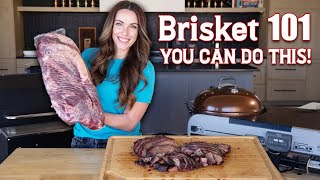
This video is a comprehensive beginner's guide to smoking a brisket, covering everything from selecting the right cut to slicing and serving. Host Susie from Heygrillhey.com walks viewers through trimming, seasoning, smoking, and resting a brisket using simple, approachable techniques.
Covers picking a brisket, what it is, trimming, seasoning, smoking, and basics for first-timers.
Brisket is an American BBQ staple from the cow's pectoral muscle; a whole packer brisket weighs 11-18 lbs.
Choose choice or prime grade for higher fat content; look for bendiness (U shape) indicating a thinner fat layer between muscles.
Freeze brisket for 30 min before trimming to make fat easier to cut; use a sharp knife and gloves.
Trim silver skin, fat half-moon, sides, ends of flat, and point overhangs; aim for 1/4-1/2 inch fat cap.
Save meaty trimmings for ground beef; save fat for beef tallow (e.g., for roasting potatoes).
Slather with yellow mustard as a binder, then season with coarse kosher salt and coarse black pepper (or use a beef rub).
Smoke at 225°F; fat side up on pellet grill for even heat; use oak and cherry pellets for flavor.
Rest at room temp for at least 1 hour; for longer holds, wrap in towel and place in cooler or off oven (preheated to 170°F, then off) for 4-8 hours.
Trim/season at night (9:30-10:00 PM), smoke overnight, wrap in morning, finish early afternoon, rest until dinner.
Separate point and flat; slice point 90° turned, slice flat straight across; first end piece cubes for burnt ends.
With simple trimming, seasoning, and smoking techniques, anyone can make a delicious backyard brisket. Practice and patience are key; don't give up if the first try isn't perfect.
What two muscles make up a whole packer brisket?
The point and the flat (overlapping pectoral muscles).
0:41
What grade of brisket is recommended for beginners?
Choice or prime grade for higher fat content.
0:55
What does the U-shape bend test indicate?
A thinner layer of fat between the muscles, leading to more even cooking.
1:07
Why freeze the brisket for 30 minutes before trimming?
To make the fat firmer, making trimming easier.
1:38
What is the recommended fat cap thickness after trimming?
1/4 to 1/2 inch.
3:44
What can you make from meaty brisket trimmings?
Ground beef (e.g., for bolognese or burgers).
4:13
What is the purpose of yellow mustard as a binder?
It helps create texture for smoke adhesion and improves bark formation; the mustard flavor cooks off.
4:49
What is the recommended smoking temperature for brisket?
225°F.
5:16
What woods are recommended for smoking brisket?
A combination of oak and cherry pellets.
5:38
What internal temperature range indicates the brisket is ready to wrap?
160-175°F.
6:48
What internal temperature range indicates the brisket is done?
195-205°F (probe tenderness is key).
7:27
How can you rest a brisket for more than 1 hour?
Wrap in a towel and place in a cooler or an oven preheated to 170°F then turned off.
8:17
Why must the point and flat be sliced in different directions?
The grain of the two muscles runs in different directions.
10:13
What thickness should the slices be?
Pencil-thick.
10:49
What is the estimated cook time per pound of trimmed brisket?
90 minutes per pound.
6:07
Brisket Anatomy
Explains the two-muscle structure (point and flat) of a whole packer brisket, crucial for understanding trimming and slicing.
0:41Bend Test for Fat Layer
A practical, easy-to-use method for selecting a well-marbled brisket at the store.
1:07Using Trimmings
Encourages zero-waste by repurposing meaty trims into ground beef and fat trims into tallow.
3:56Mustard Binder for Bark
Explains the science behind using mustard as a binder without affecting flavor, a key technique for texture.
4:49Extended Resting Method
Details how a long rest (up to 8 hours) enhances tenderness, a critical step often overlooked by beginners.
8:17Slicing Against the Grain
Emphasizes the importance of slicing the point and flat separately due to different grain directions.
10:13[00:00] - What's up?
[00:00] It's Susie from Heygrillhey.com,
[00:02] and today we are tackling Brisket 101.
[00:04] Now, if you've never
[00:06] at the end of this video,
[00:09] to successfully knock out
[00:11] We're gonna talk about picking
[00:15] how to trim it, how to
[00:18] and we're doing basics,
[00:21] so that you can achieve a
[00:24] all of the overwhelm and intimidation
[00:25] that sometimes comes from cooking
[00:29] Brisket is an American barbecue staple,
[00:31] and it really gained
[00:33] through this central Texas
[00:36] which is what we're gonna imitate today.
[00:38] A brisket comes from the
[00:41] A whole packer brisket like this,
[00:43] which is what you're gonna wanna buy,
[00:45] consists of two overlapping muscles.
[00:48] Typically in the Cryovac
[00:50] they'll run anywhere
[00:53] When picking out a brisket from the store,
[00:55] I like to pick either choice or prime.
[00:58] Those higher fat content
[01:00] a better finished product.
[01:02] Another thing I like to
[01:04] when I'm picking it out
[01:07] If it can give me a little U shape,
[01:09] I'm pretty happy with that brisket.
[01:10] It'll come home with me.
[01:12] There is a thick layer
[01:15] these two muscles, and if it's too thick,
[01:17] it's really not gonna be very bendy,
[01:19] and that means they're
[01:21] inside the brisket itself.
[01:23] It's not gonna render down
[01:24] and I think it can be a
[01:26] A thinner layer of fat in
[01:28] generally means more even
[01:32] and better final texture.
[01:33] Once your brisket's home, you can hold it
[01:35] in the refrigerator.
[01:36] I actually like to pop
[01:38] for about 30 minutes
[01:41] Really, really cold fat,
[01:42] and really, really cold
[01:44] process so much easier.
[01:46] To trim up your brisket, all you need
[01:48] is a big cutting board, a sharp
[01:51] Honestly, though, I did not
[01:53] the first time I ever trimmed a brisket,
[01:55] I just trimmed it right on my countertop
[01:56] and then sanitized after.
[01:58] Let's get into trimming this brisket down.
[02:00] Now I usually plan about 20 to 30 minutes
[02:03] to trim a full brisket.
[02:04] If it's your first time, it
[02:08] That's okay, you can rewind
[02:11] as many times as you need to
[02:13] but I'm gonna give it to you
[02:16] Now, there are a lot of videos
[02:19] Competition trims are insane.
[02:20] Some backyard trims are
[02:23] We're going for a super
[02:26] so you can easily do it your first time.
[02:28] Using a filet knife, I just
[02:31] or stringy fat across the
[02:34] I then move on to this
[02:38] of fat and trim it down.
[02:39] I don't cut it all the way out.
[02:41] I just trim it down so
[02:43] even layer across the bottom of a brisket.
[02:46] Next, I turn my attention to the sides.
[02:48] A long straight cut up either
[02:52] fat or anything left over from processing.
[02:55] Then I focus on the ends of my flat.
[02:57] The flat is the thinnest
[03:00] of your brisket.
[03:01] You can see it's pretty uneven,
[03:04] and trim it off so it has a
[03:07] These thin edges are just gonna
[03:09] the brisket anyway, so it's
[03:12] before you even start smoking.
[03:13] Next I turn my attention to the point,
[03:15] which is the thicker piece
[03:18] This is where the two
[03:20] Similar to the flat, I take off any pieces
[03:23] that are overhanging, hanging loose,
[03:25] and give it a nice round final appearance.
[03:27] Once my underside is done,
[03:30] and turn my attention to the top.
[03:31] Now the goal here is to
[03:34] to about a half inch layer
[03:38] There are some places where it's less
[03:40] and some places where
[03:42] I like to take the thicker
[03:45] quarter to a half an inch,
[03:48] If you have any large
[03:51] I also trim those down at this time.
[03:53] Now, you might be worried about what to do
[03:55] with all of those trimmings.
[03:56] I separate mine into two
[03:59] where there's a good amount
[04:02] and the fat pile where it's mostly just
[04:05] that thick white fat.
[04:07] I save the meaty trimmings
[04:10] pop 'em in the freezer, build
[04:13] and then once I have
[04:14] to make my own ground beef.
[04:16] It's great in bolognese, it's
[04:18] It's absolutely delicious.
[04:20] You paid for it, don't waste it.
[04:22] Now with the fat, I
[04:24] I like to use this as a cooking fat
[04:26] to roast potatoes, a bunch of other food.
[04:28] I use it on my griddle all of the time.
[04:30] I have a full video for
[04:33] if that's something you
[04:34] Once your brisket is trimmed,
[04:37] I like to slather mine with yellow mustard
[04:39] before hitting it with
[04:42] But you can use equal
[04:45] and coarse black pepper.
[04:46] Salt and pepper is really all you need
[04:48] to season the brisket.
[04:49] The mustard acts as a binder.
[04:51] It also helps create some of
[04:54] for the smoke particles to
[04:57] I think it gives you a
[05:00] crunchy bark, but you don't
[05:02] flavor at all.
[05:03] If you are vehemently opposed to mustard,
[05:05] you can skip this entirely
[05:07] and just go straight to seasoning.
[05:08] Now that the brisket is
[05:10] it's time to hit the smoker.
[05:12] I like to run my briskets
[05:16] Pop my brisket on there.
[05:17] I'm cooking this on a pellet grill.
[05:18] I think it's a great
[05:21] for your first time cooking a brisket.
[05:22] And because the heat from my pellet smoker
[05:24] comes from the bottom, I'm gonna
[05:28] to start, and then I'll
[05:31] I'm gonna flip it fat side down to finish.
[05:33] I think it gives me a nice
[05:36] My favorite woods to use
[05:38] are a combination of
[05:40] but you can use your
[05:42] It's gonna be smoking
[05:44] and it's such a low
[05:47] to actually taste the flavor
[05:49] So choose a wood that compliments beef.
[05:52] Like I said, oak and cherry are my picks.
[05:54] Now, when you're a beginner,
[05:57] to want an exact time and
[06:01] I'm gonna give you my best estimation
[06:03] and then I'm gonna tell
[06:06] just to be safe.
[06:07] I usually plan about 90 minutes per pound,
[06:10] and that's trimmed weight.
[06:11] So if you trim your brisket
[06:14] you plan 90 minutes per pound.
[06:17] Your total cook time is gonna
[06:20] Now, your brisket might or
[06:24] be done before that, but that is okay
[06:26] because we're gonna
[06:29] at the end of our cook.
[06:29] So the seasoned brisket is
[06:33] close the lid, let it go for
[06:36] before you crack open the
[06:39] We want our bark at this
[06:43] and crunchy, starting to develop
[06:46] and we want our temperature
[06:48] of about 160 to 175.
[06:51] Once we've hit that target
[06:53] and the outside of our brisket
[06:55] that we want it to, I like
[06:59] Butcher paper is untreated
[07:02] for finishing out this brisket.
[07:03] It holds in some of the moisture,
[07:05] but still lets that bark
[07:08] without softening.
[07:08] I've also used unwaxed parchment paper,
[07:11] so not the waxed parchment
[07:14] That would be terrible,
[07:18] has helped me out in a pinch
[07:19] when I didn't have butcher paper on hand.
[07:21] Our wrapped brisket is
[07:23] until it is done.
[07:24] Now, the range for finished
[07:27] between 195 and 205 degrees fahrenheit.
[07:29] There's not one perfect
[07:32] What you're really looking for
[07:35] to slide in and out of that
[07:38] and out of softened butter.
[07:39] Also, squish your brisket a
[07:42] If it bends and gives
[07:45] your brisket's gonna be nice and tender.
[07:47] At this point, it's time
[07:49] off the smoker.
[07:50] I like to pull it off and let
[07:53] for at least an hour before serving.
[07:56] This is where planning ahead
[07:58] and giving yourself a few extra hours
[08:00] of cook time is really valuable
[08:01] because if your brisket cook runs long,
[08:03] you've given yourself a grace period.
[08:05] If your brisket comes in on time
[08:07] or even a little bit short,
[08:08] you can extend the resting
[08:13] It's really forgiving here at the end.
[08:15] If you do have to rest
[08:17] what I recommend is wrapping
[08:19] Don't use your favorite,
[08:22] It will smell like brisket
[08:25] Pick up brisket towel, that
[08:28] Wrap it up in the towel,
[08:31] or into an oven that has
[08:34] and then turned off and
[08:37] It can hold this way for anywhere
[08:39] between four and six hours.
[08:40] I've even held them up to eight hours
[08:42] if it's been a really long rest time.
[08:44] I actually think the longer
[08:46] Three to four hours is my
[08:49] So just a quick general
[08:52] is I will trim, slather and
[08:56] 10 o'clock, get it onto the
[09:00] I do have alarms on my smoker
[09:02] to monitor the temperature
[09:04] shoots up or down, it will wake me up.
[09:06] When I get up first thing in the morning,
[09:08] I get a good like, seven
[09:11] and I check my brisket.
[09:12] Typically at this time,
[09:14] So first thing in the morning,
[09:17] After I wrap my brisket in
[09:19] keep an eye on the temperature.
[09:21] It's usually finished somewhere
[09:24] and at that point, I can let
[09:27] until we're ready to eat dinner.
[09:29] Okay, our brisket has rested.
[09:31] That means it is time to unveil and slice.
[09:34] I'm gonna give you a couple of quick tips
[09:36] for slicing your brisket
[09:37] because with all the time
[09:39] and get it ready, you wanna
[09:46] My gosh, look at that.
[09:50] That is a juicy brisket.
[09:54] I'm gonna save these juices.
[09:56] I'm actually gonna drizzle
[09:59] You can see how much this
[10:02] It is what it is, it's
[10:05] All of that fat has rendered
[10:08] gorgeous brisket.
[10:09] So, because we have the point on this end,
[10:12] the flat on this end,
[10:13] and there are two overlapping
[10:15] that run two different directions.
[10:17] We have to slice them in
[10:19] So I'll typically take my knife
[10:22] and slice into my brisket
[10:27] kind of those two main
[10:30] Look at that inside,
[10:35] That is a gorgeous, juicy looking brisket.
[10:40] So my point gets sliced.
[10:45] It gets turned 90 degrees
[10:47] before it gets sliced into
[10:51] and then my flat, I'll
[10:54] Same with the first cut that I made.
[10:58] This first piece on the end
[11:02] what I cube up, and these
[11:08] But also being the one
[11:10] means that you get this magical privilege
[11:12] of taking the first bite,
[11:14] and this is always the best
[11:17] crispy edges of this point.
[11:24] That's money, that's how
[11:28] This was a simple brisket.
[11:31] We didn't overcomplicate anything.
[11:33] Simple trim, simple seasoning,
[11:38] couple of tips and tricks,
[11:41] and you end up with a smoked brisket
[11:44] that looks like this.
[11:47] (upbeat music)
[11:49] Dripping juice, bending over the knife.
[11:52] So tender, but not totally falling apart.
[11:57] That is a backyard
[12:02] all of your friends and family over.
[12:04] Now, this was a beautiful brisket.
[12:06] Not every brisket I've ever
[12:09] this nice, and I will say,
[12:13] So, hopefully your first
[12:17] maybe your second won't,
[12:20] What I don't want you
[12:22] Sometimes good things take
[12:26] Brisket is one of those things,
[12:28] but I am fully confident that
[12:31] If you wanna go even deeper
[12:34] 101 tutorial, you can check
[12:38] I have a full 30 minute
[12:42] that covers all of this and more.
[12:45] So if you wanna go deeper into the world
[12:47] of barbecue brisket, I've got you covered.
[12:50] If you have any more
[12:54] or if you have any other ways
[12:56] leave a comment in the
[12:59] I do read all of them.
[13:00] I want to be kind of your
[13:04] I wanna help you make
[13:06] give you the tips and tricks
[13:07] and the confidence that you need
[13:09] to make really great barbecue
[13:12] So, leave a comment, I
[13:16] I'm gonna enjoy this brisket
[13:19] Wow.
[13:21] We'll see you guys next time.
[13:23] That is beautiful.
⚡ Saved you 0h 13m reading this? Transcribe any YouTube video for free — no signup needed.