[00:22]
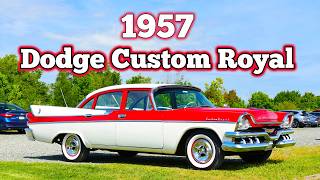
>> I drive a 1957 DODGE CUSTOM ROYALE and I am a confirmed bachelor. am a confirmed bachelor. My gray suit is tight. My mustache is My gray suit is tight. My mustache is thin and my derby hat is jaunty.
[00:37]
My icebox is full of vodka and my mattress is warmed with a hot water bottle for guests. >> This episode of Regular Car Reviews is sponsored once again by Factor. Factor
[00:52]
are fresh, never frozen meals and they have options for all kinds of dietary have options for all kinds of dietary needs. Protein plus, vegetarian, vegan, calorie smart, that's another one and they have premium meals. Today I'm
[01:07]
having garlic parmesan cream shredded beef. You know, I recently had uh hernia surgery and I was out of the gym for a good month.
[01:20]
for a good month. So, I am working on keeping my calories So, I am working on keeping my calories in check as well as getting to the gym. Not every single day I'm putting in rest days, you know, doing progressive
[01:34]
overload and stuff like that, but Factor is assisting in that, making sure I don't overeat so I can get rid of the Oh, yeah, these meals are ready in 2 minutes. So, head to the factor75.com and use my code regularfb50.
[01:51]
That's regular foxtrotbravo50. What that does, it gets you 50% off your first box plus free breakfast for a year. How cool is that? Now,
[02:03]
that's good. Factor has a disclaimer that I need to say. >> New subscriptions only. Varies by plan. One free breakfast item per box per year while subscription is active. >> Once again, head to factor75.com. The
[02:17]
link's in the description down there. Use my code regular FB50.
[02:30]
Thank you, Factor, for sticking with us. And now, >> Every time Dodge makes a car, the universe flips a coin. Heads, it's a classic, and tails, it's the kind of C-tier garbage that keeps the bellies of
[02:45]
salvage yard owners large enough that their dick stays hidden. See Chrysler their dick stays hidden. See Chrysler 200. But sometimes, the car defies the laws of chance by landing perfectly on its side. This car is a piece of
[03:02]
But it gives off the kind of warm, bittersweet joy that you can only get from the knowledge that an age is ending. This is a massive family sedan
[03:14]
from an age when American cars never had to compete with foreign markets. That means that assembly line workers could drink on the job, [ __ ] around, and [ __ ] off all they wanted. And, oh, this is good. The build
[03:30]
date of your car determined how well your car was assembled. If your car was put together on a Tuesday or Wednesday or Thursday, and nowhere near a holiday,
[03:42]
your Chrysler product, or any American car for that matter, would be okay. But if your build date fell on a Monday, well, all the workers were hungover from the weekend. And if it was a Friday, and if it was on a Friday, they were
[03:58]
pre-gaming during the day for that night. And if a holiday was coming up, they would be focused on their work as much as a middle school student would be focused on their work sheet the moment snow flurries started falling outside
[04:12]
the classroom window. This Dodge Custom Royal was assembled on December 22nd, 1956, right before Christmas. So, not even the
[04:24]
ashtray was put in straight. Speaking of straight, "Hello, it's me again. I am no longer a confirmed bachelor. Meet my new wife, Gertrude.
[04:38]
Meet my new wife, Gertrude. Her face looks like a pumpkin and she Her face looks like a pumpkin and she smells like a garbage barge. I love her so much.
[04:51]
And tonight we will have marital relations, after which I will retire to my study and enjoy Cubans and Hennessy with Yul
[05:07]
Brynner. The King and I see what you mean." In some ways, the Dodge Custom Royal changed the automotive industry because it was part of a Chrysler fleet whose quality issues in 1957 caused the
[05:24]
company to make radical changes and try to drum up some goodwill. As noted in a 1969 Esquire article, the industry standard warranty in the early 1960s
[05:36]
standard warranty in the early 1960s was 2 years or 24,000 mi, whichever came first. But for model year 1963, Chrysler introduced the first 5-year 50,000 mi powertrain warranty in America because the president of Chrysler at the
[05:51]
time, a man named Lynn Townsend, needed to boost the brand's image due to how badly their cars performed in 1957. This was a huge change from early warranties was a huge change from early warranties that covered parts for only 90 days and
[06:06]
labor for only 30 days. But Chrysler needed to do it because the brand got spanked so hard during the Eisenhower recession that their cheeks were still red during the Kennedy administration. The latter part of the 1950s saw a wide
[06:20]
adoption of the four-barrel carburetor. Before the four-barrel, when tuners wanted more air and fuel, they would buy or make an aftermarket intake manifold onto which would be bolted multiple single-barrel carbs. You may have seen
[06:36]
those on period-correct T-buckets and hot rods at car shows. The yellow 1932 Ford Deuce Coupe from American Graffiti is an example of multiple single-barrel is an example of multiple single-barrel setups. Multiple singles, they work, but
[06:51]
you have to sync all of the carbs to open in unison because if one off, then the engine behaves weird because one or two signal cylinders are making less power and dragging the other. Anyway, multi singles makes the throttle feel
[07:05]
like an on-off switch, like rap rap, which is great for 1950s hot rodders, but for regular people who just wanted smooth power, that's not going to work. Dodge also experimented with a push-button transmission. Here's how to
[07:18]
start a 1957 Dodge. >> Okay, ignition on. >> See, you know holding it for a while to start it, but when button. >> So, you but just give it like a quarter
[07:30]
bit of throttle while you do. And just push the starter button hold it like to the floor or to >> Where's the starter button? >> Neutral button starts it. >> That's brilliant cuz then you can't
[07:42]
>> Yeah, so it didn't want to start that time. Just give it a little more gas and just hold it until it starts. And a little bit of throttle. And that's it? >> The year is 1957
[07:54]
and history was like a scoreboard. Sputnik 2, Vatican 1. And while the recession that happened under President Dwight D. Eisenhower was called the Eisenhower recession of 1958, it actually began in the summer of 1957.
[08:09]
And the result was high unemployment, low production, and low new car sales. This is significant because the golden 1950s that boomers sugarcoat and always
[08:21]
seem to be trying to run back to, half of the like the latter part of that decade was just crap. Like nothing was going on. So, these great period of
[08:33]
going on. So, these great period of America was really only '55 to '57. Five three years around which they have built an entire personality and I'm I'm getting off track. I mean, there's people in front of us, so we don't
[08:47]
really get a fantastic demonstration of the Dodge Custom Royal's power. But I'm guessing this thing makes somewhere around 190. >> It's not bad. New they were supposed to be like
[09:02]
that. >> But we have to remember that back in the day they they rated the engine power of these engines on a engine stand with no accessories on it and a big hose for
[09:15]
coolant that's just coming in and going out. So, like yes, technically probably this engine would make 240 horsepower if there was not if it didn't have to do >> The '50s weren't that they they were they weren't that good. But even if the
[09:29]
recession hadn't happened, I don't think this car would be any better or more well received. This came as part of Chrysler's forward-look design philosophy with longer, lower, and wider bodies. Like the people who would
[09:42]
display them at car shows 50 years on. The concept was this idea of designer Virgil Exner who called it the hundred million dollar look or the million dollar look. But it was really just a glorified goon bucket for his fin
[09:57]
fetish. Fins [snorts] were getting larger like a Susquehanna bass near Three Mile Island. And considering the financial shape of the country, it was the wrong thing to focus on. And in a way, it's kind of similar to now.
[10:11]
Everything sucks, but we have a fake flying car. Sweet. Back in the 1950s, the S&P 500 took a tumble, but look, my stupid neighbor's car has a larger fin. I can't wait to get my prostate checked to feel human touch. Depending on body
[10:27]
style, the MSRP when new was around $3,000. So, in the general ballpark of $3,000. So, in the general ballpark of $35,000 in 2026. In the 1950s, Plymouth was lower in prestige than Dodge, but that didn't mean Dodge was at the top of
[10:43]
the product line. It went Imperial at the top, then Chrysler, then DeSoto/Dodge, then Plymouth. Roman talked about this in his Roman report on the Ford versus Dodge Brothers case, but Dodge wasn't a
[10:57]
thing until the Dodge Brothers left Ford in 1914. Basically, the two went to Henry Ford with suggestions on how the Model T could be improved. Henry Ford told them to go [ __ ] themselves. They said, "Okay, we will." and created
[11:11]
Dodge, which later got absorbed into Chrysler and became a thorn in the side part of the 20th century, even beating them in overall registrations for a time. Dodge also fell on the right side of history. In 1957, they were the first
[11:27]
domestic manufacturer to feature people of color in advertisements. They were the first auto manufacturer to buy ads in Ebony magazine, and by 1959, featured entire African-American casts in their ads. So, I guess we indirectly have
[11:41]
Henry Ford to thank for the Custom Royal. Oh, by the way, these double antennas in the back, they're functional, and they go really, really high. Both are wired into the head unit, unlike the Ford Galaxies, where if you
[11:54]
ask for the double antenna option, one would be real and the other one was a dummy. Now, almost everything that's decent on this car is because the owners, Jim and John and their friend Kurt, made changes. Power brake
[12:09]
conversion, front discs from a '72 Chrysler, retrofitted 15-in wheels with all-season radial tires. And the wheels have wheel covers that are upscaled versions of the original size. It has new upholstery on the inside and paint
[12:25]
except for the roof and and maintenance that has kept this thing running. It's mileage is 94,399 mi, which for the 1950s is supposed to be the end of the car's life. I mean, cars back then there's a reason the
[12:39]
speedometers went to 99,000. They didn't go to six figures. They ended at 99. Anyway, now this sort of looks like a show car, but if it is, it's a show car rather than trailered. But then that doesn't mean it would actually be fun to
[12:53]
never experienced the novelty of being in a classic show before. I have Jim and John to thank for this line that I have used in real life multiple times. When I
[13:05]
used in real life multiple times. When I owned my '63 Galaxy, the crazy taxi, and I would drive it around, occasionally I would get some blumper dumper coming up "YEAH, THEY DON'T REALLY MAKE THEM LIKE THEY USED TO." And I'd immediately fire
[13:21]
back with, "What, like shit?" And it would immediately stop them. They're like, "Ooh, what?" Like, "Yeah, these cars are terrible." Ooh. "But they're made of metal." Yeah, pot
[13:33]
"But they're made of metal." Yeah, pot metal. These cars are terrible. Like, they're built by drunks. Nothing They never had to compete with foreign markets. Everything about this is mediocre at best. Ooh, it has a V8.
[13:47]
>> And then I And then I would smooth things over by saying, "But they are the recognition he deserves. And then he asked, "Uh so, what year is it?" I It's You don't care I This is Eisenhower recession
[14:03]
performance. The fastest Kurt has gotten this up to was around 80 mph, and even that sounds like a miracle. Yeah, I had my '63 Galaxy up to 90, and that was woo, that was This is a 325 cubic inch polyspheric V8
[14:19]
engine with 8 and a half to one compression. Wow. It's got the four-barrel carburetor and 260 horsepower at 4,400 RPM and 335
[14:32]
pound-feet of torque at 2,800 RPM. Now, yeah, polyspheric, but it's not a Hemi, but that probably wouldn't have improved things much anyway. Hemis [snorts] of this era Hemis in general are overrated. The 440 is better. Anyway, 1957 gave us
[14:48]
the introduction of Chrysler's torsion air front suspension. Coming one year after the introduction of the three-speed TorqueFlite push-button automatic that this has. And the combination is, well, you might as
[15:01]
well be driving one of those cookie tins where grandma keeps her sewing supplies. This car leaks so much that if you hit a bump during a rainstorm, some water ingress may happen. And this is a hard top. Because this car is about as
[15:17]
watertight as cupped hands at a drinking fountain. And it would be one thing if the water problems were limited to the interior, but Kurt told us that the reason he had to ditch the original drum brakes is because they could create
[15:30]
pockets of rust if they got wet and end up warping the brakes so much that you pretty much had to replace them anyway. If there's a silver lining in the design of this car, it's the low-cut trunk that is refreshingly ahead of its time. But
[15:43]
even then, the trunk lid can clip your head if you aren't careful. And I got rid of my Ford Galaxy because I couldn't justify owning a classic American car anymore when the headaches accumulated faster than the fun that could offset
[15:56]
it. And that car was younger than this one. This next assessment is not directed at Jim or John or Kurt. I love classic American cars, but the justifications you have to have to own one has to transcend the recursive
[16:11]
yearning for an America in which none of our neighbors or enemies were and were guided by the stabilizing hand of season military men. This car is pregnant with self-reverence. It's in all of the period it came from, conjuring undead
[16:26]
spirits of the post-war American nuclear family, when houses and cost of living were affordable. But the trade-off was that your bowel lining was irritated by Cold War anxieties, and depending on your demographic, every town was a
[16:41]
sundown town. Welcome to the 1950s, where dads have the intellectual curiosity of a department store mannequin, and the wife's favorite movie is whatever the neighbors are up to. And the kids play
[16:54]
good-natured pranks that don't really hurt anybody, but still get their asses kicked for it once dad gets debriefed by the neighbor. If you're queer, you have the neighbor. If you're queer, you have to bury it deep deep down inside, and
[17:07]
scoot yourself and your pompadour up to a piano and invent an entirely new genre of music. It's the 1950s, and it isn't perfect. But in the sepia-toned memory of elderly family exiles, it might as well be Camelot. And
[17:24]
the Custom Royal might as well be whatever King Arthur's horse was called. Lancelot, probably. The car represents the days before the future emptied a clip into the American dream, even though it was emptying that clip into
[17:38]
the marginalized sections of society. But classic cars should be about preserving history and preserving a feeling, rather than simply preserving an idea. But the idea here is well, okay, this car isn't good. It
[17:53]
isn't all that notable, but you should like it because it's still here. It's still alive, and it's always, 100% of the time, a good thing when a classic car survives. But survival doesn't justify blind praise, and we sort of
[18:10]
came in here thinking that it was going to be at least memorable. But this car really wasn't. Not for the right reasons, anyway. And yet I can see why it would be worth going out of your way to preserve this.
[18:23]
This car was never meant to survive. In the same way the golden 1950s only lasted for 3 years, the manufacture of the manufacturers of these cars only
[18:35]
expected these cars to last 3 years. And here it is over a half a century later. The car still runs. Granted, the transmission was rebuilt five times, the engine once, the paint once. You know, that's the thing about classic American
[18:50]
cars. You will never stop repairing them. This car is history. It is an aesthetic you don't get anymore. And it does have its moments of levity that
[19:02]
make you forget you're driving a five-figure problem. It's nice that the past isn't entirely dead, but it is good that the horrible parts of it did die. With that said, you shouldn't always meet your legends. Not not if you're
[19:16]
going to place on them the burden of having to evoke the good old days. But the good old days of this car are now. now. It continues. It surges on. It surges on
[19:29]
now. As a tribute to all those queer couples who are no longer with us, who disappeared into forests or followed the wrong person behind the
[19:42]
followed the wrong person behind the wrong door that locked behind them. Or left town and changed their names never to come back or see their parents again. This car is really a tribute to that,
[19:54]
the alternative 1950s. But like my Toyota Sera, driving this is But like my Toyota Sera, driving this is like a reimagining of the past. And it's still out here creating new memories for new people who drive such
[20:08]
memories for new people who drive such an archaic machine in between traffic. It's still going because we are still going. And I'd like to end this video in a way that I don't normally do.
[20:21]
With an interview with the owners, Jim and John. >> If I were to describe this car, it was in terms of relationships because John bought the car since he was dating somebody and he
[20:35]
thought that if the two of them had this car, they would be able to have a better, deeper relationship. And that completely fell apart in a
[20:47]
Lambda Car Club meet in September of 1999 and when the guy ditched John literally the same night, John met me. And we've been together with adventures in this car ever since.
[21:04]
I think one of the best ways of describing the car is the memories of all the adventures we've had including the times it [ __ ] the bed or tires blew up. Remember the Cokers?
[21:19]
>> Jesus. Yeah, or when the exhaust would blow up or when we we didn't get stranded all that much. The stories about what it's like going to a car show and it turns into a
[21:34]
monsoon. Holding towels against the windshield for all the water that's It's it's like anything else in a relationship. You remember all of the crazy [ __ ] and that's what becomes
[21:47]
And the same thing is true with that car. We think about all the crazy [ __ ] that happened with it and the fact that in retrospect it was a lot of fun. And
[21:59]
we hit a deer and so the paint had to be re you know, we did the Pennsylvania >> Yeah. >> And what was funny about that is that the cop showed up happened to be around and we're surveying the damage and he
[22:13]
deer is yours." And we said "You can have it." >> Auto shop couldn't match the original paint for that fender. They had to >> And the insurance company had to have to cover it because you know
[22:27]
stuck for it. So we we got we got we basically got the entire car repaired >> Awesome. >> So I I was very happy to see that. >> era. Okay, by the time that this car came out
[22:42]
in the late 50s people did not expect these things to last more than two or three years. They rotted out. They had terrible rust problems. Um quite frankly, if you look at the build quality of an early 50s car
[22:57]
at the build quality of an early 50s car from Chrysler or GM or Ford and you compare it to a late 50s car, it's night and day in terms of how well it was made >> Yeah. >> Um one of the things I mentioned earlier
[23:12]
is that in the late 50s uh an auto warranty for a new car was uh 30 days. >> And it was like it's on you after that. The reason why we have longer warranties today is because the cars got such a terrible reputation that the car company
[23:28]
starting with Chrysler had to think of a way to induce people to buy the new ones. They were for the era, if you compared it in terms of comfort, if you compared it in terms of ease of driving and so forth because this was the era
[23:43]
when power steering and power brakes came in and when they went to electric windshield wipers and when they had engines that could go all day at 80 miles an hour and and the fact that the interstates were beginning to open at
[23:56]
interstates were beginning to open at that point. So for all of those reasons, yes, a vast improvement over cars from say 20 years earlier mechanically, but say 20 years earlier mechanically, but the build quality was absolute garbage.
[24:10]
So there was even a famous book that came out at that time called the Insultant Chariots and it was an expose of the big three and they talk about how poorly the cars were made. Really, if you look at it, one of the things John
[24:26]
and I talked about do we've been together now 27 years. And it is highly improbable, certainly when we first met, that this long. Because very frankly,
[24:40]
very few people we know who are same-sex couples had relationships that have gone on for decades. And in a way, it's as improba- the car is as improbable as we are. That
[24:53]
it kept going in spite of any expectations about how long something would run. >> Yeah, it's at 194,000 miles now. And I never expected it to last that long. >> Yeah, and I never expected us to last
[25:06]
that long. And I think so in a way it's it is sort of ironic about the car matching the nature of the relationship that both of them have managed to that both of them have managed to survive with a lot of extra bodywork and
[25:21]
a lot of time in the air and a lot of stuff breaking along the way, but stuff breaking along the way, but nevertheless, it just keeps going.