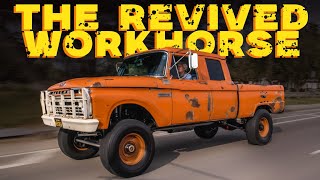

Patina Truck: Why Leave Rust?
45sThe owner explains why he kept the rust and damage, including a skid steer fork hole, to preserve the truck's story, which is a controversial and engaging take on car restoration.
▶ Play Clip"The title accurately describes a rare, customized Mercury M250 with patina, built for around $200K, and the video thoroughly covers the build and history."
In this episode of Jay Leno's Garage, host Jay Leno explores a highly customized 1966 Canadian-market Mercury M250 truck, a rare vehicle with fewer than 10 crew cab units built. The truck, built by Jason Null of FatFender Garage and owned by Roman Taherin, retains its original weathered 'patina' exterior while featuring a completely new, modern chassis, a supercharged 5.8L Ford GT500 engine, and advanced suspension. The video highlights the philosophy behind preserving the truck's history and the collaborative effort between builder and owner.
Jay Leno introduces a 1966 Canadian-built Mercury M250 truck, noting that Mercury trucks were not made in the US and this is a rare Canadian-market vehicle.
The owner, Roman Taherin, explains he wanted the truck's exterior to tell its story, with dents and damage (e.g., a fork lift hole in the quarter panel) preserved as part of the vehicle's history.
The truck is powered by a 5.8L supercharged Ford engine (from a GT500), producing 650 horsepower. The builder notes the motor was ceramic coated to match the truck's color theme.
Discussion about the truck's genuine patina versus modern artificial patina. Jason Null confirms the truck will continue to age naturally.
FatFender Garage collaborated with the owner, Roman, to modify the truck. The build started with a custom chassis, designed for a crew cab 250, including eight-lug Currie axles for an authentic look.
The chassis is brand-new, designed for this era of truck. It features 4-wheel disc brakes, a Currie 9-inch differential front and rear, and Icon active suspension, adjustable via phone.
FatFender Garage is a 45,000 sq ft shop with 75 employees. Build time for a project like this is generally about a year, including ordering the chassis and scheduling.
Jay Leno explains that luxury trucks originated in the US due to a 5% luxury tax on vehicles over $30,000, leading manufacturers to improve trucks instead of paying the tax.
The truck has four-wheel disc brakes from an F250, a six-speed sequential manual transmission, and a custom air intake box to manage heat, improving performance.
The owner insisted on leaving the chassis bare metal (cleared only) to show off the welding and fabrication, despite the builder's concerns about rust.
The owner explains that Ford crew cabs were special orders before 1965, often built by third-party companies. This particular truck was one of fewer than 200 made for the 12-month calendar year.
The truck was originally special-ordered by Manitoba Hydro Engineering for the Kettle Rapids project in 1966. It had a 240 inline-6 engine and 3-speed manual, with two-wheel drive.
Roman explains he kept the patina so his kids could scratch the truck without worry, making it a family heirloom rather than a pristine showpiece.
Jay and Roman take the truck off-road, demonstrating its modern capability despite the classic look. The truck handles well with adjustable suspension and a good turning radius.
The 1966 Mercury M250 is a rare, meticulously built truck that combines authentic patina with modern performance, reflecting a trend toward preserving history while maximizing capability and safety.
What engine powers the 1966 Mercury M250 featured in the video?
A 5.8L supercharged Ford engine (from a GT500), producing 650 horsepower.
1:41
Why did the owner keep the truck's patina (rust/dents)?
To preserve the truck's history and story, including marks from its working past.
2:36
What type of suspension does the truck have and how is it controlled?
Icon active suspension, which can be adjusted on the phone via dynamic settings for each corner.
5:56
How many crew cab Mercury M250 trucks were estimated to be built?
Fewer than 200 for the 12-month calendar year.
23:00
What was the original purpose and owner of the truck?
Special-ordered by Manitoba Hydro Engineering for the Kettle Rapids project in 1966.
23:12
What type of transmission does the truck use?
A six-speed sequential manual transmission.
16:06
What was the original drivetrain configuration?
A 240 inline-6 engine, 3-speed manual, and two-wheel drive.
24:18
Preserving the Story
The owner explicitly chooses to keep the truck's dents and damage as part of its history, a rare perspective in restoration.
0:15Modern Chassis, Classic Soul
The truck rides on a completely new, custom chassis with modern suspension and brakes, while retaining original sheet metal.
5:56Bare Metal Chassis Debate
The owner insisted on leaving the chassis unpainted to showcase fabrication, highlighting the tension between authenticity and practicality.
16:26Family Heirloom Mindset
The owner designed the truck to be used and enjoyed by his children, rather than kept pristine.
29:08Off-Road Capability
The truck's modern suspension allows it to handle off-road conditions, demonstrating that patina vehicles can be fully functional.
37:23[00:00] Here
[00:03] we go. Water up ahead.
[00:13] >> You really can go anywhere with this
[00:15] thing.
[00:15] >> Oh man,
[00:17] this is awesome. I wanted it to
[00:19] mechanically be sound, mechanically be
[00:22] safe but
[00:23] >> I wanted the outside to tell the story
[00:25] of everything. Like even in the back
[00:26] passenger side quarter panel, you can
[00:29] tell where they stuck a skid steer fork
[00:31] through it just to lift it out of the
[00:33] mud to get it out. People are like, "Why
[00:34] would you hammer and dolly in and weld
[00:37] it?" I'm like, "Cuz that's part of the
[00:38] story."
[00:45] >> We probably should have had the windows
[00:46] up.
[00:47] >> Welcome to the episode of Jay Lo's
[00:49] Garage. As you may have figured out, we
[00:50] have eclectic tastes here at the show.
[00:52] You never know what it's going to be.
[00:54] this particular vehicle, 1966
[00:56] Canadianbuilt Mercury M250 truck. Now,
[01:00] if you're surprised that Mercury made a
[01:02] truck, well, they didn't make one in the
[01:04] United States. This is Canadian market
[01:06] only, apparently. The Mercury name
[01:08] plate. Why it was put on trucks up
[01:09] there, I don't know. Maybe we'll find
[01:11] out. You know, this is what I like. I
[01:13] like something that looks like a truck,
[01:15] does the work of a truck. It's not
[01:17] babyed. It doesn't look like something
[01:19] you're just going to park somewhere and
[01:20] and drive on dry days and never go on
[01:23] the stuff. This still looks like an
[01:25] extremely capable vehicle, but heavily
[01:27] modified cuz I look at this go Mercury 2
[01:30] supercharged. What? 196. Well, no, he
[01:33] made that badge, but it but it looks it
[01:35] looks correct. It looks period. The
[01:36] chassis we will discuss and you will see
[01:39] in a minute. Totally custom. The engine
[01:41] 5.8 L Ford. I guess it's out of the Ford
[01:44] GT500, I think, if I'm not mistaken.
[01:46] Yeah. Uh, so you've got plenty of
[01:48] horsepower. Let Let's meet the man who
[01:51] built this car, Jason Null. Jason, come
[01:53] on in here, my friend. Good. Beautiful
[01:54] job.
[01:55] >> Thank you. Thank you.
[01:56] >> Yeah, I I like the fact that it it's
[01:58] it's true to what its purpose is. It's
[02:01] meant to be something you can go
[02:03] off-road and and just beat the hell out
[02:05] of and it's going to take it without and
[02:08] you can't scratch it. And if somebody
[02:10] keys your car, you just go, "Thanks."
[02:11] You know? Yeah. I mean, yeah. It's it's
[02:14] it's really pretty pretty cool. Uh did
[02:17] did you sort of put the shellac or
[02:19] something over here to keep this rust
[02:20] sort of frozen in time?
[02:23] >> No, I mean it might have, you know, some
[02:25] wax on it, but really it really is going
[02:28] to continue to age, you know, left alone
[02:31] and it'll continue to, you know, they
[02:33] call it patina nowadays, right?
[02:34] Everybody patina. Yeah.
[02:36] >> Everybody likes to use the word patina,
[02:37] throw that around. But um but this is
[02:39] this is the real deal.
[02:40] >> Now, you have a shop. Is it Fat Friended
[02:42] Garage? Is that the name of the shop?
[02:44] >> It's FatFender Garage. Yes. in Gilbert,
[02:46] Arizona.
[02:46] >> Okay. And you do a lot of custom work,
[02:48] restoration, modify, whatever you need,
[02:50] I guess.
[02:51] >> Yeah, I you know, we just started buying
[02:53] some old trucks and fixing them and sold
[02:57] them and then that just kind of turned
[02:59] into
[02:59] >> Oh, okay.
[03:01] >> much larger.
[03:02] >> So, this was not a customer coming to
[03:04] you with his truck telling you what he
[03:05] wants. You find this, you do the
[03:07] modifications you want, and then you
[03:09] sell it to someone who's looking for
[03:10] that. We we used to that's how we began
[03:12] our business. But now everything's done,
[03:15] you know, with the customer in mind.
[03:17] They they bring their truck to us. And
[03:18] so the owner of this truck uh you know,
[03:21] had some ideas and thoughts and so we
[03:24] collaborated together because he wanted
[03:25] to like uh you know take something that
[03:28] was something he loved so much but make
[03:30] it better and that's what we did for
[03:32] him.
[03:32] >> Now would you prefer to do a restoration
[03:35] or have this sort of patina look as you
[03:39] say? So patina is not for everyone as
[03:41] you know. I guess for me it depends on
[03:44] the customer and what they want in the
[03:46] truck. I love painting and it and they
[03:48] look beautiful when they're done. But
[03:50] like you said in the very beginning they
[03:52] become like questionable whether they're
[03:55] going to drive it or not later because
[03:56] they're like like I don't know. It's so
[03:58] nice. I don't know if I can drive it
[04:00] now. That's what they'll say. And then
[04:01] then then you kind of feel like
[04:03] >> darn it, you know, I want them to drive
[04:05] it. And so, uh, but this was left, you
[04:08] know, um, to where it doesn't matter.
[04:11] >> I think we probably scratched it in our
[04:12] shop, but nobody knows.
[04:14] >> Now, how often do you have the case
[04:15] where an owner I always call it more
[04:19] money than brains club, they don't
[04:21] really know what they want. They have
[04:22] this vision and you go, I said, "No,
[04:25] it's not going to work. That's crazy.
[04:26] That's got to be a tricky situation
[04:28] explaining people. No, you got to be
[04:29] realistic in what you want here. that
[04:32] won't work. You can't turn it into a
[04:34] boat and a car, whatever. I mean, it
[04:36] must just just get crazy because, you
[04:38] know, people watch a lot of these stupid
[04:40] shows on YouTube where in a weekend you
[04:42] bring it on Friday, Monday, it's a full
[04:45] custom, you know, and they're Yeah.
[04:46] Yeah. So, that's got to be frustrating
[04:48] for you as an owner.
[04:50] >> It is hard is because we get a lot of
[04:52] input from owners and and some owners
[04:55] are are easy to work with,
[04:57] >> right?
[04:57] >> And uh it's like show business.
[04:59] >> Yeah, they're easy. And then others are
[05:01] like, like you said, like how am I going
[05:03] how am I going to break this to them?
[05:05] They can't do that.
[05:06] >> And uh and you learn to say no. The more
[05:09] I learn to say no, the better it is for
[05:11] me right?
[05:11] >> And it's not always easy to do that
[05:13] because you want people to have what
[05:14] they want. But we've had plenty of
[05:16] projects come through the shop and we're
[05:18] redoing an interior right now as we
[05:21] speak because he picked the colors out
[05:22] and I was like, "All right, well, we'll
[05:23] just let him pick it, right?"
[05:25] >> And then after he saw it, he's like, "I
[05:26] don't think that looks good." And so I
[05:29] said, "Were you going to let me pick
[05:30] it?" And he goes, "Yeah." So you did.
[05:31] >> Well, I think because just looking at
[05:33] this, I can see you did it right. I
[05:34] mean, number of people I know, for
[05:36] example, get like a mid60s Barracuda. It
[05:40] had a six-cylinder.
[05:41] >> They put a big 440 Chrysler in it. And I
[05:44] look and it still got the the four lug
[05:46] nut wheels with drum brakes as opposed
[05:48] to, oh, I I don't want to upgrade. I
[05:50] couldn't afford the Oh, no. That's now
[05:52] you got a dangerous
[05:53] >> just terrible thing. I mean, this you
[05:56] you built it to do what's intended to
[05:57] do. I mean that looking at this chassis,
[05:59] it's just massively strong, isn't it?
[06:01] >> It is. And this was the first chassis we
[06:03] designed for this era of truck, uh, a
[06:05] crew cab. And of course, we we have
[06:08] options for people, you know, but
[06:09] anytime we get into like a 250, I I say
[06:12] it should be eight lug, you know,
[06:14] because that's what you're used to
[06:15] seeing today. And so we did eight lug
[06:18] Curry axles. And so it really provides
[06:21] that look that to be expected. Have you
[06:23] modified the original chassis a ars and
[06:25] all or or is it a brand new chassis?
[06:28] >> So this is all brand new.
[06:29] >> Okay. So and then you lay this sort of
[06:32] >> patina or ratty ass as you call it body
[06:35] on it.
[06:36] >> Yes. Yes. We
[06:37] >> I love it. I think it's fantastic.
[06:38] >> Well, it has its story, right? That's
[06:40] what's cool about it is it there's a
[06:41] story. If it was all painted, it'd be a
[06:43] different story. And now we get a lot of
[06:46] um uh we call it hate mail online where
[06:49] these guys want to go on I can't believe
[06:51] you didn't fill in the blank left rust
[06:53] didn't paint it you know we and I'm just
[06:55] like this is not our vehicle this is a
[06:58] customer's vehicle we're doing what he
[06:59] asked us to do and so a lot of people
[07:01] forget that but the only thing that is
[07:03] not new is the sheet metal
[07:05] >> right and I guess you save a fortune
[07:07] actually not doing paint and body work
[07:09] don't you I mean the customer does
[07:11] >> fair fair enough
[07:12] >> I mean to me I like the fact that any
[07:14] money that's gone into it has gone into
[07:16] it to make it more durable, stronger,
[07:18] reliable, faster, break better, handle,
[07:21] but whatever, you know. Although, I do
[07:22] like this. The fact I was so perplexed
[07:24] by the super ch I think it's 66. I can't
[07:27] think of maybe in Canada they but it
[07:30] looks like it was built for the car, but
[07:32] this was put on afterwards, right?
[07:33] >> Yeah, it was. Yeah, he the owner made
[07:35] it. It is a supercharged and but he
[07:37] wanted it to look original,
[07:39] >> which fooled both of us.
[07:41] >> Yeah. So, now let's see. I'm watching
[07:43] your face and I'm thinking you didn't
[07:44] like it cuz you
[07:45] >> Well, the owner wanted it so he put it
[07:47] on there that way. It seems like So
[07:49] that's a constant struggle, isn't it?
[07:51] Trying to get
[07:52] >> owner and builder together and something
[07:54] that's going to please everybody.
[07:56] >> Well, and I I worry about our brand.
[07:59] Yeah.
[07:59] >> And if we put something out there, it
[08:01] could is it good for us or, you know, so
[08:03] we have to be really careful. But but
[08:04] this this was a fun project for us.
[08:06] >> Yeah. And you have quite a big shop,
[08:08] right? I mean, it's a
[08:08] >> We do. We have a shop in Arizona. It's
[08:10] about 45,000 square ft, 75 employees.
[08:15] So it's
[08:15] >> okay.
[08:16] >> A lot of babysitting.
[08:17] >> Yeah. Yeah.
[08:18] >> And how long does a project like this
[08:20] take? Because most times when we talk to
[08:22] folks like yourself,
[08:24] >> it's a two or three man shop and it's 18
[08:26] months. I mean, what what does something
[08:29] like this? If I came in with one of
[08:31] these and I wanted it modified
[08:33] similarly, a year, six months. So
[08:36] generally about a year because
[08:37] oftentimes we'll have to order up a
[08:39] chassis,
[08:40] >> right?
[08:40] >> So that's got to get put in production,
[08:42] that's got to get made and and then that
[08:44] once that chassis is done, then we can
[08:46] kind of coordinate a schedule to get
[08:47] that in. But but generally uh you know,
[08:50] we'll try to do some of the waiting like
[08:52] you keep your vehicle, drive it, we'll
[08:54] let's get the chassis ordered and then
[08:55] when the chassis is ready, bring it in.
[08:57] So it can be anywhere from 6 months to
[09:00] two years depending upon what the build
[09:01] is.
[09:02] >> Right. Well, very nice. So now these
[09:04] were here. You didn't put these patina.
[09:08] >> No. Well, and it was originally a blue
[09:09] truck.
[09:10] >> Oh, okay.
[09:10] >> And so it was originally blue. If you
[09:11] look underneath, you can see the blue
[09:12] and then it was painted orange.
[09:14] >> Okay.
[09:15] >> Yeah. Yeah. You can see.
[09:16] >> Okay. So, but you didn't paint it
[09:17] orange.
[09:17] >> No. No. We didn't do any of that.
[09:19] >> So, you haven't really touched the body
[09:20] other than
[09:21] >> this came out of Canada just like you
[09:23] see it.
[09:23] >> Okay.
[09:23] >> And as you walk around it, it gets, you
[09:25] know, as a bed would be expected to be
[09:28] in, you know, Canada, beat up and used.
[09:30] But yeah,
[09:31] >> because Mercury as a name plate, at
[09:32] least in America,
[09:34] >> it was a higherend Ford. It was sort of
[09:36] like uh old and Buick to Chevrolet,
[09:39] right? Ford using that GM model. Like
[09:41] the Cougar was a Mustang. So people had
[09:44] a few more bucks that had electric
[09:46] windows and and more
[09:48] sound deadening and you know, all that
[09:50] kind of stuff. And maybe the Canadians
[09:52] didn't want anything to do with Ford and
[09:55] so this was their way of getting
[09:56] something that was a little special for
[09:58] them, but uh only sold in Canada.
[10:00] >> Yeah. Well, it was probably built by
[10:02] Ford but in Canada.
[10:03] >> Yes. Yeah. They just put a different uh
[10:06] grill on it. Yeah, they did.
[10:07] >> And a different hood and then put some
[10:08] badges.
[10:09] >> Well, they had the Bowmont and they had
[10:10] all these other cars with Canadian names
[10:12] on it. Really cool. And of course the
[10:14] aftermarket mirrors. How How about the
[10:16] interior? Is the interior pretty? Oh,
[10:18] no. Look at that. Okay.
[10:19] >> Yeah. So, we didn't go with the original
[10:21] interior.
[10:22] >> No, we didn't. It would have been a
[10:24] bench seat and it was pretty tired. So,
[10:27] owner wanted to maintain that. You see
[10:30] how nice that shut?
[10:31] >> Very, of course, you have the uh the
[10:33] running board that comes out. And of
[10:35] course, when this was built, the idea of
[10:36] a luxury truck was ridiculous. I mean,
[10:38] there's no such thing.
[10:39] >> There's no such thing. Uh that came
[10:42] about because in America, there was a 5%
[10:45] tax on any vehicle more than $30,000. It
[10:47] was a luxury tax. But if it was a truck,
[10:50] well then they take that 5% and they
[10:53] just make a luxury truck and you So the
[10:56] money normally go to tax just goes to
[10:58] giving you a better vehicle. That's
[10:59] that's how it started. You had the
[11:01] Lincoln Blackwood and then the idea of
[11:03] having trucks with air conditioning and
[11:05] fancy stereo cuz when this came out it's
[11:07] a bench seat with a big stick here and
[11:10] it's a manly vehicle, you know,
[11:11] >> right? And and fit and finish was
[11:13] something that was Yeah. only save for
[11:15] the cars,
[11:16] >> right? Yeah. Because as soon as you got
[11:18] it, you loading cement in it and it was
[11:20] going to work.
[11:21] >> Going to work on the farm, whatever.
[11:22] >> But very nice. Four-wheel discs all the
[11:25] way around. I
[11:25] >> four-wheel disc all the way around. Yep.
[11:27] >> And what do you use for disc? What
[11:28] aftermarket do you use?
[11:29] >> These are actually uh F250 disc brakes
[11:32] on here. Out of a newer truck.
[11:34] >> What is a differential since you brought
[11:35] it up?
[11:36] >> Curry 9 in.
[11:37] >> Oh, okay.
[11:37] >> Front and rear.
[11:38] >> Okay. So, that's an aftermarket
[11:40] >> Well, the Ford 9 in. You know, the Ford
[11:42] 9 in that they used. And so, we just use
[11:44] that front and rear. Keep it simple.
[11:45] Well, I mean, honestly, he's probably
[11:47] never taking this off-road if we, you
[11:49] know.
[11:49] >> Let's open the hood and see.
[11:50] >> Let's do it.
[11:51] >> Do I have to open it from inside or
[11:53] >> No, but we got a we got a trick here.
[11:55] >> Oh,
[11:56] >> right here. We hit a little latch,
[11:58] >> right?
[12:00] So that people wouldn't
[12:02] >> Yeah. So now only 4 million people will
[12:05] know that that is there.
[12:07] That's our number of subscribers.
[12:09] >> Yes. Number of subscribers. So
[12:11] >> Well, look at this. Wow. This is Yeah,
[12:13] this is We need a step ladder to see
[12:15] everything in here. Okay, that's a 5.8
[12:18] L correct?
[12:19] >> 5.8 supercharged.
[12:21] >> Yeah. What What are you looking at? 650
[12:23] 700 horse
[12:24] >> about 650.
[12:25] >> Oh, it's 650. Yeah. Okay.
[12:27] >> We actually painted the motor. We cerak
[12:29] coated it
[12:29] >> so it would kind of tie in with the rest
[12:31] of the color theme of the truck.
[12:33] >> Right.
[12:33] >> Because it was a motor he had and it was
[12:36] a little bit greasy.
[12:37] >> Yeah.
[12:38] >> You know, we wanted to clean it up so it
[12:39] looked a little nicer when we gave it
[12:40] back to him. Oh, so this is a motor he
[12:41] had sitting around somewhere. Okay.
[12:44] >> And I like this airbox with the plastic
[12:45] in it. Look at that. That's something
[12:47] >> 3D printed.
[12:48] >> Yeah. You know, it's amazing how
[12:50] effective the airboxes are cuz I was
[12:52] always like, you really need it. I've
[12:53] got a 66 47 L. We put a 427 in it.
[12:57] >> Okay.
[12:58] >> And it's LA and it's 95° 100 degree. I'm
[13:01] on the freeway and I just stop. I go,
[13:05] what? What is this? So, I opened the
[13:07] hood and the wave of heat, it didn't
[13:10] knock me over. I was like, "Oh my Oh my
[13:11] god." I mean, I could just feel it, you
[13:13] know? I was like, "What am I on fire?
[13:15] What's happen?" No, the engine just
[13:18] generates so much heat.
[13:19] >> It It's boiling the gasoline and the air
[13:22] it was just it couldn't take it anymore.
[13:24] It's like it was choking on the hot air.
[13:26] We put the airbox in. It's like a brand
[13:28] new car. It It all we did was move it up
[13:30] here and you're pulling it here instead
[13:32] of pulling it from right near the
[13:34] exhaust, you know? So, same thing. dual
[13:36] masters and that's all modern stuff.
[13:37] >> Yep.
[13:38] >> So, this I guess this was sort of the
[13:40] original blue of the car.
[13:41] >> This that would have been the original
[13:43] blue color, but we repainted it to
[13:46] match. That was a question that he's
[13:49] like, "What do we do? What color should
[13:51] we do?" And I said, "Well, let's paint
[13:52] this." Because when you pop the hood,
[13:54] you know, you expect to
[13:55] >> We thought it would be a little bit of a
[13:57] conflict if we didn't, you know, if this
[13:59] looked really bad under here. So, we
[14:00] painted the bottom of the hood. We
[14:02] painted the firewall and then these
[14:04] inner fenders. and the core support and
[14:06] then everything else was left.
[14:07] >> Now, was this a driving truck when it
[14:09] did it drive into your shop? What motor
[14:11] was in it?
[14:12] >> This motor.
[14:12] >> Oh, this motor was already in it.
[14:14] >> This was in it. Yes.
[14:14] >> Oh, that's Oh. Oh, that's interesting.
[14:17] >> So, this motor was in it and a running
[14:19] driving, but you could imagine it was
[14:21] just, you know, it's 1966 technology
[14:23] under there. And it's old, it's tire,
[14:25] there's leaf springs, there's, you know,
[14:26] all that.
[14:27] >> So, you had the drum brakes on it. You
[14:29] had exactly what I was talking about
[14:31] being a dangerous
[14:33] >> supercharged on top. That's the greatest
[14:35] thing about modern supercars because in
[14:37] the 60s they were dangerous. I've got a
[14:39] 66 Hemi coronet drum brakes. It's just a
[14:43] whole I mean you're on you're on the
[14:45] brakes with both feet trying to stop
[14:47] this thing. It just won't do it. No
[14:49] power steering. Nothing is up. The only
[14:51] thing huge is is the motor, you know. So
[14:54] you finally have muscle cars now that
[14:56] handle and stop and go around corners.
[14:58] It it's really because the trick is
[15:00] really not to get cars to go fast.
[15:02] They've always gone fast. It's making
[15:03] them stop and go around corners and be
[15:05] reliable and get some semblance of
[15:07] mileage, you know. Very cool. Very
[15:09] nicely done. Okay. So, so this motor is
[15:11] already in it. How about the
[15:13] transmission?
[15:13] >> So, same transmission, same motor. We we
[15:16] did swap out the transfer case and uh
[15:18] and then one of the big things that we
[15:20] were really concerned about was, you
[15:22] know, when you're when you're pitching a
[15:23] a new chassis to someone and they want
[15:26] to go that route, is it really going to
[15:28] be better? you know, there's always that
[15:30] question, you know, and so we spent a
[15:32] lot of time dialing in suspension,
[15:34] tuning suspension, so before we hand it
[15:37] over to them, like we we know it's good.
[15:38] So, we must have changed the springs out
[15:40] three times. And then right at the last,
[15:42] we um uh put on Icon active suspension.
[15:48] So, he's got full, you know, dynamic
[15:50] active suspension on his phone that he
[15:52] can change the suspension on it. So, and
[15:55] in a 1966, that's not something
[15:57] >> no that you expect. What transmission is
[15:59] it? Is it manual or I didn't look?
[16:01] >> Yeah, it's a it's a TMIC and it's a
[16:04] manual transmission. Sequential.
[16:06] >> Okay. Oh, it's a sequential. Manual.
[16:09] Okay. Five-speed.
[16:11] >> Six.
[16:12] >> Oh, six-speed. Okay. Yeah. I mean, this
[16:14] really looks like the Brooklyn Bridge
[16:16] under here. These massive suspension
[16:17] pieces. It's
[16:18] >> Well, it's all bare metal, too.
[16:19] >> Yeah. Yeah.
[16:20] >> There's no paint. It hasn't been powder
[16:22] coated or anything.
[16:23] >> Is that deliberate wise?
[16:24] >> I was deliberate. But if you if you
[16:26] think about the whole truck as a whole,
[16:28] >> yeah,
[16:28] >> that the idea for the owner was to say,
[16:31] "Hey, I want it to be like more
[16:34] authentic and raw and show off the the
[16:36] welding and everything on the
[16:38] >> I would think just for the sake of
[16:39] preventing rust."
[16:41] >> That's what I said. Yeah,
[16:42] >> I actually didn't want to do it.
[16:43] >> Oh, it's funny. All right.
[16:45] >> But he convinced me and we did it. And
[16:47] we did put a clear coat on it. Like we
[16:48] cleared it just to help. But I said,
[16:50] "You're going to have to wipe this down
[16:51] every time you drive it." Well, we're
[16:53] going to talk to the owner, Roman, in
[16:54] just a little bit. In fact, he's going
[16:56] to ride with us. So, we'll find out
[16:57] which one of you won out here. Okay. I
[17:00] love this grill in the front. This looks
[17:01] like a Canadian piece. This looks like
[17:04] something that didn't come from Ford.
[17:06] >> No, but it but it was very common for
[17:08] the era in time for for these uh trucks
[17:11] to purchase those.
[17:12] >> Just shutting this hood is a massive
[17:14] thing.
[17:15] >> You got to be
[17:18] There you go. All right.
[17:22] Well, let's meet the owner, Roman
[17:24] Taherin. Come on in, Roman. How you
[17:25] doing?
[17:26] >> Doing well.
[17:26] >> Oh, this is a guy I'm fighting later
[17:27] after the show. Yeah. Yeah, that's
[17:29] right. That's right. Good to see you.
[17:31] >> Well, I'm going to go for a So, you
[17:33] pleased with what you got here? Looks
[17:34] pretty good.
[17:35] >> It's always looked the same, actually,
[17:37] in all honesty. But the functionality of
[17:40] it,
[17:40] >> that's a compliment, huh?
[17:41] >> It is. It's a total compliment to Fin.
[17:44] But um
[17:45] >> it actually functions completely
[17:46] different now.
[17:47] >> Yeah.
[17:47] >> Yeah.
[17:48] >> But it feels more complete, doesn't it?
[17:50] >> 100% complete. Yeah.
[17:51] >> Like now I feel safe. It's not like a
[17:53] still death trap so much.
[17:55] >> Could you stop it before with these
[17:57] stock brakes that were
[17:58] >> I could, but I I was very mindful of
[18:01] >> downshifting and you you
[18:03] progress.
[18:04] >> Exactly.
[18:05] >> This you actually
[18:06] stop. Well, let's go for Ryan Roman.
[18:08] We'll get his side of the story inside
[18:10] the truck. Jason, thank you my friend.
[18:12] >> You bet.
[18:12] >> Hop in. Can I drive? Let's do it. Okay.
[18:35] Oh, steering is nice.
[18:38] >> I'm telling you, this thing drives great
[18:40] compared to what it was like. Oh,
[18:42] >> I could imagine.
[18:44] >> I was pretty nervous driving through
[18:45] your shop here.
[18:48] Oh yeah.
[18:48] >> I didn't want to hit anything.
[18:50] >> Come on. Everything.
[18:51] >> Yeah. I'm spectating too as I'm driving
[18:53] in. I'm like, h
[19:11] >> good.
[19:11] >> It's totally classic, right?
[19:13] >> Yeah. Totally classic.
[19:16] I like how you roasted me. My son would
[19:18] have liked that.
[19:18] >> That's it.
[19:19] >> There's nothing classic about this
[19:21] truck.
[19:21] >> Yeah, that's it.
[19:26] >> Yeah. So, just punch it off. So, that's
[19:28] like a partial neutral between second
[19:30] and first. So, if you go further more,
[19:32] you're going to be in first.
[19:33] >> So, push it forward.
[19:34] >> Yeah. If you go, you'll be in first if
[19:36] you go forward.
[19:37] >> All right.
[19:38] >> Is that easier than a regular
[19:41] >> H pattern? Cuz you always got to go. say
[19:44] for racing like it it's you're not going
[19:46] to miss shift, right?
[19:47] >> You know, that's the big thing is you're
[19:48] not going to miss shift.
[19:50] >> I think where I dislike it very much cuz
[19:53] this is like a daily driver for me.
[19:55] >> Yeah, it's a lot of work.
[19:56] >> It's a lot of work.
[19:57] >> Yeah.
[19:57] >> And especially being in LA, you know, or
[19:59] or county, Southern California, you're
[20:02] >> truck it here or drive it here?
[20:04] >> I drove it.
[20:04] >> Yeah.
[20:05] >> Yeah. This thing's built to
[20:07] >> I built this thing to drive. I only did
[20:09] I did the leather for the wife because
[20:11] she likes the smell of the interior.
[20:14] >> So there you go first.
[20:24] So you go there. Uh go forward just a
[20:27] tad.
[20:29] >> There you go. First and then when you go
[20:31] through clutch and and commit to second.
[20:34] >> Come back or back.
[20:36] >> Commit to second. There you go. And then
[20:38] every gears like that, slamming through.
[20:41] >> There you go.
[20:43] >> It's kind of more aggressive.
[20:45] >> Seems a lot more work than an H pattern.
[20:48] >> Yeah.
[20:48] >> I mean, it does seem It doesn't seem any
[20:50] quicker. I mean, it seems
[20:53] >> once you get used to it, I think you get
[20:55] another
[20:56] >> 15 minutes into this thing, you're going
[20:58] to you'll get the hang of it. You
[21:00] already got the hang of the clutch. The
[21:01] clutch is the trickiest part on this
[21:03] truck.
[21:03] >> Clutch is easy on this thing. I know you
[21:05] asked a lot about some of that history.
[21:07] The M series market was from 1947 to
[21:11] 1968.
[21:13] >> Yeah. Yeah.
[21:13] >> The Ford Motor Company was Ford Lincoln
[21:15] Mercury.
[21:16] >> Beautiful truck.
[21:17] >> Thank you, my friend. Have a good day.
[21:21] >> So, it was a Ford Lincoln Mercury
[21:23] obviously. And then they had district
[21:25] sales offices. DSOs is what the Ford
[21:28] gurus tend to call them. But out of
[21:31] those district sales offices in Canada,
[21:33] they had around six of them. And these
[21:36] crew cabs at the time were special
[21:38] orders, every single one of them.
[21:41] So the indicative thing, there's a lot
[21:43] of these people trying to make these
[21:45] trucks and clone them as Mercuries.
[21:47] Basically, your DSO number needs to line
[21:50] up with one of those special numbers,
[21:53] special codes from one of those district
[21:54] sales offices. And then all of them are
[21:57] basically special ordered. So all these
[21:59] crew cabs, like nobody really needed
[22:01] crew cabs. Like you look nowadays,
[22:03] >> everybody has a four-door truck in their
[22:05] family. It seems like in 1965,
[22:08] that's when Ford started making their
[22:10] crew cabs in house.
[22:11] >> Yeah.
[22:13] >> Prior to 1965, October of ' 65, what
[22:17] they were doing was sending their cabs,
[22:19] like a regular cab with a long bed or a
[22:22] short bed, and they throw an extra cab
[22:23] in the back, and then they send it to a
[22:25] third party company. Yeah. telling them,
[22:27] "Hey, just go ahead and make us what
[22:28] they call a coachu built truck." So,
[22:30] every crew cab was basically special
[22:32] ordered. But Ford didn't start making
[22:35] them until 1965. And then that's when
[22:37] everything kind of like the design
[22:39] started becoming more streamlined.
[22:41] Otherwise, like prior to 1965, you could
[22:43] get two different crew cabs from the
[22:45] same exact company, like let's just say
[22:47] Orville. Yeah.
[22:49] >> And depending on who was working that
[22:51] day, how they decided they wanted to
[22:52] weld the cab together,
[22:54] >> they're so different and so intricate.
[22:56] So, but this body style for the F series
[22:59] or M series,
[23:01] >> they say they had less than about 200 of
[23:03] them were special ordered for that
[23:05] 12-month calendar year.
[23:12] Now, this truck was originally like it
[23:14] was for it was special ordered by a
[23:16] company called Manitoba Hydro
[23:19] Engineering.
[23:19] >> Yeah.
[23:20] >> And that's out of Manitoba, Canada.
[23:22] >> They're like the Southern California
[23:24] Edison, if you will, like the power
[23:26] company.
[23:26] >> Right. Right.
[23:27] >> They started electricity in Canada. They
[23:30] went to Ford. They went to a Mercury DSO
[23:33] and ordered two crew cabs for a project
[23:37] called the Kettle Rapids project in
[23:39] 1966.
[23:41] And so when they ordered these trucks,
[23:43] they came back, their fleet color was
[23:46] light blue and dark blue, kind of like a
[23:49] police car. So when you look at the
[23:51] front quarter and the rear bedside
[23:53] panels, they're light blue and then the
[23:55] doors are dark blue. Well, the whole cap
[23:57] was light blue, just like the inside of
[23:59] the interior. And then after 10 years
[24:02] when that project was done, the truck
[24:04] was decommissioned and then auctioned
[24:06] off and it went to like a race car
[24:08] company or a race car team is what we're
[24:10] alluding to just because of all the
[24:12] decals and stuff that were on the truck.
[24:14] They were all kind of like race car
[24:15] stickers and
[24:17] >> but this thing originally came with a
[24:18] 240 inline 6 and a 3-speed T89.
[24:22] >> That's funny.
[24:22] >> Two wheel drive.
[24:25] So it's come a long way now.
[24:29] I love this motor.
[24:31] >> Yeah. This uh Yeah.
[24:34] >> So, it's that 2013 2014. I don't know
[24:36] why they stopped making this motor
[24:38] though. From 2013 to 14, they made the
[24:41] Trinity. That's a nickname. Trinity.
[24:43] It's SVT motor. 5.8 L 32 valve double
[24:47] overhead cam.
[24:48] >> Yeah.
[24:49] >> Stock came 661 horse with like 630
[24:53] foot-lb torque.
[24:56] So, this thing,
[24:57] >> it scoots.
[24:58] >> Oh, yeah. Yeah, it does.
[25:00] >> You know, but
[25:01] >> it just needed to be geared, right?
[25:03] >> Yeah.
[25:03] >> When I first got this truck, I mean, I
[25:05] think that the gearing was completely
[25:07] off, so I would never get into sixth
[25:09] gear
[25:10] >> in this truck. Jason and I always been
[25:12] friends. I've always actually been a
[25:14] very big fan of his whole production.
[25:15] >> Oh, I see. So, you knew him before?
[25:17] >> Yeah, I knew him before. And then Jason
[25:19] was I want to say they were always more
[25:22] keen to the lowered market, you know,
[25:24] like slammed F100s on full custom
[25:27] chassis or Chevy C10s. And
[25:30] >> um I was always a vintage 4x4 guy. I
[25:32] always have been. In 24, we were at the
[25:36] F100 Western Nationals
[25:39] and he uh
[25:42] he came up to me and I remember we were
[25:45] on the tailgate of the truck. He goes,
[25:47] "Hey." So he slaps on it and he goes,
[25:50] "So Hercules, huh?" He goes, "What's
[25:53] your thoughts on I go, don't even tell
[25:55] me." I go, "You guys are going to build
[25:57] custom 4x4 chassis now." Goes, "That's
[26:00] right." And he goes, "Would you be in?"
[26:02] I go, "Put me in." I go, "I'm I'm game,
[26:05] man." I go, "This truck," I go, "It's
[26:07] never going anywhere. It's like a family
[26:10] heirloom to me. This will go on to my
[26:12] son, so he already knows it's his
[26:14] truck." I said, I'd like to make it
[26:16] safer.
[26:17] You know, I go, it needs better braking
[26:19] power. I want it to be more comfortable
[26:22] for the kids, the family. I want air
[26:25] condition. I want better interior. I
[26:26] want the whole I want the whole gamut.
[26:29] >> Yeah.
[26:29] >> And so, we partnered up and and did
[26:32] that. And I tell you what, it was a
[26:34] pretty penny.
[26:35] >> Yeah, it is.
[26:36] >> To get it done, but
[26:37] >> it's not cheap.
[26:38] >> No,
[26:40] but you ask me now. Well, now that we're
[26:42] putting smile miles in, I tell you what,
[26:44] I don't even think about it. That's
[26:45] right.
[26:45] >> You know,
[26:46] >> well, it drives like a much smaller
[26:48] vehicle. You certainly get a commanding
[26:51] view of the road up here in the up in
[26:53] the second story.
[26:54] >> I know. And then this big windshield,
[26:55] too.
[26:56] >> Oh, yeah.
[26:56] >> It's nice.
[26:58] >> I imagine when you drop it in six, you
[27:00] get pretty good mileage.
[27:02] >> You know, I kind of got a heavy foot.
[27:04] >> Yeah.
[27:05] >> I'm a I'm a very big proponent of I
[27:08] think smiles per gallon. And what are
[27:10] you what are you average about 13 with
[27:12] this?
[27:13] >> I think the best I've ever done was like
[27:16] 14 miles per hour,
[27:21] >> but I'm usually doing street driving, so
[27:25] it's probably more like in that 11
[27:27] range.
[27:32] You got the hang of it now.
[27:34] >> Yeah, you're clutching through gears
[27:36] now.
[27:38] Oh yeah.
[27:41] This is where we Now you can open this
[27:44] up. You know, it's a lot smoother too
[27:47] now.
[27:48] >> Yeah.
[27:49] >> Before when it was all leaf sprout. I
[27:52] mean, I had a Dana 44 open knuckle disc
[27:54] brake front end, but it was still just a
[27:57] rear spring leaf old school Ford truck
[28:01] rear end from literally like 1979.
[28:03] >> Yeah.
[28:05] And this thing rode like
[28:06] >> Yeah.
[28:08] >> But it was fun. You know what? I think
[28:10] more of the fun and the excitement came
[28:12] from the fact that we were like dancing
[28:15] with death. You know,
[28:17] >> dancing with death.
[28:18] >> I'm telling you, man. Like every time I
[28:20] got in it and we were whipping this
[28:22] thing, I was like, "Hell, we could wrap
[28:25] this thing around a pole. We're going to
[28:26] go rolling. I mean, we're going to go
[28:28] flipping down the road."
[28:29] >> I think you wrapped the pole around this
[28:31] thing. So now I now that the
[28:33] suspension's so plush, I'm still just
[28:35] trying to figure out all that suspension
[28:37] management stuff.
[28:56] >> Man, you got us down.
[28:58] >> That was nice.
[28:58] >> I I tried to get my wife to drive this
[29:00] thing. She's She gave up after probably
[29:05] 5 minutes. She like the hell with this
[29:07] truck.
[29:08] >> Put an automatic in it.
[29:09] >> Yeah.
[29:11] >> Yeah. Had to put the air condition in
[29:13] for us. We put resto mod air in this
[29:15] thing cuz my wife's the one. She always
[29:18] wants windows up.
[29:20] >> Yeah.
[29:20] >> Yeah. She's always cold. I'm always hot.
[29:22] She's always cold. I like windows.
[29:25] >> Well, you want a hot wife. That's what I
[29:26] say.
[29:26] >> I definitely got a hot wife.
[29:28] >> Yeah. There you go.
[29:29] I'm telling you, I don't feel like I'm
[29:31] in LA anymore.
[29:32] >> No, you're not. That's what's great
[29:33] about it.
[29:35] >> Might find some more old trucks to save.
[29:37] >> Yeah.
[29:39] >> I really wish you would have drove it
[29:40] the other way.
[29:42] >> What you mean when it was terrible? Why
[29:43] would I want it? Terrible.
[29:44] >> I thought the ride when it's good.
[29:46] >> So that way you could appreciate. But I
[29:47] tell
[29:48] >> you how many terrible
[29:49] >> If we made it to the end of the road,
[29:51] you would have seen that you you cheated
[29:53] death.
[29:54] >> So many people just do a half job. Just
[29:57] >> put the motor in. forget about
[29:58] everything.
[29:59] >> No, you got to have brakes. You got to
[30:01] have all that. I have when I ventured
[30:04] out to do this build, it was more
[30:07] keeping my family in mind. You know why
[30:09] I don't want pretty paint? Like cuz I'm
[30:12] in that season of life where my kids are
[30:14] going to f everything up. You know, the
[30:17] Hot Wheels you gave me, my son and
[30:19] daughter will be scratching down the
[30:20] side of the surface of the truck. Like,
[30:22] what's the point of painting it pretty?
[30:24] It's not going to last. And I didn't
[30:26] want to be that dad where my kids 30
[30:28] years from now say, "Screw that truck.
[30:32] Sell it. Dad's dead, but sell it." That
[30:34] I have nothing but bad memories in that
[30:36] thing,
[30:37] >> you know? So, I don't I didn't want to
[30:38] have that.
[30:40] >> So, it's a project somebody else started
[30:42] but didn't finish.
[30:43] >> So, it was a project that was already I
[30:46] want to say it was mechanically all put
[30:49] together. As far as the uh 2014 the
[30:53] GT500 motor, the funny thing is I at the
[30:56] time and his name's Kyle. Um Kyle
[30:59] originally he's the one who originally
[31:02] got the truck in 2018 and I kept barking
[31:05] up his tree and he finally he
[31:06] relinquished the title over to me. I at
[31:09] first was going to throw a Cumins in
[31:10] this thing.
[31:11] >> Oh yeah.
[31:11] >> Yeah.
[31:12] >> You know they're reliable, they're
[31:14] mechanical but
[31:15] >> I think he did the right thing
[31:16] >> once you get a taste of this
[31:18] >> Yeah. this raw modular power.
[31:21] >> Yeah. Yeah.
[31:22] >> And how it's just so snappy. You're
[31:25] like, "This is definitely something I
[31:28] could get used to." And I have four of
[31:30] those Cumins trucks and they're loud
[31:32] diesel smacking tractors, you know? But
[31:35] I have a lot of these old trucks. So,
[31:38] whenever I'm going through one, I always
[31:40] want to do them different. One's got
[31:42] this motor. I don't want that motor in
[31:44] my next truck. I want them all kind of
[31:46] different. If one's got a big single
[31:49] turbo, I want to compound my next one,
[31:51] you know? Like,
[31:52] >> yeah,
[31:53] >> I like them all different,
[31:55] >> but I gotta say Hercules is probably
[31:58] like out of all of them, my wife. This
[32:00] is the one that's not I could never part
[32:02] with this one. It's it's funny when we
[32:05] ventured down this project with Fat
[32:07] Bender Garage and then we started doing
[32:09] a lot of collaborations on Instagram and
[32:12] social media.
[32:13] I was starting to get a lot of recourse
[32:15] from folks asking like why are you not
[32:18] painting this truck? They're so used to
[32:20] seeing
[32:21] >> things come out of Fat Fender Garage
[32:23] like done to the tea. For me, it was
[32:25] just more of keeping the history of the
[32:28] truck alive, like the legacy. I didn't
[32:30] want to wipe out everything. I wanted it
[32:32] to mechanically be sound, mechanically
[32:34] be safe, but I wanted the outside to
[32:37] tell the story of everything. Like even
[32:39] in the back passenger side quarter
[32:41] panel, you can tell where they stuck a
[32:43] skid steer fork through it just to lift
[32:45] it out of the mud to get it out. People
[32:47] are like, "Why wouldn't you hammer and
[32:48] dolly in and weld it?" I'm like, "Cuz
[32:50] that's part of the story." You know, the
[32:52] tailgate, they're like, "Hey, why don't
[32:54] you just get a new tailgate and put that
[32:55] mercury panel in there so that way it's
[32:57] perfectly straight?" I go because this
[32:59] is like a piece of history. I'm like
[33:02] every little chipped piece of paint,
[33:04] every dent tells some sort of story. You
[33:09] saw the chassis wasn't powder coated
[33:12] either.
[33:13] >> Yeah.
[33:14] >> I got a lot of recourse from that, too.
[33:17] Jason and I actually got into a I don't
[33:19] want to say like a Jason likes things
[33:22] very Swiss. He likes things done very
[33:24] nicely. You can tell Jason rolls up with
[33:27] a collared polo shirt. Roman rolls up in
[33:29] a t-shirt. And I actually put pants on.
[33:31] I usually have my jeans. They're cut to
[33:33] shorts. So I look like discombobulated.
[33:36] Jason's very put together. When
[33:38] >> I told him I didn't want to powder coat
[33:40] this thing. He was about to
[33:43] >> just take your chassis and go go finish
[33:45] it yourself kind of thing. But I think
[33:48] he kind of got the sense for what I was
[33:50] going for, man. I really like the
[33:52] rawness of the of the chassis. I like
[33:55] all works for me.
[33:56] >> It It's very artistic to me and I didn't
[33:58] want to hide any of that.
[34:00] >> You really can't go anywhere with this
[34:01] thing.
[34:02] >> Oh man,
[34:04] this is awesome.
[34:14] We probably should have the windows up.
[34:22] >> Are we in two wheel drive now or
[34:23] fourwheel? Oh, you're two wheel. We have
[34:25] to manually This is still manually
[34:27] locking hubs.
[34:29] >> So, if you want, we can throw in.
[34:39] >> See, if you had nice paint, you'd have
[34:41] been like, "Oh we just scratched
[34:43] the truck."
[34:43] >> Well, nice thing is by the end of the
[34:44] day, you wouldn't have nice paint
[34:46] anymore. You'd be all right.
[34:47] >> I'm telling you, man. Every little mark.
[34:50] Like, it's funny. I'll I'll squeeze into
[34:52] parking spots. Like I'll go to a Costco
[34:55] >> and I will squeeze into a parking spot
[34:57] between two of the nicest cars. And I'm
[35:01] not being a jerk or nothing. That's
[35:03] that's the space I'm giving. I'm parked
[35:04] within my lot. Exactly.
[35:06] >> I could give two shits if I came out and
[35:08] somebody ran a shopping cart into my
[35:09] truck. I wouldn't care,
[35:11] >> you know.
[35:13] We're doing it today.
[35:18] >> Well, the chassis really works well.
[35:20] >> Yeah. So, the chassis works good, but
[35:22] it's also got
[35:25] >> Icon Vehicle Dynamics
[35:27] >> active suspension. So, like if you think
[35:29] it's pretty rough, like right now, I had
[35:31] it on like road drive settings. I'm
[35:33] still getting very used to it. We're
[35:35] probably like in mile 800 800 or so on
[35:39] this fresh build.
[35:41] >> So, I'm still myself trying to figure
[35:42] out the tuning of the suspension
[35:45] management. But I mean, you can adjust
[35:48] anything from they call it like your G
[35:51] boost and your corner boost. So you can
[35:54] adjust all that stuff on how it corners.
[35:56] You can adjust
[35:58] everything on the coilovers, which is
[36:00] cool on the fly. So if you feel like
[36:02] it's too stiff, like we can loosen it,
[36:04] too.
[36:04] >> No, it's all right. I don't mind at all.
[36:06] >> I think you're the first one to get this
[36:08] chassis dirty.
[36:11] But yeah, on the spectrum, as far as the
[36:14] suspension goes, it goes from like a
[36:16] zero to like a 12 and you can adjust all
[36:19] four corners individually. So, makes it
[36:22] pretty cool to have that on the fly. I
[36:25] know you mentioned something about that
[36:26] grill guard up front,
[36:28] >> right,
[36:28] >> where it's very Canadian. I think that's
[36:30] for
[36:31] >> they call them grill guards for deer and
[36:35] >> analopee and all kinds of like
[36:37] that,
[36:37] >> right?
[36:40] There you go. There you go. There you
[36:41] go.
[36:42] >> Let's turn it around.
[36:43] >> There you go.
[36:45] >> Nice.
[36:49] >> It's good turning radius, huh? Yeah.
[36:50] >> Not bad.
[36:52] >> Like I would See, I'm like you. I'd much
[36:54] rather just whip it like that.
[36:56] >> Yeah.
[36:57] >> Than to throw this freaking thing in a
[36:58] three-point turn. Because with that
[37:00] sequential shifter, like to do a like
[37:03] switch through and do a reverse lock
[37:05] out, it's a pain in the ass doing a
[37:07] three-point turn.
[37:08] >> Here we go. Water up ahead.
[37:17] >> Well, this is probably the first time in
[37:18] the show we spent more time in the dirt
[37:20] than we have on the road. But, uh,
[37:22] usually when I go off-road, it's
[37:23] accidental. The car just goes off the
[37:25] road. But, this is so much fun, Ron.
[37:28] Thank you, my friend.
[37:28] >> Thanks. Thanks, Jason. Tell me you did a
[37:30] terrific job.
[37:32] >> And uh we hope you like this little
[37:34] something different. We try to mix it up
[37:36] here on the show. And uh we'll see you
[37:38] guys next week with something else.
[37:39] Thanks for watching.
[37:43] That was cool.
⚡ Saved you 0h 37m reading this? Transcribe any YouTube video for free — no signup needed.