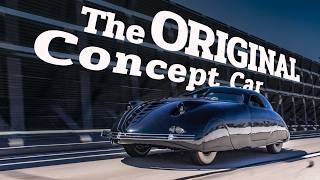

The Flying Wombat: A Car Too Fast for the Cops?
38sOpens with the myth of a 150 mph car that police couldn't catch, instantly grabbing curious viewers.
▶ Play Clip"The title accurately describes the car and its futuristic nature, though the 'Flying Wombat' nickname and tragic story are covered in the transcript."
This video from Jay Leno's Garage features the 1938 Phantom Corsair, a highly customized and futuristic car built on a 1936 Cord chassis. Originally designed by Rust Hines, a wealthy heir, the car was intended for a limited production run but never went into series manufacturing. The discussion covers its unique design, heavy weight, lack of visibility, and the tragic story of its creator's early death.
The car was considered too futuristic for most people when it was introduced, with features like pop-up headlights and a hydraulic system that were seen as potential failure points.
The car featured is a 1938 Phantom Corsair, also known as the 'Flying Wombat' from a 1930s movie, and is part of the Harris Collection.
Phil McDougal, president of the National Automotive Museum in Reno (formerly the Harris collection), is brought in to discuss the car's history. Bill Harris had 1,500 cars at his death.
The car was created by Rust Hines, a multimillionaire from the Hines dynasty. He designed it as his personal car, using a 1936 Cord chassis, but died at age 25 before production could begin.
It cost $24,000 to build in the 1930s (equivalent to about $560,000 today). The car weighs over 4,600 pounds and has a front-heavy weight distribution.
The body is original aluminum. The car has had several owners, including Herb Schreiner. The car was originally black but has been repainted.
The car was marketed as the 'Baby Duesenberg,' but this was a poor strategy because wealthy buyers preferred larger cars. The name was later changed to Cord.
The Cord introduced many firsts: a horn ring, a gas door, pop-up headlights, and a front-wheel-drive V8. The vacuum electric transmission was innovative but troublesome.
The car had two custom radiators and additional grooves cut into the body for airflow due to chronic overheating problems.
The car seats four in the front and two in the back facing backward, originally intended for a bar. There are no rear-view mirrors, and visibility is extremely poor.
The doors are electronic and operate via hydraulics; if the battery dies, there is no way to enter the car. The hood, roof, and other components were hydraulic.
The car was designed with soundproofing (cork and rubber), bullet-resistant glass, and plans for a heater, air conditioner, and radio, though the AC was never installed.
The car drives like a Cord but has very poor visibility, no power steering, and brakes that are inadequate by modern standards.
The design is visually stunning and art deco, but there is no significant engineering innovation—it is essentially a Cord with a custom body. The car is front-heavy and handles poorly.
The 1938 Phantom Corsair is a beautiful but impractical vision of the future from a young designer who died tragically. It remains a fascinating museum piece that embodies the tension between innovative design and market reality.
What is the approximate weight of the 1938 Phantom Corsair?
Over 4,600 pounds.
09:57
Who created the Phantom Corsair?
Rust Hines, a multimillionaire from the Hines dynasty.
02:23
How much did it cost to build the Phantom Corsair in the 1930s?
$24,000.
03:28
What were the original plans for production volume of the Phantom Corsair?
He planned to make about 15,000 units.
03:13
What was the unusual seating arrangement in the Phantom Corsair?
Four seats in the front and two in the back facing backward.
11:10
What car was the Phantom Corsair based on?
A 1936 Cord 810.
03:42
What was the Phantom Corsair's nickname from a 1930s movie?
The Flying Wombat.
00:39
What was the main cause of the Phantom Corsair's overheating issues?
Insufficient airflow due to the body design, requiring two custom radiators and additional grooves.
10:42
How did Rust Hines die?
He died at age 25 in a car accident shortly after the car was finished; his friend was driving and was killed in a U-turn accident.
06:45
What was the marketing name for the car before it was called the Phantom Corsair?
The 'Baby Duesenberg'.
08:31
Creator's Tragic Story
Rust Hines, a wealthy heir, created the car but died at 25 right after finishing it, preventing production.
02:23Marketing Mismatch
The car was called 'Baby Duesenberg' when wealthy buyers wanted large cars, a key reason for its failure.
08:43Vision vs. Reality
The car's design was stunning but impractical, with poor visibility, no power steering, and heavy weight.
17:51[00:00] Well the transmission ships are very nice in here. Yeah it does. What people like and inspired to is not what they would actually buy. Right.
[00:12] Even when the cord came out, it was a little futuristic for most people, oh, another thing to break is my dad would say, you know, kids love it because, oh my god, this is cool, you know, just turning this thing is a chore.
[00:25] It is. Yeah. There's a lot of room. Well in the episode of J. Lennel's Garage, the car featuring today, 1938 Phantom Course
[00:39] there. What is that? We'll find out in a minute. You know, when I was a kid, this is a car that was in movies in the 30s, I think it was in movie, they called the Flying Wombat.
[00:51] And there were so many rumors about this car. This looks like the ultimate CADs car or bad guys car. You know, I remember when 150 miles an hour and the cops couldn't chase it and couldn't catch it, just all kinds of silly things.
[01:04] I mean, it's based on I guess the 1936 cord front wheel drive. It looks kind of cool, it's just such an unusual car. This is part of the Harris collection.
[01:17] In fact, it's one of the centerpieces that people went to see because there were just so many rumors about it and it'd been on the big screen, you know, in the 30s and we'll find out the name of the movie. Let's bring in Phil McDougal.
[01:29] Phil, come on in here. He's president of the National Automotive Museum in Reno. It's the old Harris collection, really. Bill Harris was quite a guy. He probably restored and saved more cars than anybody.
[01:42] He had 1,500 at the time of his death. He did, 1,500. He died pretty young at 66, and I had just started kind of my career and show business. I remember I was like 26, and I said, well, he died at 66.
[01:56] Well, that seems long enough. Look at us. Yeah, yeah, that was way too young. But he just loved these cars and he kept records and meticulous.
[02:09] He saved every piece of literature. He just left a wonderful legacy for those of it like this hobby. So you have the facts here. What I have is all just sort of conjecture and what I kind of have truth.
[02:23] So give us a real story here. Well, the real story is that it was the creation of a gentleman called Rust Hines. Rust Hines was the famous Hines dynasty, 57 varieties, multi-multimillionaire.
[02:37] He was the second child. He went to Yale, his kind of that story of, didn't want to follow the father's footsteps, took him off, went to Pasadena to, you know, claim his own glory, wanted to be a designer.
[02:49] And the only way he could do it is because his aunt at the time said, I'll fund you because the family said, no, he wanted a piece of paper and he scratched off this design which was like literally space age back then.
[03:01] He created it. He had a 1936 cord that was cool and he said, I'm going to take that cord in the chassis and create my own vision, which you see here. So this was his personal car. This was his personal car.
[03:13] It was an experimental car. He planned to go in production and make it like 15,000, never managed because tragically he passed away 25 years old. Well, 15,000 would have been a lot of money, I mean, that's a crazy money.
[03:28] It cost 24,000 to build. Nowadays that would have been $560,000. So now there's nothing, it's just modified visually. There's no, it's just a cord underneath.
[03:42] There's no souped up motor or anything of that nature. No, it's built on a 1936 cord. So no, it's just basically an 810 cord, 4.7 liters, 289 cubic inches and he started with the
[03:57] vision. But a lot of other things added to it, a lot of other special nicks. It must be incredibly heavy because you know, the original cord, the reason the wheels had those holes because the brakes overheated.
[04:12] So they put the holes in. Now you get the skirts on here. So I can't imagine how hot this must have been to drive. You really can't see out. I mean, it does have that sort of 1939 Batman comic look to it, you know, that the idea of
[04:31] what they thought was streamlined, supposed to actually be wind tunnel testering in that nature. I mean, it's certainly fascinating. And when I was a kid, it was just like the coolest car because you just assumed it went 150,
[04:45] 200, and you know, you catch bad guys or whatever, yeah, just hilarious. And who built it? Did you say Boman? Yeah, Boman and Pasadena, he came here and Boman and Swartz designed it with him and built
[04:58] it. But you just talked about the engine, I mean, it tends to overheat, so you see all these things. The grooves and the hydraulics, the things that he did were unique, were like hydraulic system. Right.
[05:10] He had a hydraulic that would open up the hood, hydraulic with the bumper. Even electronic door, you open the door, no handles. Right. So you're in a mess if there's no electricity, no battery, you can't get in or out.
[05:23] Right, right. And I didn't imagine those hydraulics work at this point, do they? No, they don't work. We're working on restoring it all. Right, right. You know, very interesting. Okay. Is any of the original body here?
[05:35] Yes. Aluminum body. They had a couple of about five or six owners, including we mentioned earlier, Herb Schreiner he owned it. Yeah. Because the cord was a four door. Yeah.
[05:47] So this they made a two door. And his son, Will Schreiner, a very funny comedian as well, talented guy like his dad, he hoped to inherit this car, but his father was killed quite young in the car accident.
[06:00] And you know, money's tight and the car was sold, but it was too bad because he would have inherited this and it would have been interesting. Rest times was obsessed about aerodronomic dynamics. He literally wanted to make sure this thing was flawless.
[06:15] Even inside it's got cork and it's got sound proof and you can look at the dash. It's like the, you know, the shuttle. Right. It's got everything you can imagine in there. Was this done in a wind tunnel or just his idea of what? It's funny because it was done when Swartz and Bowman got together with him.
[06:30] They made the clay models and actually back then that was revolutionary. They did it out of wood and they did in the wind tunnel and they took five or six different attempts to get it to the final design. Even that they had to go back in because of overheating issues and cut additional grooves
[06:45] in there for him. And he was killed right after the car was finished, is that cool? Yeah. It was terrible because right after he finished, he was the ultimate salesman. He was before Tucker, 11 years before that. He was out there. He had an Esquire magazine is the car for the future.
[06:59] Right. I mean, it was everywhere. He went back east to Pittsburgh just to see his family. His friend was driving the car and his friend lost his hat. The guy made a U-turn to go get his hat and got hit and died instantly on this car.
[07:12] No, his friend's car, but this is right when it was about to take off and go into productions and it just never went anywhere but a garage after that. That's too bad. Well, it's fascinating. It's all this is aluminum body.
[07:25] Is that correct? Aluminum body? Yep. It did a lot of modifications by Herbie Schreiner. He made a lot of modifications, but again, when Mr. Herrick got it, he brought it all back into the original state then when...
[07:37] Can we open it up? Yeah, yeah. Let's open it up. It's going to take a couple of steps. Okay. Yeah. I don't want you to do it.
[07:50] Was it always black? Was it black originally? You know, there's rumors about that. The internet says, everything in the internet must be true, right? The internet said that it was originally black and then after that, it turned gray and then
[08:05] one of the owners turned it in and he made it different colors, chrome, different things. And then after that, he went back to black again with Mr. Herrick.
[08:17] And how hard is this to work on? You know, this is all pretty much cord, and this was a revolutionary car. You know, this car that was supposed to be the Baby Doosenberg.
[08:31] The idea was, Doosenberg was a big car. Let's build a personal luxury car. Well, in the 30s, if you had money, you wanted a big car. I mean, why would you pay more money for a small car?
[08:43] It didn't make sense. It didn't make sense. It didn't make sense to people. You want to be something where you show up and you get the big grill and all that kind of stuff like the Model J. So calling it the Baby Doosenberg didn't do it any favors, then they just went to cord because
[08:56] it yield cord. But revolutionary, first car with a horn ring, first car with a guess-up a gas door, first car with headlights of pop-up, all kinds of things. And a great V8 purpose built just for this car, front wheel drive, you know, you put a set
[09:15] of radial tires on these and boy, it handles like a car from the 60s, I mean, it really is terrific. And you had that vacuum electric transmission which was troublesome, but you put it in gear and then you hit the clutch and it would shift on and out.
[09:29] The idea would be you could enter a turn, downshift, and as you went through the turn, you hit the clutch and it would shift. So you didn't actually take your hand off the wheel, you know, but it was a big heavy transmission
[09:42] like this. Yeah. We made some modifications on the radiator there and again, just for the air flow, but you'll see some of the hydraulics here that aren't functioning right now, but that would stay the art. He even had the tempered glass, like bulletproof glass back then.
[09:57] Well, this must be like a 60, 40 weight distribution, I mean, all the weights up here, and then you hang this big thing over the front, oh my God, it's over 4,600 pounds. Yeah, that's big, it is big.
[10:10] Not crazy crazy. And powerful, long, very long. And I think it was about what, maybe 160 horsepower is that about what? Well, it was, it ended up being modified to 190, but closer to like 145 in the beginning
[10:25] until it made some modifications. But it was flying, and every time the story got told, the story was, it went a little faster. Right, right, yeah, interesting. And then what do you have to, these bolts? Yep, two custom radiators, we have two radiators, they made a custom one because of the
[10:42] wasn't enough air getting into it, overheating, that was the one modifications, the same size of hydraulics. Right, okay. But even like the roofs come up, all that was hydraulic, the hood was hydraulic.
[10:54] And you have a sand way back here and the radiators way up here, well, no wonder you were over here. Yeah, you wonder. Every time they went out, they added some additional cuts in there just for the air flow.
[11:06] See, if there are trunk, does it open? Nope, no trunk, but it's interesting, you know, it's got a 4-seater in the front. And the steering wheel is one over. So the thought was, the guy is driving the car, had someone on his left hand side driving.
[11:19] Oh, yeah. And in addition to that, the back seat is a 2-seater. Well, someone said, so you said, not quite in the middle, but yeah. Yeah. And if you're my size, you probably can't have someone on the left hand side.
[11:33] Yeah, it's just. And he had, the rumble seats are facing the other direction, and it's funny because he could have had another seat, but it was important to him to have the two places for the bar and the back seat. So there's a place there that had little cocktails in the back.
[11:46] Yeah, you need that. Yeah, he did. You got no rear view mirrors. You can't see out the window. Let's throw liquor into your face, you know, as well. And across the, disappearing headlights were gone. I'm surprised he didn't want to keep that.
[11:58] You think there's, it has these wood lights, which are terrible. Yeah. It's just awful. Oh, it's terrible. But the fog lights there, you know, with the aluminum around it, it was great at that time. You get a little extra projection all the way around.
[12:11] Yeah, I mean, it's amazing. I guess you would put suitcases in through the door here. That's about it. Yeah, yeah. Trying to get in, not really nice with your lady in 1938, trying to crawl in the back seat. Yeah, yeah.
[12:23] This is a dream of being a car designer. Yeah. Looks good. Not as practical sometimes. I mean, you know, from, from the side angle, it looks great. It's very swoopy and all that kind of stuff.
[12:36] It looks terrific. You wonder how much he did and how much Bowman and Schwartz did, you know. It's funny because a lot of things you read is that mostly Schwartz and Heinz did it versus Bowman. They have a lot of protocols about it.
[12:48] But they said that his original drawings that he made and they have those, the drawings he made a year and a half earlier compared to the final, almost identical. Yeah, that's interesting. Almost identical. I think someone got carried away on all the gauges in the front there.
[13:02] It's like something you see up in the space. Yeah, look at that. It's got about 12 or 13 to those. Again, four people in the front, electronic doors. Yeah, four across the front. That's hilarious. Yeah.
[13:14] And then the two in the back seat facing the wrong way. The panel is lift up so it's got some nice fresh air there. And then if you want to get in though, the battery dies, you're, you're not in good shape because it's no way to get into the car.
[13:26] I guess that's right, isn't it? Yeah. Now, did he go to pass the, well, was passing in the school to design there in the 30s? Now, he was, well, he was, he was a Yale and dad didn't like that very much because he
[13:38] dropped out to go find his dreams. Right. Went to Pasadena to be with an aunt who decided to fund him because the family says, you're, you're not going to the path they want you to. Right. So they funded it there. He just, he worked directly with Swartz and Bowman to put this together saying, okay.
[13:53] All right. I imagine a drive's just like a 36 cord. Yeah. Well, you can drive the same way, but you want to see good luck because you have this much vision on both sides. You can't see anything in the back of the front.
[14:06] Double thick glass. You say bullet resistant. Yeah. Bullet resistant back then. It was temper green with the bullet resistant. Don't know why he was obsessed with the noise and padding in here and fork and rubber to
[14:18] protect everybody. You know, there's a lot of aviation influence in this car, even when the cord had it like combing, built all the aircraft motors. They did the do's in bird block, they did this block. Yeah. And the airport might be the better place to drive this thing because I'm not even sure.
[14:34] You can't see out of it, right? It's really hard to see. I've got to get a lot of people to give us some second looks as we're driving down the airport on this one. Yeah. All right. Well, let's, let's take it down to the airport and see how it goes.
[14:47] All right. Let's see what we got there. And no power steering of any kind.
[15:00] You're going to do a workout before this one. Why okay on that end? Over there? Yep. Do good here. You get a switch for every possible thing.
[15:14] I mean, it's not as long as it's got a couple of side mirrors and putting it in a set of brakes wouldn't fix really. At a minimum.
[15:26] And if you weren't sure what to do, you got 12 cages here to work with. Well, you know, you have that thing where designers are not businessmen and businessmen are not designers. Right.
[15:38] And, you know, there are very few people who can do the whole package. You know, guys can build a great motor but then I, they're doing some very brothers and not designers or the cars when they built them, were kind of stodgy looking, you know,
[15:51] so that at first they didn't sell but they had fantastic motors. Yeah. Because that's what they care about. I mean, guys, just care about design. They don't care about the motor. They don't care. Some of them don't care about it. You can see on the side or the back.
[16:04] Yeah. As long as it looks good. Yeah. Right, right. And he was definitely in that category. Innovator designer, they said it very close to his initial concepts on the little drawings of Nathan Appkins, compared to the final product.
[16:18] Well, I would say dreamer, I mean, at $15,000 a car, I think the average person was only making 1,200. Well, there were people who could afford it but it was really just a cord with some body
[16:33] works stuck on it. Yeah. Modified engine, you know, you've got to spend $15,000 on a deuce of berg inspired overview. Get a real deuce of berg. Yeah.
[16:45] No. I think that's what a lot of people said afterwards otherwise it would have gotten somewhere. And this is a true tea top, isn't it? Yeah, true. Tea top? Yeah. Originally, it was like hydraulic.
[16:57] So you push the button and that would pop up a little bit. The hood would pop up a little bit. You know, again, the doors were all automatically electrotics, original plans for the heater and air conditioner and a radio with speakers, anyway.
[17:11] Well, there was no air conditioner. No, they didn't get it in but it was the plan for that. Well, no, air conditioner didn't come out until 1940. Oh, that's why I didn't come out with it. Yeah, the first air conditioner was Packard.
[17:23] Well, I didn't know that. Packard had the very first and it really wasn't air conditioner with the refrigeration unit. It was either on or off. You're the freezing.
[17:35] Freezing, you're boiling. Yeah. So he was thinking about it. It was unbelievable. I mean, look, most buildings, one of the air conditioning, movie theaters used it the best because they have cold air and people would go just to get out of the hot air, you know.
[17:51] Yeah. Well, the transmission ships are very nicely made. Yeah, it does. It does. This is, it went through a whole bunch of owners. It went through a couple of little fender bedders, including one with us originally.
[18:04] But well, you know, this would have, it would not have been a success in almost any, what people like and inspired to is not what they would actually buy.
[18:16] Right. Well, even when the cord came out, it was a little futuristic for most people. Oh, a lot of, another thing to break is my dad would say, you know, headlights had to flip up and all kinds of things like that.
[18:28] You know, can't flop. Yeah. Because oh, my God, this is cool. You know. It made the cover of Esquire magazine in the car of the future. But I mean, how many times do you see things like that that don't go anywhere? Right. For the reasons you just said, not as practical, a lot of bells and whistles, but it basically
[18:43] is a cord. And it's front end, it's so front end heavy. Oh, my God. It is. It's a beast. Yeah. Four seats in the front, 4,600 pounds. Four seats. Yeah.
[18:55] Two in the back. Well, that's about what a Dodge Hellcat weighs now. Yeah. So that's not unusual for now, but it was that. See, I thought it was turning. I mean, it is kind of a hard to turn, but because of the weight with no fenders on there,
[19:09] it kind of covered that. Well, it was hard to turn because the engine is in the front. Yeah. And all the weight is over the front wheel. So I mean, power steering would have fixed that, but it hasn't been invented yet.
[19:21] When was power steering invented? Roughly. It probably didn't come until the 40s, until the very late 50, 51 really is when it really started to happen. You know, see these ads with the power brake with the lady in a little high heel shoe touch
[19:38] you. Yeah. So realistic. Yeah, yeah, yeah. So realistic. Well, kind of was because that was the idea behind it. It's the smallest amount of pressure. Dozenberg had a hydraulic gauge since people didn't trust hydraulic brakes.
[19:53] When you press it, show you, you're putting 500 pounds of, oh, 900 pounds of pressure. You know, how much the foot could, that's just more to make the driver feel more comfortable and safe. Just turning this thing is a choice.
[20:06] It is. Yeah. You need a lot of room. Well, look, 1, 2, 3, 4, 5, 6, 7, 8, 9, 10, 11, 12, 13 different gauges out here. Well, you know, it's interesting. This is what they call airplane type.
[20:19] You know, Lindbergh had flown the ocean just less than a decade earlier, and it was, everybody wanted aircraft inspired. That's why Dozenberg came with all timidr. Yeah.
[20:31] Yeah. It does have that look, doesn't it? It has that whole aerodynamic look in there. The airplane theme. It's got a lot of backpubial theme though. So was that easier than you thought?
[20:44] Harder than you thought. What's the biggest thing that stands out to you on this car? Well, you mean, well, the brakes, obviously. Yeah, the brakes. Yeah, I mean, it has no brakes for all the types of purposes. You couldn't stop it at 40 miles an hour.
[20:59] But the design is it, because you said it's just a cord. What stands out to you is cool about the car. Well, I mean, it looks cool. It does what it's supposed to do beautifully. It's visually stunning.
[21:12] It looks so art deco, streamlining, like something the bank robber would drive. To get away from the bank man, you know, that kind of thing. But like the movie they made, the back guys had it.
[21:24] Yeah, there's no engineering in it. It's like some with sandbags over the front end. You got two radiators hanging over the front end. I mean, it's like having waited the end of a broomstick, you know.
[21:37] It's so much heavier because it's so long, you know, and you can't hold it up. I think the windows are so small, it's like you're in a cockpit of an airplane. Yeah, I think that's the idea. Yeah. It's supposed to be like a cockpit, you know.
[21:49] Better to look good. Yeah, yeah, yeah. Yeah. The cord was a great car when it worked, but troubles, they were just under financed, drove again.
[22:01] Yeah. Now it's got some power. And you shift, push it, push it, push it, push it, push it, push it, push it. There you go. Well, the center gauge, I think, is just the vacuum gauge.
[22:14] I mean, you got every single gauge in the world here from the oil pressure to the vacuum, to the typical, the clocks in here from the cord, but also the gauge in the middle is one that stands out to you.
[22:27] This thing is huge, about quite sure how functional it is because it's just talking about your deceleration and let you know comfortably that you go to the right speed. I don't know what, I don't know what, I think it's just a vacuum gauge.
[22:39] It's like in the Chrysler's, they would have an economy gauge when you get off the throttle and whatnot. It's literally telling you, like, how many feet, what your rate is. So right before you hit the last few feet, it tells you to stop.
[22:51] You know, the cool thing, though, is being like the bad child, he literally was going to go back and just go work in the catch-and-factory and because he had to follow out with his father and move back in this on-took event, that's what made the big difference in this life.
[23:07] You know, the only time when we drove the Thomas Flyer. Yeah. That's cool. It's incredibly high gear, because that means second gear, if this would be 4th gear or any
[23:20] of the cross-degree, it would be an hour and third gear. Third gear, let's go 4th gear. 4th gear. Awesome. It's great. It's good. So now we're just passing the lead.
[23:32] We're passing the front. The Germans are right next to us and we're just going for that. The 100 years never went past second gear until you won the runway.
[23:44] Yeah. And I told you that. I said, oh, never been past second. You said, today, well, then you went to third, then you went to 4th. And it did good. Yeah. 100 years low. They made it to last.
[23:57] Yeah. And this one too. I think had at least nine different odors before it got to Mr. Hara. Yeah. So we look at all the part, took it down to the bear, put it to the original.
[24:10] You can see in the previous version how the Mr. Triner, he tried to make the windows much bigger in the back and the side and he opened up so the air was much more air coming into the
[24:23] vehicle. It was. Yeah. But you can kind of tell the way it was that the windows were at least double the size. But they had to have small windows back then originally underhines because he wanted it to be tempered bulletproof glass.
[24:36] And then he just couldn't make them that big. That was the only limitation. Yeah. Well, thanks for bringing this folksy. They don't get to the Reno area. Go to the National Automobile Museum.
[24:49] Love to have you. Yeah. You'll see the ghost of Bill Hara wandering around here. And he's the guy that started all these cars. And a lot of the greatest cars are still there. Yeah.
[25:01] It's a lot of fun for everyone in Reno. I like to go there. Thank you, my friend. Thanks very much, Joe. Oh, yeah. We appreciate it. Thank you. We're having this back again. Yeah, I'm sorry. Hopefully I'll get that next time we drive it. We'll take the teapot off and we'll see if it really goes 100 or 50.
[25:16] Thanks, folks. See you next week.
⚡ Saved you 0h 25m reading this? Transcribe any YouTube video for free — no signup needed.