
Master the Scoop Drill for Card Counting
45sThis segment introduces a unique, hands-on card counting drill that is both educational and visually engaging, appealing to viewers interested in learning a new skill.
▶ Play Clip"The title accurately describes the content—three drills are demonstrated—but the video includes some filler and self-promotion, slightly diluting the value."
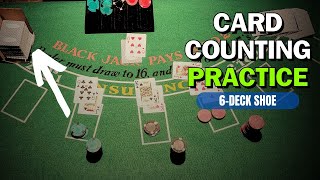
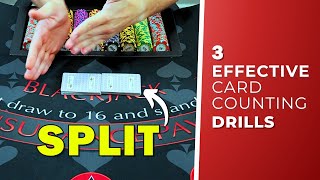
This video presents three practical card counting drills designed to improve speed and accuracy for blackjack players. The host, A1 Blackjack, demonstrates each drill with a single or double deck, explaining the methodology and offering tips to enhance practice sessions.
The video introduces three favorite card counting drills, starting with the 'scoop drill' using a double deck.
Remove six random cards from a double deck and place them under a poker chip. The drill involves dealing three spots and using a seventh card to scoop up the played cards.
Wait for the second card to see if high and low cards cancel, allowing for faster counting by skipping neutral pairs.
The drill is performed for real, with the count ending at zero, and the remaining six cards should also sum to zero to verify accuracy.
Split a deck roughly in half, count one side, and the other side should be the opposite value. This drill works with both single and double decks.
Start and end at a non-zero number (e.g., 10) using chips as a target. This drill helps practice counting with a different baseline.
The host shares tips like placing a chip with the count value on top of the deck to remember the target, and encourages viewers to like the video.
The video provides three effective drills to improve card counting speed and accuracy, emphasizing practice and verification. The host encourages viewers to incorporate these drills into their routine for better performance at the blackjack table.
What is the purpose of the scoop drill?
To practice counting cards quickly by dealing three spots and using a seventh card to scoop up played cards, verifying the count at the end.
00:01
How many cards are removed at the start of the scoop drill?
Six random cards are removed from a double deck.
00:14
Why does the host wait for the second card before counting?
To see if high and low cards cancel each other, allowing for faster counting by skipping neutral pairs.
01:33
What is the expected final count after completing the scoop drill with a double deck?
The count should be zero, and the remaining six cards should also sum to zero.
04:20
How does the half and half drill work?
Split a deck roughly in half, count one side, and the other side should be the opposite value (e.g., plus two and minus two).
05:19
What is the 'high number, low number' drill?
Start and end at a non-zero number (e.g., 10) using chips as a target, practicing counting with a different baseline.
09:35
Cancellation Technique
Explains a key speed technique: waiting for second cards to cancel high/low pairs, reducing counting effort.
01:33Verification Method
Demonstrates how to verify count accuracy by checking that remaining cards sum to the expected value.
04:20Half and Half Drill
Introduces a simple yet effective drill to practice counting with a split deck, reinforcing the concept of balanced counts.
05:19Non-Zero Baseline
Shows how to practice counting with a target other than zero, improving flexibility in real-game scenarios.
09:35[00:01] over my three favorite card counting drills that I do all the time, and I deck and a double deck here. We're actually going to start with a double deck and do my favorite drill, which I like to call a scoop drill. Okay, for
[00:14] need a double deck, and then you're going to take out six random cards. If you're doing this with me, fan out your cards and take out six without looking cards and take out six without looking at them. Three, four, five, and six. All
[00:26] to put these underneath the poker chip to keep them safe. Just like that. The together. All right. So, I'm just going to give these some cuts here. Should be good enough. And then I call this a scoop
[00:38] be scooping up three piles. We're going to be playing in these three spots here. So, if you are playing, like I said, kind of along with me and you're playing that's a little slick, uh you might want to have like a mat down or something or
[00:51] maybe do it on the uh carpet where um has a little grip to it. Uh because this is for speed. Those cards can go sliding like crazy if you're on a kitchen table brought these in a little bit compared to the bedding circles because I want
[01:05] these to be a little bit closer to me when I deal uh as I'm trying to do this even. I'm not going to do that today, but uh you can maybe time yourself. I'm just trying to teach you what these drills are. And so the way this works is
[01:18] we're going to deal out three spots, but not the dealer. Okay? And then I'm gonna drops. So nice. Got blackjack there. I'd say D1, D2. And I'm keeping the running count. So still D2 and still D2. A bunch of neutral cards there. The reason that
[01:33] we wait for that second card, let me get Cherry pick some here is because if I have cards that cancel like this. So I would say D1 D2. And then I'm not even going to count these. So I wait for that
[01:47] second card because those cancel. I can just blow right past that as I know one's high and one's low. I don't have to worry about counting each one individually. So, D1, D2, D3, and then this is called a scoop drill because not
[02:00] only do we use these six cards here, but we also use a seventh card that's going to scoop these up. Scoop, scoop, scoop, and throw them off to the side. Now, my and throw them off to the side. Now, my count was currently D1 D2 cancels D3. I
[02:13] over and starts to scoop, I have to count what its value is as well. So if it was D3 currently, now it's D2 with the five D2 and throw off to the side and I would do it again. So my count's at D2 D1 01.
[02:30] Those cancel and then a neutral card. So still one. And then I would keep doing still one. And then I would keep doing that. So it's one, two, three, four, five, and throws off to the side like that. Okay, I'm going to shuffle these
[02:42] ones back in. And then we're going to try it for real. You can try to do it along with me here. And I still haven't looked at these six cards yet. So the way the math works is if we're using seven cards each time, 2,
[02:54] four, six, and the scoop card is our seventh, there's seven times, however many are left comes out even. So that there should be six when we're done if using a single deck, I want to say it's two or three. So you'll have to figure
[03:08] your own. All right, ready? Let's try it. it. So we have one, two, three.
[03:29] Five. Six. Did you see the scoop card? Seven. 8. 9. 10. 11. Nice. High count. 10 9 8
[03:42] [Applause] 9 8 9 9 8 9 8 7 6
[04:01] 5 4 3 2 3 2 1 0 D1 1 0 1 2 3 2 1
[04:20] mess of cards over here, but more importantly, my count is at zero. I'm importantly, what's the count? Well, my count is at zero. Okay. And because of that, the six cards that are left should get me back to zero as well. These
[04:36] should also equal zero. If my count was at plus two, then these would have to equal minus2. As we always end at zero, as long as we're using a normal double deck here. All right, let's count out what we have. We have one, two. So,
[04:50] these should be two high cards left over and they were back to so one, two, one, zero. So, therefore, my count is correct. All right. I call that a scoop drill. Kind of a fun one. Um, I like to do that one quite a bit. Uh, the next
[05:05] drill we're going to use is going to deal with just one deck. Okay. Actually, we can do this with both one deck and two decks. So, maybe maybe I'll do it both ways. And let's give these a shuffle. I like to call this a half and
[05:19] half drill. I made a YouTube short recently about this. And anyway, what we do is just kind of eyeballing it. I'm going to get roughly half. Doesn't have to be perfect. 26 and 26, but roughly half in each side. Now,
[05:37] what we're going to do is we're going to count up one side and then whatever we get there for a number, just like kind of before with the the double deck, the opposite should be what the other chunk of the deck is worth. So, if this is
[05:50] plus 10, which would be pretty extreme, this would be worth minus 10. Or if this is plus4, this would be worth minus4, and so on. Okay, this is another one that's kind of fun to time yourself and try to get faster and faster. Let's try
[06:02] this. I'll go a little bit slower this time. We have D1 0 1 0 1 time. We have D1 0 1 0 1 2 1 2 3 2 3 4 3 2 1 2 1 zero one zero
[06:19] one and two. So this chunk was worth plus two. And if you ever forget, sometimes what you can do is just put that number on top just like that. So and tricks along the way here. This is worth plus two. This one needs to be
[06:35] worth plus two. This one needs to be worth minus two. Let's try it. We got 0 worth minus two. Let's try it. We got 0 1 2 3 2 3 2 3 2 1 2
[06:55] minus2. So plus two and minus2 of course come back to give us zero. All right, faster and then maybe we can do it also with a double deck as it works the same
[07:07] way. Again, just kind of eyeball it. Doesn't need to be perfect. If one's 27, the other one's 25. That's fine. Okay, I'm going go as quick as I can here. We'll try it. We got 1 0 D1 D2 D1 0 1 0 1 0 D1 0 D1 D2 D3 D45 D65
[07:25] D43. All right, so this is worth minus three. This should be plus three. three. This should be plus three. We have D1 0 1 0 1 2 1 2 3 4 3 4 3 2 3 4
[07:38] We have D1 0 1 0 1 2 1 2 3 4 3 4 3 2 3 4 3 4 3. Yep. So minus three and plus three. So that is what I like to call the half and half drill. Now like I said, it does also work with double deck like we just had. This might be a better
[07:51] one to kind of judge half where you don't want to necessarily count out, you know, 52 cards, 52 cards. You can do the same thing. I might go a little slower same thing. I might go a little slower than that last one. There we have 1 2 1
[08:06] than that last one. There we have 1 2 1 0 D1 D2 D3 D2 D1 0 D1 D2 D1 0 1 0 1 0 D1 D2 D3 D4 D3 D4 D5 D6 D5 D4 D3 D4 D3 D4
[08:27] D4 D3 D4 D5 D6 D5 D4 D3 D4 D3 D4 D5 D6 D7 D8 D7 D8 That's a fun one. So minus 8. When you do double deck, your count can be a little bit more varied. So minus 8. That should be worth plus eight.
[08:41] eight. 1 0 D1 0 1 0 D1 1 0 D1 0 1 0 D1 0 D1 D2 D1 D2 D3 D4 D3 D2 D1 0 D1 0 1 0
[08:53] 0 D1 D2 D1 D2 D3 D4 D3 D2 D1 0 D1 0 1 0 1 2 1 2 3 4 5 4 5 4 5 4 5 6 7 8 7 and 8.
[09:06] Yep. So this was minus 8 and this one was plus eight. So you kind of get the idea that you can do that half and half drill with both a single deck and a double deck. Let's go back to the single deck now and kind of similar but
[09:22] slightly different. This is what I would call high number, low number. I don't know. I'm not very creative with my names. But again, let's give this a quick shuffle some strips. And then instead of starting and ending at zero
[09:35] with our deck, we can start and end at a different number. All right. Uh sometimes what I like to do is just grab a chunk of of um chips. Let's count a chunk of of um chips. Let's count these out. We got 1 2 3 4 5 6 7 8 9 10.
[09:49] All right. So we got 10 chips there. So I'm going to start and end at 10. And instead of starting ending at zero, 10 is where I want to get back to. So I'll doing double decks, some like put two cards off to the side for however many
[10:03] cards off to the side for however many decks you have. And instead of starting at zero, we're going to start at 10. So, currently my count is at 10. And I'm currently my count is at 10. And I'm going to say 9 10
[10:15] going to say 9 10 11 10 11 11 10 11 12 11 10 9 8 9 8 9 10 9 10 9 8 9 8
[10:32] 12 11 10 9 8 9 8 9 10 9 10 9 8 9 8 9 10 11 10 9 10 11 10 9 10 10 9 10 11 12 9 10 11 10 9 10 11 10 9 10 10 9 10 11 12 11 12 11 12 11. So I'm at 11 right now.
[10:45] Remember I want to get back to 10. And so this needs to be worth minus one, which would be a 10 or an ace valued card. And it was all right. So this is a 10 valued card. And of course, you can do the same thing with a double deck as
[11:00] well. So those are three of my favorite counting drills. I do those a lot um in I do those quite a bit. So, you maybe have seen some of those, but it's kind of tips and tricks and things along the way, like whatever you get when you do
[11:15] the half and half. Like, if you got plus seven, go through and find a seven, put that on top. I kind of like that trick. That way, I don't forget. Or you can have a Sharpie or something that would keep you going. Um, if you guys like
[11:29] the thumbs up button for me. That really helps me out, helps spread these videos to other people. And uh I get more money when you guys hit the thumbs up button, for you, though, so I appreciate it.
[11:42] Anyway, till next time, this is A1 Blackjack.
⚡ Saved you 0h 11m reading this? Transcribe any YouTube video for free — no signup needed.