
Feel Nothing on Chest Exercises? Do This
44sThe 'chest high' cue gives an instant mind-muscle connection fix for anyone who feels nothing on pressing movements.
▶ Play Clip"Delivers exactly five actionable cues with clear explanations — no bait-and-switch, just solid training advice."
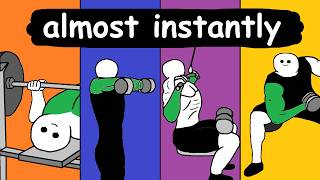
This video presents five practical training cues to improve exercise effectiveness: keeping your chest high and arched for chest presses, pulling with your elbows while keeping forearms aligned for back work, using a full range of motion with pauses for calves, leading with your elbows in lateral raises, and pinning your elbows to your sides during biceps curls. Each cue is meant to shift tension to the target muscle and prevent compensation by other muscles.
Many lifters feel like an exercise 'doesn't do anything,' but hidden training cues can instantly make the same movement feel incredibly effective.
On any chest exercise, hold your chest high and get into an arched position by pushing your chest up, squeezing shoulder blades together, and pushing your traps into the bench. Hold this for the entire set.
Pushing your chest up as high as possible shifts the load from the shoulders to the chest. Even on cable flyes, where you can't arch against a bench, keeping your chest high allows a greater stretch and prevents shoulders from caving in.
The cue 'pull with your elbows' means your hands only hold the weight, while your elbows drive the movement. Your forearms must stay in line with the direction of the pull, which applies to all back exercises.
For calf raises, go all the way down into a full stretch with a small pause, then rise all the way up and squeeze the calves hard with another pause. Avoid bouncing like you're on a bouncy castle.
When raising your arms, lead with your elbows, not your hands. Imagine your hands have no strings—only your elbows are controlled, like a puppet.
If your elbows move forward during a curl, your front delts take over tension from the biceps. Keep your elbows pinned to your sides so the biceps lift all the weight.
The video wraps up by pointing to a bundle of even more training cues via the first link in the description.
Implementing these five cues can instantly increase muscle engagement and reduce joint strain. The key is to consciously focus on positioning and joint alignment rather than just moving the weight.
What is the key cue for chest exercises?
Hold your chest high and maintain an arched position by pushing your chest up, squeezing shoulder blades together, and pushing traps into the bench.
00:16
How does the arched chest position affect load distribution?
It shifts the load to the chest instead of the shoulders.
01:13
What does 'pull with your elbows' actually mean for back exercises?
Your hands only hold the weight; pulling is done by the elbows, and your forearms must stay in line with the direction of the pull.
02:05
What should you do at the bottom and top of a calf raise?
Stretch fully at the bottom with a small pause, then go all the way up and squeeze the calves hard with another pause.
02:46
What is the mental image for lateral raises?
Imagine you are a puppet controlled by strings attached to your elbows, not your hands; lead with the elbows.
03:25
Why must elbows stay pinned to your sides during biceps curls?
If elbows move forward, the front delts take over tension from the biceps.
03:51
What happens if you let your shoulders cave in and chest collapse during chest exercises?
You will never be able to build an impressive chest.
01:40
Chest high changes everything
Simply holding the chest high can turn a useless chest exercise into an effective one, and it protects the shoulders.
00:16Elbows, not hands, for back
Explains the common cue 'pull with your elbows' concretely: forearms must align with the pull direction.
01:53Calf raises need pauses and full stretch
Eliminating bouncing and adding pauses at stretch and squeeze turns calf raises into real training.
02:46Puppet strings for lateral raises
The puppet mental model is a vivid way to ensure elbow-led lateral raises that hit the target muscle.
03:25Pinned elbows protect biceps tension
Forward elbow drift lets front delts steal the curl, so pinning elbows keeps tension on the biceps.
03:51[00:02] really feel anything on this exercise? Is this even doing anything? And you course that you feel that way on at least one exercise. So, today I want to that I will show you hidden training cues that will instantly change the
[00:16] whole exercise for you. So, you will be able to go from, eh, this doesn't really do anything to, oh my god, this feels beyond incredible. Let's start with the such a big difference that you will be asking yourself why you didn't do it
[00:29] simple it actually is. All you need to do on any chest exercise is try to hold your chest high. Simply just make sure that you are holding your chest up when makes the difference between not feeling anything and getting mediocre gains and
[00:45] and gains like you have never seen before. To guarantee that you do this into the arched position. To get into the arched position, push your chest as shoulder blades together while pushing your traps into the bench. And then you
[01:00] hold this position for your whole set. If you manage to do it right, your back will not be laying flat on the bench anymore. Instead, it's going to have that you get the best chest gains possible and you will also protect your
[01:13] you get into the arched position and you push your chest up as high as you can, all the load will get shifted to your chest instead of your shoulders. And cable fly and there is nothing that you can arch your back against, you still
[01:27] you do that, you can stretch out your chest so much more. Pushing your chest up high prevents your shoulders from caving in and will instantly change your chest training around. So, anytime you do a chest exercise, ask yourself, am I
[01:40] allow your shoulders to cave in and your chest collapse, you will quite literally never be able to build an impressive chest. So, remember that. The next training cue is for back training. I'm sure you have heard in the past that
[01:53] exercise, you need to focus on pulling with your elbows and not with your hands, which is true. This is very important, but do you even know what this phrase means in reality? Because when you hear pull with your elbows,
[02:05] really means. So, let me show you what this actually means. First thing you have to realize is that your hands are only for holding the weight. Otherwise, pulling is done by your elbows. And to pull with your elbows correctly, you
[02:19] need to remember one simple thing. Your forearms always need to be in line with the direction of the pull. Your forearms shouldn't be in this position or even perfectly aligned. This is how you pull with your elbows and not with your arms.
[02:32] And this is not only relevant for the lat pulldown. This goes for all the back you apply this to your back training because it's going to change everything at the training cue that will completely transform your calf training. A lot of
[02:46] calves, and that's because they are missing out on this crucial training cue. Every time you do any type of calf raise, you need to make sure that at the full stretch by going down and even adding in a small pause. And then you do
[03:00] a very similar thing when you reach the top of the rep. You want to go all the way up and really squeeze your calves as much as possible. Also with a small pause. Because if your calf training looks like you are on a bouncy castle,
[03:12] have never trained them. Once you start using this training cue, I'm sure you will see an insane difference. Now, let's take a look at a super important specific to the lateral raise. To really
[03:25] need to do one thing. When you move your arms up, you need to lead with your elbows and not your hands. This might seem super small, but it makes all the difference in the world. Imagine that you are a puppet and there are strings
[03:37] hands. And what you want to do is cut these strings attached to your hands. And the puppet should just be controlled by the strings connected to the elbows. out of the lateral raise. And now finally, the most important biceps
[03:51] biceps, you need to pay very close attention to your elbows. If your elbows start to really move forward while you curl, your front delts start taking over tension from the biceps. You need your elbows to be pinned to your sides at all
[04:05] times. So, your job is to keep the elbows locked in this position. Some elbow will, of course, happen, but you really don't want to do something like pinned to the sides, and you will see some great gains as a result, because
[04:19] actually lift all the weight. And that's all I got for you today. If you would started in the simplest way possible and uncover even more useful training cues bundle by clicking the first link in the description. Thanks for watching, and I
[04:34] If you like this video, then I'm sure you will like this one, too. you will like this one, too. >> [music]


⚡ Saved you 0h 04m reading this? Transcribe any YouTube video for free — no signup needed.