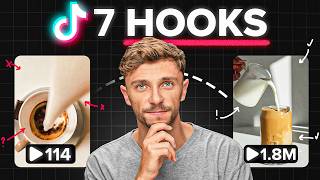

The 3-Second Rule That Decides Virality
45sReveals a critical insight about TikTok's algorithm that creators desperately want to know.
▶ Play Clip"The title accurately promises seven hooks, and the video delivers exactly that with clear explanations and examples."
The video explains that on TikTok, the first 3 seconds of a video are crucial for success. The creator shares seven proven hook styles that can make videos go viral, each backed by psychology and real examples.
Open with something unexpected to break the scroll. Example: 'Stop doing crunches, they're ruining your abs.' The key is to challenge a common belief.
Use numbers like '3 websites you didn't know existed.' Numbers create a mental checklist that keeps viewers watching to complete the list.
Tease information without giving it away. Example: 'This one website replaced a $200 software I was using.' Delay the reveal but deliver within 5-15 seconds.
Ask a specific question your audience is already thinking. Example: 'How do you actually grow on TikTok without dancing?' Use TikTok search or AnswerThePublic to find questions.
Name a frustration your audience feels. Example: 'Have you ever spent 3 hours editing a video and it only gets 200 views?' Build trust by showing you understand their pain.
Make a strong, confident statement. Example: 'This AI tool will replace 90% of copywriters.' Back it up with proof to avoid being clickbait.
Start in the middle of a story. Example: 'I accidentally crashed a Shopify store in one night.' Create an open loop that makes viewers want to know what happens next.
Mastering these seven hook styles can dramatically improve TikTok performance. However, a hook is just the start; the content behind it must deliver value to retain viewers and drive growth.
What is the 'pattern interrupt' hook?
Opening a video with something unexpected that breaks the scroll pattern, challenging a common belief.
00:47
Why do numbers in hooks (like '3 websites') make people stay?
Numbers create a mental checklist; viewers feel incomplete until they've watched all items.
02:56
What is the 'curiosity gap' hook?
Teasing information without giving it away, creating an open loop that viewers want to close.
05:24
How can you find questions for the question hook?
Use TikTok search autocomplete, AnswerThePublic, or scroll your own comment section.
08:35
What is the key to a successful 'pain hook'?
Name a specific frustration your audience feels, then offer a promise of relief.
10:07
What is the difference between a bold claim and clickbait?
A bold claim must be backed up with proof; clickbait makes claims without evidence.
12:54
How does a 'story tease' hook work?
Start in the middle of the action and hint at the outcome without revealing it, creating an open loop.
13:57
Pattern Interrupt Explained
Introduces the core concept of breaking the scroll with unexpected statements.
00:47Power of Numbers
Explains the psychological effect of numbered lists on viewer retention.
02:56Curiosity Gap Psychology
Connects the hook to the Zeigarnik effect and cliffhangers.
05:24Pain Hook Builds Trust
Highlights how naming pain creates empathy and filters the right audience.
10:07Bold Claim Establishes Authority
Shows how confident statements position the creator as an expert.
12:06[00:00] On Tik Tok, the first 3 seconds decide
[00:03] everything. You see, I used to think the
[00:05] platform was random. Some videos blew
[00:07] up, some flopped. But then I realized it
[00:10] all came down to the hook. The first 3
[00:13] seconds decide whether you get ignored
[00:15] or you go viral. And here's the good
[00:17] news. Right now, it's a level playing
[00:19] field. Whoever knows how to open a video
[00:22] the right way is going to win. I've been
[00:24] able to pick up on this after years of
[00:26] breaking down viral Tik Toks, running
[00:28] accounts that scaled to millions of
[00:30] followers, and consulting for brands
[00:32] that went from zero views to millions of
[00:34] dollars in sales. So, in this video, I'm
[00:37] going to walk you through the seven Tik
[00:39] Tok hooks that are converting right now.
[00:41] Each with a structure, real examples,
[00:44] and the psychology behind why it works.
[00:47] The first hook style that I've seen
[00:48] across every account I've touched is
[00:50] what I call the pattern interrupt. This
[00:52] is when you open a video with something
[00:54] so unexpected that people literally
[00:57] can't help but stop scrolling. It's that
[00:59] shock factor. And look, on Tik Tok,
[01:02] shock doesn't have to mean anything
[01:03] extreme. It just has to break the rhythm
[01:05] of what people are used to seeing. For
[01:07] example, your teacher lied to you about
[01:10] success. If you're still using Google
[01:11] Docs, you're behind. I've spent $10,000
[01:14] just to test this one idea. Now, here is
[01:18] why it works. The human brain is wired
[01:20] to notice when something doesn't match
[01:22] the pattern. It's the same reason if
[01:24] you're in a quiet room and someone drops
[01:25] a glass, you instantly snap to attention
[01:28] or why a neon sign stands out in the
[01:31] middle of a dark street. On Tik Tok, you
[01:33] have 3 seconds to win the scroll. 3
[01:36] seconds. And the pattern interrupt is
[01:38] one of the fastest ways to do that. But
[01:40] here is the mistake that most people
[01:41] make. They try to be shocking for the
[01:44] sake of it. They'll say something wild,
[01:46] but that has nothing to do with the rest
[01:47] of the video. And when that happens, the
[01:49] viewer feels tricked and they swipe even
[01:52] faster. The key here is interrupt the
[01:55] pattern, but do it in a way that
[01:56] directly connects to your content. Let
[01:59] me give you a practical example. Let's
[02:00] say you're in the fitness niche. If you
[02:03] start with, here's a workout you can
[02:05] try, you've already lost. Nobody cares,
[02:07] right? However, if you start with stop
[02:10] doing crunches, they're ruining your
[02:11] abs. Now you've got my attention. Why?
[02:15] Because that single line forces people
[02:17] to stop and rethink what they thought
[02:19] they knew. That curiosity pulls them in
[02:21] to the next 10 seconds. People are wired
[02:23] to protect their beliefs. So when you
[02:26] challenge one in the very first line,
[02:28] you create this mental itch that they
[02:29] need to scratch. They literally can't
[02:31] swipe until they get the answer. So here
[02:34] is the formula you can steal. Take a
[02:35] belief and flip it upside down. State it
[02:38] as a bold fact in the very first
[02:40] sentence. That's it. Just drop the line.
[02:43] Let the curiosity do the heavy lifting,
[02:45] then pay it off in the body of your
[02:47] video. And when you do this right,
[02:48] you're buying yourself the next 10
[02:50] seconds of watch time. And we all know
[02:52] that 10 seconds are usually the
[02:54] difference between a flop and a viral
[02:56] Tik Tok. The second hook style that has
[02:59] consistently worked for me and thousands
[03:01] of other creators is the list formats.
[03:04] Numbers make people stay. That's why
[03:06] countdowns, top five lists, or three
[03:08] things you didn't know still dominate
[03:11] Tik Tok. Take my underrated website
[03:13] series. I've literally built millions of
[03:15] followers off of the exact same
[03:17] structure. Three websites you didn't
[03:19] know existed. That one line has
[03:21] generated tens of millions of views
[03:23] because it's so simple yet so sticky.
[03:26] Here is why. Every number you say
[03:28] creates a mini promise. If you say three
[03:31] website you didn't know exist, the
[03:32] viewer's brain immediately says, "Okay,
[03:35] let me watch the first one. All right,
[03:37] now that I've seen the first, let me
[03:38] just watch the second and I might as
[03:40] well watch the third." while I'm at it.
[03:42] Right? It's like a mental checklist.
[03:44] Once you've tik tock the first, you feel
[03:46] incomplete until you've ticked them all.
[03:49] And the best part is this format is
[03:51] completely repeatable. You don't need to
[03:53] reinvent the wheel every time. I've seen
[03:55] this walk in education, fitness,
[03:58] finance, even cooking. Five shoulders
[04:00] exercise that you're not doing yet.
[04:02] Three body hacks that no one is talking
[04:04] about. Top five foods to boost your
[04:06] energy. It works because humans
[04:08] naturally want to complete lists. If you
[04:10] open with a number, you've already
[04:12] created a contract in the viewer's mind.
[04:14] They feel unfinished until they watch
[04:16] until the end. Now, the usual mistake
[04:18] most beginners make is they'll say top
[04:21] five tips and then the first one is
[04:23] boring. If you don't land your first
[04:25] punch, you've already lost. The first
[04:28] item has to be the strongest because
[04:30] this is what convinces your audience to
[04:33] keep going. So, here is the formula that
[04:35] you can steal for this list format.
[04:37] Start with a clear number. three ways,
[04:39] five tips, top seven mistake, and then
[04:41] you frontload your best example fast.
[04:44] You want to keep each item short and
[04:46] punchy so the pacing matches the
[04:48] attention span. Obviously, you want to
[04:50] pay off on the promise. So, if you say
[04:52] three things, you want to give the three
[04:54] things. You don't want to bait and
[04:55] switch. But this style works because
[04:57] it's predictable for you as a content
[04:59] creator and unpredictable for the
[05:01] viewers. They never know what's coming
[05:02] next. And the only way to find out is to
[05:05] keep watching. And look, quick side note
[05:07] before we move on. If you're a brand or
[05:09] a creator and you just want the
[05:11] framework that actually has helped me
[05:13] and my team to build a system that
[05:15] drives millions of views and customers
[05:17] on Tik Tok, there's a link down below
[05:19] that you can apply to work directly with
[05:22] us. The third hook style that has worked
[05:24] insanely well on Tik Tok is what I call
[05:26] the curiosity gap. Instead of giving
[05:28] people the answer right away, you tease
[05:31] it. You leave just enough information on
[05:33] the table so that they stick around to
[05:35] close the loop. For example, this one
[05:38] website replaced a $200 software I was
[05:40] using. The secret Shopify feature that
[05:42] crashed my store overnight. I paid $500
[05:45] for advice and this one sentence made it
[05:47] all worth it. Do you notice what's
[05:49] happening here? You've already delivered
[05:51] the context. Software, Shopify, business
[05:54] advice, but the payoff is missing. So,
[05:56] the viewer knows something is coming,
[05:58] but that tension is what makes them
[06:00] stay. This is the same psychology that
[06:02] drives cliffhers on Netflix shows. The
[06:05] episode ends, the loop is open, and
[06:08] suddenly it's 3:00 a.m. and you've
[06:10] watched six episodes. The human brain
[06:12] literally hates unfinished information.
[06:15] It feels like an itch that needs to be
[06:17] scratched. And on Tik Tok, that itch is
[06:19] gold because every second that someone
[06:22] spends watching you to close that loop,
[06:24] that increases your watch time. And
[06:26] watch time is what feeds the algorithm.
[06:28] Now, here's the catch. If you drag
[06:30] people for too long, they'll end up
[06:32] swiping. If you tease something
[06:33] incredible but you underd deliver, you
[06:36] lose their trust. So balance is
[06:38] everything, right? So here is how I like
[06:40] to structure the curiosity hook. You set
[06:42] the stage, give the viewers a little
[06:44] context so they know the topic. Example,
[06:46] the Shopify feature, the free website,
[06:49] $500 advice. Then you tease the payoff.
[06:51] You can hint at something surprising,
[06:53] valuable, or unusual. For example,
[06:55] crashed my store, replaced the $200
[06:57] software, one sentence that made it
[07:00] worth it. And finally, you delay the
[07:01] reveal. So you don't give the answer
[07:03] right away, but you deliver on it within
[07:05] five to 15 seconds so the tension
[07:07] doesn't break. And the mistake I see all
[07:09] the time is people open the loop, but
[07:12] then wander. They ramble. They add fluff
[07:14] before the reveal. On Tik Tok, that
[07:17] kills you. Your job is to keep the
[07:19] suspense high and pay it off quickly.
[07:22] Let me give you a practical example.
[07:24] Let's say you're in fitness. Again,
[07:26] instead of saying, "This is the best
[07:27] exercise for abs," try this. This
[07:30] exercise is more effective for your abs
[07:32] than crunches, and you've probably never
[07:34] done it. Instantly, the viewer needs to
[07:36] know what's the exercise, and that earns
[07:38] you the next 10 seconds. When you master
[07:41] the curiosity gap, you actually create
[07:43] momentum because when the reveal finally
[07:45] lands, people feel satisfied, and that
[07:48] satisfaction makes them watch your next
[07:51] video, too. One of the simplest yet most
[07:53] powerful hook style is just asking a
[07:56] question. It might sound almost too
[07:58] basic, but it works because you are
[08:00] literally meeting people what their
[08:02] brain already is. You're voicing the
[08:04] exact thing that they are already
[08:06] thinking or searching for. Examples: How
[08:09] do you actually grow on TikTok without
[08:11] dancing? What are the best side hustles
[08:12] to start in 2025? Why do most drop
[08:15] shipping stores fail in that first 3
[08:17] months? When you open with a question,
[08:19] the psychology flips. Instead of pushing
[08:21] the information, you're pulling the
[08:23] viewer into a conversation. their brain
[08:25] can't help but answer in real time, even
[08:28] if it's just subconsciously. The beauty
[08:30] of this is that you don't have to guess
[08:32] what questions to ask. Tik Tok literally
[08:35] hands them to you. Just type the
[08:36] keywords in the Tik Tok search bar and
[08:39] look for the autocomplete suggestions.
[08:41] You can also use tools like
[08:42] answerthepub.com to see what people are
[08:45] typing on Google. Or you can also just
[08:47] scroll on your own comment section and
[08:49] your audience in there are already
[08:51] leaving questions about the pain points
[08:52] that they have. So, just answer those.
[08:55] Now, here is the trick. The best
[08:57] question hooks are specific, not vague.
[09:00] Here's an example of a bad one. Want to
[09:02] make money online? And a good one. Want
[09:04] to make $500 this weekend without
[09:06] touching Shopify? The second one hits
[09:08] because it narrows the scope, paints a
[09:10] clear outcome, and speak to a real
[09:12] curiosity that people have. Another pro
[09:15] tip, questions also work insanely well
[09:18] when you already know the answer is
[09:19] unexpected. For example, can you
[09:22] actually grow on Tik Tok without posting
[09:23] every day? Everyone assumes that the
[09:25] answer is no. So, the curiosity to hear
[09:28] you break this down skyrockets. The
[09:30] formula looks like this. Find the
[09:32] question that your audience is already
[09:34] asking. Say it word for word at the
[09:37] opening line. And then you answer it
[09:39] quickly, but in the way that flips their
[09:41] expectations. This hook is so effective
[09:44] because it doesn't feel like an ad or
[09:46] even like content. It feels like you're
[09:48] giving help, like a friend. giving you
[09:50] the answer that you've been googling for
[09:52] hours. If you're ever stuck on an idea,
[09:54] this is the fastest way to generate 10,
[09:56] 20, even 50 Tik Tok hooks in a single
[09:59] afternoon. Just collect real questions,
[10:01] then record straight to camera your
[10:03] answer, and you've got content that
[10:05] people actually want to see. One of the
[10:07] most underrated ways to hook people into
[10:10] a Tik Tok is by starting with a
[10:12] frustration that they are already living
[10:14] through. Because here is the truth. When
[10:16] someone feels seen, they instantly pay
[10:19] attention. You don't even need to sell
[10:20] them. Just naming their pain creates
[10:23] empathy. Have you ever spent 3 hours
[10:25] editing a video and it only gets 200
[10:27] views? How do you get out of the 200
[10:29] view cycle? You're posting daily, but
[10:31] nothing is working right. You've tried
[10:32] five different side hustles and none of
[10:34] them are making you more than $100. When
[10:36] you open with this type of line, the
[10:38] viewer leans in because it feels
[10:40] personal. It's just like you're reading
[10:42] their mind. And now they have to stick
[10:43] around because if you understand the
[10:45] problem that they have, you might have
[10:47] the solution. Psychologically, this
[10:50] works because humans are wired to pay
[10:52] more attention to pain rather than
[10:54] pleasure. Losing $100 hurts more than
[10:57] winning $100. And that same bias shows
[11:01] up in content. Pain hooks cut through
[11:03] stronger than anything else. But, and
[11:06] this is the key, you're not just
[11:07] steering up negativity. The goal isn't
[11:10] to make your audience miserable. The
[11:11] goal is to build trust. You're saying,
[11:14] "I get it. I've been there, too, and I
[11:16] can help you get out of it." So, here is
[11:18] the formula I use. I call out the pain
[11:20] by naming something specific that my
[11:23] audience feels on a daily basis. Then, I
[11:25] twist the knife just enough by
[11:27] exaggerating the frustration so they
[11:29] feel this instantly. And finally, I
[11:31] offer the promise of relief by
[11:33] transitioning my video into here is how
[11:36] to fix it. And you can use this across
[11:38] any niche. Fitness. You've already been
[11:40] going to the gym for months and scale
[11:42] hasn't moved, right? Finance. You're
[11:44] saving money in your bank account, but
[11:46] that account never seems to grow.
[11:48] Productivity. Your to-do list is full,
[11:50] but you still feel like you've got
[11:52] nothing done today. This hook style is
[11:54] especially powerful because it doesn't
[11:56] just grab attention, it grabs the right
[11:58] type of attention. You're literally
[12:00] filtering people who feel that exact
[12:02] pain and want your exact solution.
[12:06] Sometimes the fastest way to grab
[12:07] attention is to say something so strong,
[12:10] so confident that people can't ignore.
[12:12] That's what I call the bold claim.
[12:15] Examples: This AI tool will replace 90%
[12:18] of copyriters. If you're still running
[12:20] Facebook ads like it's 2022, you're
[12:22] burning money. Drop shipping is dead
[12:24] unless you do this one thing. You see
[12:27] how each one of them almost feel like a
[12:29] challenge. Viewers instantly think,
[12:31] "Wait, what? Is that true?" Prove it.
[12:33] And that's the exact reaction that you
[12:35] want. Curiosity mixed with a little
[12:37] skepticism. Human brains are trained to
[12:39] notice things that break certainty. A
[12:41] bold claim feels like a violation of
[12:44] what they thought they knew. So, we need
[12:46] to resolve that tension. Either we agree
[12:48] or we disagree or we watch to find out.
[12:52] But either way, we're locked in. Now,
[12:54] there's a fine line between a bold claim
[12:55] and just clickbait. The difference is
[12:57] whether you can actually back it up. If
[12:59] you say, "This Shopify hack doubled my
[13:01] sales overnight," you better show some
[13:03] proof. Otherwise, you lose the trust
[13:05] instantly. The formula looks like this.
[13:08] You lead with confidence. You drop the
[13:10] claim up front in plain English. Make it
[13:12] polarizing so you attract enough people
[13:15] and they want to argue with you. And
[13:16] then you back it up fast, showing some
[13:18] evidence, case studies, or personal
[13:20] story. And here's the beauty. You don't
[13:22] need to invent any crazy claims. Just
[13:24] frame the truth more powerfully. So
[13:26] instead of saying AI can help you with
[13:28] copywriting, say AI makes human
[13:30] copywriters obsolete. The core idea is
[13:33] the same, but the hook feels 10 times
[13:35] stronger. The goal isn't just shock
[13:37] value, it's positioning. A bold claim
[13:40] establishes authority. You're showing up
[13:42] as someone who knows, someone with an
[13:44] insight that the average person doesn't
[13:46] have. And that authority is what keeps
[13:48] people watching past the hook. So, if
[13:51] you're confident in your knowledge and
[13:52] you've got proof to back it up, this is
[13:54] one of the most powerful hooks that you
[13:57] can use to dominate attention. Humans
[13:59] are wired for stories. Before social
[14:01] media, before books, before even
[14:03] writing, people learn through
[14:04] storytelling. And that psychology hasn't
[14:07] changed. If you can open a Tik Tok like
[14:09] the beginning of a story, people will
[14:11] stay to hear the ending. I accidentally
[14:13] crashed a Shopify store in one night.
[14:15] When I was 19, I made the dumbest
[14:18] mistake with $10,000. This student went
[14:20] from zero to $5,000 in 30 days, but what
[14:24] happened in week two shocked me. You see
[14:26] what's happening? Each one plants a
[14:28] seed. The viewer doesn't know the ending
[14:30] yet. And that creates an open loop.
[14:32] Their brain starts asking, "What
[14:34] happened next? How does this end?" And
[14:36] the only way to close that loop is again
[14:39] to keep watching. It's the same reason
[14:41] you can't ignore a half-written text
[14:43] bubble. That little dot dot dot leaves
[14:45] your brain hanging until you see the
[14:47] full message. So, here's the formula for
[14:49] story tease. You start in the middle of
[14:51] the action. I was $20,000 in debt when
[14:54] dot dot dot or my ad account got banned
[14:57] yesterday dot dot dot. You hint at the
[14:59] outcome, but you don't reveal it. What
[15:01] happened next shocked me. Then you
[15:03] transition into the lesson or the value.
[15:05] The story is the setup, but your insight
[15:07] is the payoff. Now, here's the key. The
[15:10] story tease isn't about virality. It's
[15:12] about depth. It builds a connection. For
[15:15] instance, nobody remembers the exact
[15:18] statistics of Michael Jordan's career.
[15:20] They remember the story Nike told with
[15:23] the jump pan, right? That story sold
[15:25] more shoes than any number ever could.
[15:28] And those are the seven Tik Tok hooks
[15:30] that are converting right now. And
[15:33] here's the thing, none of them are
[15:35] theoretical. These are the exact
[15:37] frameworks that I have used to grow Tik
[15:40] Tok accounts from zero to millions of
[15:42] followers and the same ones I've taught
[15:44] to brands spending multiple six or seven
[15:46] figures a month on Tik Tok ads. But
[15:48] remember, a hook is just the start.
[15:51] Winning the first 3 seconds is like
[15:53] opening the door. If what's behind the
[15:55] door isn't valuable, people will leave.
[15:57] The real game is building a system where
[16:00] every hook flows into engaging content.
[16:02] Every piece of content compounds into
[16:04] growth. Now, if you're a brand or a
[16:06] content creator and you want me to
[16:08] personally help you build this system,
[16:10] there's a link down below where you can
[16:11] apply to work with me directly. Also, if
[16:13] you found this video valuable and you
[16:15] want the full system instead of just one
[16:17] piece of it, click right here on the
[16:20] screen and watch the full masterass.
[16:22] It's completely free and it will give
[16:23] you a much deeper understanding of how
[16:25] you can actually scale an account on Tik
[16:27] Tok in 2025.
⚡ Saved you 0h 16m reading this? Transcribe any YouTube video for free — no signup needed.