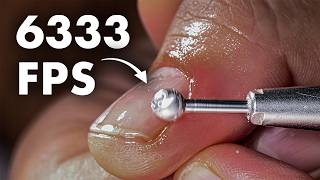

Drill that cuts bone but not skin?
43sThe surprising contradiction between cutting bone and not cutting skin sparks curiosity and challenges common understanding.
▶ Play Clip"Title exactly describes the content — a clear explanation of why a bone drill doesn't cut skin."
This video explores the Halo, a specialized surgical drill bit that can cut through bone but not skin. Through high-speed footage and expert explanation, the mechanism behind its selectivity is revealed: a spring-loaded ring pushes soft tissue aside while exposing a cutting blade to hard surfaces. The implications for safer and faster surgeries are discussed.
A drill bit that cuts bone but not skin is introduced, setting up the central question.
The creator visits Bijan from Surgify Medical to understand the Halo drill bit.
Traditional burrs easily cut soft tissue, requiring caution near nerves and arteries.
High-speed footage shows the skin wobbling under the Halo, indicating the ring pushes it away.
A spring inside the Halo yields to hard surfaces like bone, exposing the cutting blade, but pushes soft tissue aside.
The Halo removes eggshell without breaking the membrane, while a traditional burr fails.
The Halo avoids chatter (vibration) by limiting the cutting edge exposure, providing a smoother drilling experience.
The Halo drill bit offers a safer, faster, and less stressful alternative for bone drilling in surgery, with over 2,000 successful procedures already performed.
What is the Halo drill bit designed to do?
Cut through bone while minimizing damage to soft tissue.
01:57
How does the Halo avoid cutting skin?
A spring-loaded ring pushes soft tissue out of the way, preventing contact with the cutting blade.
03:06
What problem do traditional burrs cause?
They can easily cut soft tissue and produce heat that damages surrounding tissue.
01:43
How many procedures has the Halo been used in?
Around 2,000 procedures.
05:12
What is 'chatter' in drilling?
Chatter is when the cutting blade bites too much into material, causing vibration.
07:08
Paradox introduced
Establishes the intriguing question that drives the entire video.
00:04Skin wobbles under Halo
Visual evidence of the mechanism in action, captured by high-speed camera.
02:52Spring mechanism explained
Core engineering principle that makes the Halo selective.
03:49Egg test
Demonstrates the Halo's precision in a relatable way.
05:12Chatter avoidance
Explains a practical advantage of the Halo over traditional burrs.
07:08[00:04] as you can imagine, it easily cuts through bone. But, no matter what I do, if you watch my cast saw video, you going on here, but actually the explanation is completely different. The
[00:16] reason a cast saw doesn't cut through skin is because it's an oscillating backwards and forwards. So, it just drags flexible things like skin back and forth instead of cutting it. But, here's the thing. The Halo is a drill bit. So,
[00:31] it's not an oscillating tool. It's a rotating tool. And rotating tools can cut through flexible material like this. And yet, this special drill bit can cut a groove in the nail of my thumb, but it can't penetrate my skin. How the heck is
[00:47] that possible? To figure it out, I've come to Helsinki. Well, it's actually Espoo. Say Helsinki. Like, everyone knows what Helsinki is. But, this is in the water, it'd be fine. Or not with
[01:01] those shoes. This is Bijan from Surgify Medical, where they make this drill bit. They're not sponsoring me or paying me in any way. It's just that Bijan emailed brought my high-speed camera with me, and we got to see for the first time how
[01:14] this thing works. But, first, what's it for? Well, surgeons use all sorts of different tools to get through bone. For example, if they're cutting through a skull, they'd use a drill. It's probably called a burr, which is
[01:27] basically a ball with grooves cut in it. So, you end up with these serrations. And when it spins, those serrations slice away layers of bone, a bit like a into the bone. But, as you can see from this slow-motion footage, a traditional
[01:43] burr can easily cut into soft tissue, as well. So, with traditional tools, a surgeon has to be really careful when they approach soft tissue, especially something like nervous system tissue or major arteries or things like that.
[01:57] Whereas this bone drill, called the Halo, is designed to minimize contact with soft tissue. But how is that? How is this drill bit cutting into this gelatin-stuffed sausage skin, but the Halo isn't? The only way to know for
[02:10] sure is to get super close and film super slow. Actually, I made this little tool to test whether my high-speed camera is up to the job. So, you put in the RPMs of the thing you're filming. In this case, we wanted to film at 10,000
[02:23] RPM. If we were recording at 2,000 frames per second, it would look really choppy like this. But if we record just above standard definition, we get about 6,300 frames per second. That's actually quite
[02:37] nice. I think the Chronos is up for the job. You can see a hint of what's going on here. See how the skin is wobbling under the Halo. Why is that? Well, as the ring comes around, it bumps into the skin on my finger, and it's like the
[02:52] skin is knocked out the way. The sausage is very flexible, right? So, why doesn't cut? You see what I mean? You can imagine this Here's the soft tissue. It kind of goes down. It takes time for it to come back, couple of microseconds.
[03:06] Okay, I go like this, and it's like bang, like that. Yeah, exactly. >> down like this. Yes, that process. And then And then by the time it gets back, >> gone. Okay, cool. That's cool. You can just about see that at super high speed.
[03:21] skin. So, we understand how the Halo doesn't cut my skin, but how does it cut through wood? Like when the ring comes around, it would collide with the hard surface of the wood, and wouldn't that cause the drill bit to bounce up and
[03:34] away from the wood? Well, yes, it would. But here's the clever part. That ring against the hard surface, the ring is pushed out the way, exposing the cutting blade to the wood or the bone or whatever. There's a spring inside that
[03:49] And they've tuned the spring so it's stiff enough to push soft things out of the way, but yield to bone. Isn't that cool? I actually printed a 3D version so you can see what's going on at a larger scale. See how this hard surface pushes
[04:04] the ring out of the way and now that cutting blade is coming into contact with the surface. So I made a video about the castle. It's an oscillating tool so it doesn't cut skin. Are there tools out there
[04:17] that are like an oscillating tool? >> Yeah, usually in those oscillations it's not effective for removing bone. With the Halo, that just clicks into an existing thing that a surgeon already uses. Oscillating burs, do they fit in
[04:29] >> No, they have to have their own their their own system. So you can It's just like, don't use that, use this. Look, you get to use the same handle and the same pedal. Yeah, from surgeon's point of view it's exactly the
[04:43] what if you wanted to do something really important like take the shell off an egg without breaking the membrane? Okay, because as you know, if you use a regular bone drill on an egg, the membrane breaks every time. I mean, a
[04:57] take the shell off an egg without breaking the membrane using a drill bit, even an untrained neurosurgeon like me can do it. So what You've gone through several design iterations. Are you selling the thing?
[05:12] Yes. So it's a new device on the market, but we have done around 2,000 procedures. Head, neck, and spine surgery is a very critical field because you have the central nervous system structures, cranial nerves, spinal nerve
[05:27] protect during the surgery. This is a model of a skull. So this is the bone and under that is the dura, which is a flexible membrane protecting the brain. So with the usual burr drill bit, to
[05:41] avoid damaging soft tissue, you have to be incredibly careful when you get close to the brain. That means slowing down. To do that, a surgeon would typically switch to an abrading tool like this. This is called a diamond burr, basically
[05:54] a ball wrapped in expensive sandpaper. The diamond burr reduces the speed of the cut, but at the cost of producing lots of heat, which can damage surrounding tissue. Not only that, but if you do overshoot, the soft tissue is
[06:07] really vulnerable to damage. When I tried with either of the traditional burrs, the dura didn't stand a chance. But, here's that attempt again with the Halo. You can see the ring repeatedly pushing that flexible membrane out the
[06:19] way. This is just a model, of course, and real tissue is more complicated. So, footage of these drill bits being used on real tissue acquired from a local countdown timer on screen if you want to
[06:34] look away, but we've desaturated it, so it's not too gory. See, with real tissue, the very last layer of bone becomes flexible like soft tissue. And so, the final step is to lift that flap of bone out the way manually with a
[06:48] spatula, almost like a fish scale, which is the absolute safest way to do it. can be harder to leave that last layer Okay, that's the last time I'll show surgery. Let's drill some wood instead.
[07:08] into your hand. Yeah. Good idea. That weird changing sound is because the traditional burr is experiencing something called chatter, and it's a weirdly horrible feeling in your hand. Chatter is what happens when
[07:21] the cutting blade bites too much into the material, and you can imagine that that would be undesirable in a clinical setting. This is what that looks like in slow motion. But, when I was drilling with the Halo, I didn't experience
[07:34] chatter. What we have designed it so that the ring has a kind of limited movement. It's just a very tiny kind of section of the the cutting edge exposed to the board. It does the job very nicely, but not too much. And that that
[07:46] prevents the chatter. And just to come full circle back to the cast saw video, here are the two different drill bits on rubber. It's interesting like on the surface, it's designed to minimize accidental
[07:58] contact with soft tissue, but it also has an effect on the the way the surgery is carried out. Like it's going to be faster. It almost sounds mercenary like I'm trying to get more surgeries done or like you know or make it cheaper. But
[08:12] actually the way I know from people that you know in my family who've had shortening the length of the surgery is really important, isn't it? You don't really important, isn't it? You don't want to be under anesthetic for too
[08:24] >> Exactly. I spoke um with one neurosurgeon actually who had drilled for 12 hours. That surgical drill is one of the most stressful uh tools for the surgeons. You know, surgeons try to reduce the length of
[08:38] operations. Not just so that they can help as many people as possible, but because long operations come with additional risks. If a safer drill bit could reduce cutting time and reduce operator stress, well, I'd want my
[08:53] is an electric pencil sharpener in slow motion, which is somewhat reminiscent of a bone drill. And in fact, I think you can see a bit of chatter in there as a whole lot of engineering with my kids. That's because they made this electric
[09:08] pencil sharpener themselves. And when I showed them the slow motion footage of the chatter, they became obsessed with making a perfectly smooth pencil tip. And this is what I love about the sponsor of this video, KiwiCo. KiwiCo is
[09:20] a subscription box where every month your kids get an exciting STEM project the box, so there's no running to the shops last minute or anything like that. instructions are really clear, and it's been play tested like crazy, which
[09:36] really shows by the way. because one of my kids, who's got more ADHD than anyone I've ever met, is completely engrossed in it every month. I get crates that my kids can do on their own. I also get crates that are a
[09:50] little bit above their level, and I do those ones with them, like this pencil sharpener is 14 plus, for example. And it's just amazing to see how they've turned into little engineers over the years of us getting KiwiCo. They've
[10:04] tools. They now have an intuition for all these they're so invested in it, it always becomes a launchpad into loads of other
[10:16] STEM-related discussions and activities. If you're interested, the promo on this one is really good. If you go to kiwico.com/stevemould, you'll get 50% off your first crate. And then, you know, maybe
[10:30] film what you've made with a high-speed camera. Anyway, the link's also in the description, so check out KiwiCo today. did, don't forget to hit subscribe. And the algorithm thinks you'll enjoy this
[10:45] the algorithm thinks you'll enjoy this video next.



⚡ Saved you 0h 11m reading this? Transcribe any YouTube video for free — no signup needed.