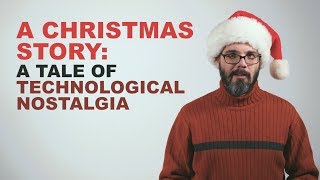

A Christmas Story is Fake Nostalgia
42sChallenges the beloved holiday classic by exposing it as manufactured corporate nostalgia, sparking debate among fans.
▶ Play Clip"The title 'Television Dreams' is abstract, but the video delivers a deep, insightful analysis that matches the implied theme of nostalgia and media."
This video essay analyzes the enduring popularity of the 1983 film 'A Christmas Story', arguing that its success is rooted in technological nostalgia and corporate economics rather than cinematic quality. The creator deconstructs the film's appeal, explaining how its rise to holiday tradition was driven by cheap licensing deals and generational memory, not just its content.
The film is described as 'technological nostalgia yearning for a pre-lascerian world', using material objects as signifiers of a false past. This frames the movie's entire aesthetic and appeal.
The creator admits disliking the movie as a child and finding it boring, but appreciates the craft as an adult. The adult view shifts the nature of the dislike rather than improving the overall opinion.
Released in 1983 to lukewarm reception, the film found its audience through repeated televised broadcasts. In 1997, Turner Broadcasting began airing a 24-hour marathon on TBS.
The film is a series of vignettes about Ralphie's desire for a Red Ryder BB gun, but is cynically framed around 'technological nostalgia'. It is fixated on material things and brands like Ovaltine, Oldsmobile, and Radio Flyer.
The film is about the childhood world remembered by adults, not as children perceive it. By 1983, a nine-year-old had no reference for jokes about furnace dampers, making it essentially a period piece for adults.
The film's structure is poorly suited for theaters but perfect for background TV viewing. Its meandering vignettes allow viewers to drift in and out, making it ideal for holiday marathons.
Unlike typical holiday films, 'A Christmas Story' has no moral or affirmation of human goodness. It's simply about a kid getting a toy, which is part of its unique, dark charm.
Popularity exploded in the late 90s when people who saw the movie as children became old enough to associate it with their own childhood nostalgia. The film became an object of nostalgia itself.
MGM's library was acquired by Ted Turner in 1985, allowing Turner to broadcast the film for virtually nothing. This economic incentive, not broad appeal, explains its constant airing versus other popular films.
The popularity surge was capitalized on by TBS, which could air the movie endlessly because they owned it. The 24-hour marathon is a corporate stunt younger than 'Men in Black'.
Children lack the capacity to curate their experiences; their childhoods were programmed by network scheduling. The film's success is a symbol of this programmed nostalgia, much like Ralphie's decoder pen message.
Technological Nostalgia
This is the core thesis of the entire essay, framing the film's appeal in a unique way.
00:12TV Suitability
Explains a key reason for the film's success, tying its structure to the medium of television.
05:03Corporate Economics
Exposes the economic incentive behind the film's constant airing, which is a crucial and often overlooked factor.
08:09Programmed Nostalgia
The conclusion highlights how childhood experiences are often curated by corporate entities, not personal choice.
09:27[00:00] Tis the season for Time Warner, owner of Turner Broadcasting, owner of the Metro-Goldwyn-Meyer's pre-1986 film library, to pump your household full of a Christmas story for 24 hours straight.
[00:12] Let's talk about how a Christmas story is technological nostalgia yearning for a pre-Lascerian world, by definition fictional, encapsulated in material objects as signifier of the age of innocence,
[00:24] a false memory of a time that never truly existed, implanted in the collective video form through corporate repetition. I love Christmas so much.
[00:42] I don't think A Christmas Story is a particularly good movie, and I've honestly never liked it. As a child, I found it boring and obnoxious. My feelings towards it have softened a bit watching it as an adult.
[00:55] I can appreciate the craft now better than I could as a kid, and in particular I think Peter Billingsley is quite talented as a physical actor, especially for a child actor, but overall seeing it through adult eyes hasn't actually improved my opinion of the movie
[01:09] as much as it has shifted the nature of what I dislike about it. A Christmas Story, advertising itself as a tribute to the original traditional 100% red-blooded two-fisted all-American Christmas,
[01:22] was released in 1983 to lukewarm reception before finding an audience through the 80s and 90s in increasingly frequent televised broadcasts, escalating to the point that in 1997, Turner Broadcasting, shortly after being bought out by Time Warner,
[01:36] began airing a 24-hour marathon over Christmas Eve and Christmas Day on TBS. The film consists of Ralphie as an adult recounting what he frames as a particularly memorable Christmas from his early 1940s childhood, a technique that would get recycled in similar nostalgia-driven properties
[01:53] The Wonder Years, and the very, very strange Tom Hanks film Radio Flyer.
[02:10] Damn, I gotta talk about Radio Flyer someday. The story here plays out in a series of loose vignettes mostly centering around nine-year-old Ralphie's desire to get a Red Ryder carbine-action, 200-shot range-model air rifle for Christmas,
[02:24] his attempts to persuade the adults around him, and various other incidental episodes. Cynically, the film's version of the original, traditional, 100% red-blooded, two-fisted, all-American Christmas manifests largely as technological nostalgia.
[02:39] The film eye is like Ralphie particularly obsessed with material things and how they used to be The children in the opening montage stand outside Higby department store looking in wonder at what the adult Ralphie narrates as mechanized electronic
[02:53] joy, a montage of an animatronic in his claws, electric trains puttering along on their tracks, and wind-up tin tanks that drive themselves. Several scenes with Ralphie's old man hinge their humor
[03:05] on his father's combat with a household furnace and electrical systems, with one gag in particular relying on knowing what this device is and how it works. Ralphie and his brother crowd around the radio to listen to Little Orphan Annie serials.
[03:20] In a particularly memorable scene, endlessly referenced by later works, Ralphie finally receives his Little Orphan Annie secret decoder pen, ecstatic to be a part of the privileged Little Orphan Annie inner circle, but comes to the sad realization that he's being sold a bill of goods
[03:35] as the evening secret message decodes to, be sure to drink the Robleteam. A plug for the show's sponsor. As Ralphie says, all that for a crummy commercial. And Ovaltine and Little Orphan Annie are alone.
[03:48] Oldsmobile, Raggedy Ann, Red Ryder, Radio Flyer, The Wizard of Oz, Mickey Mouse, Lux, Palmolive, and Oxidil are all placed or referenced. The original, traditional, 100% red-blooded, two-fisted, all-American Christmas
[04:02] is unabashedly a Christmas of things and brands. The oddity of this particular brand of nostalgia is that it makes A Christmas Story a movie about kids, but only nominally for kids.
[04:16] The focus is not on the world as children perceive it, but on the childhood world remembered by adults. The iconography, the references, the physical space, the film doesn't resemble the world children exist in,
[04:28] and it never did. Already by 1983, a nine-year-old had no point of reference for an extended joke about the furnace damper. It is a movie nebulously set in a very distinct time that explicitly looks with fondness on the materials of a childhood already 40 years distant at the time of its construction.
[04:47] And that fact that it is a period piece certainly does help to make the film feel older than it really is, feel like it is part of some tradition that has survived generations. This all ties into why I think the film did poorly in theaters but better on television.
[05:03] Television adds to the sleight of hand, disguises age. Movies that were on TV in the 80s and 90s were, by definition, no longer brand new. It is structurally poorly suited for watching in a theater anyway,
[05:17] but perfectly suited for playing in the background while everyone bustles around the house doing holiday stuff. The film drones along while everyone chatters until someone notices the screen and says, hey, everyone, here's the best part,
[05:30] and then recites their favorite joke in rough sync with the film before going back to the snack table to get more punch The fact that the movie is so structuralist makes it somewhat perfect for TNT 24 looping marathon It just kind of ends At the end of the film the neighbor dogs
[05:46] eat the dinner turkey and the family ends up instead at the Bowling and Sons Chop Suey Pallet Company for a painfully long joke revolving around Shining's accent and the song Deck the Hall.
[06:02] What can I say but yikes? After their dinner of duck, that's pretty much it. The family tucks away for the night, Ralphie and Randy clutching their things,
[06:16] and the credits roll. Unlike most holiday fare, there's no moral, no lessons, no affirmation of human goodness or appeals to the better, softer nature of mankind. It is a story about a child who gets a toy, and little more.
[06:32] It's about that one year when a lot happened, none of it meant anything. Be sure to drink your Ovaltine. I don't think the movie is a particularly good movie, but is a darkly perfect match for the medium of television.
[06:44] A handful of memorable scenes, competently executed, strung together in a way that actually improves more the less you pay attention. However, I don't think the medium change alone tells the whole story of the film's reassessment and rise in popularity.
[06:58] The shift from the big screen to the small, the mode of engagement changing from being confined in a theater to drifting in and out between chores, all of this is substantial, but it isn't the entire picture.
[07:11] Autobiographically, I was actually shocked when I realized this movie came out after I was born. It had in my mind as a child always been there, and loved and quoted as it was by my parents, in some level of my consciousness, I had assumed it was as old as they were.
[07:26] from the nebulous before time preceding my existence. It is instead a little younger than me and merely laser-focused on my parents and their memories of childhood as the 50s in rural Canada were not so different from the urban 40s.
[07:42] The movie's rise in popularity, however, doesn't explode until the late 90s, until people who were young enough to see A Christmas Story of Children were old enough to associate the movie directly with their own childhood,
[07:56] old enough for the movie to become their own object of nostalgia. It should be noted, too, that the conditions for that association are, in their own way, as artificial as the products Ralphie covets.
[08:09] In 1985, Metro-Goldwyn-Mayer was purchased by Ted Turner, who was looking to secure their substantial batch catalog of films as held assets for his WTBS superstation. The following year Turner sold off every component part of MGM except the pre film library This gave Turner a huge library of films to exploit for broadcast as Turner Entertainment could license the MGM films to Turner Broadcasting for functionally nothing
[08:35] The proliferation of A Christmas Story, in addition to a number of other films, has as much to do with the cost for broadcasters to license them as it does their actual popularity. This is why actually really popular and successful Christmas movies like Home Alone, Else, and The Santa Clause are only occasionally on broadcast,
[08:54] while the objectively kind of bad Rankin-Bass Rudolph the Red-Nosed Reindeer has aired more or less uninterrupted since 1964. So, a movie that saw middling reception with its release in 1983 gained new life in 1986 as the functionally free holiday filler for Turner Broadcasting,
[09:13] but didn't really gain true popularity until the maturation of a generation of children who had seen it as children. And those people had seen it as children because it was on TV, where it was a filler movie that stations could readily license,
[09:27] and the synergistic surge in popularity was then capitalized on by TBS, who could afford to air the movie as many times as they wanted because they owned it. The tradition of A Christmas Story, its true roots as a phenomenon of the season,
[09:42] The history of the 24-hour marathon isn't a deep-rooted cultural practice. It's a corporate stunt that's younger than men in black. Childhood nostalgia is a tricky thing and should always be handled with some skepticism.
[09:56] Children, by and large, lack the means and capacity to seek out, to curate, to filter. In the 80s, you watched what you did because that's what was on TV.
[10:08] Whether it was the decision of our parents or the person doing the scheduling of the network, our childhoods were programmed for us. It is altogether fitting that a Christmas story, a story of nostalgia for things, wasn't able to succeed until the film itself became the object of nostalgia,
[10:27] when it could become the self-contained symbol of childhood Christmases, the evocation of sitting around a 12-inch tube television, watching movies, and running to the bathroom during commercial breaks. But, to me, I'm Ralphie, sitting around the radio, scratching away with my decoder pen,
[10:44] only to realize that the message at the core of my childhood entertainment, well, it's just a crummy commercial.
[11:08] Thank you.



⚡ Saved you 0h 11m reading this? Transcribe any YouTube video for free — no signup needed.