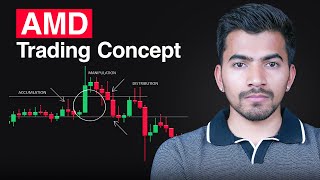

What Is AMD? 3 Market Phases Explained
56sThe confession-style opening instantly hooks traders frustrated by stop losses and promises a simple 3-phase explanation.
▶ Play Clip"Solid beginner explanation of AMD, but padded with a lengthy sponsor segment and repeated examples."
The video explains the AMD (Accumulation, Manipulation, and Distribution) concept in trading, which describes how big players or smart money drive markets by creating zones that trap retail traders. The presenter teaches beginners how to identify these phases, avoid stop-loss hunting, and enter trades during the distribution phase to capture large moves.
AMD stands for Accumulation, Manipulation, and Distribution. The market is driven by big players/smart money, creating an accumulation zone, then manipulation, then distribution.
After a big move, the market forms a resistance zone. Before moving further, it invites retailers by creating a range of equal highs and equal lows, which is the accumulation zone.
In the accumulation zone, the market tests retailers' patience. Impatient traders start predicting the market, and the market fills orders from these retailers.
Manipulation occurs when the market shows a breakout or breakdown to trap traders. It first eats the stop losses of traders who enter on the breakout, then reverses.
The market knows where stop losses are because they represent liquidity. It creates manipulation to eat that liquidity before making a real move in one direction.
Distribution is where real money is made. You should enter during distribution, after the market has manipulated and then starts moving decisively in one direction.
To catch the distribution, wait for a pullback after the range breakout, then place your stop loss at the swing high/low and enter in the direction of the actual move.
70-80% of the time, entering the first breakout after accumulation results in a stop loss hit. Instead, wait for the market to break out, pull back, and then move in the same direction before entering.
The first breakout or breakdown is most often manipulation. Avoid it; let a pullback come and then enter for a better risk-reward ratio.
Use top-down analysis: check the 4-hour timeframe for structure, then 1-hour, 30-minute, and 15-minute. This helps you trade in the direction of the higher timeframe and avoid false breakouts.
Applying the 9 and 20 EMA reduces noise and helps filter distribution moves, making it easier to identify quality trade setups.
Accumulation, manipulation, and distribution is a core concept every trader must understand. It helps you avoid getting trapped and improves your profitability by trading only in the distribution phase.
The AMD concept is a foundational framework for understanding how smart money moves markets. By staying patient and trading only distribution after manipulation, traders can significantly reduce stop-loss hits and capture large market moves.
What does AMD stand for in trading?
Accumulation, Manipulation, and Distribution.
00:20
What is an accumulation zone?
A range with equal highs and equal lows that forms after a big move, testing retail traders' patience.
02:25
Where is real money made according to the AMD concept?
In distribution.
07:16
Why does the market create manipulation?
To eat stop losses and gather liquidity from trapped traders before the actual move.
06:48
What percentage of the time does the first breakout after accumulation result in a stop loss hit?
70-80% of the time.
17:33
What is the recommended entry rule to catch a distribution move?
Wait for the breakout, then a pullback, then a move in the same direction, then enter.
17:33
What is the purpose of top-down analysis?
To understand the higher timeframe direction and avoid false breakouts in smaller timeframes.
21:29
If the larger timeframe is bullish and you see a bearish breakdown on the 15-minute chart, what should you do?
Do not enter, because it is likely manipulation.
22:11
What is the benefit of using the 9 and 20 EMA?
They reduce noise and help filter distribution moves.
25:29
What is required for a big move after accumulation?
Liquidity (fuel) generated by eating stop losses on both sides of the range.
15:55
AMD as a Market Framework
Introduces a complete lens for understanding how smart money drives price action.
00:20Manipulation Trap
Shows concretely how the market uses false breakouts to trigger retail stop losses.
04:54Distribution Is Where Money Is Made
Crystallizes the core investment principle: only trade distribution, not accumulation or manipulation.
07:16Entry After Pullback Reduces Stop-Loss Hits
Provides a clear, actionable rule that improves probability and risk-reward.
17:33Top-Down Analysis for Direction
Emphasizes the importance of higher timeframes to avoid manipulation in lower timeframes.
21:29[00:06] your stop loss gets hit as soon as you take the trade. That means you don't know about AMD. What is AMD? AMD is a concept that once you learn [music] is a concept that once you learn [music]
[00:20] AMD stands for Accumulation, Manipulation and Distribution. Look, you will understand these things more only in the Forex market but this concept works in every market because every market is
[00:34] market is run by the big [music] players. And when the market is driven by big players or smart money, it will create an accumulation zone in the market. Then a manipulation will be created. Then a distribution will come in the market. But many
[00:49] traders get their stop loss hit in the manipulation zone or get themselves wiped out of the market before they can catch the distribution. By the time they they are left with no capital. [Music] Well, in today's video, I'm going to show you
[01:02] how to understand the AMD concept in the market and how you can reduce the probability of your stop loss being hit. Because if your stop loss gets hit less often [music] only then will you be able to become a profitable trader in the long term. And if you
[01:16] understand the AMD concept, you will be able to catch the big moves in the distribution market. If you are new to my channel, please subscribe to the channel. not miss out on any upcoming video. And I say subscribe
[01:29] because 70% of my viewers, if 100 people are watching this video [music], then 70 people are those who have not subscribed. If you subscribe, and you will be able to learn things on time. So, please subscribe.
[01:42] AMD [music] concept. So as you know the meaning of AMD. Accumulation, Manipulation and Distribution. How exactly do these faces of the market come into being how are they formed? Let us understand this. For this I would like to tell you the structure of a market.
[01:57] So that you can understand how this face is created. For example, there was momentum within the market. A big move came. Right? Now the market is standing at such a zone. Which is an resistance zone? You can call this a resistance zone. I have
[02:10] marked this with R here. And this is a round number of ₹100 or a round number of x amount. And wants to move in any direction, then before that it invites the retailers.
[02:25] what will he do? This will create an accumulation zone. That means it will create equal highs, equal lows, equal highs, equal lows, equal highs, equal lows, equal highs, equal lows. That means it will create a range within which the
[02:39] market will take some time. If it takes time, retailers lack patience. Right? There is lack of patience. So what do they do ? Start making market predictions. example, see the resistance zone. So what does resistance zone mean? That
[02:52] from a support zone to resistance. Does this mean we think the market will fall now? So some people will sit here in the down side position in the meantime. Right? Some people will take upside positions here and holding at the resistance zone for so long then it may go up somewhere. There are two different
[03:07] different traders. It is a zero sum game. Some will think it will come down, some will think it will go up. Now the more time goes on, the more range it stays in, the more frustration [music] a retail trader gets. The more he does it, the more his patience will run out.
[03:21] tries to enter and the market wants you to enter the market. You should start predicting the market. And maximum of the retailers work on predictions within the market. No one works on actual logic in the market. You will
[03:35] work on actual logic only when you understand AMD. Now a distribution came into the market. This is a distribution. Right? I marked the distributor with a D. And what is this market doing now? Accumulate
[03:47] is accumulating. He is calling, he is filling up here. Whom? To retailers. Now understand that buyers as well as sellers came here. The market created a range. This is the accumulation zone. Right? We call this the accumulation zone. I
[04:01] [nasal noise] OK? Now what does the market do in the accumulation zone ? Tests patience. He tells me to be patient. I don't keep it. People enter. Any number of predictors
[04:14] down? Someone has thought that it will burst and the market is at such a place where it is natural to think like this. There are such a place where it is natural to think like this. There are What does Thein Market do? The market has to go to one zone, it will not go so easily in one zone,
[04:26] in one direction. What the market will do, the market will create a manipulation like this, you will enter, the breakout will come, you will enter here, you will buy here, the patience of all the people was being tested here, who were waiting for the
[04:40] breakout will come, the volume will increase, all of them will enter here, the market will come down, that means they will wait for the pullback, the market will come like this, do you understand what a fuss this is, this is manipulation because before going in any direction, the market wants to eat all the
[04:54] people who were inside this zone, all the people who were sitting inside this zone. market will show a breakout. When the breakout is shown, you will feel that such a created, so let's enter. You will try to enter here, right?
[05:11] But maximum people enter during breakout. When such a big range is made, everyone thinks it will be genuine. You went upstairs for the market, right? Your stop loss after the breakout is obviously below this. Your stop losses were hit
[05:23] on the downside. Right? Stop loss was hit on the downside. Now you feel that friend, if there is a breakout on top then it should go down. Should go down. Now you sellers have entered here for the down side. When sellers entered for the downside, the
[05:37] market moved up and again came inside this box. And again, maybe they created a little bit of a range [music] or maybe they went up again and ate their stop losses. So what has been created here is called manipulation. I'm marking this with N
[05:52] here. Manipulation means now the market is being manipulated. The market is trying to tell you that [music] brother, the range here is breakout has come, enter. So here came the breakout, everyone entered and he killed them. Then
[06:07] he said, friend, there was a breakout on the top, if it fails then it will go down. There was a breakout downwards and all the sellers entered and killed it. [Music] So basically the market is being manipulated here to trap the retailer and then there will be an actual move. This this this and this
[06:24] move comes like this. And here you enter the breakout. Your stop loss is hit as soon as you enter the breakout. You enter the breakdown here. Your stop loss is hit above as soon as you enter the breakdown. Then the market moves. Then you think, friend,
[06:36] I had entered the market. My stop loss was here. The market even went this far. I hit the stop loss and came back. And after that he went in my direction. That means the market knows where my stop loss is. Yes, the market knows where the stop losses are.
[06:48] But he does not know where your stop loss is. Right? No one knows your stop loss. But does the market know where the stop losses are? Stop losses mean where liquidity is being created. Where is the major liquidity being created? And to
[07:01] eat up that liquidity, a manipulation is created inside the market. And in that manipulation, yours, mine and many other people's stop losses who got into the manipulated move get then the market moves in one direction. And what goes in the market direction is what
[07:16] we call distribution. And where is the real money made? The real money is made in distribution. When you enter the market, you will enter here and exit here. This is called accumulation manipulation and distribution.
[07:32] Which is the accumulation zone? This one was in the market range within the zone. This is the manipulation and this is the distribution that you see moving downwards. [MUSIC] Right? Now let me explain this to you on the chart as to
[07:45] [sound of clearing throat] How does manipulation happen ? Isn't it? How does end accumulation Brother, I talk about crypto. Look, the Forex market is different. There are sessions within the Forex market. There the concept becomes a little deeper.
[07:58] But this concept works in every market. So most of my viewers trade cryptos here. And yes, if you are new to Delta Exchange whose link you will find in the description box. This is
[08:11] an FI platform and here you is good liquidity and good volume. So you will never see lag in trading. I use this personally. I have been
[08:26] best. You guys can use it. Link is in description. And yes, many how they would get access to this tool? A detailed video is coming on this. And before that you can open your account and fill up the Google form. So that
[08:41] you can get access to this tool free of cost. Look, it is not publicly accessible because there is a cost involved. If you use AI for anything, you have to Here also, if we have made any tool, then there is a cost involved in it. So
[08:53] give access to it only to serious traders. And if you are a serious trader and have opened an account and are and I will be able to give you access to it free of cost. Ok? There are many features inside it. which is a one stop solution for all traders. Right? Right now let us talk about
[09:08] AMD's which is accumulation, manipulation and distribution. How does one look inside the market? What phase would the market be in right now ? Let us understand this. Right now the market is in an accumulation phase. Accumulation fuzz means
[09:21] what will be created inside the market? Equal lows will continue to be equal highs. what is the market doing in the middle of this area, right? The market is testing the patience level.
[09:35] The market is not giving any breakout of the range. But in the middle of this area we can can see from the front. This is what I just told you in the example. What was that mentioned in the example? This is called manipulation. Manipulation This is
[09:51] our accumulation zone going on. But market manipulation is creating in the accumulation zone. distribution has not come here. Currently, distribution has not come in any one direction. Now how to catch the distribution ? We will have to understand that. Right? So, this is the
[10:05] manipulation breakdown shown here. The market again came into range. You placed an SL at this swing high. Right market, you entered here, the market has hit your stop loss, right? Here, the
[10:18] come down and hit stop loss in this area. [Music] So what is going on, this current scenario, what is going on, this current scenario is completely accumulation and manipulation zone. Now I have explained to you how good manipulation is,
[10:32] because I know that this is going on for the time being, which is accumulating here. The market has to call , hit, and then it will make a big move. Right? How does the end market give big moves?
[10:46] Where does he give it? In what way does he give? By manipulating, they example. I have seen a very good example here. Look at this. Ok? Now from here, if you look carefully, I create a trend line type
[11:01] formation. I made a trend line formation like this. Connected this point to this point. Right? And maybe you will find some channel or the other at the top also. Right now maybe you will find some channel or the other at the top also. Right now
[11:15] What happened inside the market after the fall? The fall in the market comes from here. The market moves in this range. Goes up. Then shows the breakdown from here. What is this? This is called manipulation. What did the market show? Breakdown candle appeared. A
[11:27] downward momentum came. As the end went up, a breakout was also shown here. So the low of the range was also broken. Also got the breakdown entry done. The range also went into the highs. Also got entry in breakout. Then the price came down. So, this area,
[11:39] this range that is formed in the middle, is the accumulation zone. But, manipulation is created in this accumulation before the distribution. What did the market do before getting to where the price actually wants to go ? Created a range.
[11:53] hit stop losses on both sides of that range. Because you know that the Those who are sitting for buying have their stop losses here. So the market ate the upper SLs as well as the lower SLs. And at the end what happened? The market
[12:07] went into a distribution fuzz. So this is the thing that we need to understand that whenever the market goes , gives a big move or any momentum , wants to go in any direction , then what will it do? First he will accumulate you, call you, invite you.
[12:19] Then it will create liquidity. Both sides. Will Will manipulate. After the manipulation, distribution will be given after some time. If you look here, now manipulation has been created here. Right? And then
[12:34] [music] gives the breakdown. Look carefully. Gives a breakdown of the trend line. After giving the end breakdown, he gave the As You Can See top of this swing high has been hit. Manipulation was created here also. Gave breakdown again.
[12:47] Gave a pullback again. Now there is a distribution. And if you want to make actual money, you have to enter this distribution. When the market pulls back and starts moving in the same direction. So here is your SL, here is your entry
[13:01] and this is the complete distribution zone. Where you should get the full distribution according to me. Look here, fallen. Nonstop fall. Now this is where money is made in big falls. But
[13:16] what is our problem? All our money enters this zone of accumulation and manipulation. Do you understand? And try to find some examples. Look, it's the same thing here too. What has happened? This made this range a range.
[13:30] What is this range? Equal highs create equal lows. The market gets stuck in between. That is the accumulation zone. The volume is very low and the patience level is tested. The patience of the impatient trader is tested and impatient traders get
[13:42] trapped in this area. All the new beginner traders get trapped as soon as they enter this area. traders get trapped as soon as they enter this area. What happened if you got stuck here? As you can [music] See Same Cheese Market came down.
[13:54] What was done here? Manipulation. Manipulation went up. Down again from here sit for the down side. What above? Manipulation. He has come down, right ? Formed a range and gave a pullback. And Now Distribution. Right? So we have to trade here when the
[14:07] market manipulates us. Manipulates within a range. takes an actual direction. After catching the direction, he gives a pullback. After giving a pullback, it moves in the same direction. This is where our trade is made. Only then does our
[14:20] we be able to catch the big moves. If we look at such manipulation zones that are being If we lose our money in this, then we will not be able to make money in the market. When there was a good actual move in the market, we were not able to participate in it.
[14:35] we were not able to participate in it. Another example is in front of you. You will see this here also, what has happened in this also? Same thing has happened at this place also. There is an what has happened in this also? Same thing has happened at this place also. There is an
[14:48] will see that accumulation zone is going on here also. These equal lows equal equal highs. This is completely an accumulation zone. Now the market did not go into this accumulation zone also. Even before this you will see that the market
[15:00] came from distribution. A range was made from above. The high low of this range was broken. Look, the market came up through distribution. The market fell from the top. Which zone was created here after falling? The market formed an accumulation zone. The market invited
[15:12] catch it here. Then what did you do? The markets came down. Then again the same upper side manipulation manipulation again the same range was created. Manipulation, manipulation and distribution again. Do you understand on? We have to focus
[15:26] how will you focus on distribution? How will we be able to catch the actual move? When there is so much manipulation in the market, able to catch all this manipulation? He has a method. So the way to do that is how can we prevent our stop losses
[15:39] from being hit so that we can catch the actual distribution in the market. Now look at this carefully. There other, distribution took place after accumulation manipulation. A big move has come. Now if
[15:55] it has to make a big move from here, then first it will have to gobble up the liquidity of the market. You will have to eat it, then it will give you the move. Isn't it ? Need fuel. Where does the fuel come from? It comes from liquidity. Now this is a journey of fuel creation. Here it came and
[16:07] started creating an equal high equal loss. Right? Now what will happen in the meantime? Equal high becomes equal loss. This will be a move like this.
[16:19] Equal highs and equal lows were created at this place. So what did it become? Accumulation zone. to this [nasal sound] area ? The manipulation started. Now if this trend has to be continued then what will he do? Will go below the manipulation zone. This will
[16:34] give you a kick. Right? Will go out of range. After coming out of the range, it will give a pullback to the resistance of the range, which is an important level. Either there will be an FVG here, the Fair Value Gap
[16:49] will be a big candle or here after the breakdown of this range, after giving a pullback, it will pullback and then it comes out, then your entry is made here, then if you want to catch a big move, then you can place a high stop loss of this range, then
[17:03] your probability of catching the entire accumulation increases. Same thing, if you see the market going up from here and breaking out, then there is a pullback, right after the pullback it comes out again. This is a zone where you have to enter.
[17:18] ? You hold it and see. Your stop losses will definitely be hit. Most of the time, 70-80% of the time, you enter the accumulation zone and after the accumulation, In the first breakout breakdown, your stop losses will be hit. So, as per the rules, your
[17:33] entry is made here when the market breaks out of that range, then takes support in that range, then again moves in the opposite direction, then when you enter, 100% sure about the probability of your stop loss being hit, it can reverse again but the probability of hitting your stop loss will reduce
[17:47] and you will be able to capture the entire move from here, the entire distribution, capturing the distribution, we should not get trapped in accumulation and manipulation, right [Music] so this is one way in breakout and breakdown when there is actual accumulation in the market.
[18:01] [nasal sound] Then there's the manipulation of the market at this place. breakout or breakdown occurs in the market. And after direction in which the breakout is given or the direction in which the breakdown is given.
[18:14] If the market moves in the same direction, you have to enter again. So that you can capture a big move. You should remove yourself from this noise. Which one? remove yourself from this noise. Which one?
[18:29] is the avoiding zone. If you learn to avoid this, you will learn to ride the distribution zone. Riding the distribution zone means directly proportional to money. Meaning that if you take the direction then money is made only in your direction. Otherwise, if you
[18:43] lose your money in this area, you will not make any money. Because your confidence will be person loses confidence. Ok? So I hope you understand how to do it. Again, let me explain it to you again. The
[18:58] market is making a move. The market created one range after another in the up trend. Stop losses are placed up and down in this, right? Then I did this, then I did this. Right? So, this is the area where the price of paying the pullback comes , this is the entry zone.
[19:12] Understood? These. And this market that is creating up and down , what it is creating manipulation zone. This is accumulation. is accumulating. This is the distribution. Where will the money be made?
[19:24] In distribution. What do we have to capture ? Distribution. If you get stuck in the middle of this area, your stop losses will go 70 to 80% of the time. Then the market will go in your favor and you will keep regretting. So it is better that you wait a little. Be
[19:39] patient. In this area, when the market breaks out of the range, gives a breakout, then , then enter the trade. So the probability of hitting your target can increase by 60 to 70%. But if you trade in between then the probability of your SL getting hit may
[19:53] increase. So you have to think whether I should enter with the probability of hitting the target ? Where will profitability come in? This will Right? [nasal sound] So the other [music] thing is whenever the market is
[20:07] accumulation coming in the market. The market moved and formed a range. After making these ranges, we become very impatient and when we become impatient, we enter. We mark these areas as levels and as soon as the breakout occurs, we enter.
[20:21] and as soon as the breakout occurs, we enter. survive in the market, as a range can form at any time. The first breakout comes with Don't Enter. You are taking a risk. You are taking too much risk. First, this first breakout means
[20:36] nothing. It is manipulation. The first breakdown means nothing. This is most of the time manipulation. Most of the time manipulation. Now, if you are getting into something which is 70 to 80% manipulation, then you are taking risk with your capital. So
[20:49] never enter on the first breakout, let the pullback come and then exit. Then enter. Let the pullback come and then let it go. Then enter. So here your safety and the reward space against your risk becomes quite
[21:03] large. Do you understand? So this is how you have to plan on the market how you have to work. You have to understand the phases. Which fuzz is accumulation fuzz. Which is fuzz manipulation. After accumulation, the market manipulates. Then where does the
[21:17] actual distribution come in? When you invest money in Actual Distribution or trade in Actual Distribution Fuzz, whether in a large time frame or a small time frame, you will understand. Now for this, one more thing happens, you have to do a little
[21:29] top down analysis. If you are working in 15 minutes then you will have to do top down analysis. Right? What happens in top down analysis? Go with 4 hours. What structure is formed in the 4 hour time frame ? Right? Then come in 1 hour, then
[21:43] ? Right? Then come in 1 hour, then come in 30 minutes. And then you can come analysis helps you in understanding the direction of the actual market. Once you understand the actual direction in the larger time frame, then it is not unnecessary to move in the smaller time frame. If the market is
[21:58] moving upwards in the larger time frame, then the probability of the market giving an actual move in the upside direction in the smaller time frame will also be that. probability of the market giving an actual move in the upside direction in the smaller time frame will also be that. that manipulation will create more on the down side. Do not enter the downside breakout.
[22:11] trend is bullish and [nasal sound] in 15 minutes you are getting a breakdown of the range, then don't enter, no entry, you should not enter there. trend direction of our larger time frame is showing bullishness and
[22:24] in the smaller time frame when I am getting a breakdown on the bearish side, then this can be a manipulation. The market will manipulate you and then it will kill you. [MUSIC] Right? Then it will go in the same direction. So this is also a way how you can avoid manipulation in small time frames.
[22:37] Right? So I told you two-three points. Now let me go back to the chart and here we see some manipulation zones. Ok? If you look here also, the market is in a down trend.
[22:52] manipulation and accumulation zones. Look at this as you can see. What happened in this too? The market had formed a range. Here breakout is shown, breakdown is shown and the market is trying its best to trap. Because the job of the market
[23:06] is to trap. If you are not trapped then how will you make money in the market? came in the range, then an attempt was made to show the breakout here, right, then if it came down, came down, the price gave a pullback, went down, gave a pullback, went out, now
[23:20] you have to enter, you have to make a short side trade or you can make it here, your entry will be made at this place, right, you have found a place to place the stop loss of the swing high, so you made a small stop loss, now I made a short side trade, this is my
[23:32] time frame, you will mark it, you take it in 15 minutes, you will come to know good is the risk reward. Within this we got a risk reward of 1:2 on the one hour time frame. Where the SL is set to a stop loss of the swing high. Why? Because he had
[23:46] brought Pulbak, he left. So in this situation I got clean targets. But in such a situation, if I enter, I enter inside this area. For example, I am From here I started making short trades. Started making long. I gave a breakout from here.
[23:58] So [nasal sound] here this is a zone which is very narrow and the candlesticks are very small and a range is formed in the market which is accumulation in which manipulation will happen again and again and we have to
[24:11] avoid those repeated manipulations, we have to wait so that we get the actual move here, get the actual direction and catch the distribution, if you see here also it has happened multiple times like I showed you last time
[24:23] how the trade will be made, the trade will be made, a range has been formed in the market, the overall trend has to be bearish, I have not gone to the bullish side, I got some pullback in bearish, for example it did Here ours went out of range. [MUSIC] Here you go. You
[24:36] can create SL here also. Right? The first one of this low you got is 1:2. Now if you go up to here, you've got a risk reward of 1:3 or something like that, you've got a risk reward of 1:3.5 here. Again you will see this is a zone. Let me mark a zone here again.
[24:50] Here trend line type marking was being done. Look, we'll mark the trend line here. And there is a very good trade here. From here I placed a short trade. I have to make SL of this high. Because the actual overall
[25:03] trend I see appears to be bearish. The direction is bearish. So I will try to plan trades mostly in the bearish direction. If I get a bullish side, enter the breakout. I will enter only when you pull back and come out in the same direction. The butt is not coming out. It is
[25:16] coming down side. Look at the pullback. Downside momentum. This is the stop loss of the high. Entry and there is a risk reward. Risk reward big move. How far is the risk reward? Even if you catch up, this is 1:10. Even if
[25:29] you catch this, this is 1:12. Right? I have also applied 9 and 20 EMA in it. And this is perfect on 9 and 20 EMA. On the basis of EMA, the noise of excessive distribution gets reduced. So if you want to understand and learn the strategy of 9 and 20 EMA, then
[25:41] reduced. So if you want to understand and learn the strategy of 9 and 20 EMA, then how we can work on EMA based strategies on the Then you will understand EMA. Right? So I hope you have understood from the example
[25:54] manipulation and distribution happens. Let me show you some more examples on the made a box, inside this box you will see that this is an accumulation zone and after accumulation, look here in the range, the SL is being hit, the market is taking multiple time stop losses. He is
[26:10] gave a breakout here and came down. Then it came out higher in the range here. Then I This created a bullish candle. So this means this is can plan your entry here. The probability of hitting the stop loss will decrease. Here
[26:22] you have a stop loss at the swing low, the momentum from here to here and then the market showed you a distribution here. Right? And let's go and see where we find ourselves next. Ok? And if you look here also, then here also different types
[26:36] of accumulation zones have been created. A box type pattern is formed at this place. What did this low price do? Gave breakout. Pullback came after giving a breakout. If the price moves up after the pullback, you have a directional setup.
[26:50] after the price came out, you saw the pullback here. After the pullback, the price started giving momentum. You also find a place for stop loss. You got a distribution. Meaning, what is our main motive? Our main motive is to get into the distribution fuzz. When it is
[27:03] in the range, the market is being manipulated. Instead of entering there, Provide distribution market. Then we left. Range Bunny and Look at This. A range was formed here. There was a breakout of the range. There was a pullback. After the pullback, the
[27:18] market came out in the support candle. And this is the zone where we can mark the stop loss. According to this stop loss, I got to see 1:1. Right? And if I go with this stop loss with a stop loss of swing low then I get to see a risk reward ratio of around 1:4.
[27:31] Right? So, this is what we have to capture within the market so that we can understand the accumulation, manipulation and distribution of the market. Now we have to sit quietly in accumulation and manipulation.
[27:43] We have to make a trade plan only when distribution comes. Right? If the price goes down after the pullback, we can proceed with the trade plan in distribution. Ok? Or although I got 1 here, I left after that. If you look here at this place. So
[27:56] reduce to a great extent. safe and secure and you will be market is so volatile, so volatile , making money here is a challenge
[28:10] [music]. Unless you work on a large time frame, there are a lot of more you work in the smaller time frames, the more your stop losses are going to be hit here. So that is why it is
[28:25] trading in accumulation manipulation within the market. So that we are able to
[28:38] ? If you see, what is the current market going through right now? This is an accumulation fuzz where the market repeatedly manipulates in between. Right? Now we will need some big breakout or breakdown near this area.
[28:51] After the pullback, the market should move in the same direction. Then Only We Can Go for Long and Short. Right? So till then I will have to sit here. Will have to wait. I ca n't enter the non-essential market right now. If I enter, my stop losses will be hit. At the same time,
[29:06] I can see that the accumulation zone is going on in the larger time frame. You will not see big moves even in small time frames. Now in this zone you will be able to catch any number of big moves in 15 minutes. Ok? When the volume inside the market
[29:20] is low. Very small candles are being formed inside the market. The market is moving in a range. A spike is coming. Then it is coming into range. A spike is means what zone is he running in? That accumulation and manipulation zone is going on.
[29:33] distribution. When will the distribution take place? When a major breakout of that range occurs. The When will the distribution take place? When a major breakout of that range occurs. The pullback will come after the breakout. The market will test that range as a support.
[29:46] market moves in the same direction in which the breakout occurred and the candle closes. Then Only We Have to Enter. At that time the probability of hitting our targets will increase significantly. The probability of stop losses being hit will decrease significantly. But we will have to wait patiently.
[30:00] Ok? So this was the complete concept of accumulation, manipulation, distribution which we call AMD concept which is important for every trader to understand in the market. If he has to survive in the market. If he does
[30:14] not know about AMD concept then it means he does not know anything about trading yet. He does it only inside the market. And when you do, you can never be profitable in the market. And the market invites and
[30:28] excites people like you and wants that you people should come to the market with your hard earned money and do [music] here, play, learn, understand, do not concentrate on learning, just trade, sometimes by sitting live, sometimes by sitting somewhere, sometimes by seeing some strategy,
[30:43] sometimes by giving some Telegram tip, sometimes by seeing someone's analysis and go away after sinking your money in the market, this is what the market wants, if you people do not want to be like them, do not want to work in their way, do not want to lose money.
[30:56] So the first concept is learn. Learn how the market works? And for that it how the market works? And for that it explained to you what is the AMD concept in the market ? What is accumulation,
[31:09] manipulation and distribution ? And what makes the actual money? Accumulation or distribution? Please do let me know by commenting. And if you are new to the channel Press the bell notification button because I keep sharing such learning videos with you all.
[31:22] And in between I will also keep sharing videos of my trades. Isn't it We have taught him many things through many series and I am still His channel link will be found in the description box. So that's where
[31:35] he's an 18-year-old [music] trader who just started trading. To whom I have taught many things. Look at him too, how he does it. And You will get to learn a lot from that too. See you
[31:49] in the next video. And until then bye-bye see you. Jai Hind.



⚡ Saved you 0h 31m reading this? Transcribe any YouTube video for free — no signup needed.