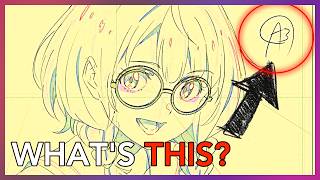

What Do Those Letters and Numbers in Anime Mean?
39sThis opening immediately hooks viewers by addressing a common, unanswered question about anime production, sparking curiosity.
▶ Play Clip"The title accurately promises a beginner-friendly explanation of anime notation, and the transcript delivers exactly that."
The video explains the standard notation used in Japanese anime production, focusing on the layer system (A, B, C...) and the meaning of circles and triangles on animation sheets. The animator uses a simple stack-of-papers analogy to clarify how layers work and how keyframes and in-betweens are marked.
The background is the furthest back; layer A is the next closest, then B, C, etc.
Circles mark key animation drawings (keyframes) that form the base structure.
Triangles mark in-between drawings that make animation fluid.
What letter is used for the layer closest to the background (excluding the background itself)?
A
01:03
What do circles represent in anime notation?
Key animation drawings (keyframes).
01:56
What do triangles represent in anime notation?
In-between drawings that make animation smoother.
02:10
Why might a character be split into multiple layers (e.g., body on A, hair on B)?
To separate moving parts from static parts, making animation more efficient.
01:30
Stack of Papers Analogy
Provides a simple mental model for understanding animation layers.
00:51Circles = Keyframes
Clearly defines the most important frames in animation.
01:56Triangles = In-Betweens
Explains the role of in-between frames for smooth motion.
02:10[00:00] What exactly are these letters and numbers in terms of anime production? What exactly do these circles and triangles actually mean? For those who don't know me, hi, my name is spywai, I'm an animator, and I'm working on my own original anime series called Welcome to the Mind Palace.
[00:14] Every time you look at behind-the-scenes footage of Japanese anime, you're guaranteed to see these A123, B123 drawings all over the place. And you might think to yourself, oh, this looks so confusing.
[00:27] There's so many letters and numbers and shapes all over the place. Why isn't this explained anywhere? Lucky for you, I'm going to try to explain this concept as simply as possible. First off, there's going to be different types of layers in anime.
[00:39] The background, the animation layers, and the little in-between sections called books, which are basically just bits of the background that are on different layers. You don't have to worry about that too much, but just know that those are there.
[00:51] Think of a single animation shot as a set of different pieces of paper stacked on top of each other, and then you point a camera directly at the stack papers. The background, of course, is going to be the furthest back.
[01:03] Anytime you see anything labeled with the letter A, whether it be in the time sheet or the animation shot, it's referring to the layer that is furthest from the camera, not including the background. So in this instance, if I have a background layer and my character,
[01:18] then the character would be labeled as layer A, and then you stack another layer on top of that and label it B, C, and so on and so forth. Sometimes, if you have a complicated character animation,
[01:30] you can separate different parts of the character into their own layers. In this example from one of my recent animations, the letter A refers to the body of this character as it's being held still. Layer B will represent the hair,
[01:43] and it'll be its own separate layer because this is the only part of the animation that's moving. And now we move on to the circles and the triangles. This is actually really, really easy to explain. The circles represent the key animation drawings.
[01:56] These are the most important frames or poses or drawings that need to be drawn to make the base structure of the animation. The triangles represent the in between drawings or the frames drawn in between the key frames
[02:10] to make the animation look more fluid and smooth. And now you've learned a little bit more about the anime industry. Great job. Be sure to share this video with an animator friend who's interested in the Japanese anime industry or tag them in the comments below.
[02:22] Thanks for visiting the Mind Palace, and I'll see you all next time.
⚡ Saved you 0h 02m reading this? Transcribe any YouTube video for free — no signup needed.