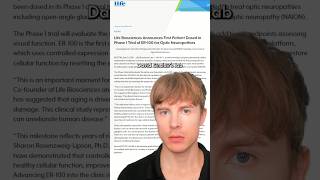

First FDA-Approved Anti-Aging Therapy!
44sThe announcement of the first FDA-approved anti-aging therapy is a groundbreaking, highly shareable news that sparks curiosity and debate.
▶ Play Clip"Delivers exactly what it promises: a clear, factual update on a major medical milestone."
The first FDA-approved anti-aging therapy is here. This video breaks down the science behind ER100, a cellular reprogramming therapy that has shown promise in restoring vision in mice. We'll explore how it works, its limitations, and what it means for the future of anti-aging medicine.
The first FDA-approved clinical trial for an anti-aging therapy has begun. The therapy, called ER100, uses cellular reprogramming to treat age-related eye diseases.
ER100 uses three Yamanaka factors (OSK) to reprogram cells. This Nobel Prize-winning technology can turn back the clock on aging cells.
In mice, OSK restored vision after optic nerve damage, glaucoma, and age-related vision loss. It also showed neuroprotective effects in 2025.
Human trials are set to begin in 2026, with results expected by 2032. This is a major milestone for the field of anti-aging medicine.
The therapy is partial and eye-specific, not a full-body rejuvenation. However, it could pave the way for future whole-body anti-aging treatments.
The first FDA-approved anti-aging therapy is a major milestone, but it's a partial, eye-specific treatment. It paves the way for future full-body rejuvenation therapies.
What is the name of the first FDA-approved anti-aging therapy?
ER100
00:01
Which three Yamanaka factors are used in ER100?
OSK (OCT4, SOX2, KLF4)
00:14
When are the first human clinical trials for ER100 expected to begin?
2026
01:08
What was a key preclinical success of OSK therapy?
Vision restoration in mice with glaucoma
00:53
What is a major limitation of the ER100 therapy?
It's partial and eye-specific, not a full-body rejuvenation.
01:21
First FDA-approved anti-aging therapy
This is a historic milestone, marking the first time a therapy targeting aging itself has been approved for human trials.
00:01Uses Yamanaka factors (OSK)
This Nobel Prize-winning technology is being repurposed from basic science to a potential therapeutic.
00:14Preclinical success in mice
OSK restored vision in mice with glaucoma and age-related vision loss, showing promise for human application.
00:53Human trials begin in 2026
This is the next critical step in determining if the therapy is safe and effective in humans.
01:08Not a full-body rejuvenation
The therapy is partial and eye-specific, highlighting the challenges of developing anti-aging treatments for the whole body.
01:21[00:01] первое в мире клиническое исследование омолаживающего препарата, одобренное FDA . Терапия называется ER100, и это тип клеточного перепрограммирования, в котором используются три перепрограммирования, в котором используются три фактора Яманаки: OCT4, SOX2 и KLF4,
[00:14] в совокупности обозначаемые как OSK. Их более ранние исследования на мышах показали восстановление зрения, особенно после повреждения зрительного нерва , глаукомы или возрастной потери зрения. Терапия ER100 основана на факторах Яманаки, за которые
[00:27] факторах Яманаки, за которые в 2012 году была удостоена Нобелевской премии. В 2006 году Казутоши и Шинья Яманака показали, что четыре специфических транскрипционных фактора, OSKM, могут перепрограммировать соматические клетки взрослых мышей в плюрипотентные стволовые клетки. Эти
[00:40] индуцированные плюрипотентные стволовые клетки ведут себя аналогично эмбриональным стволовым клеткам и могут превращаться в клетки любого другого типа. Синклер и Колд Эйдж модифицировали эти факторы Яманаки и превратили их в терапию клеточного перепрограммирования. В 2020 году
[00:53] OSK восстановил поврежденные и состарившиеся ганглиозные клетки сетчатки у мышей. В 2023 году они наблюдали долговременное восстановление функции глаз у мышей, страдающих глаукомой. В 2025 году OSK также продемонстрировал некоторые нейропротекторные эффекты в отношении дегенерации, вызванной воспалением. Теперь
[01:08] предстоит настоящее испытание в 2026 году — первые клинические испытания на людях. Однако исследование будет завершено в 2032 году, то есть через 6 лет. Несмотря на то, что это весьма значимая веха — первая в мире терапия против старения, одобренная FDA, — нам все же следует
[01:21] Во-первых, это не обратная процедура для всего организма . Оно воздействует только на глаза и частичная, а не полная. В модели глаукомы наблюдалось восстановление зрения примерно наполовину, а не полностью. Но ведь с
[01:36] Нельзя сразу же приступать к омоложению всего организма. Начать с области вокруг глаз – один из самых простых способов, и это может проложить путь к whole new generation of anti-aging therapies.

⚡ Saved you 0h 01m reading this? Transcribe any YouTube video for free — no signup needed.