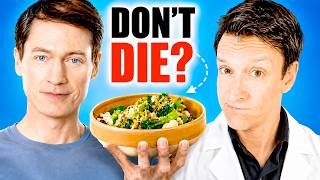

Bryan Johnson's $2M Diet: Free Hack
44sReveals that the core of a millionaire's expensive anti-aging diet can be replicated for free, sparking curiosity and saving money.
▶ Play Clip"The title promises a fact-check and free replication; the video delivers both by breaking down Johnson's diet scientifically and offering actionable, cheap alternatives, staying mostly accurate."
This video fact-checks Bryan Johnson's expensive anti-aging diet by stripping away the branding and hype. A PhD in aging and nutrition explains which parts of Johnson's diet are scientifically sound and easily replicable for free, and which expensive aspects are unnecessary. The key takeaway is that the core of Johnson's diet—removing junk, eating fiber-rich whole foods, and covering nutrient gaps—is simple and cheap.
Brian Johnson is the eccentric millionaire creator of 'Don't Die', a program aimed at slowing or stopping aging. A major part of it is a carefully designed diet, but when stripped down, the most powerful points are not the expensive parts.
Johnson eats about 2,200 calories a day (10% deficit). In animal studies, caloric restriction extends lifespan, but this may be due to rescuing overnutrition. In humans, a trial showed benefits like improved epigenetic clocks, but participants lost body fat, so benefits may be from fat loss, not the restriction itself.
If you have excess body fat, caloric restriction is beneficial. If you are already lean and active like Johnson, cutting calories further may not help and could cause harm (muscle loss, hormone issues). The advice: dial down to lose excess fat, then maintain.
Johnson gets 25% protein, 35% carbs, 40% fat. His protein intake is 1.6 g/kg, which is more than what Valter Longo recommends (low protein for longevity) and at the minimum of Peter Attia's recommendation (high protein for muscle). The speaker agrees with Johnson's approach, citing evidence that high protein (especially from plants/fish) is beneficial for muscle and mortality.
Johnson eats all meals before noon (6-hour eating window, 18-hour fast). Fasting itself doesn't make a significant difference when calories are matched; it's useful as a strategy to reduce calories. However, eating earlier in the day may have a small metabolic benefit.
Johnson's 'super veggie' bowl includes lentils, mushrooms, broccoli, cauliflower, and seasonings (garlic, apple cider vinegar). This meal is rich in protein, fiber, and sulforaphane (antioxidant). He adds extra virgin olive oil, which is high in polyphenols and evidence-backed for health.
Johnson adds no regular salt but gets some from pink salt in supplements. Most Westerners overconsume sodium; cutting back is beneficial. Fancy salts (Himalayan pink) are mostly hype—they are still >98% sodium chloride. Potassium salt is an evidence-based alternative for high blood pressure.
Another meal example is a sweet potato curry with quinoa, broccoli, cauliflower, green beans, and spices. His meals are consistently fiber-rich and antioxidant-rich.
A study found that fruits, vegetables, whole grains, unsaturated fats, nuts, legumes, and low-fat dairy are linked to healthy aging, while trans fats, sodium, sugary drinks, and processed meats are linked to worse outcomes. Johnson's diet nails almost every positive item.
Johnson is vegan (except collagen supplement). Studies on Adventists showed pescatarians (fish eaters) had the lowest mortality; vegans and vegetarians trended lower but not significantly. You don't need to be plant-exclusive; a high-fiber, high-plant diet is sufficient. His vegan reason is AI-ethics-based, not health-necessity.
His 'nutty pudding' is a mix of nuts, seeds, berries, cocoa, and bee protein—healthy fats and antioxidants.
Johnson takes 50-100 supplements daily. The speaker recommends only B12 (if plant-exclusive), vitamin D (if little sun), and algae oil for EPA/DHA (if no fish). The evidence for most others is weak.
Johnson is cynical about organic food, and the speaker agrees: no compelling evidence that organic provides clear benefits. The priority is eating healthy foods, not how they're grown.
1) Remove junk (sugar, processed meats, ultraprocessed). 2) Fiber foundation: legumes, vegetables, fruits, whole grains daily. 3) Best fats: olive oil, nuts, seeds, avocados, fish. 4) Enough protein from good sources (beans, lentils, fish). 5) Cover nutrient gaps (B12, D, iodine if needed).
Bryan Johnson's expensive anti-aging diet boils down to simple, cheap principles: remove junk, eat whole foods, and cover nutrient gaps. You don't need his budget or team to achieve similar benefits.
What is Bryan Johnson's daily caloric intake and deficit?
About 2,200 calories a day, a little over that, putting him at a 10% caloric deficit.
1:47
What is the main caveat of caloric restriction studies in animals?
Animals are kept in unnatural lab environments with unlimited high-calorie food, so benefits may be from rescuing overnutrition, not extending maximum lifespan.
2:22
What biomarker improved in a human caloric restriction trial?
An epigenetic clock, suggesting slower aging.
3:14
What are the two opposing views on protein and longevity?
1) Low protein: Valter Longo recommends <73 g/kg/day to reduce IGF-1. 2) High protein: Peter Attia recommends 1.6-2.2 g/kg/day to preserve muscle mass.
5:59
What is Bryan Johnson's protein intake in g/kg/day?
1.6 g/kg/day.
7:33
What does Bryan Johnson's 'super veggie' bowl contain?
Lentils, mushrooms, broccoli, cauliflower, garlic, apple cider vinegar, extra virgin olive oil, and fermented foods like kimchi.
12:08
According to the video, what is the main benefit of eating earlier in the day?
A small metabolic benefit; not huge, but might be better than eating later.
10:52
What is the verdict on fancy salts like Himalayan pink salt?
They are mostly hype; >98% sodium chloride, with negligible trace minerals. To get meaningful minerals, you'd need six times the max sodium, which would skyrocket blood pressure.
15:19
Which diet group had the lowest mortality in the Adventist study?
Pescatarians (fish eaters).
19:17
What three supplements does the video recommend for most people?
B12 (if vegan), vitamin D (if little sun), and algae oil for EPA/DHA (if no fish).
21:05
Caloric Restriction: Benefits vs. Risks
Clarifies that for lean, active individuals, cutting calories further may not help and could cause harm, addressing a key controversy.
1:47Protein Intake: 1.6 g/kg/day Backed by Evidence
Settles the low vs. high protein debate by endorsing Johnson's moderate approach, citing muscle hypertrophy and mortality data.
7:33Super Veggie Bowl: Scientific Core of Diet
Shows that Johnson's expensive diet boils down to cheap, whole foods like lentils and cruciferous vegetables, which are evidence-based.
12:08Five Simple Rules for Longevity
Provides a clear, actionable framework for viewers to replicate Johnson's benefits cheaply, cutting through hype.
22:49[00:00] Brian Johnson spends millions every year
[00:02] on his diet and program to delay aging
[00:06] and death. I'm going to show you how to
[00:08] do it for free. Brian Johnson is the
[00:10] eccentric millionaire creator of Don't
[00:13] Die, a program aimed at slowing down or
[00:17] even stopping the aging process. A major
[00:20] part of the program is a carefully
[00:22] designed diet. But when you strip it
[00:24] down and you take away all the flash,
[00:27] the most powerful points of his diet are
[00:30] not the expensive parts. They're not
[00:31] some secret for millionaires that is
[00:33] beyond your grasp. They're things you
[00:35] can easily replicate in the comfort of
[00:37] your own home for no extra cost. In
[00:40] fact, if you follow what I'm about to
[00:42] share with you, you might even save
[00:44] money. I received my PhD for research on
[00:47] aging and nutrition. And I've put
[00:49] everything I've learned over the years
[00:51] into designing my own diet to maximize
[00:54] health and delay death. And going over
[00:57] Brian Johnson's diet surprised me
[01:00] honestly because he gets a lot of things
[01:02] right. In fact, I think his approach
[01:06] beats a lot of popular influencers out
[01:08] there, including some that are doctors
[01:11] and scientists. But there's also a
[01:12] number of things about Brian Johnson's
[01:15] diet that are extremely controversial
[01:18] and that might not even be a good idea.
[01:20] So throughout the video, I want to focus
[01:22] on this question. When we remove all the
[01:25] branding and all the hype, which parts
[01:27] of his diet will actually deliver
[01:30] results for you, and how can you
[01:33] implement them as easily and as cheap as
[01:36] possible, and which other parts you
[01:38] don't need to waste time and money on?
[01:40] If you want more evidence-based
[01:42] breakdowns like this with no sponsors
[01:44] and no sales, subscribe. According to
[01:47] his website, Brian Johnson eats about
[01:50] 2,200 calories a day, a little over
[01:53] that, which puts him at a 10% caloric
[01:56] deficit. He explains in some of his
[01:59] videos that his philosophy is that every
[02:01] calorie in his diet needs to fight for
[02:04] its life. So, he's under consuming
[02:07] calories every day indefinitely into the
[02:10] future. And that is a really, really
[02:12] controversial strategy. I'll summarize
[02:15] everything we know on this topic real
[02:16] quick so you can make your own informed
[02:18] decision. When I was working on my PhD,
[02:22] caloric restriction was huge. We talked
[02:24] about it all the time and we did these
[02:26] experiments. You can calorically
[02:28] restrict animals in the lab like small
[02:30] worms or fruit flies or even mice and
[02:32] they do live longer when you do that.
[02:35] It's actually pretty impressive. But you
[02:37] keep these animals in an unnatural
[02:39] environment in the lab where they have
[02:41] access to unlimited amounts of very
[02:43] caloric rations. So we always wonder, we
[02:46] always have these discussions in lab
[02:48] meetings. Are we just rescuing the
[02:50] damage of over nutrition when we
[02:53] calorically restrict or are we actually
[02:56] extending the maximum lifespan of the
[02:58] species? In humans, studying aging is
[03:00] extremely difficult because it takes
[03:02] forever. There's one recent trial that
[03:04] actually tried to calorically restrict
[03:06] people for a couple years and they did
[03:08] see some benefit. Their blood work
[03:11] improved and this biomarker of aging,
[03:14] it's called an epigenetic clock that
[03:16] improved as well. So, it's suggesting
[03:18] that they're aging at a slower rate when
[03:21] they're calorically restricted. But the
[03:23] concern here is similar to the animal
[03:25] research because although these
[03:27] participants were not obese about half
[03:29] were overweight and the average body fat
[03:33] in the group was pretty high and in fact
[03:35] the participants that were calorically
[03:36] restricted lost some body fat. So are
[03:39] the benefits just because of the fat
[03:41] loss? Are we just rescuing the harms of
[03:44] over nutrition which has a lot of value?
[03:46] No one's arguing that. or are we
[03:48] actually extending the maximum lifespan
[03:51] of the human species, which is a
[03:52] completely different question. So, what
[03:54] does all of this mean for you? Well, if
[03:57] you have some excess body fat, like most
[03:59] Westerners do, then absolutely finding a
[04:02] way to restrict calories to moderate
[04:04] calories is going to be beneficial. And
[04:06] it doesn't have to be counting calories.
[04:08] There's many ways to do it. It will
[04:09] reduce your waist and your blood work,
[04:12] your cholesterol, your blood sugar, your
[04:14] blood pressure. Everything's likely to
[04:16] improve. But if you're already very
[04:18] lean, very low body fat like Brian
[04:20] Johnson is, and very physically active,
[04:23] and eat a very clean diet with no junk,
[04:26] then it's pretty uncertain if cutting
[04:29] calories even more beyond that is going
[04:31] to provide any benefits. And it could
[04:33] even cause some harm. Loss of muscle,
[04:36] loss of bone mass, hormone issues, or
[04:39] some things that could go ary. Brian
[04:42] Johnson does all kinds of blood work and
[04:44] tests all the time. So I imagine he's on
[04:46] top of that. But those are some
[04:48] theoretical concerns. And so personally,
[04:50] that's what I try to do as well. I
[04:52] absolutely dial down the calories to
[04:54] lose excess body fat to get to an ideal
[04:56] body weight and body composition. But
[04:59] once I'm there, I don't keep cutting
[05:01] calories for the rest of my life. I just
[05:03] maintain. So this is the first mindset
[05:05] shift in the video. So you don't
[05:07] necessarily want to just copy someone's
[05:10] anecdote bit by bit exactly. You want to
[05:13] understand is the benefit likely to come
[05:16] from the extreme behaviors or is it
[05:18] something more basic. Okay. But the next
[05:20] question is even more controversial and
[05:23] more relevant to you honestly and that
[05:25] is how does Brian Johnson distribute
[05:29] those calories in his diet? He gets
[05:31] about 25% of his calories from protein.
[05:34] 35% from carbs and 40% from fat. Right
[05:38] off the bat, this upsets every diet
[05:41] tribe on the internet. The low-faters
[05:43] think it's too much fat. The low carbers
[05:46] think it's too much carb. Leaving
[05:47] ideology aside, we want to look at this
[05:49] objectively based on the best evidence
[05:52] we have. Is this approach, is this
[05:54] breakdown likely to bring benefits for
[05:57] you? So, let's start with protein.
[05:59] There's basically two schools of thought
[06:01] out there on protein and longevity. One
[06:04] view is that you want to keep your
[06:06] protein very low to live long. And
[06:09] people often point to the work of Velter
[06:11] Longo. And the rationale there is when
[06:14] we eat protein, it induces IGF-1, this
[06:17] growth factor. And so it might cause
[06:20] cancer and speed up aging. And in fact
[06:23] on his website Longo proposes a pretty
[06:27] low range of protein intake of 73 grams
[06:30] of protein per kilo of body weight per
[06:33] day which is right under the RDA. A lot
[06:37] of people already complain the RDA is
[06:39] too low. Valter Longo's recommendation
[06:41] is to eat slightly below that at least
[06:44] until the age of 65. After 65 he
[06:47] recommends more. The other school of
[06:48] thought is the opposite that you want to
[06:50] eat high amounts of protein. This is
[06:53] championed by people like Peter for
[06:55] example. And the idea there is that with
[06:58] age we lose muscle mass. And so you want
[07:01] to be as muscular as possible in your
[07:04] middle age so that when that inevitable
[07:06] muscle loss comes we still hold on to
[07:09] enough muscle by our later ages. And so
[07:12] you want to eat a lot of protein to get
[07:14] a lot of muscle. That's basically the
[07:15] rationale. And Peter Retia on his
[07:17] website recommends from 1.6 to 2.2 g of
[07:22] protein per kilo of body weight per day.
[07:25] So it's about 2 to three times what
[07:28] Velter Longo recommends. So a huge
[07:30] spread. And Brian Johnson eats about 1.6
[07:33] g per kilo of body weight per day. So
[07:36] that's more than twice what Velter Longo
[07:38] recommends. And it's around the minimum
[07:40] that Peter Aia recommends. And I agree
[07:43] with Brian Johnson's approach. the
[07:45] evidence backs him up. And this is
[07:46] something I've changed my mind on over
[07:48] the years as the evidence evolved.
[07:50] During my graduate work, we published
[07:53] these experiments showing that you can
[07:55] restrict protein intake in model
[07:58] organisms like fruit flies and you
[08:00] extend their lifespan that way. But this
[08:02] hasn't really translated to humans. When
[08:05] we look at human data, we actually see a
[08:07] lower risk of mortality for some types
[08:09] of protein like plant protein for
[08:12] example or some animal proteins like
[08:14] fish. So this is saying that the problem
[08:17] is not really protein per se. It depends
[08:21] on the source. So I don't really find
[08:23] longu and the low protein school of
[08:25] thought very compelling. And as far as
[08:28] hypertrophy, we see that maximize around
[08:32] 1.6 six grams of protein per kilo of
[08:35] body weight per day. So that's roughly
[08:37] what I shoot for around Brian Johnson's
[08:40] range or the low end of Peter's range in
[08:44] that ballpark 1.5 1.6. And I pay more
[08:47] attention to the source of the protein.
[08:50] And this is what I recommend also for
[08:52] most people because most debates online
[08:55] on this topic put too much emphasis and
[08:57] too much focus on the amount of protein,
[09:00] which is not a problem for most
[09:02] Westerners, and not enough focus on the
[09:05] source of protein, which is a much
[09:06] bigger issue. So, we'll come back to
[09:08] this question. Right now, let's look at
[09:10] some of Brian Johnson's actual meals. I
[09:12] looked at his website. I looked at a
[09:13] number of his videos. The details vary a
[09:16] little bit, but it sounds like he eats
[09:18] about three times a day, which is
[09:20] normal. But all of his meals are shifted
[09:23] really early. He gets up before sunrise
[09:26] at 5:00 a.m. and he's done eating before
[09:29] noon.
[09:29] >> An hour and a half or 2 hours later, I
[09:31] will have my final meal of the day.
[09:33] >> That's right. He eats all of his meals
[09:36] before noon. So, he eats in roughly a 6h
[09:39] hour window and then he fasts the rest
[09:42] of the time. the other 18 hours or 17
[09:45] and 1/2 hours, something like that. This
[09:47] sounds so unusual and extreme enough
[09:50] that a lot of people think this is the
[09:52] secret sauce that will get you the
[09:54] benefits and maybe this is what we got
[09:56] to replicate. But is this backed by
[09:59] evidence? Fasting per se doesn't make a
[10:03] meaningful difference when you match for
[10:05] calories and for meals eaten. Whether
[10:07] you eat these meals more spaced out over
[10:10] the course of the day or more
[10:12] concentrated and then you fast the rest
[10:14] of the time doesn't seem to make much
[10:16] difference for body weight, metabolism,
[10:19] etc. That doesn't mean the fasting is
[10:20] useless. Some people like to use fasting
[10:23] as a strategy to reduce calories, to
[10:27] reduce the overall amount of foods eaten
[10:29] or to reduce snacking and it can be very
[10:32] powerful, very effective. It's just not
[10:33] the fasting itself that's delivering the
[10:35] results. On the other hand, this
[10:37] question of timing, so eating the exact
[10:40] same meals and same spacing, same amount
[10:42] of fasting, but the meals shifted
[10:45] earlier in the day versus later in the
[10:47] day, that has some evidence to back it
[10:50] up. Some studies find a benefit of
[10:52] eating our calories earlier in the day,
[10:54] morning and early afternoon. The effect
[10:57] is not huge. It's not seen in every
[10:59] study, possibly because it's relatively
[11:02] small, so you don't always see it.
[11:04] Bottom line, eating our calories earlier
[11:06] in the day. Everything else held equal
[11:09] might be a little better metabolically
[11:11] than eating them later in the afternoon,
[11:14] evening, and night. But don't forget the
[11:16] role of food quality and overall food
[11:19] quantity are much stronger. They easily
[11:22] trump this effect of timing. So, do I
[11:24] think you need to be doing this extreme
[11:26] version that he does? I don't. We don't
[11:29] have strong evidence to back that up.
[11:31] That you need to eat everything in a
[11:32] 6-hour window and be done by noon. If he
[11:35] likes it, that's fine. I personally
[11:37] don't do that. And I don't stress too
[11:39] much over timing. I try to eat most of
[11:42] my calories earlier in the day. I try
[11:44] not to have large heavy meals at night
[11:48] and that's about it. I don't lose sleep
[11:50] over the exact timing of meals and I
[11:52] don't do complete fasts after a given
[11:55] hour. Okay, you've made it this far.
[11:57] This is where we shift gears because
[12:00] we've dispelled a lot of the
[12:01] distractions. Now, we look at the exact
[12:03] foods he eats and this is where your
[12:06] benefit is likely to come from. One of
[12:08] his staple meals, he calls it super
[12:10] veggie. He's big on branding. I think
[12:12] this a business guy thing. It's
[12:14] basically a veggie bowl. It includes
[12:16] lentils, mushrooms, a number of
[12:18] vegetables, broccoli, cauliflower. So,
[12:21] this meal gets a lot of things right
[12:23] scientifically and for health benefits.
[12:26] Lentils are one of the best sources of
[12:27] protein out there. I have them all the
[12:29] time. They come with some fiber and they
[12:31] come with resistant starch. So, it's
[12:34] great for your gut. Lentils are also
[12:35] great for your blood sugar because
[12:37] they're low glycemic index due to the
[12:39] fiber. And then the cruciferous
[12:41] vegetables, the broccoli, the
[12:42] cauliflower, those are a good source of
[12:44] sulforophane, which is a powerful
[12:46] antioxidant. And then the seasonings he
[12:49] uses are all fantastic. Garlic helps
[12:51] lower blood pressure. Apple cider
[12:53] vinegar is good for your blood sugar as
[12:55] well. So yes, it's a great idea for you
[12:58] to include this type of meals in your
[13:00] diet. Most Westerners, it would be a
[13:02] godsend if they ate more meals like
[13:04] that. He also adds a tablespoon of extra
[13:07] virgin olive oil. high in polyphenols to
[13:11] this meal. Actually, he adds that to
[13:12] most of his meals. He's big on olive
[13:15] oil. In one of his videos, he even says
[13:16] extravirgin olive oil is his number one
[13:20] anti-aging food. That might be an
[13:22] overstatement, but yeah, the evidence
[13:23] for olive oil is great. It's good for
[13:26] the heart. It's good for your liver. You
[13:28] name it. Is olive oil uniquely good?
[13:31] Probably not. I mean, any of these
[13:33] healthy fats, avocados, walnuts, they're
[13:36] all great. We do have a lot of evidence
[13:38] for olive oil. It's been studied a ton.
[13:42] So, I would say our confidence level for
[13:43] olive oil is pretty high, but I wouldn't
[13:45] say it's the best fat out there. It's
[13:48] one of the great ones for sure. And he
[13:49] also adds some fermented foods that bowl
[13:52] like kimchi. Fermented foods are great
[13:53] for the gut. I'm a little more cautious
[13:56] with kimchi because it most of the
[13:58] kimchi brands are very high in salt. I
[14:01] don't know if he uses different one or
[14:02] if he makes his own lower in salt or
[14:04] not. Salt is another fascinating topic
[14:07] because Brian Johnson doesn't add any
[14:09] regular salt to his diet. Zero. Although
[14:12] one of his supplements contains some
[14:14] Himalayan pink salt. So he's not on zero
[14:17] added salt, but he doesn't add any to
[14:19] foods and none of the regular salt. So
[14:21] what does that mean for you? Do you have
[14:23] to add salt? Sometimes people ask me if
[14:26] we need to add some salt to foods. We
[14:28] don't need to add salt. We need sodium.
[14:30] Sodium is an essential nutrient, but the
[14:32] amount we need is actually pretty small.
[14:34] And sodium is included in all kinds of
[14:36] foods. Vegetables, animal foods, they
[14:38] all contain sodium. So you don't need to
[14:39] add salt to food. Now whether adding it
[14:42] is good or bad depends on the
[14:43] individual. Most westerners over consume
[14:46] sodium and their blood pressure is a
[14:48] little too high and they would benefit
[14:50] by cutting back. Although a lot of the
[14:52] sodium comes in ultrarocessed foods, not
[14:54] necessarily added at the table. But
[14:56] individually, some people see their
[14:58] blood pressure skyrocket when they add
[15:00] salt. Some people are much more salt
[15:02] tolerant. They can handle more. Some
[15:04] people even have inverse salt
[15:06] sensitivity. So you take away the sodium
[15:08] and their blood pressure goes up. It's
[15:09] unusual. It's about 10% of people, but
[15:12] it's a thing. So I think it makes sense
[15:14] when it comes to salt to personalize for
[15:16] your nature and your goals. And as for
[15:19] these fancy salts, the Himalayan pink
[15:21] salt and the Baja sea salt, it's mostly
[15:23] hype. We looked at this in a previous
[15:25] video. No matter where the salt comes
[15:26] from and what color it is, it's still
[15:28] going to be overwhelmingly sodium
[15:31] chloride, 98 or 99%. So, it's still
[15:34] going to have the same effects on blood
[15:35] pressure as regular salt. The argument
[15:38] for these fancy salts usually is the
[15:41] trace minerals, but when you look into
[15:43] this, and we covered that in that
[15:44] previous video, the amount of those
[15:46] trace minerals is minuscule. So, it
[15:49] really doesn't make a difference
[15:50] nutritionally. There's a study that
[15:51] quantified this. They estimated that in
[15:54] order to get a meaningful amount of
[15:55] trace minerals from pink salt, you'd
[15:58] need to get six times the maximum amount
[16:01] of sodium recommended. So for most
[16:04] people, that would just skyrocket blood
[16:06] pressure. It's stepping backwards. Save
[16:08] your money with these fancy salts. It's
[16:11] mostly hype. Take it with a grain of
[16:13] salt. Sorry. Just use regular salt. And
[16:15] if your blood pressure is high and you
[16:17] want to lower it, potassium salt is one
[16:20] option. That's actually evidence-based.
[16:22] That's what I use at home. Okay. Another
[16:24] example of meal that Brian Johnson gives
[16:26] is a sweet potato curry with quinoa. It
[16:29] includes sweet potato, quinoa, broccoli,
[16:32] cauliflower, green beans, and some
[16:35] seasonings and spices as well. So, his
[16:37] meals are definitely fiber richch.
[16:39] They're antioxidant rich. That he nails.
[16:42] There's no argument there. Just to
[16:44] illustrate this, a recent study asked
[16:46] which foods are more strongly linked to
[16:49] healthy aging, which they defined as
[16:52] preserving all aspects of health and
[16:54] living to the age of 70 without chronic
[16:56] disease. Fruits, vegetables, whole
[16:59] grains, unsaturated fats, nuts, legumes,
[17:03] and low-fat dairy were linked to better
[17:05] odds of healthy aging. And then trans
[17:08] fats, sodium, sugary beverages like soda
[17:12] and red and processed meats were linked
[17:15] to warons. And so, as you can see, Brian
[17:17] Johnson nails almost every item that
[17:21] study found with the exception of dairy,
[17:24] which we'll come back to. Now, this is
[17:27] where most content on longevity fails
[17:30] miserably because most people focus on
[17:33] details and fads and expensive
[17:35] supplements that give you little to no
[17:37] benefit. Whereas Brian Johnson's diet
[17:40] actually gets the fundamentals right,
[17:43] and that's what's going to deliver
[17:44] results. The irony is that Brian Johnson
[17:47] is often seen as a fad guy, but his diet
[17:50] actually snubs every fad. He's not
[17:52] scared of fats, but he chooses healthy
[17:54] fats. He's not carbopobic. He's not
[17:57] terrified of carbs, but he chooses the
[17:59] best sources of carbs, whole grains,
[18:01] legumes, fruits, and vegetables. So on
[18:04] that chapter, he aced it scientifically.
[18:07] One recent study estimated that a diet
[18:10] with whole grains, legumes, fish,
[18:13] fruits, vegetables, and nuts, if started
[18:16] at an early age, would extend life by
[18:19] more than 10 years compared to a
[18:20] standard American diet. And the largest
[18:22] gains would come from eating more
[18:24] legumes, more whole grains, and more
[18:27] nuts. So, we're starting to answer that
[18:29] initial question we posed in the
[18:31] beginning of the video. When we strip
[18:33] away all the hype and all the
[18:35] showmanship, what remains that's
[18:37] actually going to deliver you the
[18:39] results are some of the most
[18:41] sciencebacked foods on Earth. Okay. But
[18:43] there's an important question left for
[18:46] you and your diet. Brian Johnson doesn't
[18:48] include any animal products. He's not
[18:50] entirely vegan because he has a collagen
[18:53] supplement in there that is from animal
[18:55] origin, but his foods are all
[18:58] plant-based. So, do you need to do that
[19:00] to extend life and to avoid disease? He
[19:02] explains in some interviews that he's
[19:04] vegan by choice, not by need.
[19:06] >> I'm vegan by choice.
[19:08] >> So, he doesn't think that animal
[19:10] products necessarily harm you. And the
[19:13] science backs him up on that. For
[19:14] example, one study looked at Adventists
[19:17] from California, which are known famous
[19:19] for their longevity, and they separated
[19:21] them by diet. So, the omnivores, the
[19:24] vegans, the vegetarians, the
[19:25] pescatarians, and the pescatarians were
[19:27] actually the only ones that had
[19:29] significantly lower mortality than the
[19:31] omnivores. The other plantrich diets,
[19:34] the vegans, vegetarians, etc., they
[19:36] trended towards lower, but didn't reach
[19:38] statistical significance. And as we
[19:40] said, fish is generally linked to, if
[19:43] anything, lower mortality. So you don't
[19:46] have to be completely plant exclusive
[19:49] for health, for longevity, but you do
[19:51] want to have a diet that is high in
[19:54] fiber and high in plants. Now, his
[19:56] reason for eating a vegan diet is
[19:58] actually really interesting. He says
[19:59] that AI is about to dominate us real
[20:02] soon, and it's going to model its
[20:04] behavior on ours, on whatever it sees us
[20:07] doing. And so we want to show compassion
[20:09] over creatures that we dominate so that
[20:12] AI sees it and does the same thing to us
[20:15] and doesn't treat us like trash. It's an
[20:18] interesting argument. It's almost
[20:21] ethics for a self-s serving reason. You
[20:24] let me know your thoughts on that. Brian
[20:25] Johnson has also shared some of his
[20:27] favorite desserts or snacks. One is what
[20:30] he calls nutty pudding. It's basically a
[20:32] mix of nuts, seeds, berries with some
[20:36] cocoa, and some bee protein mixed in as
[20:39] well. So, a lot of healthy fats, a lot
[20:41] of antioxidants. Smart choices. No
[20:43] question about that. In addition to all
[20:45] of his food, he also takes a plethora of
[20:48] supplements. I mean, I think it's 50 or
[20:50] 100 different supplements a day. That's
[20:53] a an a whole video by itself. Suffice to
[20:55] say, for today, I don't take the
[20:57] majority of the supplements he takes. I
[20:59] don't think they have very strong
[21:01] evidence. I'll only touch on a couple
[21:03] exceptions. B12, for someone like him
[21:05] who's on an plant exclusive diet, you
[21:09] need a source of B12. I checked. He does
[21:11] supplement that. Vitamin D, he said he's
[21:13] not in the sun much. He doesn't eat
[21:15] dairy. He doesn't eat fish. So, there's
[21:16] no source of vitamin D in his diet. I
[21:19] checked. He supplements that as well.
[21:21] 2,000 international units a day. The RDA
[21:24] is only 600 for an adult, but 2,000 is
[21:27] fine. It's not a dangerous dose. He also
[21:29] takes an algae oil for EPA, DHA, these
[21:32] long form omega-3s. The evidence is not
[21:35] super convincing, but there's some
[21:36] evidence suggesting benefit or the
[21:38] brain, maybe the heart, particularly for
[21:41] people who don't have EPA in their diet.
[21:45] And algae oil has been shown to be
[21:46] absorbed just fine, just like fish oil.
[21:49] And it might actually be cleaner, lower
[21:51] in contaminants because of the way the
[21:52] algae are grown. As for organic or
[21:55] conventionally raised, and this might
[21:57] surprise you, he is pretty cynical about
[22:00] organic food, he doesn't buy that it's
[22:03] uh beneficial, and that's actually a
[22:05] reasonable take. Despite all the hype,
[22:07] we have no compelling evidence that
[22:08] organic food provides any clear benefit.
[22:12] So, it's personal preference. I also
[22:13] don't worry much about it. I by
[22:15] conventionally raised almost always. But
[22:17] the main thing is to eat healthy foods.
[22:19] Eat fruits and vegetables and all those
[22:21] good things. Whether they're organic or
[22:22] not is up to you. Okay. Drinks. He has
[22:25] this green smoothie that's basically
[22:27] spinach, kale, banana, cherry, and then
[22:30] some nuts and seeds. He also has water
[22:33] of course, and then tea. And he has this
[22:35] drink that basically he took a bunch of
[22:36] supplements and made them into a liquid
[22:38] form. Other than that, he drinks zero
[22:41] alcohol, zero soda, actually zero
[22:44] refined sugar in all of his diet. And
[22:47] those are good choices as well. Okay,
[22:49] now let's get into the most useful part,
[22:50] the most actionable part. If you want
[22:53] Brian Johnson's results, but you don't
[22:54] want to be Bryant Johnson, this is what
[22:58] I would actually recommend to a friend.
[22:59] Rule number one, remove the junk. Sugary
[23:02] drinks, processed meats, artificial
[23:04] desserts, fried fast foods,
[23:07] ultrarocessed snacks. Getting rid of
[23:09] that is the most bang for your buck.
[23:10] Rule number two, the fiber foundation.
[23:13] Legumes vegetables fruits whole
[23:16] grains, nuts, and seeds. These should be
[23:20] staples of the diet that you have daily.
[23:22] Good for the heart, good for the gut,
[23:24] good for the brain, you name it. If you
[23:26] want one cheap longevity food, add more
[23:29] legumes to your diet like beans and
[23:31] lentils. Rule number three, best fats.
[23:35] Olive oil, nuts, seeds, avocados, fish
[23:39] and seafood, fermented dairy. You don't
[23:41] need less fat in your diet. You need
[23:44] better fats. Rule number four, enough
[23:46] protein but from great sources. Beans,
[23:49] lentils, fish, seafood, lean meats. This
[23:52] is especially important if you're older,
[23:54] over 65, if you're very physically
[23:56] active, or if you're trying to lose
[23:58] weight. And protein powder is fine, too,
[24:00] if you need a little extra. Rule number
[24:02] five, cover any nutrient gaps. If your
[24:05] diet is plant exclusive, have some B12.
[24:08] If you don't catch much sun, you might
[24:10] need a vitamin D supplement. If you
[24:12] don't eat regular salt or fish or dairy,
[24:15] you might need to supplement iodine,
[24:18] etc. So, that answers our initial
[24:20] question. When we strip away all the
[24:22] money and all the flash and all the
[24:24] branding, the healthy core is very
[24:27] simple. Remove the junk, eat healthy
[24:29] foods most of the time, and address any
[24:31] nutrient gaps. Brian Johnson had an
[24:34] entire team research and design this
[24:37] diet with endless resources, and you can
[24:39] get the same benefits at home cheap. Is
[24:42] this diet going to make you immortal? Of
[24:44] course not. It's going to help you avoid
[24:47] disease and age as gracefully as
[24:50] possible. Subscribe for more
[24:51] evidence-based breakdowns. No hype, just
[24:54] the science, and no sales. I'll see you
[24:57] on the next


⚡ Saved you 0h 24m reading this? Transcribe any YouTube video for free — no signup needed.