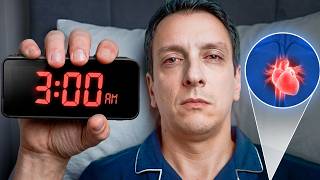

Poor Sleep Doubles Heart Disease Risk
41sStarts with a shocking statistic that immediately grabs attention and challenges common assumptions about heart health.
▶ Play Clip"The title accurately reflects the core message: poor sleep quality and timing are major, underrecognized heart risks."
The video argues that poor sleep quality and timing, not just sleep duration, are major underrecognized risk factors for heart disease. It debunks common myths like the 8-hour rule and introduces the concept of social jet lag. The speaker, an MD and research scientist, shares 10 evidence-based strategies to improve sleep quality.
People with poor sleep have up to twice the risk of dying of heart disease, even if they sleep the same number of hours.
The 8-hour rule is a myth; individual sleep needs vary from 7 to 9 hours, and some natural short sleepers thrive on 4-6 hours.
Fragmented sleep (repeated waking) increases heart disease risk, especially in women, even when total sleep duration is matched.
Circadian misalignment (sleeping at odd hours) causes insulin resistance, high blood pressure, and inflammation, independent of sleep duration.
Social jet lag (irregular sleep on weekends) leads to weight gain and insulin resistance, even with catch-up sleep.
Night owls may have higher health risks due to societal mismatch, not their natural chronotype.
Consistent sleep schedule, sunlight exposure, dim lights before bed, and avoiding caffeine/alcohol are key strategies.
For insomnia, reduce time awake in bed; get up if not asleep within 10-15 minutes.
What is the increased risk of heart disease for people with poor sleep?
Up to twice the risk of dying of heart disease.
0:19
What is more important for heart health: sleep quantity or sleep quality?
Sleep quality (restorative deep sleep) matters as much as, if not more than, sleep quantity.
6:44
What type of sleep pattern is linked to higher heart disease risk even when total sleep hours are the same?
Fragmented sleep (repeated waking during the night, even if not remembered).
5:51
What is the term for being awake when your body expects to be asleep?
Circadian misalignment.
8:28
What is the name for the pattern of staying up late on weekdays and sleeping in on weekends?
Social jet lag.
10:42
What happened to participants in a study simulating social jet lag (5 hours sleep on weekdays, catch-up on weekends)?
They gained weight (almost 1.5 kg in less than two weeks) and their insulin resistance increased.
11:41
What part of the brain controls the circadian clock?
The suprachiasmatic nucleus.
11:00
What is the half-life of caffeine?
About 5 to 7 hours.
21:00
What is the ideal bedroom temperature for sleep?
17 to 20°C (63 to 68°F).
21:43
How does alcohol affect sleep quality?
It suppresses REM sleep and fragments sleep architecture.
21:19
Poor sleep doubles heart disease risk
Establishes the core claim with a striking statistic.
0:19Fragmented sleep is dangerous even if hours are sufficient
Challenges the common focus on sleep duration alone.
5:51Circadian misalignment causes physiological harm
Explains the mechanism behind sleep timing's impact on health.
8:28Insomnia treatment: reduce time awake in bed
Provides a counterintuitive but evidence-based strategy for insomnia.
22:47[00:00] What if I told you the single most underrated
[00:06] you eat. It's not how much you exercise. It's
[00:12] you we need to fix your sleep. But here's what the
[00:19] up to twice the risk of dying of heart disease,
[00:25] of people think that good sleep means getting
[00:30] evidence tells a very different story. And I've
[00:35] going to surprise you. The main issue is not how
[00:41] getting the right kind of sleep that's actually
[00:48] I'm an MD and a research scientist and I started
[00:55] always found the science of sleep fascinating and
[01:02] A very close family member had a devastating
[01:07] just a zombie. And when we applied everything
[01:13] the 10 strategies I'm going to share with you
[01:18] I mean, it's night and day, pun intended.
[01:23] is incredibly powerful, and it's not just some
[01:30] So, my plan is to give you all of the tools that
[01:36] I think about rest so that you can start improving
[01:41] like this that look at scientific evidence and
[01:46] subscribe. We have a lot more material on heart
[01:52] Let's look at a really common sleep myth that
[01:57] myths, I want you to ask yourself a question. Do
[02:04] energized? Because a lot of us in our society
[02:09] change that. So, let's start with the 8our myth.
[02:14] need 8 hours of sleep. In reality, it's much
[02:19] least 7 hours, but it can vary between 7 and 9.
[02:26] rested with less than that. They're natural short
[02:33] between four and 6 hours, although that's unusual.
[02:39] That's about the average in the population, but
[02:45] might need them or 8 hours might not be enough
[02:50] very pervasive and that is that both sleeping too
[02:58] this comes from studies showing a U-shaped curve.
[03:04] disease is lowest in people sleeping about eight
[03:11] more correlate with higher risk. But this idea
[03:18] First of all, some studies find that pattern, that
[03:24] genetic studies, which are more robust generally
[03:30] they don't find increased risk. So, what's going
[03:36] that people who report sleeping longer often have
[03:44] spend longer in bed and so they overestimate how
[03:51] diseases that they have explain the increased
[03:57] se. As for the short sleepers, those are likely
[04:03] getting enough sleep for their needs. As opposed
[04:08] that only need four, five, six hours a night, we
[04:15] are at higher risk. And those people are much less
[04:21] hours because of life constraints but who really
[04:27] norm in our society, right? Unfortunately. Now, as
[04:33] a pattern. Studying sleep scientifically is really
[04:40] years just to see what happens. It wouldn't be
[04:45] study? So, we have to piece together what we know
[04:52] outcomes, the consequences, as well as genetic
[04:57] randomized trial, which we'll look at in a second.
[05:02] as we said, there's only so long you can
[05:07] so here's where we are. We saw that the famous 8
[05:14] to look at the flip side of the coin. And this is
[05:19] that applies directly to you. Even if you sleep
[05:26] hours of sleep on the dot every night and you
[05:31] alarm clock, not with some external interruption.
[05:37] in itself because the truth is you can sleep eight
[05:45] Large studies following thousands of people
[05:51] have fragmented sleep, that means they repeatedly
[05:58] don't remember waking up because often this is
[06:03] dying of heart disease. This effect was especially
[06:09] disease was up to twice as high as the folks who
[06:16] detail. This held even after sleep duration was
[06:25] radically different outcome. And these studies
[06:30] techniques like polyomnogs. It's a device with
[06:37] So, it monitors sleep patterns objectively.
[06:44] this introduces a key concept of sleep quality.
[06:52] the right kind of restorative deep sleep so that
[07:00] come down and your cardiovascular system can
[07:06] indicates that sleep quality may matter just as
[07:13] worry, we're going to cover specific actionable
[07:19] just hold on to this concept. sleep quality versus
[07:25] so much how many hours of sleep you got. That's
[07:32] naturally and how you feel when you wake up. If
[07:39] than that for some people and you feel rested
[07:45] all you need. But if you have difficulty waking up
[07:52] right? And you feel tired, you feel groggy, you're
[07:58] We all know that feeling. Then even if you got
[08:03] not getting enough or not enough of the right kind
[08:10] and this one surprises most people. Sleep timing
[08:16] 8 hours a night and still be quietly damaging
[08:22] but because of when you sleep. If you're
[08:28] we call that circadian misalignment. And this
[08:34] pressure to go up. This causes your inflammatory
[08:39] shift workers. They work at night and they sleep
[08:44] shift workers have a higher risk of heart disease
[08:50] their circadian rhythm or is it something else
[08:55] lives? A team of scientists set out to test
[09:01] rhythm of participants. They found that when
[09:07] asleep during the day, their blood pressure
[09:12] scrambling your sleep patterns by itself can have
[09:18] they found that the participants that were forced
[09:23] overall. And that was part of the problem. Their
[09:29] that some of the harmful effects were independent
[09:35] if they slept the same number of hours, there
[09:40] that if you sleep at weird hours that don't match
[09:47] building up damage even if you end up sleeping the
[09:53] we said is you can't mess up people's sleep for
[09:59] a week or two. So can our bodies adapt to these
[10:05] example? Well, in shift workers, risk of heart
[10:11] on the job. So, if anything, the evidence shows
[10:17] what you're thinking. I'm not a shift worker, so
[10:21] But there's actually a much more common way that
[10:27] Let me know if this sounds familiar. On week
[10:31] we have to get up early to work. We sleep a
[10:36] over the course of the week. We get increasingly
[10:42] Sunday night, it's hard to fall asleep again. We
[10:47] we're really tired. We're out of it. We call
[10:54] millions of people go through this week in
[11:00] your brain that controls your circadian clock,
[11:06] expects a certain consistent rhythm. And by
[11:11] yourself jet lag without traveling. And your
[11:17] some harmful physiological consequences. And the
[11:23] that I'll just catch up on sleep in the weekend
[11:30] scientists simulated social jet lag by restricting
[11:37] similar to what a lot of people do during the
[11:41] started eating more after dinner. They started
[11:48] more weight. And it was a big difference. Almost
[11:53] in less than two weeks. So, it's not nothing.
[12:01] this compared to a control group that got to sleep
[12:07] people that were sleeped for 5 days, then got
[12:13] and then started sleep restricting again. similar
[12:20] And these guys gained weight similar to the ones
[12:26] and their insulin resistance also went up. So,
[12:32] likely not a healthy lifestyle. Even if we try to
[12:39] regular sleep schedule. I've actually experienced
[12:45] later in the day. It's always been hard for me
[12:50] leg thing throughout school when I was a kid. But
[12:56] now I work pretty hard at structuring my life so
[13:03] night. More on that in a second. But this leaves
[13:08] sleeping all the hours that you need, regular
[13:15] So, you go to bed late, you wake up late. Let's
[13:23] that harmful? Well, let's look at this question
[13:27] strategies to improve sleep quality because
[13:33] something that I've tried to investigate myself
[13:39] to know what's healthier. I'll try to change
[13:45] they call this a late chronotype. That's the
[13:52] there's a genetic component to this. It's not just
[13:58] prone to having a later chronotype or an earlier
[14:06] the first genetic mutations controlling circadian
[14:13] Seymour Benzer, and the scientists that followed
[14:19] gene we now know by the name of period. They ended
[14:24] we know this is partly genetic. It's not all
[14:31] doesn't tell us if this is harmful or not. For
[14:36] at night owls, the late chronotypes, that does
[14:43] even when the total sleep duration is matched.
[14:49] also have more psychological disorders, more GI
[14:57] disease. Yeah, my night owls are a mess. They're
[15:03] exercise less and be more obese. So, a different
[15:10] sleeping late that's harmful per se, but night
[15:18] at a rhythm that is not natural to them. They have
[15:22] off their kids and go on errands when everybody
[15:30] circadian misalignment that causes all the issues,
[15:37] the eating a worse diet, and eventually all the
[15:43] scientists asked if this higher risk we see in
[15:51] whether they're night owls or morning birds. So
[15:58] workers. And they found that the early birds,
[16:03] of diabetes when they did shift work, when they
[16:09] than 10 years. But the late chronotypes, the night
[16:15] they worked daytime shifts. So the key seemed to
[16:22] matching the lifestyle to their nature. And this
[16:28] that it is the conflict with the time constraints
[16:35] explain the higher risk of late chronotypes. Night
[16:42] constant circadian misalignment, be mismatched
[16:48] be clear that this question is not completely
[16:52] that many studies on this specific question. So,
[16:57] far in the video, congratulations. You already
[17:02] people, including most doctors. But everything so
[17:10] the timing issue, all of that is the foundation.
[17:15] share with you guys what I personally do based
[17:20] to your personal chronoype and then we'll wrap
[17:25] sleep quality. I try to structure my whole life
[17:33] and commitments mostly shifted to the afternoon
[17:38] I work later than most people. I start later,
[17:43] the same rationale just shifted. So most of the
[17:48] maybe you work out before you go to work, but
[17:54] I try to be pretty consistent with bedtime and
[17:59] of the 10 evidence-based strategies for sleep
[18:06] to go to bed and wake up within 30 to 60 minutes
[18:12] kismatic nucleus needs that regularity to function
[18:19] lives, different constraints. So, you do what
[18:24] generally sleep between 2 am and 10 am regardless
[18:31] be pretty consistent. Now, it's not a robotic OCD
[18:39] something like that and it changes, no big deal.
[18:44] it's not a roller coaster every 3 days. Strategy
[18:51] waking up, within 30 minutes or an hour of waking
[18:58] signal your body has. I try to go for a walk first
[19:04] able to sleep a little earlier. Whereas, if I just
[19:09] which is kind of my natural propensity, my sleep
[19:16] 4:00 a.m., 5 a.m. It's insane. Number three, if
[19:22] affects your sleep, sleep apnea is one of the most
[19:28] apnea is one of the most common causes of sleep
[19:34] impact intervention for anyone suffering from
[19:39] who suffer from sleep apnea don't know they have
[19:45] So you if you consistently wake up feeling tired
[19:51] doctor about it. Strategy number four, you want
[19:57] bedtime because this helps your melatonin go up.
[20:03] most electronic devices in this period because the
[20:10] down melatonin. If you're reading a book under a
[20:15] directly into your eyes, that's fine. Electronic
[20:20] than cell phones because the technology, the
[20:25] your eyes than a cell phone or a laptop, but
[20:33] oldfashioned paper. The good thing is with a lot
[20:37] intensity and the type of light that they emit.
[20:42] need these special glasses that influencers
[20:47] dim the lights. Strategy number five, no caffeine
[20:54] it's actually good to stop it earlier than a lot
[21:00] is about 5 to 7 hours. So, if you have trouble
[21:07] might still be having an effect. Try to aim for at
[21:13] of coffee. And some people may need even more.
[21:19] helps people fall asleep as we all know, but then
[21:26] sleep architecture. So, drinking alcohol to fall
[21:32] same as actual quality restorative sleep. Strategy
[21:38] your bedroom environment. You obviously want it
[21:43] matters. You want to keep your bedroom a little
[21:52] about 63 to 68 Fahrenheit. And this is because
[21:59] sleep onset to happen properly. Strategy number
[22:06] especially intense exercise because it raises
[22:12] So that makes it harder to fall asleep. Number
[22:17] meals close to bedtime. Digestion raises your
[22:23] it can worsen sleep quality. Number nine, you
[22:28] experiences before bedtime. Even 10 minutes of
[22:35] mindfulness exercise, meditation, reading a
[22:41] exciting book, that helps lower your cortisol and
[22:47] if you suffer from insomnia, if you have trouble
[22:52] sleep hygiene are all wrong. Because here's the
[22:58] tells people with insomnia. When you have a hard
[23:04] bed early. Every bone in your body wants to get to
[23:11] this is exactly the wrong instinct. Spending time
[23:18] your bed and your bedroom and wakefulness. Your
[23:23] be alert and to be analyzing and thinking about
[23:28] personal note, I saw this firsthand with my family
[23:34] but then if she moved to the couch, she would
[23:38] physiological difficulty falling asleep. It was
[23:45] environment. So, the evidence-based approach
[23:50] the time you spend awake in bed to an absolute
[23:56] things only. Sleeping and sex. It's not for lying
[24:03] sitting on your laptop doing work. So, you want
[24:08] the insomniac. It just feels stupid. But you want
[24:16] until you're nodding almost, and as soon as
[24:21] you need five or 10 minutes of reading in bed to
[24:26] is spend 40 minutes, an hour, an hour and a half
[24:31] up, exactly the same logic. You want to get out of
[24:37] person with insomnia wants to stay in bed because
[24:42] little longer, maybe I'll fall asleep again."
[24:46] the same with middle of the night awakenings. If
[24:51] 15 minutes, get out of bed. You want to do some
[24:56] sock drawer or count silverware in the kitchen
[25:01] ideally a boring book on paper or on a Kindle is
[25:08] of your bedroom. Then when you feel sleepy again,
[25:12] within 10, 15, 20 minutes max, you get out of bed
[25:19] actually works. It's an evidence-based approach,
[25:25] the habit of being awake in bed. I watched my
[25:32] just was against everything her body was screaming
[25:38] it and did it, the improvements were dramatic and
[25:44] improvements. And we were also able to reduce
[25:49] as her sleep quality improved. So, this is what's
[25:54] find this information useful, please consider
[25:59] who has trouble sleeping, and maybe they think,
[26:04] know why I'm so exhausted." And subscribe for
[26:08] protects your heart and your brain. This is a




⚡ Saved you 0h 26m reading this? Transcribe any YouTube video for free — no signup needed.