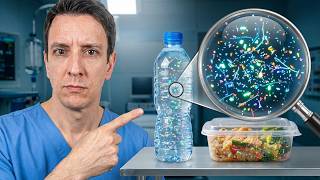

The credit card of plastic lie
45sExposes a viral myth with a shocking twist, sparking curiosity and debate.
▶ Play Clip"The title is accurate—the video thoroughly debunks the viral microplastics claim and explains the scientific flaws."
The viral claim that humans ingest a credit card's worth of plastic weekly is based on flawed science. Recent studies reveal that lab contamination and measurement errors have vastly overestimated microplastic intake. This video breaks down the real facts and offers practical, low-stress precautions.
A review estimated plastic intake at 0.1 to 5 grams per week, but this was based on assumptions, not direct measurements.
The range had a 50-fold difference, indicating no precision. Headlines cherry-picked the top value (5 grams).
A later analysis found the original estimate contained 'severe errors' and overestimated even at the low end.
A more accurate estimate is around 4 micrograms per week—equivalent to a credit card every 23,000 years.
Lab gloves shed particles (stearates) that look like microplastics to spectroscopy, causing thousands of false positives per sample.
Mass spectrometry can mistake natural fats for microplastics, especially problematic for brain tissue studies.
Science is self-correcting, but the process is gradual. Podcasts and media often hype scary findings prematurely.
Avoid heating food in plastic, don't reuse soft plastic bottles, store warm food in glass/metal. Don't stress over occasional plastic use.
What was the range of estimated plastic intake per person per week in the review that sparked the credit card claim?
0.1 to 5 grams per week.
00:41
What weight of plastic is equivalent to a credit card?
5 grams.
00:58
What did a subsequent analysis conclude about the original review's estimate?
It contained 'severe errors' and considerably overestimated microplastic ingestion.
02:23
What is a more accurate estimate of weekly plastic intake according to another analysis?
Around 4 micrograms per week.
02:52
How often would you eat the equivalent of a credit card in plastic based on the 4 microgram estimate?
Every 23,000 years.
03:04
What did the University of Michigan study discover about lab gloves?
Gloves worn by scientists shed particles called stearates that look like microplastics to spectroscopy.
03:32
What problem does mass spectrometry have in detecting microplastics?
Mass spectrometry can mistake natural fats for microplastics.
04:25
Name three practical steps to reduce microplastic exposure mentioned in the video.
Avoid heating food in plastic containers, avoid reusing soft plastic bottles, and store warm food in glass or metal.
06:40
Credit card claim origin
Reveals the source of the viral claim and its wide uncertainty range.
00:41Actual estimate is 4 micrograms
Shows the true scale is millions of times smaller than the viral figure.
02:52Lab gloves cause false positives
Highlights a critical methodological flaw that undermines many microplastic studies.
03:32Science is self-correcting
Emphasizes the gradual but reliable process of scientific correction.
05:22Practical precautions
Provides actionable, low-stress steps to reduce exposure without panic.
06:40[00:00] The whole microplastics field has just been flipped on its head. It's not every day that a scientific field gets rocked to the core like this, but this is one of those days. Chances are, you've heard this claim.
[00:13] You're eating the equivalent of a credit card worth of plastic every week. This was all over the media just a couple of years ago. But this whole story and the entire microplastics field are fraught with problems.
[00:27] And this story is a wake-up call when it comes to scary headlines and hype getting ahead of the science. So, what are the facts? What do we actually know about microplastics and how do you protect yourself?
[00:41] The credit card story came from a review that tried to estimate total plastic intake by average human beings from foods, water, and air all combined. And they concluded that the range was between 0.1 and 5 grams of plastic per person per week.
[00:58] Bear in mind, these weren't actual measurements from human beings. These were estimates that made a number of assumptions. So, 5 grams is about the weight of a credit card give or take. So, some headlines just took the top of the range and ran with that.
[01:13] And podcasters were quick to repeat it. This was all over the internet. Plastics are everywhere every week without being realizing it. We are consuming the equivalent of an entire credit card in plastic.
[01:25] Did you know that on average, we eat about a credit card worth of plastic every week in our food systems? Everybody's consuming about one credit card size worth of plastic a week. That's insanity.
[01:37] So, I have a question. When you eat one of these every single week chances are you are already. That's not surprising because this story had every ingredient for virality. This unnatural, man-made substance is all around you and it gets into your body without you even noticing.
[01:54] And it harms you over the long run. Sounds pretty scary. But to anyone paying attention, this whole story smelled really fishy from the get-go. First of all, when you have a huge range like that from 0.1 to 5 is a 50-fold difference.
[02:09] That already tells us there's no precision in the measurements. And then when you randomly pick the highest value, you're almost by definition picking an outlier. The odds that that number is not going to be accurate are huge.
[02:23] Second, that whole range was immediately disputed by a number of scientists as inaccurate. One analysis found that estimate contained, quote, severe errors.
[02:35] And they also concluded that both the maximum, the 5 grams, and the minimum, the 0.1 gram, considerably overestimated microplastic congestion. So even their minimum, that 0.1, which is 50 times less than the credit card line,
[02:52] even that would be an overestimate. Another estimate that accounted for additional factors and may be more accurate concluded the actual number is much smaller, around 4 micrograms.
[03:04] That's about a million times smaller than the credit card number. This would mean you're eating the equivalent of a credit card not every week, but every 23,000 years. Little different, but even this, this much, much smaller number,
[03:20] could still be an overestimate because the biggest blow to the microplastics field was just dealt this year, just a couple months ago. A team at the University of Michigan discovered that the gloves
[03:32] that scientists wear in the lab shed tiny particles that to the detection techniques used by scientists look exactly like microplastics. This technique is called spectroscopy.
[03:46] And for more detail on that, I refer you to a great video published by Brad Stanfield. But the bottom line is that scientists are wearing these gloves to avoid contamination in the lab.
[03:58] And ironically, they're shedding these particles, they're called steerates that are not microplastics, but they look like them to these techniques. So you generate all these false positives, all these artifacts of the measurement technique.
[04:11] And the scientists in Michigan found that most of the types of gloves and brands of gloves that they tested had this problem with the average being thousands of false positives for each square millimeter of sample.
[04:25] And it gets even worse because another technique commonly used in this field called mess spec. It mistakes some types of fats for microplastics. This is a massive problem for studies reporting microplastics found in the brain, for example,
[04:41] which of course made all the headlines because that's a really scary finding. Brain tissue is notoriously high in fat. And so this raises the obvious possibility that they're detecting remnants of those natural fats
[04:55] and not microplastics. Now, all of this is not to say that microplastics aren't real or that they can't cause problems. I take some precautions, my family and I, and we're going to talk about in a second
[05:08] some measures that you can take to ensure yourself. But the bottom line here is that this field is still in its infancy. And we got to relax, we got to slow our roll before we start repeating the first scary headline we see.
[05:22] Science actually works super well in the long run precisely because it's self-correcting. And actually, this story is a story of science finding its own fluid, correcting it,
[05:34] which is going to make the whole field much more accurate in the future. But that process is gradual. It's not fast. And so this urge of podcasts to find the next scary thing or the next miracle cure
[05:47] to hype to you tomorrow, that almost guarantees they're going to make enormous mistakes. Okay, so what do we actually know about microplastics and what can you do today? So we know microplastics are present in the environment.
[05:59] We know they can't enter the body certainly if we drink or if we eat them. And we know they can cause harm at least in high doses. So in the lab, if you expose animals or cells in a petri dish to microplastics,
[06:14] you often do see problems, but usually these experiments use very high concentrations. So how does this translate to humans? At what dose does it start being a problem? The regular exposure that we have in our daily lives is that an issue?
[06:28] Does that cause disease? No one knows these answers for sure. So while scientists are figuring that out, what are we supposed to do? I'll share my personal strategy and you let me know what you do.
[06:40] Number one, I avoid heating food in plastic containers. So if I get takeout, which I don't do very often, but if it comes in a plastic container, I make sure I transfer it to ceramic or glass plate before I pop it in the microwave.
[06:55] Number two, I avoid reusing plastic over and over, especially the softer plastic, like water bottles. So my water bottle is glass. And so that covers both the microplastics shedding into the water over time
[07:09] and also any substances lining the water bottle like BPA, for example, those can leach into the water as well. Number three, I try to have most of my food containers be made of glass or metal,
[07:21] usually glass, especially if they're going to be filled with warm food. So we batch cook twice a week and right after when we put the food in containers, when it's still warm, we try to avoid plastic containers.
[07:34] What I don't do is I don't throw away everything that's made of plastic and I don't stress too much over a plastic straw once in a while because there's all this uncertainty in the field. And my prediction is that if microplastics are confirmed in the future to be a problem
[07:50] at the regular dose that we were exposed to, it's going to be minor compared to the actual quality of the foods in the diet and lifestyle. So eating a healthy diet will easily trump which container happens to come in.
[08:05] That's my prediction. What do I mean by healthy diet? I shared everything I eat in a typical day in this previous video, so check that out and I'll see you in there.




⚡ Saved you 0h 08m reading this? Transcribe any YouTube video for free — no signup needed.