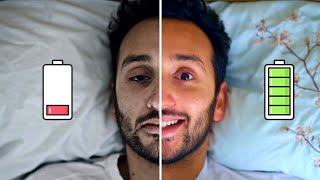

How Many Hours Should You Actually Sleep?
37sDebunks the common sleep duration myth and warns about sleep anxiety, which is highly relatable and shareable.
▶ Play Clip"The title accurately reflects the content: the video delivers a detailed, evidence-based sleep routine with nine specific tips."
The video presents nine evidence-based sleep tips derived from expert interviews, podcasts, and books. The creator shares personal routines to improve sleep quality and daytime alertness.
Aim for 7-8 hours of sleep per night, based on research from the American Academy of Sleep Science and Sleep Research Society.
Set regular sleep and wake times to align with the homeostatic sleep drive and adenosine levels.
View morning sunlight within a few hours of sunrise to trigger cortisol release and set the circadian rhythm.
Morning exercise can build an anticipatory circuit for wakefulness, but any exercise helps sleep quality.
Delay caffeine for an hour after waking and avoid it after 2-3 PM to prevent interference with adenosine receptors.
Get 10-30 minutes of evening sunlight about an hour before sunset to reinforce the circadian rhythm.
Dim lights and avoid bright screens after 8 PM to prevent disruption of melatonin production.
Expect a natural spike in alertness about an hour before bedtime; it will pass without intervention.
Keep the bedroom cool (16-19°C) to facilitate the drop in body temperature needed for sleep.
Incorporating these nine science-backed tips can significantly improve sleep quality. The creator emphasizes consistency over perfection and encourages viewers to adapt the routine to their own needs.
What is the ideal sleep duration for a healthy adult according to the American Academy of Sleep Science?
Seven or more hours per night.
0:24
What chemical powers the homeostatic sleep drive?
Adenosine.
1:18
What is the name of the master clock in the brain that controls the circadian rhythm?
Suprachiasmatic nucleus.
2:52
How does caffeine affect adenosine receptors?
Caffeine acts as an adenosine antagonist, blocking the receptors and preventing the sleepy signal.
7:36
What is the half-life of caffeine?
Five to six hours.
8:16
According to Dr. Huberman, how many hours before bedtime should you stop drinking caffeine?
Eight to ten hours.
8:28
What happens when light hits the eyes between 11 PM and 4 AM according to a 2018 study?
It suppresses dopamine and activates the habenula, lowering mood and making learning harder.
10:15
What is the ideal bedroom temperature for sleep according to some experts?
19 degrees Celsius (though the creator prefers 16-17).
11:44
Seven Hours Minimum
Cites a major 2015 study establishing the minimum sleep duration for health.
0:24Morning Sunlight Triggers Circadian Clock
Explains the mechanism of how morning light sets the internal clock for wakefulness and later sleepiness.
2:39Caffeine as Adenosine Antagonist
Clear explanation of caffeine's mechanism and why timing matters for sleep.
7:36Light at Night Suppresses Dopamine
Cites a Cell study showing light exposure at night affects mood and learning.
10:15Cool Room for Sleep
Practical tip backed by the need for a drop in body temperature to fall asleep.
11:29[00:00] So over the last few months,
[00:00] I've interviewed a bunch of sleep experts
[00:02] and listened to loads of podcasts
[00:03] and read loads of books
[00:04] all about the science behind effective sleep.
[00:07] And these are the nine evidence-based things
[00:09] that I've built into my routine
[00:10] to help me get an amazing night's sleep
[00:11] and feel well rested throughout the day.
[00:13] Let's get started.
[00:14] First off, I try to sleep
[00:15] for around seven to eight hours each night.
[00:17] Now the science on how long you should sleep for
[00:18] isn't straightforward,
[00:19] but most research says that between seven
[00:21] and nine hours of sleep at night
[00:22] is ideal for a healthy adult.
[00:24] And according to a big 2015 study
[00:26] by the American Academy of Sleep Science
[00:27] and the Sleep Research Society,
[00:29] "adults should sleep seven or more hours per night
[00:31] because regularly getting less than seven hours of sleep
[00:33] can lead to a load of bad stuff like weight gain
[00:35] and heart disease and depression
[00:37] and charmingly increased risk of death."
[00:38] If you're not sure if you should sleep seven
[00:40] or eight or nine hours,
[00:41] then the solution is pretty simple.
[00:42] Just experiment with how much sleep you need
[00:44] to feel happy and productive the next day.
[00:46] And remember, if you get too obsessed
[00:47] with getting eight hours of sleep every single night,
[00:49] that actually might spike your stress levels,
[00:51] ironically making it more difficult to get to sleep.
[00:53] And this is called sleep anxiety.
[00:55] So the second thing I try to do for healthy sleep
[00:56] is to build a sleep rhythm.
[00:58] I set a regular time for going to sleep and waking up
[01:00] and I try my best to actually stick to it.
[01:02] So for example, I usually go to sleep
[01:03] around 11 or 11.30 PM and get up around 7 AM.
[01:07] The more consistent your rhythm,
[01:08] the easier it's gonna be to fall asleep and to wake up.
[01:10] And this is because of the homeostatic sleep drive,
[01:12] one of the main systems in our body
[01:13] that determines when we feel tired and when we feel awake,
[01:16] which is powered by the chemical "Adenosine".
[01:18] See, adenosine makes us feel this intense need for sleep.
[01:20] From the moment we wake up in the morning,
[01:22] adenosine starts building up in our body
[01:24] until eventually we start feeling sleep hungry.
[01:26] The more adenosine we have, the sleepier we feel.
[01:28] When we actually do get enough sleep,
[01:30] that drives our adenosine levels down again
[01:32] and we wake up feeling well rested.
[01:33] Okay, so why does this mean we should have consistent times
[01:36] for waking and sleeping?
[01:37] Well, if we start going to sleep and waking up
[01:38] at the same time every day
[01:39] and get our proper seven to eight hours of sleep,
[01:41] then our adenosine levels will regularly peak
[01:43] at the same time each evening,
[01:44] making us feel properly tired and ready for bed.
[01:46] And after seven to eight hours of sleep,
[01:48] that adenosine will be low enough
[01:49] that we can wake up naturally
[01:50] without feeling too groggy or tired.
[01:52] So the more we can invest in building the steady rhythm,
[01:54] the more we can bring our sleep schedule in sync
[01:56] with the chemicals in our body
[01:57] and the less likely we are to feel weirdly awake at 2 a.m.
[02:00] and start playing video games.
[02:01] And here are four practical things
[02:02] that can help you build that rhythm.
[02:03] First, set an alarm for the same time every day
[02:05] to help you wake up consistently.
[02:07] Secondly, ignore the weekend.
[02:08] As far as your body is concerned,
[02:10] the weekend is just two days where you do your best
[02:12] to mess up your healthy sleep cycle.
[02:13] For me, I try to personally avoid lie-ins
[02:15] or having a different sleep schedule
[02:16] on Saturdays and Sundays,
[02:17] so I don't mess up this adenosine rhythm
[02:19] that I've been trying to build.
[02:20] Thirdly, try to phase shift your social life.
[02:22] Basically, try to schedule evening meetups with friends
[02:24] a little bit earlier in the day.
[02:25] The occasional late night is totally fine,
[02:27] I just try not to make too much of a habit of it.
[02:29] And the final tip is to actually listen to your body.
[02:31] Try not to push through that sleepy late evening feeling.
[02:33] That's the exact trigger we're working towards,
[02:35] which makes it easier to fall asleep.
[02:37] Okay, so the next thing I do to get a good night's sleep
[02:39] is to catch the morning sun when I wake up.
[02:40] That's because in addition to adenosine,
[02:42] there's a second system inside all of us
[02:44] that affects when we feel sleepy and when we feel awake,
[02:46] a kind of internal 24-hour clock
[02:48] called the circadian rhythm.
[02:49] Now, this system is mainly controlled
[02:50] from a master clock in our brain called the
[02:52] suprachiasmatic nucleus,
[02:54] which lives just above the roof of our mouth,
[02:56] and sends signals to the rest of our body
[02:57] about whether to feel sleepy or awake.
[02:59] The circadian rhythm generally looks like a wave,
[03:01] with our brain releasing the chemicals cortisol
[03:03] and epinephrine to drive our upward spike
[03:05] in alertness during the morning and the rest of the day,
[03:07] and melatonin driving the downward curve at night,
[03:10] making us feel like going to bed.
[03:11] And the number one thing that influences
[03:12] this circadian rhythm is light,
[03:14] particularly morning sunlight.
[03:15] When morning sunlight hits the retina in our eyes,
[03:18] it sends a message to our internal circadian clock
[03:20] to trigger that release of cortisol and epinephrine,
[03:23] which makes us feel awake and alert.
[03:24] Now, the sun doesn't need to be just
[03:26] peeking over the horizon,
[03:27] it just needs to be within a few hours of sunrise.
[03:29] And the sooner you can get it after waking up, the better.
[03:31] So in terms of my personal morning routine,
[03:33] I wake up, I grab some water, I take my medication,
[03:35] which in this case is finasteride
[03:37] and Heights supplement and probiotic.
[03:39] And then after having a shower,
[03:40] I'll normally go for a walk
[03:41] and I'll walk over to the local Pret-A-Manger,
[03:43] where I've got the Pret Coffee subscription,
[03:45] because that encourages me to actually
[03:46] get out of the house in the morning to grab my coffee,
[03:48] and that means I'm getting the morning sunlight
[03:50] and I've also delayed my caffeine consumption,
[03:52] more on that a little bit later.
[03:53] Now, other types of bright light
[03:54] can trigger our wake up mechanisms,
[03:56] but our brain responds best to the quality
[03:58] and amount of light that's coming from the sun
[04:00] when it's at a low solar angle.
[04:01] So on bright cloudless days,
[04:03] you should apparently stay outside
[04:04] for around 10 minutes after waking up
[04:06] to properly trigger your circadian clock.
[04:08] On cloudy days, it might take a bit longer, like 20 minutes,
[04:10] and if it's really overcast,
[04:11] it could take 30 minutes to an hour.
[04:13] But the main thing is that we don't wanna overthink this,
[04:15] perfect is the enemy of good,
[04:16] and just getting any amount of morning sunlight
[04:18] in the morning is actually great for our circadian rhythm
[04:20] and for our sleep quality.
[04:21] Now, there's a second reason it's important
[04:23] to get that morning sunlight,
[04:24] in that it sets our circadian clock on a timer
[04:26] to release the hormone melatonin
[04:28] from the pineal gland in our brain
[04:29] in about 12 to 14 hours time,
[04:32] which is gonna make us feel sleepy later that evening.
[04:34] So the earlier we get that morning sunlight,
[04:35] the sooner that clock starts counting down,
[04:37] and the sooner we start feeling sleepy in the evening.
[04:39] So if I wake up at 7 a.m. and then I go for a morning walk
[04:42] to get that strong burst of morning sun for about 10 minutes,
[04:45] I should start getting the sleepy signal from my brain
[04:47] between about 7 p.m. and 9 p.m. that night.
[04:50] But if I wake up later at 8 a.m., for example,
[04:52] the sleepy phase is gonna move forward
[04:54] to between 8 p.m. and 10 p.m.
[04:55] And before we continue,
[04:56] I wanna give a massive shout out
[04:57] to the Huberman Lab podcast.
[04:59] Andrew Huberman's podcast is absolutely sick,
[05:01] I listen to it all the time,
[05:02] and the episodes about sleep really helped me figure out
[05:05] all of this stuff around the evidence around sleep
[05:07] and helped inform a lot of the research for this video.
[05:08] So thank you, Andrew Huberman, and your team.
[05:10] Okay, next, let's look at what time
[05:11] we ideally wanna be exercising
[05:13] to get the best possible sleep.
[05:14] So sunlight is the most important thing to focus on,
[05:16] but exercise does release endorphins,
[05:18] which also make us feel happy and more awake.
[05:20] Now, in an ideal world,
[05:21] I would be doing weight training in the morning,
[05:23] but I personally find that if I go gym in the morning,
[05:25] then I kind of feel a bit groggy for the rest of the day,
[05:27] so I'm not a huge fan of that.
[05:28] Instead, I do my morning walk thing.
[05:30] This is a thing that I figured out with my health coach.
[05:32] He was like, you know,
[05:33] try and get some steps in in the morning,
[05:34] and it also doubles as an effect
[05:35] in that it gets me the morning sunlight as well.
[05:37] Now, if you can actually do some proper exercise
[05:39] in the morning, then according to Andrew Huberman,
[05:41] there is evidence that our body starts
[05:42] to develop this anticipatory circuit,
[05:45] expecting that hit of morning exercise,
[05:47] because it happened over the last few days,
[05:48] and getting us to wake up
[05:49] and feel ready for it to happen again.
[05:51] And that adds to that morning spike of energy that we want,
[05:53] and it sets us up for healthy sleepiness in the evening,
[05:56] because our body is gonna be tired
[05:57] and is gonna need sleep to recover from that training.
[05:59] Like, think about the last time you went
[06:00] for a really long hike or had a lot of exercise.
[06:03] You probably had a long, deep sleep that night.
[06:04] So we've talked about some of the stuff
[06:06] that I do in my morning routine so far,
[06:08] but one thing that I do that's unrelated to sleep
[06:09] is browse a cheeky newsletter called Morning Brew
[06:12] on my phone, who are very kindly sponsoring this video.
[06:14] Now, Morning Brew is a totally free,
[06:16] 100% free daily newsletter that's delivered
[06:18] every single day, Monday through Sunday,
[06:20] and it just takes a few minutes to read,
[06:22] and it gets you up to date on all of the interesting news
[06:24] from the world of business and finance and tech,
[06:26] which are three of the things that I care most about.
[06:28] And it's my favourite way to consume the news,
[06:30] because A, it doesn't take very long,
[06:31] and B, it's written in a dry, witty,
[06:33] kind of entertaining manner,
[06:34] unlike most other sources of news,
[06:36] which are kind of dry and kind of boring.
[06:37] And it's really useful for keeping up to date
[06:39] with the content creative business stuff
[06:40] that affects me personally,
[06:41] like for example, Zuckerberg recently rolling out
[06:43] Meta Verified, which I heard about
[06:45] because I read my Morning Brew newsletter.
[06:47] And it's been great for also keeping me up to date
[06:49] about what's going on with the whole AI stuff,
[06:50] because there's just too much going on,
[06:52] it's hard to keep track of it on Twitter,
[06:53] and so on Morning Brew, I get like a decent write-up
[06:55] of what Microsoft Edge is doing,
[06:57] and how ChatGPT is going,
[06:58] and like what's going on with Bing,
[07:00] and how it's just started making
[07:01] absolutely ridiculous statements.
[07:03] And it's just generally funny and interesting reading
[07:04] about this kind of stuff.
[07:05] So if you are interested in anything to do with business,
[07:07] or finance, or tech,
[07:08] or you just want an entertaining way
[07:10] to browse the news once a day,
[07:12] then there is no reason not to sign up to Morning Brew.
[07:14] It is completely free,
[07:15] and it takes less than 15 seconds to subscribe.
[07:17] So if you're interested,
[07:18] then head over to morningbrewdaily.com forward slash Ali,
[07:20] and then you can subscribe there,
[07:21] and you'll be supporting the channel along the way.
[07:23] That link is also in the video description,
[07:25] so thank you so much Morning Brew for sponsoring this video.
[07:27] All right, time to talk about a big topic, caffeine.
[07:29] Now, remember the chemical adenosine,
[07:31] which makes us hungry for sleep?
[07:32] Well, to actually make us feel sleepy,
[07:33] adenosine needs to get picked up by our adenosine receptors.
[07:36] And what caffeine does is act like an adenosine antagonist,
[07:39] blocking those adenosine receptors in our brain
[07:41] to stop the sleepy adenosine signal from being processed.
[07:44] So the caffeine keeps us alert and awake initially,
[07:46] but when the caffeine wears off,
[07:47] we get a caffeine crash as the blocked adenosine
[07:50] rushes through our receptors again,
[07:51] making us feel really tired.
[07:52] Now, I drink coffee every morning
[07:54] and around two to three times a day,
[07:55] but there are two things when it comes to caffeine timing
[07:58] that I find quite useful.
[07:59] Firstly, I try to avoid coffee
[08:01] for the first hour of the day.
[08:02] And the idea behind this is that it gives your body
[08:04] enough time to naturally clear the adenosine
[08:06] that's left behind in your system.
[08:08] And secondly, to get better quality of sleep,
[08:09] I try to avoid drinking coffee
[08:11] or any other caffeinated drinks too late in the day,
[08:13] specifically after around two to 3 p.m.
[08:16] Now, caffeine has a half-life of five to six hours,
[08:18] which is the time it takes for the caffeine levels
[08:19] in your system to drop by 50%,
[08:21] but it takes even longer than that,
[08:23] after drinking caffeine,
[08:24] for our adenosine to be working normally again.
[08:26] So to stop caffeine interfering with our sleep,
[08:28] Dr. Huberman reckons that we should avoid it
[08:29] eight to 10 hours before our normal bedtime.
[08:32] So stop drinking between 1 p.m. and 3 p.m.
[08:34] if your bedtime is 11 p.m.
[08:35] Matthew Walker, the author of Why We Sleep,
[08:37] is a bit more conservative
[08:38] and says aim for 10 to 12 hours.
[08:40] So basically only caffeine in the morning,
[08:41] but I personally stop around 3 p.m.
[08:43] Everyone has different caffeine tolerances though.
[08:45] Like some people can't drink any caffeine past 11 a.m.
[08:47] without it messing with their sleep.
[08:49] But for other people,
[08:50] the cutoff point is more like 4 p.m.
[08:51] There's a small percentage of people
[08:52] that can even have caffeine late at night
[08:54] and still fall asleep easily,
[08:55] but that probably still affects their sleep quality,
[08:57] even if they get technically a full night's sleep.
[08:59] And by the way, if you're enjoying this video so far,
[09:01] I'd love it if you could drop a little thumbs up
[09:03] on the thing, apparently it really helps us
[09:04] for the algorithm.
[09:05] Now, this is potentially getting a bit overboard,
[09:06] but the sixth thing that I try to do every day
[09:08] is to go outside around an hour or so before sunset
[09:12] and get a good 10 to 30 minutes of evening sunlight.
[09:14] So the sunlight trick that we talked about earlier
[09:16] works in reverse.
[09:17] When the light-sensitive melanopsin neurons in your eye
[09:20] detect the specific colour and intensity
[09:22] of evening sunlight,
[09:23] they send a signal to your circadian clock
[09:25] that it's getting to the end of the day
[09:26] and that sleep is coming.
[09:27] Again, try to be in direct sunlight if at all possible
[09:29] because windows and other kind of barriers like sunglasses
[09:31] make the sunlight a lot less effective.
[09:33] So if you get the sun in the morning and in the evening,
[09:35] you give your internal clock consistent light anchors,
[09:38] making it way easier to get into a healthy rhythm
[09:40] of waking up and going to sleep at the same time every day.
[09:43] All right, so now it's evening.
[09:44] And for me, I try my very best not to expose myself
[09:47] to artificial lights after around 8 p.m.
[09:49] And I try to avoid viewing bright lights
[09:51] between 10 p.m. and 4 a.m.,
[09:53] including my laptop screen and my computer monitor
[09:55] and my phone.
[09:56] The reason we wanna avoid light
[09:57] is because bright artificial lights
[09:59] mimic the effect of bright light.
[10:03] and releases cortisol and epinephrine that keeps us awake.
[10:06] And being awake in the evenings
[10:07] is exactly what we want to avoid.
[10:08] Now, scarily, the longer that we've been awake,
[10:10] the more sensitive we are to bright lights,
[10:11] making us feel even more awake.
[10:13] So the later it gets in the evening, the higher the stakes.
[10:15] In fact, this 2018 study,
[10:16] which was published in the journal Cell,
[10:18] which is a high quality journal,
[10:19] showed that light arriving to the eyes
[10:20] between 11 p.m. and 4 a.m. even suppresses dopamine,
[10:23] the thing that makes us feel good,
[10:25] and is a natural antidepressant.
[10:26] And it also activates the habenula,
[10:28] the disappointment nucleus in our brain.
[10:30] And so over the next few days, this lowers our mood
[10:32] and makes us feel more disappointed
[10:33] and actually can make it harder to learn new things.
[10:35] So for me personally, the way that I avoid all these lights
[10:37] is I try to avoid going on the computer beyond 10 p.m.
[10:40] If I am on the computer,
[10:41] I try and dim the brightness setting on my computer down.
[10:44] I try and use the kind of flux night mode display setting
[10:47] on the Mac to try and avoid the blue light
[10:49] that comes in from the computer screen.
[10:50] I also try my best to avoid using my phone at nighttime.
[10:53] And instead I use my Kindle,
[10:54] which is generally on a fairly dim,
[10:56] dark mode, warm light setting.
[10:57] Now, apparently the positioning of these artificial lights
[10:59] can make a difference
[11:00] because we're particularly sensitive to overhead lights
[11:02] because we've evolved to detect the light from the sunlight.
[11:05] And so having warm lights that are positioned low,
[11:06] like lamps and candles that are low down,
[11:09] instead of having the ceiling lights on,
[11:11] apparently can make a difference
[11:12] to how effective our sleep can be.
[11:13] Okay, a really quick tip here.
[11:14] I always expect to feel alert
[11:16] around one hour before my natural bedtime.
[11:18] And I know that if I just read a book
[11:19] and stick to my normal habits,
[11:20] then I'll eventually feel sleepy again.
[11:22] Now, this is totally normal.
[11:23] And according to Dr. Hiberman's podcast,
[11:25] this is a naturally occurring spike in wakefulness.
[11:27] So don't freak out if it happens, it's gonna pass.
[11:29] Now, the final step in my sleep routine
[11:31] is keeping the room where I sleep nice and cool.
[11:33] Now, our bodies need a drop in temperature
[11:35] by one to three degrees to fall asleep
[11:37] and to stay asleep effectively.
[11:38] So here's what I do personally.
[11:39] Firstly, if I'm in a hotel room or anything
[11:41] that has air conditioning and thermostat,
[11:42] I generally set it quite low.
[11:44] Some people say that 19 degrees Celsius is the ideal.
[11:46] I find that that's still a bit warm for me.
[11:48] And I like to set it at like 16, 17 degrees if I can.
[11:50] In my own home, I don't have air conditioning.
[11:52] And so I'll sometimes open the windows
[11:54] if it's particularly warm in the room
[11:55] and I'll use a fan if it's particularly hot.
[11:57] Plus I like the white noise of the fan
[11:58] which helps me fall asleep.
[11:59] And this one's a bit extra,
[12:00] but I do also happen to have an Eight Sleep mattress.
[12:02] I interviewed the founders of Eight Sleep
[12:04] on my podcast a little while ago.
[12:05] We talked a lot about sleep.
[12:06] I'll link that episode down below
[12:07] if you wanna check it out.
[12:08] But the Eight Sleep mattress
[12:09] is basically like a mattress topper thing
[12:10] that has a liquid cooling system in it.
[12:12] And so I usually have that set to the colder setting.
[12:15] Honestly, something like that is pretty overkill.
[12:16] You really don't need it.
[12:17] It's pretty expensive.
[12:18] You can just leave a window open
[12:19] or just get a cheap ass fan
[12:20] just to cool your body down
[12:22] to the temperature that it needs to be.
[12:23] And some people find that having a hot bath
[12:24] or a hot shower before bed really helps
[12:26] because it helps reduce your internal body temperature.
[12:28] So if you incorporate each of these nine science-backed tips
[12:31] for my routine,
[12:32] your day might look something like this.
[12:33] You'd have a regular bedtime and waking time
[12:35] so you'd get around seven to eight hours of sleep.
[12:37] You'd view the sun just after you get up
[12:39] and maybe do some exercise as well.
[12:41] You'd delay your caffeine consumption
[12:42] for around an hour after waking up
[12:44] and you'd stop drinking caffeine
[12:45] after around two or 3 p.m.
[12:47] You might go for a walk and view evening sunlight
[12:49] for about 10 minutes just before sunset.
[12:51] You would dim all of your house lights
[12:52] just a few hours before bed and avoid any bright screens.
[12:55] You'd try and ride out any spike in energy
[12:56] before your bedtime.
[12:58] And finally, you'd keep your bedroom cool
[12:59] so that you can fall asleep easily.
[13:01] Now, I'll be honest,
[13:02] I don't do all of these things every day.
[13:03] I try my best to stick to them,
[13:05] but I don't beat myself up if I have a little bit of a lie
[13:07] or if I have coffee a little bit too early in the morning
[13:09] or a little bit too late in the day.
[13:10] And if you go to this video,
[13:11] you might like to check out this video over here,
[13:13] which is a video about
[13:14] why you might find yourself always tired.
[13:16] And it's about seven myths that are ruining your sleep.
[13:18] And so with this video and that video,
[13:19] that's basically everything you need to know
[13:21] to have a fantastic sleep routine.
[13:22] Thank you so much for watching.
⚡ Saved you 0h 13m reading this? Transcribe any YouTube video for free — no signup needed.