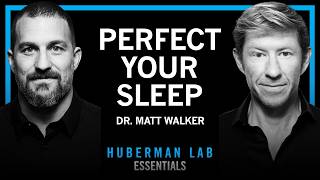

Your Brain Paralyzes You Every Night
35sShocking fact about REM sleep paralysis that is counterintuitive and visually compelling.
▶ Play Clip"The title promises both the science and practice of perfecting sleep, and the transcript delivers exactly that, with deep scientific explanations and actionable tips."
This video is an excerpt from a discussion with Dr. Matt Walker, a sleep scientist, where he explains the fundamental architecture of sleep, including its different stages and their specific functions. The conversation covers the profound impact of sleep on health, the detrimental effects of substances like caffeine, alcohol, and THC, and provides actionable, evidence-based tips for improving sleep quality.
Sleep is described as the single most effective thing you can do to reset brain and body health, involving a complex physiological ballet.
Sleep is broadly separated into non-rapid eye movement (NREM) and rapid eye movement (REM) sleep. During REM sleep, the body is paralyzed to allow safe dreaming.
A typical sleep cycle lasts 90 minutes, starting with light NREM sleep, descending into deep NREM sleep (stages 3 and 4), then rising back to light sleep before entering a short REM period.
In the first half of the night, most of the 90-minute cycles consist of deep NREM sleep. In the second half, cycles consist of lighter NREM sleep and increasingly more REM sleep.
Deep NREM sleep is crucial for regulating blood pressure and metabolism (insulin). REM sleep is linked to growth hormone and testosterone production.
Sleep survived evolution despite its seeming disadvantages (vulnerability, not finding mates), indicating that its functions are non-negotiable for human biology.
Both quantity and quality of sleep are crucial. You cannot be unimpaired with only 4 hours of sleep, even if it's high quality, nor with 8 hours of very poor quality sleep.
Getting 30-40 minutes of natural daylight exposure, especially in the morning, can significantly improve sleep time and efficiency by reinforcing the circadian rhythm.
Caffeine has a half-life of 5-6 hours and a quarter-life of 10-12 hours. The speaker recommends stopping caffeine intake 8-10 hours before bedtime to prevent a reduction in deep sleep depth.
Alcohol is a sedative, not a sleep aid. It fragments sleep, blocks REM sleep, and its rebound effect causes intense, bizarre dreams in the early morning hours.
THC may speed up falling asleep but also blocks REM sleep, leading to a REM rebound (intense dreams) when use is stopped.
Melatonin signals the time of day (circadian rhythm) but does not generate sleep. It is like the starting official of a race, not a participant.
In healthy adults, melatonin supplementation is not particularly effective, increasing sleep time by only about 3.9 minutes and sleep efficiency by 2.2%. Optimal doses for older adults are 0.1-0.3 mg, far below typical supplement doses.
Naps (20-90 minutes) can improve cardiovascular health, learning, and emotional regulation. However, they can worsen sleep problems for people with insomnia. Key tips: limit naps to 20-25 minutes, avoid napping late in the day.
After a bad night, do not sleep in, overuse caffeine, or go to bed earlier. Establish a wind-down routine (like landing a plane), keep a worry journal, and remove all clock faces from the bedroom.
The discussion reinforces that sleep is a non-negotiable biological necessity with a complex architecture designed for specific restorative functions. By understanding these functions and avoiding common disruptors, individuals can adopt simple behavioral habits to significantly improve their sleep health.
What are the two main types of sleep?
Non-rapid eye movement (NREM) sleep and rapid eye movement (REM) sleep.
00:31
What happens to the body during REM sleep?
The body is completely paralyzed (except for involuntary muscles, extraocular muscles, and inner ear muscles) to allow the mind to dream safely.
00:45
What is the typical duration of a human sleep cycle?
About 90 minutes.
04:03
How does sleep architecture change from the first to the second half of the night?
In the first half, cycles contain more deep NREM sleep. In the second half, cycles contain more light NREM (stage 2) and increasingly more REM sleep.
04:17
What is one primary function of deep non-REM sleep?
It acts as a form of natural blood pressure medication and is crucial for insulin regulation and metabolic health.
04:49
What is the half-life of caffeine in the average adult?
Between five to six hours.
11:03
According to Dr. Walker, how much can alcohol reduce deep sleep?
It can reduce deep sleep by up to 30%.
12:49
How does alcohol affect REM sleep?
It is potent at blocking REM sleep, leading to a rebound of intense dreams when it clears from the system.
15:29
What is the role of melatonin in sleep?
It signals the time of day (circadian rhythm) and helps transition to sleep, but it does not generate or structure sleep itself.
20:07
What is the optimal dose of melatonin for older adults according to the studies mentioned?
Between 0.1 and 0.3 milligrams.
24:18
What is the average increase in total sleep time from melatonin supplementation in healthy adults?
About 3.9 minutes.
21:19
What is one 'unconventional' tip for recovering from a bad night of sleep?
Do nothing: don't sleep in, don't nap, don't use extra caffeine, and don't go to bed earlier than usual.
30:45
What is the recommended maximum nap duration to avoid sleep inertia (grogginess)?
20-25 minutes.
29:45
What should be removed from the bedroom to improve sleep?
All clock faces, including your phone.
34:28
Sleep as a Health Reset
Establishes sleep as the single most effective thing for resetting brain and body health.
00:15Deep Sleep and Blood Pressure
Identifies deep non-REM sleep as a natural blood pressure medication, a critical health function.
04:49Sleep Quantity vs. Quality
Corrects the common misconception that one can compensate for poor quantity with high quality, or vice versa.
09:00Caffeine Half-Life Rule
Provides a specific, actionable guideline for caffeine intake timing to protect deep sleep.
11:03Evolutionary Non-Negotiability of Sleep
Powerfully argues that sleep's persistence through evolution proves its essential, non-negotiable biological role.
16:39Melatonin Supplementation Evidence
Reveals the surprisingly weak scientific evidence for melatonin as a sleep aid in healthy adults, contrasting with its popularity.
21:04Post-Bad Night Strategy
Offers a counterintuitive but highly effective strategy for recovering from poor sleep without compounding the problem.
30:45[00:00] Welcome to Human and Lab Essentials, where we revisit past episodes for the most potent and actionable science-based tools for mental health, physical health, and performance. And now, my discussion with Dr. Matt Walker.
[00:15] Let's start off very basic. What is sleep? Sleep is probably the single most effective thing you can do to reset your brain and body health. Sleep as a process, though, is an incredibly complex physiological ballet.
[00:31] Sleep is broadly separated into these two main types. And we've got non-rapid eye movement sleep on the one hand, and then we've got rapid eye movement sleep on the other. When you go into REM sleep, you are completely paralyzed.
[00:45] You are locked into a physical incarceration of your own body. Amazing. The brain paralyzes the body so that the mind can dream safely. Because think about how quickly we would have all been popped out of the gene pool.
[00:59] You know, if I think I'm, you know, one of the best skydivers who can just simply fly, and I get up on my apartment window and I leap out, you're done. Now, of course, the involuntary muscles, thankfully, aren't paralyzed.
[01:15] So you keep breathing, your heart keeps beating. you go through these bizarre what we call autonomic storms. There are only two voluntary muscle groups that are spurred from the paralysis.
[01:27] Bizarre. One, your extraocular muscles, because if they were paralyzed, you wouldn't be able to have rapid eye movement. And the other that we later discovered was the inner ear muscle.
[01:39] Some people have argued that the reason the eyeballs are spurred from the paralysis is because if your eyeballs are left for long periods of time inactive, you may get things such as oxygen sort of issues in the aqueous or vitreous humor.
[01:54] And so the eyeballs have to, you know, the drainage of the anterior eye are made to require movement. Exactly. People with glaucoma have deficits in drainage through the anterior chamber. So maybe take me through the arc of the night.
[02:06] When I first fall asleep, I'll go into the light stages of non-REM sleep, stages one and two of non-REM. And then I'll start to descend down into the deeper stages of non-REM sleep.
[02:18] So after about maybe 20 minutes, I'm starting to head down into stage 3 non-REM and then into stage 4 non-REM sleep. And as I'm starting to fall asleep, as I cast off from the usually with me murky waters of wakefulness,
[02:33] and I'm in the shallows of sleep stages 1 and 2, my heart rate starts to drop a little bit. and then my brainwave pattern activity starts to slow down. Normally when I'm awake, it's going up and down maybe 20, 30, 40, 50 times a second.
[02:50] As I'm going into light non-REM sleep, it will slow down to maybe 15, 20, and then really starts to slow down, down to about 10 or 8 cycles per second, 8 cycle waves per second.
[03:03] then as I'm starting to move into stages 3 and 4 non-rem sleep several remarkable things happen all of a sudden my heart rate really does start to drop hundreds of thousands of cells in my cortex
[03:18] all decide to fire together and then they all go silent together and it's this remarkable physiological coordination of the likes that we just don't see during any other brain state.
[03:33] I will then stay there for about another 20 or 30 minutes. So now I'm maybe 60 or 70 minutes into my first sleep cycle. And then I'll start to rise back up, back up into stage two non-REM sleep.
[03:47] And then after about 80 or so minutes, I'll pop up and I'll have a short REM sleep period. and then back down I go again, down into non-REM, up into REM. And you do that reliably, repeatedly, and I will be doing that every 90 minutes.
[04:03] At least that's the average for most adults. In the first half of the night, the majority of those 90-minute cycles are comprised of lots of deep non-REM sleep. That's when I get my stage 3 and 4 of deep non-REM sleep.
[04:17] Once I push through to the second half of the night, now that ceasar balance changes and instead the majority of those 90 minute cycles are comprised either of this lighter form of non-REM sleep stage 2 non-REM sleep and much more and increasingly
[04:33] more rapid eye movement sleep and who suffers more those that lack the early phase and where those that lack the later phase of the night depends on what the outcome measure is for example during deep non-REM sleep that's where we get this it's almost a form of natural blood pressure
[04:49] medication. And so when I take that away from you the next day, we're usually going to see autonomic dysfunction. We're usually going to see abnormalities in heart rate, blood pressure. We also know that during deep non-REM sleep that there is a certain control of specific hormones.
[05:05] For example, we know that the insulin regulation of sort of metabolism, meaning how will you look from a regulated blood sugar perspective versus dysregulated pre-diabetic look of profile.
[05:21] That's where deep sleep seems to matter if we selectively deprive you of that. Growth hormone is different, actually. So that's a beautiful demonstration where growth hormone seems to be more REM sleep dependent.
[05:33] And that's why we can come on to the effects of alcohol. and there's some really impressive frightening data on alcohol and its disruption of sleep. But then we also know testosterone.
[05:46] Peak levels of testosterone happen during REM sleep. The second half of the night. The second half of the night. So it really just means that your profile of mental and physical dysfunction
[06:00] will be different under both of those conditions. Which one would you prefer? I would prefer neither of them, and it really depends on what you're trying to optimize for. So it's just so comforting.
[06:13] Sleep is just so profoundly detrimental to us. If you were to take it at face value, you're not finding a mate, you're not reproducing, you're not foraging for food, you're not caring for your young,
[06:25] and worst of all, you're vulnerable to predation. On any one of those grounds, sleep probably should have been selected against. But it wasn't. sleep has fought its way through heroically every step along the evolutionary path
[06:39] and therefore every sleep stage has also survived as best we can tell what that means is that those are non-negotiable if mother nature had found a way
[06:53] to even just sort of, you know thin slice some of that sleep from us there would have been vast, I'm sure, evolutionary benefits but it looks as though she hasn't, and I'm usually in favor of her wisdom after 3.6 million years.
[07:09] So in this arc of the night, slow-waste sleep predominates early in the night and then REM sleep, there's a scenario that many people, including myself, experience on a regular basis, which is they go to sleep, they're sleeping just fine, three, four hours into it, they wake up.
[07:25] They wake up for whatever reason. Maybe there's a noise, maybe the temperature isn't right. We will certainly talk about sleep hygiene, etc. they get up, they go to the restroom, they might flip on the lights, they might not,
[07:37] they go back to sleep. Let's say after about 10-15 minutes, they're able to fall back asleep. How detrimental is that wake-up episode or event in terms of longevity, learning, etc.?
[07:53] It is perfectly natural and normal, particularly as we progress with age. at the end of our REM sleep period of the 90-minute cycle, almost everybody wakes up and we make a postural movement.
[08:07] We turn over because we've been paralyzed for so long and the body will also like to shift. For the most part, I think we can be more relaxed about that. Where we have to be a bit more attentive, though,
[08:19] is if you are spending long periods of time not being able to get back to sleep. then usually we define that by saying if it's been 20, 25 minutes. The other thing is if it's happening very frequently.
[08:31] So even if you're not awake for 25-minute stretches, but you're finding yourself waking up and being consciously aware that you've woken up for maybe six, seven, or eight times throughout the night,
[08:46] and your sleep is very what we call fragmented, the great science of sleep in the past 5 or 10 years has been yes quantity is important but quality is just as important
[09:00] And you can't have one without the other in terms of a good, beneficial next day outcome. You can't just get four hours of sleep, but brilliant quality of sleep and be unimpaired.
[09:12] nor can you get eight hours of sleep but have very poor quality of sleep and be unimpaired the next day. I'm a big proponent of people getting some sunlight, ideally sunlight, but other forms of
[09:26] bright light in their eyes early in the day and when they want to be awake. Yep. Essentially during the phase of their 24-hour circadian cycle when temperature is rising and then starting to get less light in their eyes as our temperature is going down later in the day and in the evening.
[09:43] I think that's exactly what we recommend right now, which is try to get at least 30 to 40 minutes of exposure to some kind of natural daylight. There was some great work recently coming out in the occupational health domain where they moved workers from offices that were just facing walls
[10:00] and didn't have any exposure to natural daylight. And then they did a time period during that study where they actually were in front of a window and working. And they measured their sleep.
[10:12] And their sleep time and their sleep efficiency increased quite dramatically. I think the increase in total sleep time was well over 30 minutes. And the improvement in sleep efficiency was 5% to 10%.
[10:24] And if you're batting an 80% sleep efficiency average, We're a bit concerned about that. But add 10% to that, and now you're in a great echelon of healthy sleepers.
[10:36] These portals are the only way to convey to the rest of the brain and body about the time of day and wakefulness. I have a number of questions about caffeine. Does the timing in which we ingest caffeine play an important role
[10:50] in whether or not it works for us or against us? The dose and the timing makes the poison. caffeine has a half-life and it's metabolized the half-life is somewhere between five to six
[11:03] hours and the quarter life therefore is somewhere between 10 to 12 hours it's variable different people have different um durations of its action but for the average adult five to six hours
[11:15] so let's say that you know i've been awake for 12 hours now and it's you know 8 p.m and i'm feeling a bit tired, but I want to push through and I want to keep working for another couple of hours, so I have a cup of coffee.
[11:28] All of a sudden, I was feeling tired, but I don't feel like I've been awake for 12 hours anymore. Then, after a few hours, and the caffeine is starting to come out of my system, not only am I hit with the same levels of adenosine that I had before I'd had the cup of coffee
[11:45] several hours ago, it's that plus all of the adenosine that's been building up during the find that the caffeine has been in my system. It's sort of an avalanche of... It is a tsunami wave.
[11:57] Yeah. And I have a caffeine crush. Given somebody who typically gets into bed around 10, 10.30 and falls asleep around 11, 11.30, when would you recommend they halt caffeine intake?
[12:11] And these are not strict prescriptions, but I think people do benefit from having some fairly clear guidelines of what might work for them. Would you say cut off caffeine by what time of the day?
[12:24] I would usually say take your typical bedtime and count back 10 hours or 8 hours of time. That's the time when you should really stop using caffeine is the suggestion.
[12:36] And the reason is because for those people who even just keep drinking up until into the evening, you're right that they can fall asleep fine, maybe they stay asleep, but the depth of their deep sleep is not as deep anymore.
[12:49] And so there are two consequences. The first is that for me, and it can be up to by 30%, and for me to drop your deep sleep by 30%, I'd have to age you by between 10 to 12 years,
[13:02] or you can just do it every night yourself with a couple of espressos. The second is that you then wake up the next morning and you think, well, I didn't have problems falling asleep and I didn't have problems staying asleep,
[13:15] but I don't feel particularly restored by my sleep. So now I'm reaching for three or four cups of coffee the next morning rather than just two or three cups of coffee. And so goes this dependency cycle
[13:27] that you then need your uppers to wake you up in the morning and then sometimes people will use alcohol in the evening to bring them down because they're overly caffeinated and alcohol, and we can speak about that too,
[13:39] also has very serious impacts on your sleep as well. Now, caffeine and alcohol represent the kind of two opposite ends of the spectrum. What happens when somebody has a glass, we always hear a glass or two of wine in the evening,
[13:52] or a cocktail after dinner? How does that impact their sleep? So alcohol, if we're thinking about classes of drugs, they're in a class of drugs that we call the sedatives.
[14:04] It's sedating your cortex. And sedation is not sleep. but when we have a couple of drinks in the evening, when we have a couple of nightcaps, we mistake sedation for sleep, saying, well, I always want to have a couple of whiskeys
[14:19] or a couple of cocktails. It always helps me fall asleep faster. In truth, what's happening is that you're losing consciousness quicker, but you're not necessarily falling naturalistically asleep any quicker.
[14:32] So that's one of the first sort of things just to keep in mind. The second thing with alcohol is that it fragments your sleep, and we spoke about the quality of your sleep being just as important as the quantity.
[14:44] And alcohol, through a variety of mechanisms, some of which are activation of that autonomic nervous system, that fight or flight branch of the nervous system, alcohol will actually have you waking up many more times throughout the night, so your sleep is far less continuous.
[15:02] Now, some of those awakenings will be of conscious recollection the next day. You'll just remember waking up. Many of them won't be. But yet your sleep will be littered with these sort of punctured awakenings throughout the night.
[15:17] And again, when you wake up the next morning, you don't feel restored by your sleep. The third part of alcohol in terms of an equation is that it's quite potent at blocking your REM sleep,
[15:29] your rapid eye movement sleep. And REM sleep is critical for a variety of cognitive functions, some aspects of learning and memory. It seems to be critical for aspects of emotional and mental health. It's overnight therapy.
[15:41] What we've discovered over the past 20 years here at the Sleep Center is that there is no major psychiatric disorder that we can find in which sleep is normal. And so I think that firstly told us there is a very intimate association
[15:56] between your emotional mental health and your sleep health. I don't want to be puritanical here. You know, I'm just a scientist, and I'm not here to tell anyone how to live. All I'm trying to do is empower people with some of the scientific literature regarding sleep,
[16:13] and then you can make whatever informed choices that you want. My job is not to tell people a prescription for life. It's just to offer some scientific information. I would like to ask about marijuana in many places.
[16:27] It's not all medical marijuana is approved or is legal. Does marijuana disrupt sleep? THC can seem to speed up the time with which you fall asleep.
[16:40] But again, if you look at the electrical brainwave signature of your falling asleep with and without that THC, it's not going to be an ideal fit. So you could argue it's non-natural.
[16:53] It too, but through different mechanisms, seems to block REM sleep. and that's why a lot of people when they're using will tell me, look, you know, I definitely, I was dreaming, I don't remember, you know, many of my dreams and then when they stop using THC,
[17:08] let's say I was having, you know, just crazy, crazy dreams and the reason is because there is a rebound mechanism. REM sleep is very clever and alcohol is the same way in this sense. It's the same homeostatic mechanism.
[17:21] Some people will tell me, look, if I have a bit of a wild Friday night with some alcohol, or maybe I'll sleep late into the next morning, and I'll just have these really intense dreams. And I thought I wasn't having any REM sleep.
[17:35] Well, the way it works is that it's during the middle of the night, really, when alcohol blocks your REM sleep. And your brain is smart. It understands how much REM sleep you should have had how much REM sleep you have not because the alcohol been in the system And finally in those early morning hours when you getting through to sort of you know 6 7 8
[17:55] all of a sudden, your brain not only goes back to having the same amount of REM it would have had, it does that, plus it tries to get back all of the REM sleep that it's lost. Does it get back all of the REM sleep?
[18:07] No, it doesn't. It never gets back all of the REM sleep, but it tries. And so you have these really intense periods of REM sleep. Hence, you have really intense, bizarre dreams. And that's what happens also with THC.
[18:20] You build up this pressure for REM sleep, this debt for REM sleep. Will you ever pay it back? It doesn't seem as though you get back everything that you lost. But will you get back some of it?
[18:33] Yes, the brain will start to devour more because it's been starved of REM sleep for so long. So I'd love to chat for a moment about the kind of grand, the original, I should say, not the granddaddy, but the OG of sleep supplementation, which is melatonin.
[18:50] Yeah. I was always taught, and I'm assuming it's still true, that the only source of melatonin in the brain and body is the pineal gland. Is that still true? Yeah. It seems to be from best that we can tell. I have to imagine we have melatonin receptors in the brain and body.
[19:03] Correct. Essentially, your brain has a central master 24-hour clock called the suprachiasmatic nucleus that keeps internal time. Now, it knows 24-hour time, but it needs to tell the rest of the brain and the body the 24-hour time as well.
[19:23] And one of the ways that it does this is by communicating a chemical signal of 24-hour NUS of light and day using this hormone melatonin.
[19:36] And when it is at low levels or it's non-existent, it's communicating the message it's daytime. And for us diurnal species, it says it's time to be awake. Yet, at night time, when dusk approaches and the brake comes off melatonin and we start to release it,
[19:52] then it signals to the rest of the brain and the body, look, it's dusk and it's night time, and for us, diurnal species, it's time to think about sleep. So, melatonin essentially tells the brain and the body when it's day and when it's night,
[20:07] and with that, when it's time to sleep, when it's time to wake. But it doesn't really help with the generation of sleep itself, and this is why we'll come on to what those studies of supplementation have taught us. So it tells the rest of my brain and body, it's time to go to sleep.
[20:21] It perhaps even aids with the transition to sleep, but it's not going to, for instance, ensure the overall structure of sleep, or it's not the conductor that's guiding the sleep orchestra, so to speak, throughout the entire night.
[20:35] You know, Melatonin is like the starting official at the 100-meter race in the Olympics. That's a better analogy. It calls all of the sleep races to the line, and it begins the great sleep race, but it doesn't participate in the race itself.
[20:49] That's a whole different set of brain chemicals and brain regions, which then brings us on to perhaps the question of supplementation, which is, is it helpful for my sleep?
[21:04] Will I sleep longer? Will I sleep better? sadly the evidence in healthy adults who are not older age suggests that melatonin is not really particularly helpful as a sleep aid i think there's a recent meta-analysis and what that
[21:19] meta-analysis told us is that melatonin will only increase total amount of sleep by 3.9 minutes on average minutes minutes percent not and it will only increase your sleep efficiency by 2.2 percent
[21:34] so the source is not strong the force is not strong in this one when it comes to a tool that in healthy people who are not of older age
[21:46] it doesn't seem to be especially beneficial now you know results can vary everyone is different of course so we're talking about the average the so-called average human adult here well melatonin in defense of what you're saying
[21:59] and also I should mention I have a colleague at Stanford Jimmy Zeitzer who knows wonderful things. Chuck Rice's lab at Harvard Med, where he also trained a terrific sleep researcher and asked him about melatonin, and he essentially said the same thing that you just said,
[22:11] which is very little is any evidence that it can improve sleep, and yet it's probably the most commonly consumed so-called sleep aid. Hundreds of millions of dollars industry. The only population where we typically see some benefit,
[22:24] and it often is prescribed, is in older adults. Older meaning 60 and older? Yeah, 60, 65 and older, because as we get older, you can typically have what's called calcification of the pineal gland,
[22:37] which means that that gland that's releasing melatonin doesn't work as well anymore. That's why older adults can have problems falling asleep or staying asleep. It's not the only reason by any stretch of the imagination, but it's one of the reasons, and it's why melatonin supplementation in those cohorts,
[22:53] older adults, especially older adults with insomnia, people have thought about that as maybe an appropriate use case. Do we know how much melatonin is typically released into the bloodstream per night?
[23:05] And can we use that as a kind of a rule of thumb by which to compare the typical amount that someone would supplement? I mean, typically the supplements for melatonin that I see in the pharmacy and elsewhere online range anywhere from 1 milligram to 12 or even 20 milligrams.
[23:22] My guess is that a normal night's release of melatonin, typical for somebody in their 20s, 30s, 40s, would be far lower than that. Am I correct or wrong?
[23:34] Yeah, it's many magnitudes lower. And this is one of the problems is that I see that too. I see typical doses are 5 milligrams or 10 milligrams. And of course, you know, if you're a supplement company, you know, putting 10 milligrams versus 5 milligrams, if that's what you're actually doing, you know, it's kind of like the super gulp size.
[23:54] Nobody wants to lower price. They just want you to, you know, we'll just give you more for the same price and that's how we'll compete. So it's been this escalating arms race of melatonin concentration.
[24:06] And it really does not look meaningful for, you know, for sleep in any way. what we've actually found is that the optimal doses for where you do get sleep benefits in
[24:18] the populations that we've looked at are somewhere between 0.1 and 0.3 milligrams of melatonin. In other words, the typical doses are usually 10 times, 20 times, maybe more than what your body
[24:35] would naturally expect. And this is what we call a supraphysiological dose. In other words, it's far above what is physiologically normal. I like to think in terms of manipulating any aspect of our biology
[24:49] that behavioral tools always are the first line of entry, then nutrition, everyone has to eat sooner or later, even if you're fasting, then perhaps supplementation, then prescription drugs,
[25:02] and then perhaps brain-machine interface, devices that you use to induce something. And those can be done in combination, but what concerns me is when I hear people say, well, what should I take without thinking about their behavior, their light viewing behavior, etc.
[25:16] But of course, these things work in combination. When it comes to sleep, there are many low hanging fruits that don't necessarily require you to, you know, put sort of exogenous molecules and otherwise things like supplements into your body or, you know,
[25:31] use different types of drugs to help you get there. Now, when it comes to prescription sleep aids, I think I've been, again, a little bit too forthright. We know in clinical practice that there may be a time and a place for things like sleeping pills.
[25:47] They are a short-term solution to certain forms of insomnia, but they are not recommended for the long term. and we also know that there are lots of other ways that you can get a sleep help
[26:02] or you can get a sleep curative profile from things like cognitive behavioral therapy for insomnia, which is a non-drug approach. And quite effective from what I understand. Just as effective as sleeping pills, great data, more effective in the long term.
[26:15] There's a recent study published that after working with that therapist, some of the benefits lasted almost a decade. you know now if you stop sleeping pills usually you have rebound insomnia where your sleep goes
[26:27] back to being just as bad if not worse and i think the same is true when we think about supplementation there are so many things that are easy to implement when it comes to sleep that don require venturing out into those waters and again we not here to tell anyone about whether they should venture or not That completely your choice All I saying is that if you want to think about optimizing your sleep there are a number of ways that you can do it that don
[26:53] necessarily require you to swallow anything or inject anything or, you know, smoke anything. Right. And for which the margins of safety are quite wide. Right. Let's talk about naps. I love naps. I come from a long history of nappers.
[27:08] What are the data on naps? And what are your thoughts about keeping naps short, meaning 20 to 30 minutes, versus getting out past 90 minutes, two hours? Yay, nay, or meh?
[27:21] Naps can have some really great benefits. We found benefits for cardiovascular health, blood pressure, for example. We found benefits for levels of cortisol. We found benefits for learning and memory, and also emotional regulation.
[27:35] How long are the naps typically in those studies? anywhere between 20 minutes to 90 minutes. Sometimes we like to use a 90-minute window so that the participant can have a full cycle of sleep, and therefore they get both non-REM and REM sleep within that time period.
[27:49] And then we correlate how much benefit did you get from the nap and how much of that benefit was explained by what REM sleep you got, what deep sleep you got, what light sleep you got.
[28:01] What we've also found is that naps of as little as 17 minutes can have some quite potent effects on, for example, learning. None of this is novel. NASA pioneered this back in the 1990s.
[28:14] And during the missions, they were experimenting with naps for their astronauts. And what they found was that naps of little as 26 minutes improved mission performance by 34%
[28:27] and improved daytime alertness by 50%. and it burst what was then called the NASA nap culture throughout all terrestrial NASA staff during that time period.
[28:41] So it's long been known that naps can have a benefit. Naps, however, can have a double-edged sword. There is a dark side to naps. When you nap, you are essentially opening the valve on the pressure cooker of sleep pressure.
[28:55] And some of that sleepiness is lost by way of the nap. Some people, however, if they are struggling with sleep at night and they nap during the day, it makes their sleep problems even worse.
[29:08] So for people with insomnia, we typically advise against napping. And the advice is if you can nap regularly and you don't struggle with sleep at night, then naps are just fine.
[29:20] But if you do struggle with sleep, stay away from naps. If you are going to nap, try to limit your naps. Try to cut them off a bit like sort of caffeine. maybe you know 8 to sort of 12 hours
[29:32] maybe not that you know fast maybe sort of 7 to 6 hours is a good rule of thumb try not to nap essentially late in the afternoon and if you do take a nap and you want to maintain your
[29:45] you don't want to have that grogginess hangover that can happen after a full night of sleep for the first hour try to limit it to about 20-25 minutes and that way you don't go down into the very deepest stages of sleep
[29:58] which if I wrench you out of with an alarm, you almost feel worse. No one should feel guilty about getting the sleep that they need. And I think that's been one of the big problems in society. Society has stigmatized sleep with these labels of being slothful or lazy.
[30:15] And we're almost embarrassed, you know, to tell colleagues that we take a nap. I think sleep is a right of human beings. and I therefore think that sleep is a civil right of all human beings
[30:29] and no one should make you feel unproud of getting the sleep that you need. Are there any unconventional sleep tips, the what if kind of things that, yeah, what if it turns out that, and I hear I just, I've got a blank there for you to fill in.
[30:45] The first one which is unconventional along the lines of naps, if you've had a bad night of sleep, do nothing. What I mean by that is don't wake up any later.
[30:57] Don't sleep in the following day to try and make up for it. Don't nap during the day. Don't consume extra caffeine to wake you up, to try to get you through the day. And don't go to bed any earlier to think that you're going to compensate.
[31:12] If you wake up later, you're not going to be sleepy until late in the evening. So you're going to go to bed at your normal time and you won't be sleeping. You'll think, well, I just came off a bad night of sleep. and now I still can't even get to sleep
[31:26] and it's my normal time because you slept in later than you would otherwise and you reduce the window of adenosine accumulation before your normal bedtime. So don't wake up any later.
[31:39] Don't use more caffeine for the reasons that are obvious because that's only going to crank you and keep you awake the following night or decrease the probability of a good following night of recovery sleep. And then finally, don't go to bed any earlier.
[31:52] Resist and resist and go to bed at your normal time. What I want to try and do is prevent you from thinking, well, I had such a bad night last night and I normally go to bed at 10.30. I'm just going to get into bed at 9 o'clock.
[32:04] My body is not ready to sleep at 9 o'clock. But I'm worried because I had a bad night of sleep last night. So I get into bed and now I'm tossing and turning for the first hour and a half because it's not my natural sleep window, but I just thought it was a good idea.
[32:17] I think the second tip I would offer in terms of unconventional is have a wind-down routine. Many of us think of sleep as if it's like a light switch,
[32:29] that we just jump into bed and when we turn the light out, sleep should arrive in that same way. Sleep is a physiological process. It's much more like landing a plane. It takes time to gradually descend down onto the terra firma of what we call good, solid sleep at night.
[32:45] find out whatever works for you and it could be light stretching i usually meditate um for about 10 or 15 minutes uh before bed some people like reading try not to watch television in bed
[32:58] too much light too activating you know you wouldn't race into your garage and come to a squeaking halt from 60 miles an hour you typically down shift your gears and you slow down as you
[33:14] to the character. It's the same thing with sleep too. The other thing about that idea of shifting focus away from your mind itself, get your mind off itself, is a good piece of advice.
[33:28] Catharsis. You can try to write down all of the concerns that you have and do this not right before bed, but usually an hour or two before bed. Some people call it a worry journal. And to me,
[33:43] it's a little bit like closing down all of the emotional tabs on my browser. Because if I shut the computer down and all of those tabs are still open, I'm going to come back in the morning and the computer's red hot, the fan's going, because it didn't go to sleep.
[33:56] Because it couldn't, because there were too many tabs active and open. I at first thought, this just sounds like hooey. It sounds very Berkeley. It's kind of come by all, we all hold hands and, you know, walk home at the end of the day. But then the data started coming out.
[34:09] Really good studies from good people. and they found that keeping one of those journals decreased the time it takes you to fall asleep by 50%, 5-0. That's well on par with any pharmaceutical agent. I think the fourth little tip I would give that's unconventional is remove all clock faces from your bedroom,
[34:28] including your phone, including your phone, because if you are having a tough night, knowing that it's 3.22 in the morning or it's 4.48 in the morning does not help you in the slightest.
[34:42] And it's only going to make matters worse than better. Matt, this has been an amazing deep dive on sleep. It is chock-a-block full of valuable takeaways. It's been tremendously fun for me
[34:55] to dissect out this incredible aspect of our lives that we call sleep. We're a fellow scientist and a fellow public educator. and we don't just want to hear more from Matt Walker. I speak for many people.
[35:08] We need to. The work you're doing is both influential, but more importantly, it is important work. It has the impact that's needed, especially in this day and age where science and medicine, public health,
[35:22] and the issues of the world, et cetera, are really converging. So I know I speak on behalf of a tremendous number of people and I just say thank you for doing the work you do and for being you.


⚡ Saved you 0h 35m reading this? Transcribe any YouTube video for free — no signup needed.