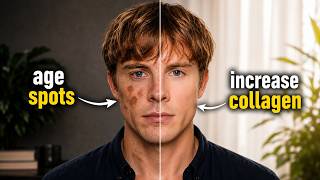

The Deadly Vitamin Deficiency That Killed Sailors
52sHistorical story of scurvy and James Lind's experiment creates curiosity and relatability.
▶ Play Clip"Delivers on the promise with solid evidence on vitamin C's role in reducing age spots and improving skin health."
Vitamin C is essential for human health, playing a critical role in collagen synthesis, skin health, immunity, and antioxidant defense. Unlike most animals, humans cannot produce vitamin C and must obtain it from diet. This summary explores its mechanisms, benefits for skin and joints, potential anti-aging effects, and optimal intake based on recent research.
Vitamin C supports collagen synthesis, skin health, immunity, and antioxidant defense. Humans cannot produce it and require daily intake.
Scurvy symptoms like bleeding gums result from impaired collagen production due to vitamin C deficiency. James Lind's 1747 experiment showed citrus fruits cure scurvy.
A 2024 RCT found that 80 mg vitamin C with 5 g collagen for 16 weeks reduced wrinkle volume by 13.8%, wrinkle depth by 16.9%, and increased dermis density by 16.3% in middle-aged women.
Taking 48 mg vitamin C before exercise with 15 g gelatin enhanced collagen synthesis in tendons being trained.
Oral vitamin C and E supplementation increased the minimal UVB dose needed to cause sunburn by a significant amount after 3 months, indicating improved skin resilience.
A 2015 RCT on obese individuals showed 1,000 mg vitamin C daily lowered hs-CRP by 48% and IL-6 by 36%, with fasting glucose dropping 33%.
New research in monkeys found vitamin C inhibited ACSL4, reducing ferroaging and reversing biological age clocks, potentially reducing lipofuscin accumulation.
RDA is 90 mg for males and 75 mg for females, but 200-400 mg per day saturates plasma and neutrophils. Higher doses may provide additional antioxidant benefits.
Vitamin C is vital for collagen synthesis and skin health, with emerging evidence supporting its role in anti-aging and inflammation reduction. While deficiencies lead to scurvy, optimal intake of 200-400 mg daily from diet or supplements is recommended for overall health benefits.
What is the primary role of vitamin C in the body?
Collagen synthesis
00:13
What disease is caused by vitamin C deficiency?
Scurvy
00:40
What was the reduction in wrinkle volume in the 2024 RCT with vitamin C and collagen?
13.8%
01:56
What enzyme does vitamin C inhibit to reverse biological age?
ACSL4
07:47
What is the RDA for vitamin C for adult males?
90 mg
08:52
What is lipofuscin?
An age pigment that accumulates in cells due to iron-driven oxidative damage.
08:14
By what percentage did 1000 mg vitamin C lower hs-CRP in the 2015 RCT?
48%
06:50
Does vitamin C supplementation reduce heart disease risk according to the 2017 Cochrane review?
No
07:05
Vitamin C Boosts Collagen's Effect on Skin
RCT data shows quantifiable improvements in skin wrinkles and density when vitamin C is combined with collagen.
01:56Vitamin C Reverses Biological Age in Monkeys
Demonstrates a potential mechanism for anti-aging via inhibition of ACSL4 and reduction of ferroaging.
07:47Vitamin C Lowers Inflammation
High-dose vitamin C significantly reduced inflammatory markers and fasting glucose in obese individuals.
06:50Optimal Intake 200-400 mg Daily
Provides a clear target for supplementation beyond the RDA to achieve saturation.
08:52Oral Vitamin C Increases UV Protection
Shows dietary vitamin C can enhance skin resilience against sun damage, beyond topical use.
04:49[00:01] important ones for staying healthy and aging well. Unlike most animals, humans can't make vitamin C ourselves. We have to get it from our food every day. And this is important because vitamin C
[00:13] supports collagen synthesis, skin health, immunity, antioxidant defense, going to break down what vitamin C actually does, how much you need, and it. Vitamin C is known as an antioxidant, but its primary role is
[00:27] probably collagen synthesis. The story of vitamin C is tightly intertwined with scurvy, a disease that once devastated sailors on long sea trips. For centuries, crews would develop bleeding gums, fragile skin, poor wound healing,
[00:40] that these symptoms are the result of the body's inability to produce collagen. The sailors on the sea were deficient in vitamin C because they didn't have fresh food during their long voyages. In 1747, Scottish naval surgeon
[00:53] James Lind conducted one of the first controlled clinical experiments. He showed that citrus fruits that contain vitamin C could cure scurvy. The sailors vegetables like sauerkraut, which is very high in vitamin C. The underlying
[01:06] mechanism was discovered much later. Vitamin C is essential for collagen synthesis, and without it, you start to see your connective tissue break down leading to the classical symptoms of scurvy such as bleeding gums. The
[01:18] pathway for vitamin C supporting collagen synthesis is this. Procollagen gets formed when hydroxyl groups get added to proline and lysine, which is a process called hydroxylation. This requires vitamin C. This results in the
[01:30] assembly of procollagen with its triple helix structure. Then, the secretion of procollagen outside the cells also requires vitamin C. Without copper or vitamin C, collagen wouldn't have its most characteristic qualities that make
[01:43] wound up together super tightly, and it's incredibly cross-linked. The formation of collagen from procollagen requires vitamin C. That's why vitamin C is often used in collagen supplements as well as in skin care products topically.
[01:56] So, does vitamin C supplementation support collagen synthesis in the joints and skin? Well, yes it does. A 2024 randomized controlled trial noted that supplementing 80 mg of vitamin C with 5 g of hydrolyzed collagen for 16 weeks
[02:10] lowered wrinkle volume by 13.8% wrinkle depth by 16.9% skin roughness by 9.6% and increased dermis density by 16.3% compared to placebo in healthy middle-aged women. The addition of 30 mg of hyaluronic acid
[02:24] provided some small additional benefits. Taking 48 mg of vitamin C before exercise together with 15 g of gelatin enhanced collagen synthesis in the tendons that are being trained. Both gelatin groups received vitamin C and
[02:37] there was no group who didn't get vitamin C. But, vitamin C before synthesis. If anything, it would support it. So, vitamin C helps to support maximize the benefits of collagen on skin and joints. I want to take a quick
[02:52] break to tell you about the Bond Charge infrared sauna blankets. My go-to way of getting 20-minute sauna sessions on the go without needing to spend an hour to is in my opinion one of the best things for your overall health and heart
[03:04] function. Studies show that taking a sauna regularly is associated with 63% lower risk of sudden cardiac death, 63% reduced heart disease mortality, 46% lower risk of hypertension, and 40% reduced all-cause mortality. This is
[03:17] mediated by an increase in body temperature and increased heart rate while at the same time improving arterial stiffness, endothelial function, blood pressure, and metabolic health. It doesn't matter if it's a
[03:30] traditional wooden sauna, an infrared sauna, an infrared sauna blanket, or temperature above what's normal. Bond Charge infrared sauna blankets have the advantage of shining far infrared light that can penetrate deeper into your
[03:43] warms up in 2 minutes to the optimal temperature of 70° C and it's low in EMF. You can get a 15% discount by heading over to onecharge.com/seamland and use the code seam for 15% discount.
[03:57] vitamin C alone? Is it going to help the skin or joints when you just take it vitamin C have a lower likelihood of However, that refers to dietary vitamin C and could be a result of people who
[04:11] consume more fruits and vegetables. People who eat more vitamin C are just controlled studies looking at this. A brand new study tested the effects of eating a high vitamin C foods like kiwi fruit on skin vitamin C levels and
[04:24] collagen synthesis. Plasma and skin vitamin C also increased, showing that dietary vitamin C can reach the skin tissue. This was associated with improved skin function. So, eating more dietary vitamin C does help to supply
[04:36] more vitamin C to the skin. Oral vitamin E and C supplementation has been noted to increase the dose of UVB radiation from the sun needed to cause redness of the skin. As you can see from this graph, after 3 months, the minimal dose
[04:49] for UVB radiation to cause sunburns was significantly higher than before. This suggests that the skin becomes more resilient against sun damage when it has vitamin C has also been seen to clinically improve photodamaged skin and
[05:03] provide relief to deep furrows. When it comes to topical vitamin C, then the for wrinkles and photoaging. It can act locally in the skin and has clinical trials showing modest improvements. When talking about oral vitamin C alone, then
[05:16] wrinkles. It supports normal collagen formation, especially if the intake is low, but there is not strong evidence that extra vitamin C by itself visibly people. However, eating more dietary vitamin C appears to directly support
[05:30] skin collagen and function. Regarding joint function, a 2021 meta-analysis of that vitamin C supplementation significantly reduced the risk of complex regional pain syndrome after orthopedic procedures, but it didn't
[05:43] improve long-term functional outcomes or lower overall complications in patients vitamin C can lower inflammatory markers and reduce the use of opioid and reduce the use of opioids especially in the first 24 hours.
[05:57] synthesis and protects the skin against photoaging. Another important role for vitamin C is that a vitamin C deficiency atherosclerosis and scarring of blood vessels. Scurvy in arteries is
[06:10] essentially atherosclerosis or inadequate blood vessel healing and integrity. In the mouth, scurvy causes bleeding gums, but a similar phenomenon of bleeding tissues and then the subsequent clotting may occur in the
[06:22] which leads to vascular dysfunction, thrombosis, and myocardial infarction. have lower rates of heart disease probably cause they eat more fruits and healthier. But, it's partly also because vitamin C supports wound healing and
[06:37] without vitamin C you develop scurvy in the arteries essentially. And don't forget that vitamin C can act as an antioxidant, which lowers inflammation, atherosclerosis. The 2015 randomized controlled trial on obese individuals
[06:50] saw that 1,000 mg of vitamin C 500 mg twice a day for 8 weeks lowered inflammation as measured by hs-CRP by 48% and IL-6 by 36%. Fasting glucose also dropped by 33%. However, when it comes to overall heart disease risk
[07:05] reduction, then a 2017 Cochrane review of clinical trials concluded that vitamin C supplementation doesn't reduce the risk. However, a 3-year randomized placebo controlled trial in 520 men and postmenopausal women found that a
[07:18] combination of 250 mg of slow-release vitamin C and 91 mg of vitamin E given twice a day decreased the progression of carotid atherosclerosis in men. So, with deficiency can lead to poor wound healing in the gums and in the arteries.
[07:35] prevent vitamin C deficiency, but there's no evidence that taking large reduce the risk of heart disease or something like that. Lastly, I want to talk about the new finding regarding vitamin C's role in the broader context
[07:47] of aging. Recently, scientists discovered that vitamin C was able to reverse biological age clocks in monkeys by inhibiting an enzyme called ACSL4. ACSL4 leads to cell senescence through what's called ferro aging or iron
[08:01] accumulation. Excess iron levels are not only associated with a higher risk of they're also implicated in the process of biological aging through what's known as lipofuscin. Lipofuscin is often called the age pigment. It's a
[08:14] yellow-brown waste material that gradually accumulates inside long-lived cells like neurons, heart muscle cells, and retinal cells. It looks like dark Unlike many other forms of cellular damage, lipofuscin can't be eliminated
[08:27] that easily. As it accumulates over the course of decades, it begins to inhibit the normal cellular processing. Lipofuscin is made of oxidized proteins, damaged lipids, and iron. Iron acts as the catalyst that drives the process of
[08:39] lipofuscin accumulation. And vitamin C may help to interrupt this cycle in several ways, both as an antioxidant and by also supporting ferritin synthesis, safely and reducing the pool of free iron. So, based on all of this, how much
[08:52] vitamin C should you get per day? The recommended daily allowance RDA for vitamin C is only 90 mg for males and 75 mg for females. That's not a lot, and pieces of vegetables or fruit. To prevent scurvy, only 1 to 2 mg is
[09:07] needed, but potentially as much as 7 to 10. Intakes of 200 to 400 mg a day of vitamin C from food or supplements largely saturates plasma and neutrophils in most healthy adults. The benefits above this level are largely limited to
[09:20] common colds. You might see some additional benefits for antioxidant protection and blood sugar control at doses of 1,000 mg a day. So, taking over 200 to 400 mg of vitamin C can be an overkill, especially if you consume it
[09:33] in one meal or one supplement take. That's why for both supplementation and spread out the vitamin C across the day is a controversial supplement with many different opinions. Check out my video
[09:46] where I rank 100 supplements from worst to best based on clinical evidence.




⚡ Saved you 0h 09m reading this? Transcribe any YouTube video for free — no signup needed.