
The Muscle Building Myth: It's Not Just Protein
45sChallenges the common belief that more protein is the key to muscle growth, sparking curiosity and debate.
▶ Play Clip"The title promises a nutrition guide for muscle building, and the video delivers exactly that, though it focuses more on pitfalls than a step-by-step plan."
This video explains that muscle growth depends not just on protein intake but on the nutrients required to convert protein into muscle tissue. It highlights the roles of potassium, trace minerals, and other vitamins, and discusses how insulin resistance and stress can hinder muscle building. The video also offers dietary and lifestyle recommendations for preserving muscle mass.
The myth is that you need just more protein to build muscle; you actually need the right nutrients to convert protein into muscle tissue.
Protein from animal muscle is broken down into amino acids by enzymes in the stomach, pancreas, liver, and small intestine.
Vitamins and minerals act as co-enzymes or co-factors to help convert amino acids into body tissue.
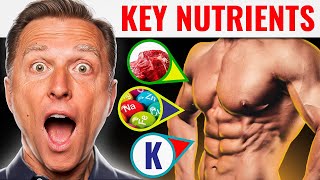
Potassium (needed 4700 mg/day) is often lacking because people don't eat enough vegetables. Trace minerals are missing from soils, impairing enzyme activation.
Fat-soluble vitamins A, D, E, K (especially A), B vitamins, and vitamin C are all necessary for converting protein into muscle tissue.
Insulin resistance, caused by excess sugar, blocks the cell's ability to absorb both sugar and amino acids, leading to muscle weakness and loss of collagen.
Cortisol is catabolic and breaks down muscle protein, converting it into sugar (gluconeogenesis), often leading to loss of muscle in the thighs and buttocks.
Intermittent fasting triggers growth hormone, which helps preserve and build muscle. Eating 2-3 meals a day without snacks is recommended.
Whey protein powder can spike insulin; it's better to consume protein with fat to reduce the insulin spike. Moderate protein intake (3-6 oz) is advised.
High-intensity interval training (HIIT) is better for muscle preservation than long-distance running, which increases cortisol and can cause muscle wasting.
Building and preserving muscle requires adequate nutrients (especially potassium and trace minerals), managing insulin resistance and stress, and incorporating intermittent fasting and high-intensity exercise.
What are the two top nutrients most missing for muscle building?
Potassium and trace minerals.
01:37
How much potassium is needed per day for muscle building?
4700 milligrams per day.
01:37
What is the role of vitamins and minerals in muscle building?
They act as co-enzymes or co-factors to help convert amino acids into body tissue.
01:06
How does insulin resistance affect muscle protein absorption?
Insulin resistance blocks the cell's ability to absorb amino acids, leading to less muscle protein.
02:34
What hormone is catabolic and breaks down muscle?
Cortisol.
03:42
What is the process called when muscle protein is converted to sugar?
Gluconeogenesis.
04:13
What dietary practice triggers growth hormone for muscle preservation?
Intermittent fasting.
05:09
Why is whey protein powder not recommended for muscle building?
It spikes insulin, which can interfere with protein absorption.
06:17
What type of exercise is recommended for muscle preservation?
High-intensity interval training (HIIT).
07:23
Potassium and Trace Minerals Are Key
Identifies the most common nutrient deficiencies that hinder muscle building.
01:37Insulin Resistance Blocks Protein
Explains a key mechanism linking high sugar intake to muscle loss.
02:34Cortisol Breaks Down Muscle
Highlights the destructive effect of chronic stress on muscle tissue.
03:42Intermittent Fasting for Growth Hormone
Offers a practical dietary strategy to naturally boost muscle preservation.
05:09HIIT Over Long-Distance Running
Provides a clear exercise recommendation to avoid muscle wasting.
07:23[00:00] Hey guys, in this video, we're going to talk about the nutrients that make your muscles grow, okay? We're also going to be talking about other things that will slow down the breakdown of muscle. So let's see, you're going into metapology, getting older and your muscles are getting weaker
[00:12] and you're having lots of collagen underneath your arm, this video is for you, or you just want to build a muscle. The myth is that you need just more protein to build muscle, okay, so check this out.
[00:25] You eat protein, which is basically animal muscle. You might have eggs, you might have fish, it's the muscle of that animal. And you digest it and you're liver and your stomach and your intestines and enzymes start
[00:37] breaking down into these small particles or building blocks called amino acids, okay. Meno acids are the foundational building blocks of protein. So it takes certain acids, it takes certain enzymes to break it down, all right?
[00:53] And they're in your stomach, it's in the pancreas, it's in liver, it's in the small intestine, so you have these enzymes. So this whole conversion of breaking down the protein and then building up back up require
[01:06] these nutrients, okay, vitamins and minerals and other things. So in other words, the purpose of vitamins and minerals are basically co-enzymes or co-factors to help convert the raw material, amino acids into body tissue or other like fatty acids into
[01:24] healthy tissue. So we need the vitamins for that and we also need these vitamins and minerals to support the enzymes, which are the magical workers that pull this off and it's quite magical.
[01:37] So we don't need more protein, necessarily, we need more of the nutrients. The two top nutrients that are mostly missing would be potassium and trace minerals, potassium because we need so much, we need 47 hundred milligrams a day and there's not a lot of people
[01:52] that are consuming seven to ten cups of vegetables per day. So they're not going to get the potassium. And trace minerals because it's missing in our soils. So if you don't know the trace minerals, it's hard to activate the enzymes, all right?
[02:05] There's other vitamins that you need to, like the fat, soluble vitamins, vitamin A, D, E, and K, but specifically vitamin A. And but most people get those and you need certain B vitamins, which most people can get easily,
[02:18] and vitamin C. These are all necessary in the conversion into actual muscle tissue, okay? And of course, if you exercise, you're going to break down tissue and you start building back up and that's a necessary thing, but I want to go through some common issues that
[02:34] people have that are, might not necessarily relate to nutrition in general, it relates to amount of sugar and refined carbs. So in the other videos I talked about insulin resistance, okay? And that's a condition where your cells no longer allow insulin into the cell as much
[02:50] as it should, so it's kind of blocked. And that's simply because there's too much sugar in the diet, so the body shuts it down because it's toxic, so it doesn't allow the cell to actually allow the sugar to go in the cell anymore.
[03:03] But because insulin is also involved in the absorption of protein and amino acids, you have this dual effect of, now you can't get fuel, but you also can't get amino acids in the cell.
[03:15] So that's why diabetics, for example, have a lot of weakness in the muscle, loss of collagen, loss of muscle strength. And here's the animation how it works, you have the normal protein going in the cell with
[03:27] the help of insulin, like a key, and then over here you have insulin resistance where the cell is blocked, insulin can't enter anymore, and thus you have less protein in the cell, thus you have less muscle protein, collagen, joint tissue, you name it, okay?
[03:42] So insulin resistance is one thing, and then you also have stress in general. Those people that are adrenal body type, they're stressed out, what happens, they're activating a hormone called cortisol. Cortisol is very, it's called catabolic, it's very destructive on the muscles, okay?
[03:59] Catabolic means breaking down, antabolic means building back up. So when you have the muscle breaking down its particles in this animation, you can see these muscle particles are breaking down because of the hot levels of cortisol.
[04:13] It basically then converts to sugar, okay? So protein is being converted to sugar. If you want to know the name of that, it's called glyco-neogenesis, glyco-meaning sugar, neo-meaning new genesis, meaning the generation of, the formation of.
[04:29] Formation of new sugar from muscle, eventually they get diabetes because the blood sugars go up because the muscle protein is turning into sugar. Primarily, taken from your quadriceps and your thigh and the glutinous maxinous, that's
[04:43] your butt muscle. So you see these cases with the adrenal over time, they have no butt and they have no legs, it's all gut in the middle part, right? They got like a little, I like a trunk and these stick legs.
[04:55] That's the adrenal and that's what's happening with muscle. So you can have excessive stress causing a loss of protein, you can have lack of nutrients, you can have high levels of insulin because the insulin is not working, insulin resistance
[05:09] prediabetes causing a lack of absorbable protein, okay? So here are the dues. You want to do intermittent fasting, intermittent fasting triggers growth hormone, growth hormone increases muscle preservation and retention of muscle and muscle building, okay?
[05:26] So you need three meals, maybe two meals a day, okay? I have tons of videos on that, you could watch that. This whole four, five or six small meals a day, not good, it spikes insulin, it keeps
[05:38] your protein from going in. Now, let's talk about snacks. Adding snacks spikes insulin, again, causes more protein problems, you would think that having protein snacks between meals can help your muscles know.
[05:51] So you don't want to do any snacks because you want to do intermittent fasting because that way you can heal insulin resistance, okay? Now, that's why the pre-imposed meals or even protein meals is a bad idea.
[06:03] Gatorade filled with sugar, not good because this sugar is what we're trying to counteract because it's creating the insulin resistance messing with your muscles, okay? Now, as far as a lot of people, this is a mistake they make, they have protein powder,
[06:17] so way protein powder thinking they're going to drive all this protein in the muscle, but that's going to spike insulin. You'd be better off having a fatter protein, the more fat, the less insulin spike, the better.
[06:29] Okay? Modern amount of protein, okay? Three to six ounces, don't go with massive amounts of protein, and I see people just eating so much protein, thinking that it's helping them when it's just overloading the liver.
[06:42] Your body can't handle that much protein, it just puts stress in the liver. If you're 18 years old, you can pretty much handle it, but eventually it starts slowing down. I don't even think at 18 you could probably handle too much. When we have the type of exercise, if you ever see a long distance runner, they don't
[06:57] look very muscular, do they? They kind of have smaller muscles, probably because of the carboloding, or just the glucose they consume. If you take marathon runners, they have this thing called goo, which is this pure sugar, and
[07:10] they're taking this sugar, they're running out, they're doing a lot of carbs. Unfortunately, that's going to create more insulin resistance in black than muscle. Not to mention the sustained exercise increases cortisol and causes muscle wasting.
[07:23] A much better exercise would be high-intensity, innable training, because that can spike growth hormone and preserve your muscles as well. Short bursts of high-intensity exercise, full body, very important.
[07:36] Sleep is also necessary to increase growth hormone, stress is not good, so these are the things you don't want to do, and these are the things you want to do, okay? So hope this summary helped, and go ahead and apply it, and give me your comments.
[07:51] Hey, I just wanted to take a moment to thank you personally. There's so many of you that have gotten this book, and the feedback that you're giving me is mind-blowing. Thank you so much. I really appreciate it. And if you wouldn't mind, I have one quick favor to put your unbiased review on Amazon.
[08:06] I would really appreciate it. Thank you so much.
⚡ Saved you 0h 08m reading this? Transcribe any YouTube video for free — no signup needed.